
Table of Contents
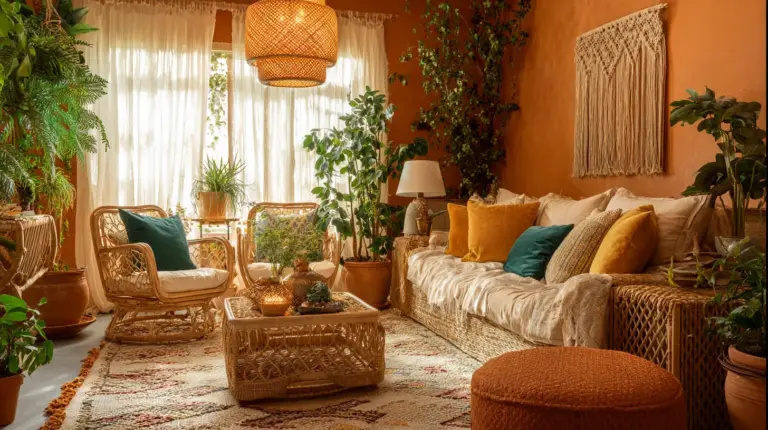
There is a certain kind of room that stops you the moment you walk in. It does not look like a catalog page. It looks lived in — full of stories, textures, and quiet curiosities gathered over time. That is the eclectic living room at its best: intentional, personal, and surprisingly calm beneath all its layers.
At ERYLIN, we believe the eclectic style is not about throwing everything together and hoping for the best. It is about knowing which threads to pull — a warm color anchor here, a handwoven textile there — until the room begins to breathe like a whole.
This guide will walk you through every element of a global eclectic living room: from defining the style and choosing your palette, to mixing furniture eras, sourcing cultural pieces with care, and avoiding the most common mistakes. Whether you are starting from scratch or layering into what you already have, this is your roadmap.
Let us begin.
What Is Eclectic Interior Design, Really?
Eclectic design is the art of mixing styles, periods, and influences into a space that feels cohesive rather than chaotic. It draws from multiple sources — mid-century modern silhouettes, Moroccan textiles, Japanese ceramics, Scandinavian minimalism — and weaves them together through shared color, material, or scale.
The key word is intentional. Eclectic is not the same as random. Every piece earns its place.
Think of it like a well-curated bookshelf: different authors, different genres, different spine widths — but arranged with care so the whole thing feels considered. That is the energy a great eclectic living room carries.
The Secret to Eclectic Cohesion
One Anchor Palette, Controlled Accents
The most common fear with eclectic decorating is clashing colors. The solution is simpler than most people think: choose one anchor palette of two or three tones, then let your accent colors live within that same temperature range.
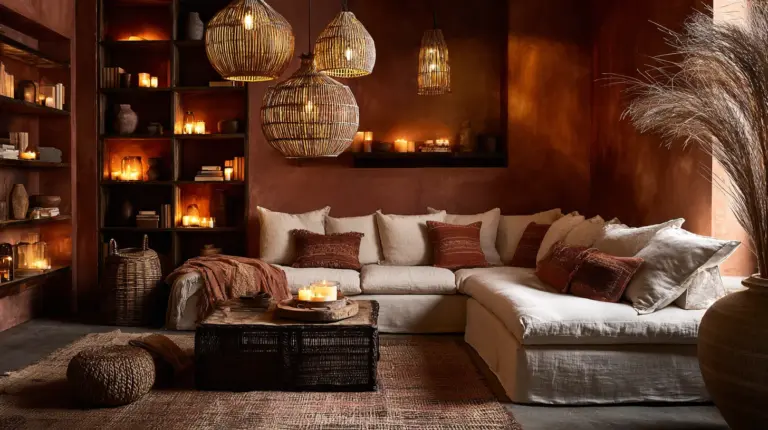
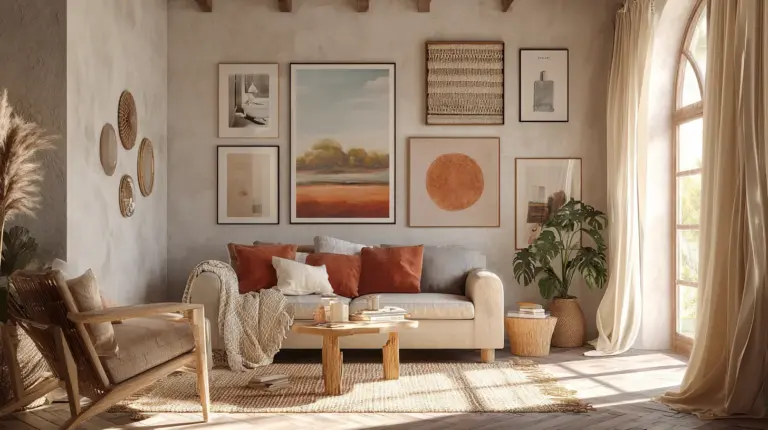
Warm anchors — terracotta, warm linen, aged brass, soft ochre — welcome warm accents like rust, deep plum, or olive. Cool anchors — slate blue, warm white, sage, muted charcoal — carry cool accents like dusty rose, indigo, or muted teal. The room may have twelve colors in it, but if they all live in the same light, it feels unified.
Material Threads
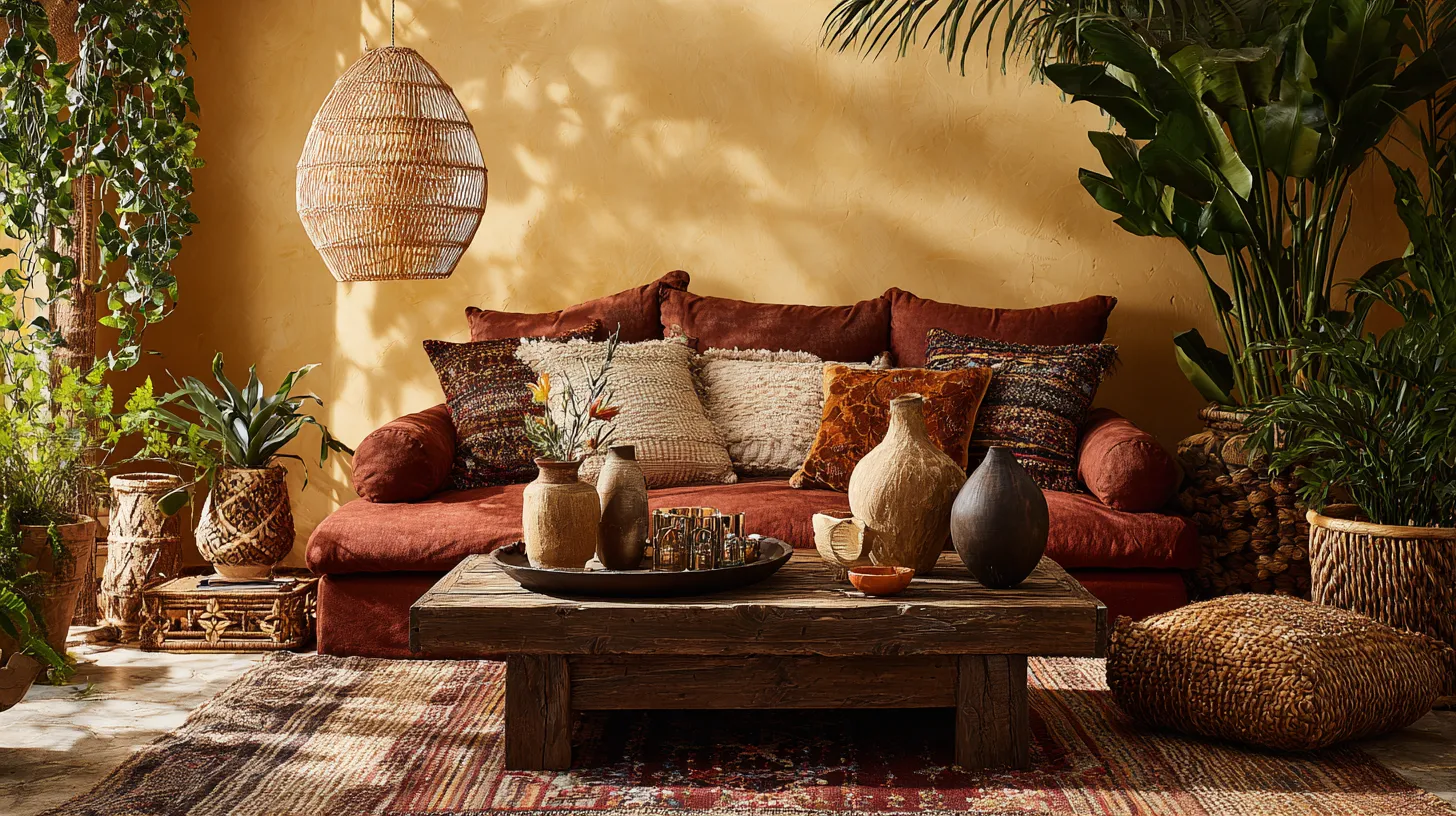
Choose two or three recurring materials and let them travel through the room. Brass hardware on a vintage lamp, a brass-edged tray on the coffee table, and a brass-framed mirror on the wall — suddenly the room has a pulse running through it.
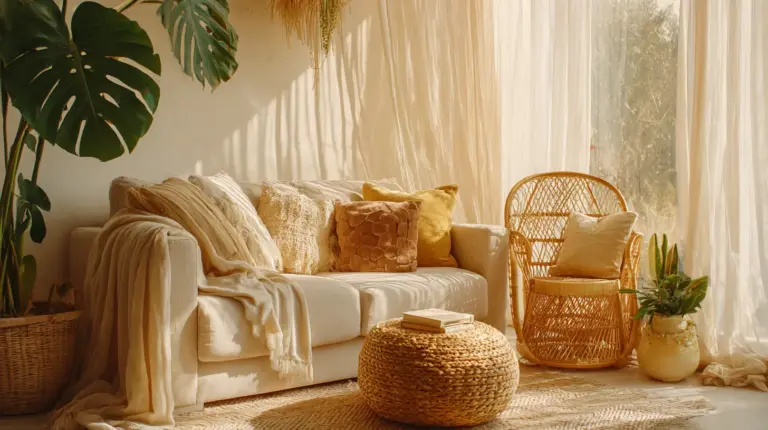
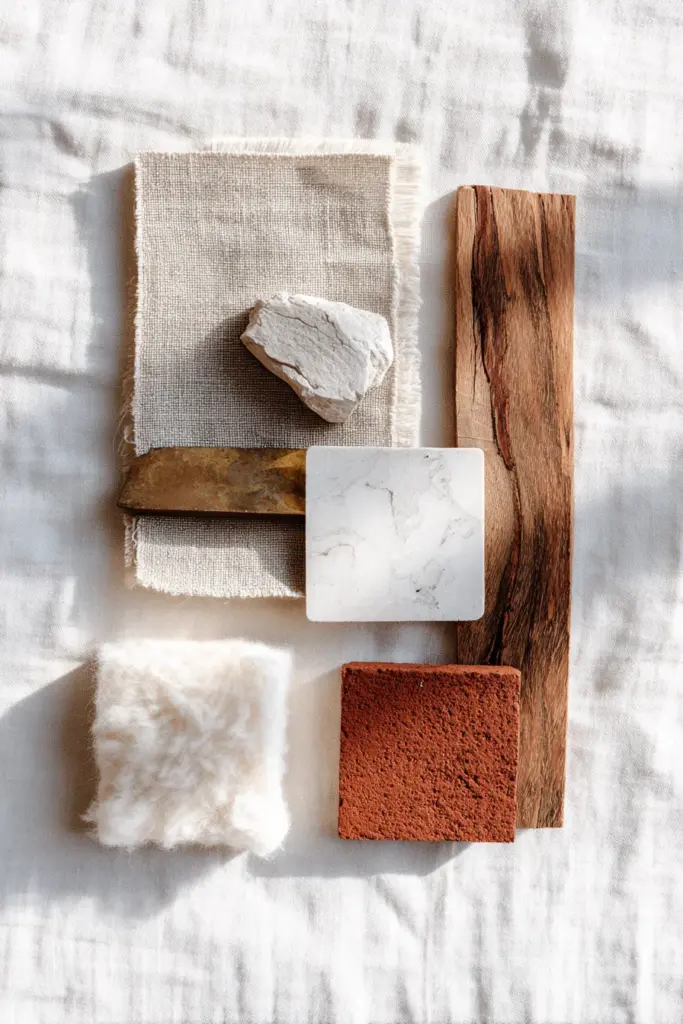
Good material combinations for global eclectic spaces include: rattan + linen + aged wood, brass + marble + linen, and raw clay + jute + bleached oak. Pick your thread and repeat it quietly.
The Rule of Three for Mixing Styles
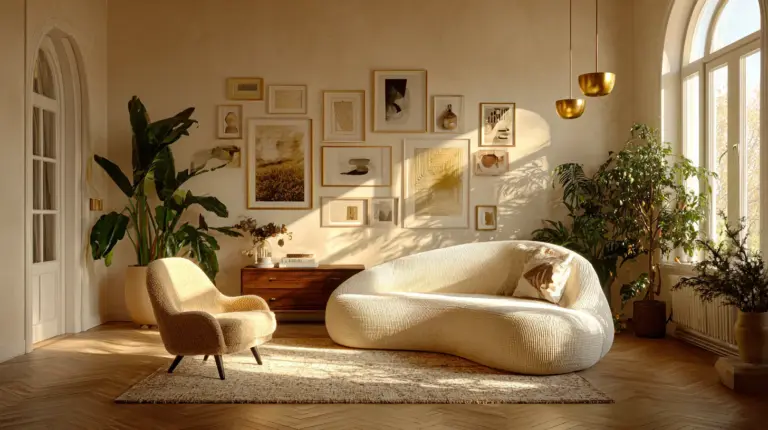
If you are nervous about mixing more than two design styles, use the Rule of Three: anchor the room with one dominant style (about 60%), layer in a secondary style (about 30%), and introduce a third as an accent (about 10%). For example — a mid-century modern sofa base, layered with Moroccan textiles, finished with a single Japanese ceramic vase. The dominant style grounds the room; the others add depth.
Choosing Your Global Influences
How to Mix Cultural Objects With Respect
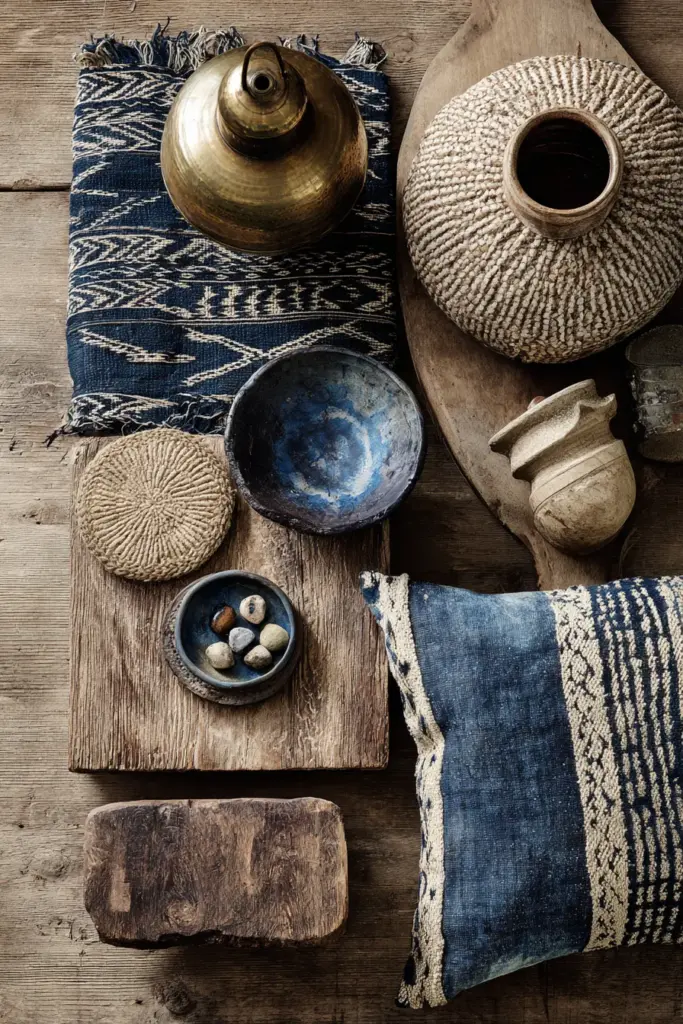
A global eclectic living room draws from the world’s design traditions — but it does so thoughtfully. The goal is to celebrate craft, not to treat cultural objects as costume. Research the pieces you bring in. Know what they are and where they come from. Display them in ways that honor their original intention.
A Ghanaian kente throw is not just a texture — it is a textile with deep cultural meaning. A hand-thrown Japanese bowl is not just a prop — it carries the mark of a maker’s hands. When you understand what you are bringing into the room, you display it with intention, and the room becomes richer for it.
Global Influences Worth Exploring
| Influence | Key Materials | Signature Pieces |
|---|---|---|
| Moroccan | Zellige tile, brass, wool kilim | Poufs, lanterns, arched mirrors |
| Japanese Wabi-Sabi | Raw clay, linen, aged wood | Low tables, ceramic vessels, shoji-inspired panels |
| West African | Kente, mudcloth, carved wood | Textiles, sculptural stools, woven baskets |
| Scandinavian | Sheepskin, pale oak, linen | Clean-lined sofas, wool throws, simple ceramics |
| Indian | Block-printed cotton, brass, jute | Embroidered cushions, brass trays, dhurrie rugs |
| South American | Leather, woven wool, terracotta | Geometric textiles, clay pots, natural fiber lamps |
Choose two or three influences that genuinely resonate with you. Mix them through material and color rather than by filling the room with obvious symbols from each.
Furniture Layout for Every Room Size
Small Living Rooms
In a small eclectic space, restraint is your most powerful tool. Choose one statement piece — a beautifully upholstered armchair in a bold pattern, or a sculptural coffee table — and let the rest of the room breathe around it.
Use multifunctional furniture: a rattan chest that doubles as a side table, an upholstered ottoman with storage. Keep the floor visible. The more floor you can see, the larger the room feels, even with layered textiles and interesting objects on every surface.
Medium Living Rooms
A medium-sized room gives you room to play with groupings. Anchor the space with a large area rug — ideally one with a pattern that carries two or three of your palette colors — then arrange seating around it. The rug does the hard work of defining the zone.
Layer your seating: a sofa as the main piece, two mismatched armchairs opposite or at angles, a low pouf or floor cushion for informal seating. Mismatched does not mean unrelated — look for chairs that share a leg finish, upholstery tone, or silhouette weight with the sofa.
Large Living Rooms
A large room needs multiple zones to feel warm and not like a waiting room. Create a conversation area, a reading nook, and perhaps a small desk or display corner. Each zone should have its own lighting source — a floor lamp, a table lamp, a pendant above — so the room feels layered and inhabited at night.
Use a large statement rug to anchor the main seating zone, and a smaller complementary rug to define the reading corner. They do not need to match, but they should share at least one color.
Layered Lighting: The Most Underrated Element
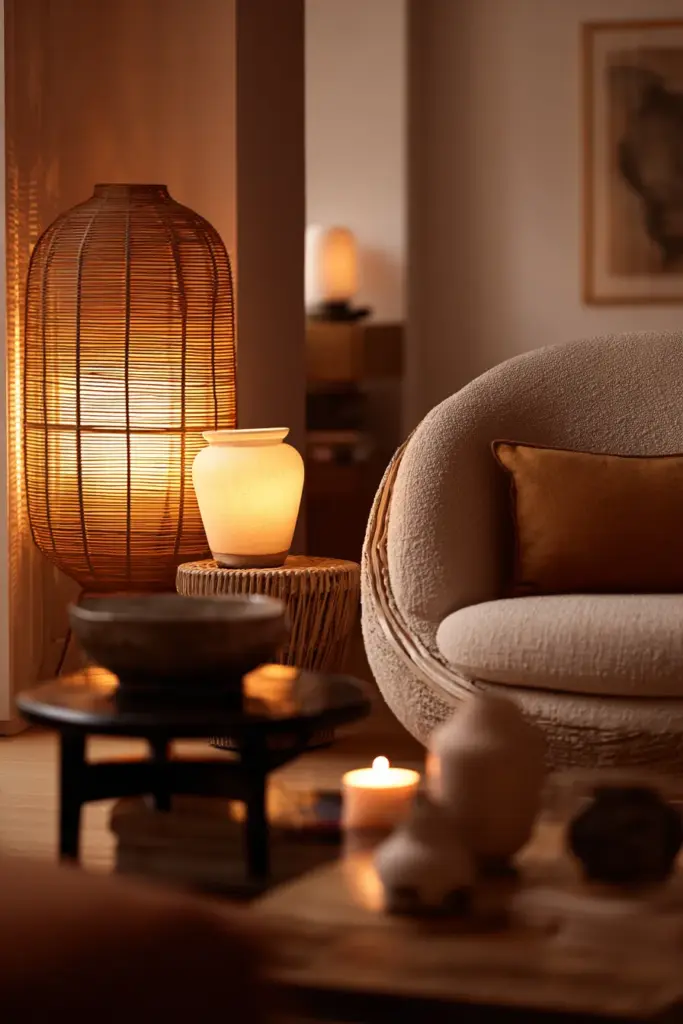
Lighting is where most eclectic rooms either soar or fall flat. A single overhead light flattens every texture you have carefully chosen. Layered lighting — three or more light sources at different heights — brings the room to life.
Think in three layers: ambient (a soft pendant or chandelier for general light), task (a reading lamp beside the armchair, a table lamp on the console), and accent (a small spotlight on art, a candle grouping on the coffee table, a backlit shelf of ceramics). For a global eclectic room, look for lighting ideas that carry their own sculptural presence — a rattan pendant, a hammered brass table lamp, a handmade ceramic base with a linen shade.
Warm bulbs only. Aim for 2700K to 3000K. Cool white light will strip the warmth from every textile and wood tone you have chosen.
The Vintage vs. Modern Balance
The 80/20 Rule
A practical ratio for beginners: keep about 80% of your pieces in a familiar, comfortable register — whether that is modern, vintage, or somewhere between — and use the remaining 20% for the unexpected. This keeps the room from feeling like a museum on one end or a furniture showroom on the other.
For example: a clean-lined modern sofa, a simple oak coffee table, neutral linen curtains (the 80%) — then a vintage carved wooden mirror, a stack of antique books, and a collection of hand-thrown pottery (the 20%). The modern pieces give the eye a place to rest. The vintage and handmade pieces give it somewhere to land with delight.
Where to Source Eclectic Pieces
- Thrift stores and estate sales — the best source for genuine vintage pieces at low prices
- Artisan markets and craft fairs — for handmade ceramics, textiles, and baskets
- Online vintage platforms — eBay, Chairish, and Etsy for specific eras and styles
- Import stores — for global textiles and objects with authentic provenance
- DIY and upcycling — a thrifted frame repainted in aged gold, a vintage stool reupholstered in a bold textile
The eclectic room is one of the most budget-friendly styles to build over time, because it is designed to be collected rather than purchased all at once.
Materials to Mix (and How to Balance Them)
The Material Palette
A well-balanced eclectic living room draws from natural materials above all. Synthetic surfaces tend to sit awkwardly beside handmade objects — they have a different energy. Natural materials speak to each other across style boundaries.
A strong material palette might include: warm-toned wood (walnut, teak, or light oak), woven naturals (rattan, jute, seagrass), soft textiles (linen, cotton, wool), metal accents (brass, aged bronze, or matte black), and one stone or ceramic presence (a marble tray, a clay vase, a soapstone candle holder).
Material Balance Table
| Category | Proportion | Examples |
|---|---|---|
| Soft textiles | High — covers sofa, cushions, curtains, rug | Linen, cotton, wool, velvet |
| Natural woven | Medium — furniture, baskets, lamp shades | Rattan, jute, seagrass, bamboo |
| Wood | Medium — furniture frames, shelving, floors | Oak, walnut, teak, reclaimed wood |
| Metal | Low accent — hardware, frames, trays | Brass, bronze, matte black |
| Stone or ceramic | Low accent — objects, vessels, trays | Marble, clay, soapstone |
Your Global Eclectic Shopping List
For a room that feels complete, work through these categories intentionally rather than all at once. Cozy furniture anchors the room; everything else layers in.
- Sofa — a clean-lined silhouette in a neutral or earthy linen, velvet, or cotton
- Area rug — patterned, large, and carrying two or three of your palette colors
- Coffee table — wood, rattan, or stone; sculptural shape preferred
- Armchairs — mismatched but related; one patterned, one solid
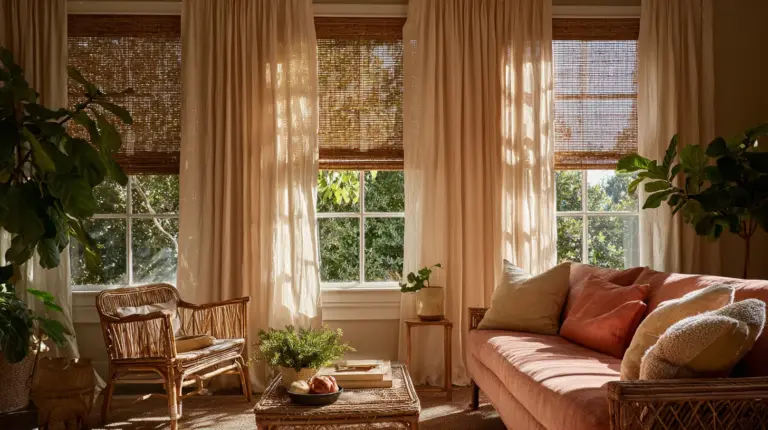
- Curtains — linen, floor-to-ceiling; a gentle texture rather than a loud pattern
- Floor lamp — rattan, ceramic, or brass; warm light source beside the sofa
- Table lamp — handmade base (ceramic or wood) with a linen shade
- Art — one large piece above the sofa or on a feature wall; prints, paintings, or textiles
- Baskets and storage — woven, natural materials; decorative and functional
- Objects and ceramics — handmade, globally sourced; grouped in odd numbers
Mistakes to Avoid in an Eclectic Living Room
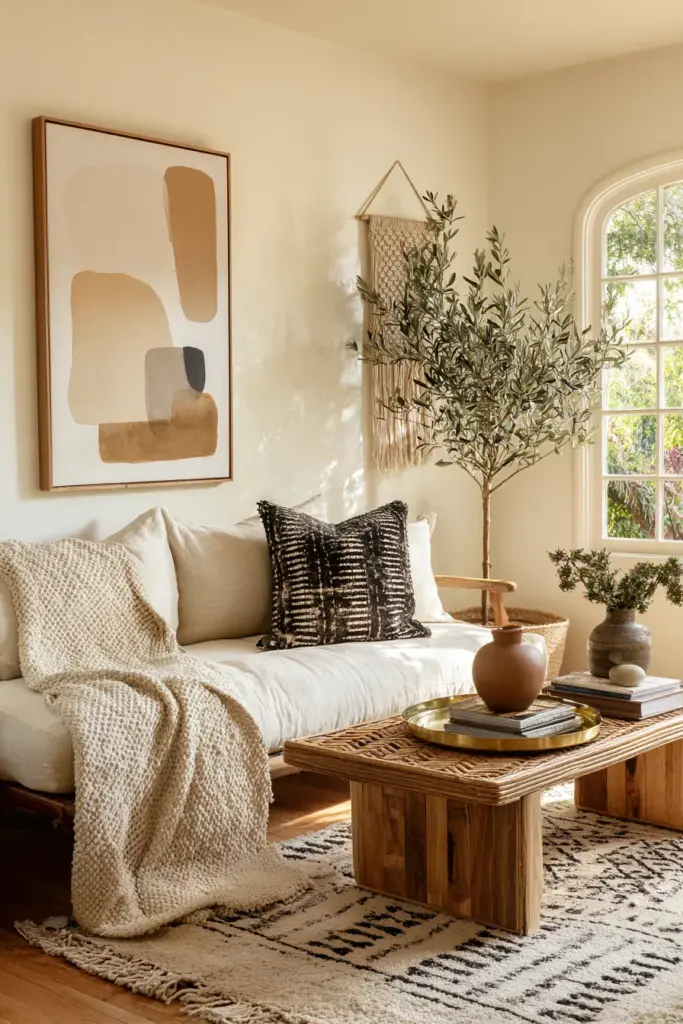
- Too many focal points — choose one hero wall, one statement piece of furniture; let the rest support
- Ignoring scale — a small rug, a tiny lamp, and a massive sofa will never feel right; match the weight of objects to the scale of the room
- Overusing pattern — if you have a patterned rug, a patterned sofa, and patterned curtains, the room has no place to rest; use pattern in two of three and keep the third solid
- Skipping the lighting layer — one ceiling light is never enough; always add at least two floor or table lamps
- Buying everything at once — eclectic rooms are meant to be built over time; give yourself permission to live with a space before filling it
Quick Checklist: The Eclectic Living Room Essentials
- One anchor palette of two to three tones
- Two or three recurring materials that travel through the room
- Layered lighting with at least three sources
- One large area rug anchoring the seating zone
- A mix of vintage, handmade, and modern pieces in roughly an 80/20 ratio
- Global objects displayed with intention and context
- Pattern used in no more than two major surfaces
- Natural materials prioritized over synthetic
Conclusion
The eclectic living room is, at its heart, a room that tells the truth about you. It does not perform a single era or a single aesthetic — it holds everything you love, from the handmade bowl you found at a weekend market to the vintage armchair that belonged to someone else’s story before it became yours.
The secret is not in the individual pieces. It is in the conversation between them — the quiet agreement of a shared color, a repeated material, a sense of warmth that runs through every layer. When you get that right, the room does not feel like a collection. It feels like a home.
Build it slowly. Trust your eye. Let it grow.
Frequently Asked Questions
What is the definition of eclectic interior design?
Eclectic interior design is the intentional mixing of styles, periods, and cultural influences into a cohesive space. Unlike maximalism, which layers for abundance, eclectic design layers for meaning — every piece is chosen deliberately and connected to the others through shared color, material, or scale.
How do you mix different styles without making a room look cluttered?
The key is to establish unifying threads: a consistent color palette, recurring materials, and a balanced scale across furniture pieces. Use the Rule of Three — one dominant style at 60%, a secondary at 30%, and an accent at 10% — and let the rug and lighting hold the room together visually.
Can I combine more than two design styles in one space?
Absolutely — in fact, the richest eclectic rooms often draw from three or more traditions. The more styles you introduce, the more important it becomes to establish a strong color anchor and consistent material thread so the room reads as curated rather than chaotic.
Where can I find eclectic furniture and decor?
The best eclectic pieces come from estate sales, thrift stores, artisan markets, online vintage platforms like Chairish or Etsy, and import shops with ethically sourced global goods. Building the room over time — piece by piece — produces a more authentic result than buying everything at once.
How do I choose a color scheme for an eclectic room?
Start with one anchor tone that you love and can live with long-term — a warm linen, a soft terracotta, a dusty sage. Build your palette from colors in the same temperature range (all warm or all cool), and use your patterned rug or largest textile as a guide, since it will naturally contain the colors that belong together in the space.