
Table of Contents
By ERYLIN — Your calm guide to soulful, affordable interiors.
There is a particular kind of peace that settles into a room decorated with intention. Not the kind bought in one extravagant swoop, but the kind built slowly — one careful choice at a time. That is the soul of Japandi design, and the good news is: it does not require a generous budget to feel genuinely beautiful.
Japandi is the meeting of two worlds: the wabi-sabi warmth of Japanese imperfection and the hygge-touched minimalism of Scandinavian living. Together, they create spaces that breathe — rooms that feel curated, not crowded. And when it comes to art, this aesthetic is uniquely forgiving for those of us who want beauty without the price tag.
At ERYLIN, we believe a thoughtfully chosen print, a small framed sketch, or a single ink-washed canvas can transform an entire corner of your home. You do not need original gallery pieces. You need presence. You need quiet.
This guide is your invitation to explore the most inspiring, budget-friendly Japandi art ideas for 2026 — from sizing tips and framing choices to where to find pieces that feel expensive without being so.
What Makes Art Feel Truly Japandi?
The Philosophy Behind the Aesthetic
Japandi art is not about decoration for decoration’s sake. It is about resonance — the feeling a piece gives you when you pass it in the morning, coffee in hand. It favors restraint. A single ink brushstroke. A pale winter branch. The suggestion of fog over a mountain.
The colors lean toward warm neutrals: soft clay, bone white, charcoal, sage, and muted indigo. The subjects are drawn from nature — botanicals, landscapes, stones, water, seasons. Think less “bold statement piece” and more “quiet meditation on the wall.”
Key Visual Characteristics
Good Japandi art tends to share a few qualities that make it recognizable even when you spot it in a thrift shop or a discount print store.
- Muted, natural color palettes — no saturated primaries
- Organic subjects — branches, leaves, stone, water, sky
- Negative space — what is not painted matters as much as what is
- Texture-forward mediums — ink, watercolor, linen, rice paper
- Asymmetry over symmetry — beauty in the off-center, the unexpected
Budget Japandi Art Ideas 2026: Where to Start
Start With a Single Anchor Piece
Before you buy three small prints, consider one slightly larger anchor piece. The 2/3 rule in design says your artwork should span roughly two-thirds the width of the furniture beneath it — a sofa, a console, a bed. This creates visual harmony without crowding. One well-proportioned piece can do more for a room than a scattered gallery wall ever could.
For a Japandi living room, this might be a misty Japanese landscape print in a natural wood frame, hung at eye level above a low linen sofa. Simple. Grounding. Enough.
Affordable Art Sources That Actually Look Beautiful
You do not have to spend gallery prices for gallery-quality feeling. There are wonderful sources for budget Japandi prints in 2026 that align with the aesthetic beautifully.
| Source | Price Range | Best For |
|---|---|---|
| Society6 / Redbubble | $15–$60 | Digital prints, instant download |
| Etsy (independent artists) | $10–$80 | Original illustration, handmade |
| IKEA (KNOPPÄNG, BJÖRKSTA) | $10–$50 | Ready-framed, clean lines |
| Thrift stores / estate sales | $2–$30 | Vintage frames, unexpected finds |
| Free printables (Unsplash, Canva) | Free | DIY, botanical photography |
| Local art markets / pop-ups | $20–$100 | Handmade, support local artists |
Tip: When downloading free printables, choose high-resolution files (at least 300 DPI) so they print crisply on quality paper at home.
The Magic of Natural Wood Frames
The frame is not an afterthought in Japandi design — it is part of the artwork itself. A natural wood frame in light oak, ash, or bamboo transforms even a simple black-and-white print into something that feels handcrafted and intentional.
Look for frames with a matte finish rather than glossy. Avoid gold and silver metal unless it is very muted and brushed. For a snowy Japanese landscape print or a single botanical sketch, a thin natural wood frame lets the art breathe without competing with it.
How to Size Japandi Art for Your Space
The 2/3 Furniture Rule, Explained
One of the most common mistakes in decorating is hanging art that is too small for its wall. In Japandi spaces, proper sizing is everything — it signals intention and confidence.
The rule is simple: your artwork (or grouping) should measure approximately two-thirds the width of the furniture below it.
| Furniture Width | Ideal Art Width |
|---|---|
| 48 inches (sofa) | ~32 inches |
| 60 inches (sofa) | ~40 inches |
| 36 inches (console) | ~24 inches |
| 72 inches (bed, queen) | ~48 inches |
For small spaces — a narrow entryway, a cozy reading nook — a single vertical print in a slender frame creates the illusion of height. For larger walls, consider a diptych (two matching prints side by side) rather than one enormous piece. It feels more considered, and it is easier on the budget.
Hang Lower Than You Think
In Japandi interiors, art hangs lower than conventional wisdom suggests. The center of the piece should sit at roughly eye level — around 57 to 60 inches from the floor — rather than pushed high. This creates a sense of groundedness, of everything in the room belonging together rather than floating separately.
DIY Japandi Art: Creating Beauty With Your Own Hands
Why Handmade Fits the Philosophy
Wabi-sabi — the Japanese concept of finding beauty in imperfection — is the philosophical heart of Japandi design. This means a painting you made yourself, even if imperfect, belongs here more naturally than a mass-produced print ever could. The slight wobble in a brushstroke. The uneven wash of watercolor. These are not flaws. They are fingerprints.
Simple DIY Ideas to Try
You do not need artistic training to create Japandi-appropriate art. These beginner-friendly ideas are surprisingly achievable and beautiful.
Ink Wash Landscapes
Using a wide, flat watercolor brush and black ink diluted in water, paint soft horizontal bands that suggest mountains, fog, or a still lake. Let the layers bleed into each other. Mount on ivory cardstock and frame in natural wood. This is perhaps the most Japandi thing you can make with your own hands.
Pressed Botanicals
Collect leaves, ferns, or dried flowers from your garden or a walk. Press them flat between heavy books for two weeks, then arrange on watercolor paper or cream cardstock. Frame without glass for a textural, three-dimensional feel. The impermanence of dried botanicals is deeply wabi-sabi.
Minimalist Charcoal Sketches
Draw simple outlines — a stone, a branch, a single leaf — in soft charcoal on cold-press watercolor paper. Don’t over-blend. The marks and smudges are part of the appeal. Mount with a wide mat in linen or cream.
Found Nature, Framed
A piece of peeling bark. A flat river stone. A dried seed pod. Shadow boxes and deep-set frames can hold three-dimensional natural objects as art. This costs almost nothing and says everything about the Japandi love of raw, honest material.
Curating a Japandi Gallery Wall on a Budget
Less Is More — Even in a Gallery Wall
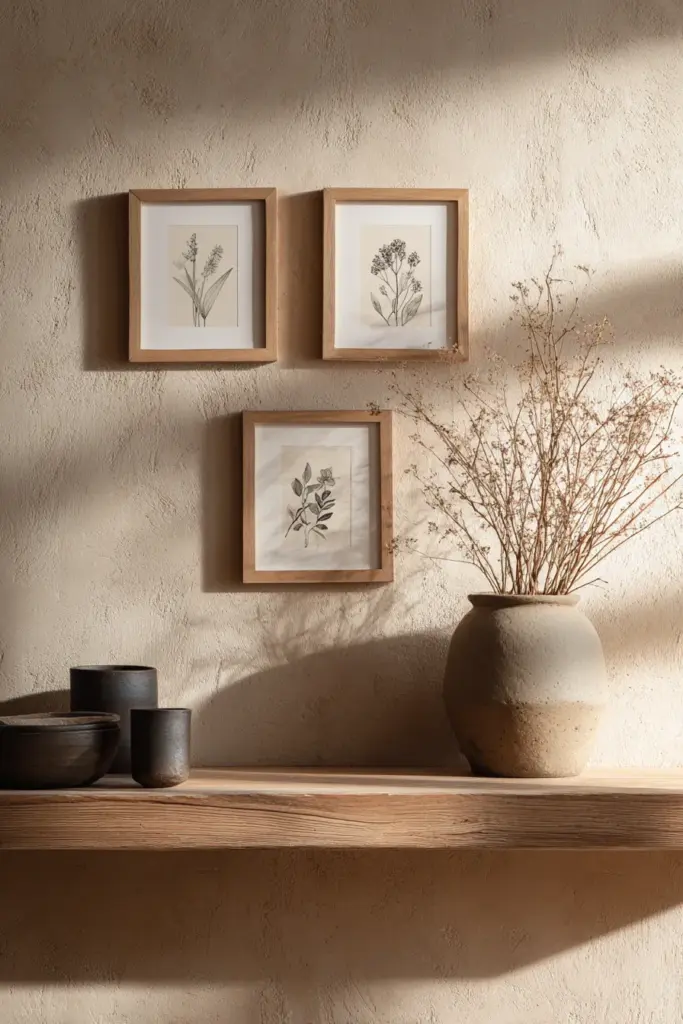
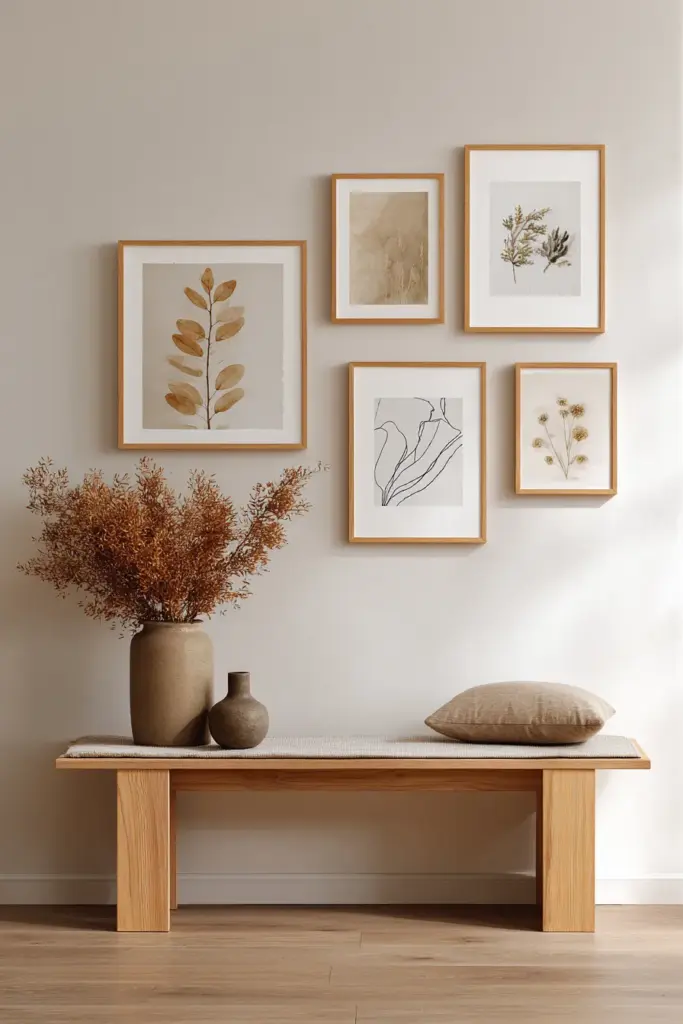
A Japandi gallery wall is not the maximalist Pinterest grid of 15 mismatched frames. It is quieter. It is purposeful. Aim for three to five pieces maximum, all sharing a similar palette and mood. Leave generous space between frames — let the wall breathe around them.
Mixing Mediums for Depth
The most beautiful budget gallery walls combine different mediums rather than identical prints. Consider pairing:
- A muted watercolor botanical with a simple black ink line drawing
- A small framed square of handmade washi paper alongside a snowy landscape photograph
- A pressed fern beside a single haiku printed in a delicate serif font
The variation creates interest without chaos. The shared tonality — warm neutrals, organic references — holds everything together.
Cohesion Through Framing
Even if your art pieces are wildly different in subject and source, unified framing creates instant cohesion. Choose one frame style — all natural light wood, all thin black metal, or all white painted wood — and stay consistent. This single decision transforms a random collection into a considered gallery.
Japandi Art for Small Spaces: Making Every Inch Count
Think Vertical
In compact rooms and hallways, vertical prints create the illusion of height. A tall, narrow print of a bamboo grove or a single standing stone brings the eye upward and makes the ceiling feel higher. Pair with cozy furniture that sits low to the ground to emphasize that vertical stretch.
The Single Statement Corner
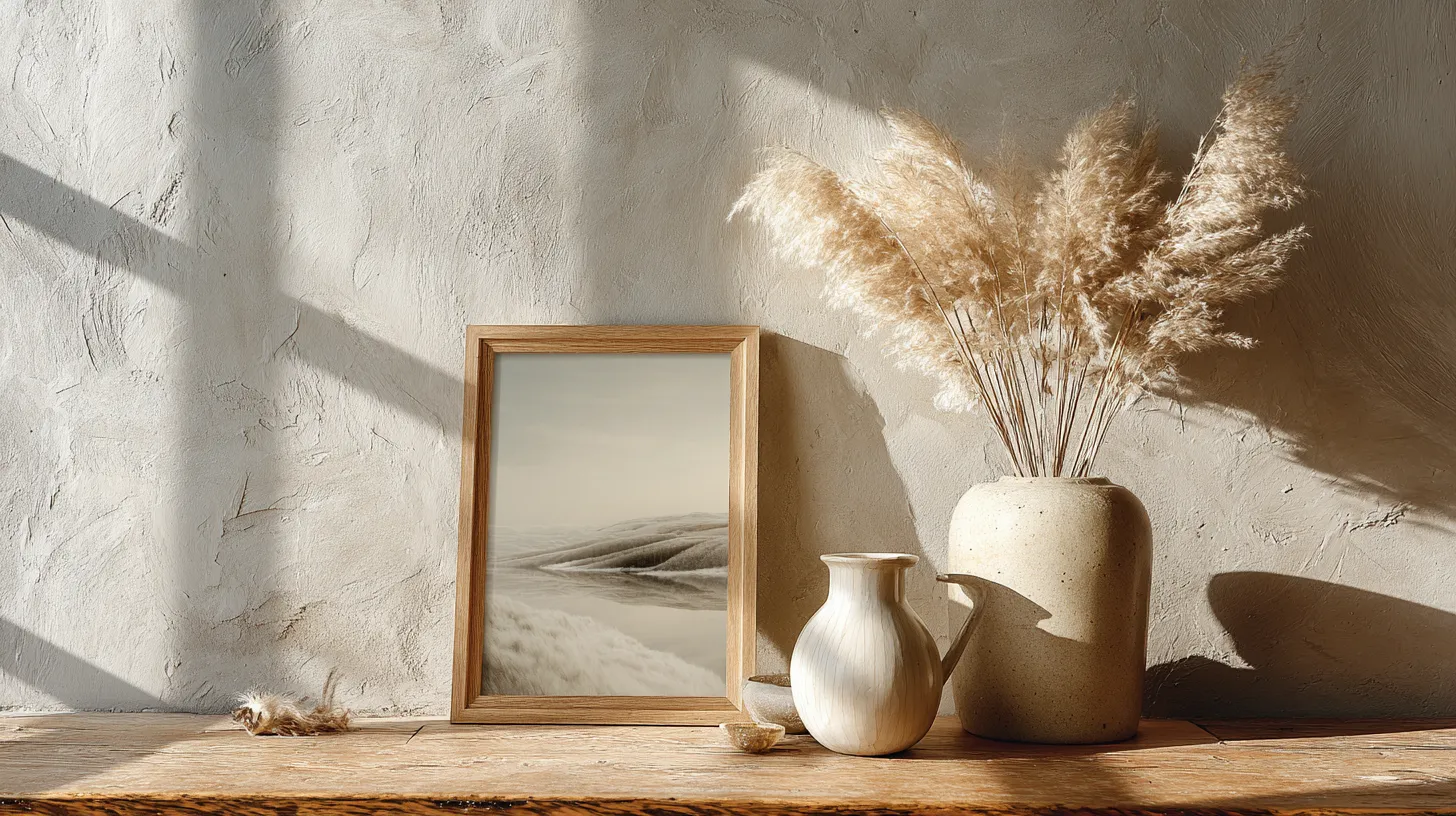
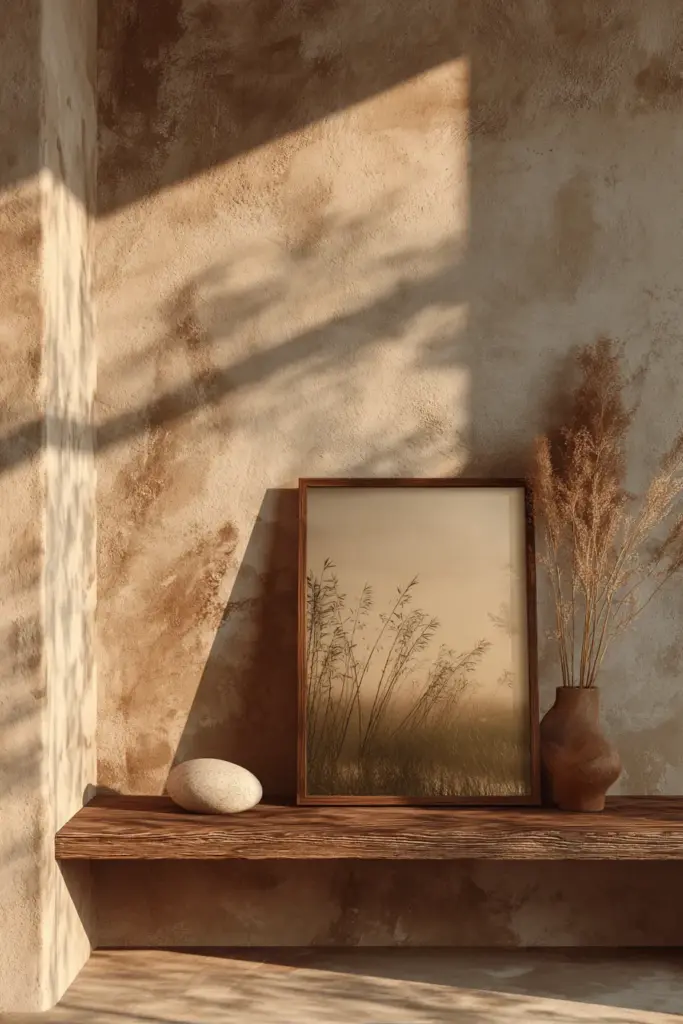
Not every wall needs art. In Japandi design, one considered corner — a print on an easel, a framed piece leaning against the wall, a canvas resting on a shelf — can define an entire room’s personality. The lean is intentional. The negative space around it is part of the composition.
Layering Art with Objects
In a Japandi shelfscape, art does not stand alone. It layers with objects: a ceramic vase, a smooth stone, a bundle of dried grasses. A small framed print propped among these objects feels like it grew there naturally. This kind of casual intentionality is very difficult to buy — but very easy to build, slowly, with pieces you love.
Seasonal Japandi Art: Changing Your Space with the Seasons
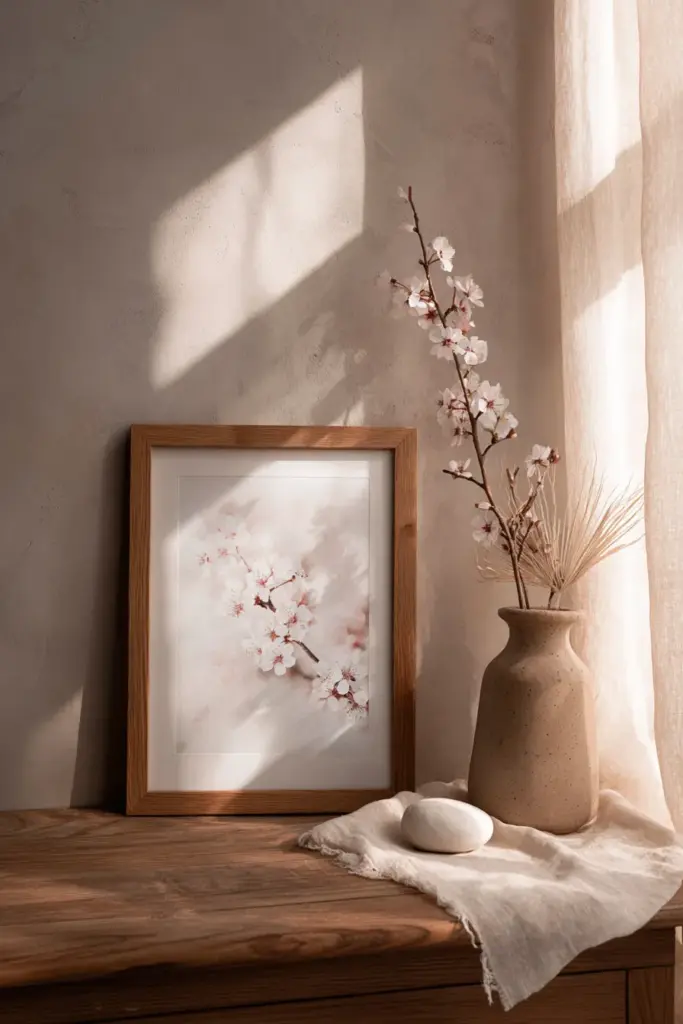
One of the most beautiful and budget-conscious practices in Japanese interiors is the tradition of tokonoma — the seasonal display. Rather than permanent art on every wall, curate a single display corner that changes with the season.
In winter: a snowy landscape print, bare branches, a single white candle.
In spring: a pale cherry blossom watercolor, a small ceramic vase with fresh stems.
In autumn: pressed leaves in amber tones, a print of misty hills in gold and rust.
This practice means you need fewer pieces total — just a small rotating collection that keeps your home feeling alive and current all year long.
Quick Reference: Budget Japandi Art Checklist
Before you buy or make your next piece, run through this quick checklist to make sure it fits your space and your vision.
- Does the palette lean toward warm neutrals, muted greens, soft charcoals, or natural tones?
- Does the subject reference nature — botanicals, landscapes, water, stone?
- Is there enough negative space in the composition?
- Is the frame natural wood, matte black, or matte white?
- Does the size follow the 2/3 rule relative to the furniture below?
- Does it feel quiet rather than attention-demanding?
- Do you love it — not just like it?
If you can say yes to most of these, you have found your piece.
Conclusion: Beauty That Costs Very Little
There is something deeply liberating about a design philosophy that finds beauty in simplicity. Japandi art does not ask you to spend more. It asks you to choose better — more slowly, more deliberately, with your own senses as the guide.
A single print, well-framed and well-placed, can make a room feel like a sanctuary. A pressed leaf in a natural wood frame can carry more meaning than a canvas that cost a thousand dollars. The beauty is not in the price. It is in the intention.
At ERYLIN, this is what we come back to every time: that the most beautiful homes are built not all at once, but one quiet, considered choice at a time. Start with one piece that speaks to you. Frame it simply. Hang it low. And let the room breathe around it.
That is the heart of Japandi. And it belongs to everyone.
Frequently Asked Questions
What is Japandi art, and how is it different from regular minimalist art?
Japandi art blends Japanese wabi-sabi aesthetics — imperfection, nature, quietude — with Scandinavian minimalist design values like simplicity and function. Unlike generic minimalism, Japandi art feels warm and organic rather than cold or clinical. It favors natural subjects, muted tones, and textures that suggest handcraft.
What size art should I hang above a sofa?
Follow the 2/3 rule: your artwork should span roughly two-thirds the width of your sofa. For a standard 84-inch sofa, aim for art between 54 and 60 inches wide. You can achieve this with a single large print or a diptych — two prints hung close together with a small gap between them.
Where can I find affordable Japandi art prints?
Etsy is one of the best sources for independent artists creating authentic Japandi-style prints, often for under $30 as digital downloads you can print locally. Society6, Redbubble, and free sites like Unsplash also offer beautiful options. Don’t overlook thrift stores — Japandi framing can elevate almost any simple nature print.
Can I make my own Japandi art even if I’m not an artist?
Absolutely. Ink wash painting, pressed botanicals, and simple charcoal sketches are all beginner-friendly and deeply aligned with the Japandi philosophy of handmade imperfection. The wabi-sabi principle actively celebrates the mark of the human hand, which means your u0022imperfectu0022 art is more Japandi than a perfect printed reproduction.
How do I create a Japandi gallery wall on a budget?
Choose three to five pieces maximum in a shared neutral palette. Frame everything in the same style — all natural wood or all matte black — to create cohesion. Space frames generously apart, and resist the urge to fill every gap. The breathing room between pieces is as important as the art itself.