
Table of Contents
By ERYLIN — Home Décor & Interior Styling
There is a quiet magic that happens the moment you walk into a room and your eyes know exactly where to go. That first glance — effortless, unhurried — is the work of a well-designed focal point. It is the soul of the space, the thing that makes a room feel intentional rather than assembled.
A modern living room focal point is more than a pretty wall or an impressive piece of furniture. It is the visual anchor that holds everything together — the reason a sofa feels placed rather than pushed, the reason lighting feels layered rather than lit. It gives your eye a place to rest, and your guests a reason to pause.
At ERYLIN, we believe every room deserves one honest, beautiful anchor. Whether your space is sun-drenched and airy or compact and cozy, a thoughtful focal point transforms a living room from a collection of furniture into a composed, living experience.
In this guide, we will walk you through how to choose, create, and style a modern living room focal point — including ideas for small spaces, fireplace-free rooms, and budget-conscious transformations that do not sacrifice beauty.
What Is a Focal Point in a Living Room?
A focal point is the first thing your eye lands on when you enter a room. It is the dominant visual element that commands attention — the architectural feature, the statement piece, the dramatic wall — around which everything else is arranged.
In a modern living room, a focal point creates hierarchy. Without one, a room feels scattered and restless. With one, even the simplest spaces feel curated and calm.
Think of it as the anchor of a composition: it holds the arrangement steady and gives every other element something to respond to.
Choosing Your Modern Living Room Focal Point
The right focal point depends on your room’s architecture, its natural light, and the feeling you want to evoke. Here are the most beautiful and effective options for modern homes.
The Fireplace: A Timeless Natural Anchor
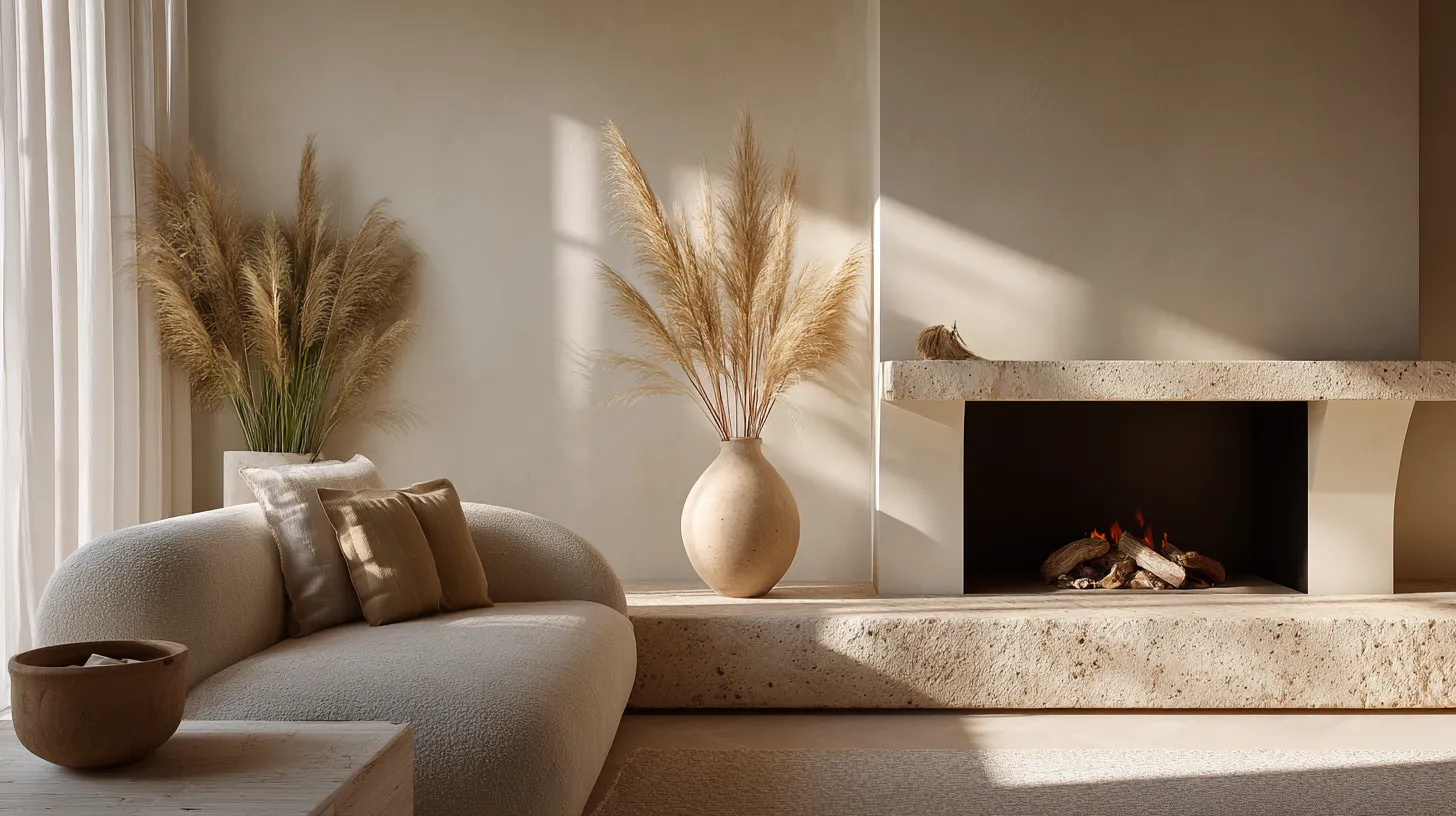
A fireplace is the original focal point — warm, textural, and instinctively human. In a modern living room, a fireplace framed in natural stone, smooth plaster, or raw concrete becomes both a design statement and a sensory invitation.
For a Japandi-inspired space, consider a minimalist fireplace with a flush stone surround and a single sculptural object on the mantle — a rough ceramic vase, a dried branch, a quiet candle. Less is more. The fire does the work.
If your fireplace feels dated, a painted makeover can transform it entirely. A coat of limewash paint in warm white or matte charcoal costs under ₱5,000 and shifts the entire energy of the room.
The Statement Wall: Bold, Intentional, Yours
An accent wall is one of the most accessible focal points for any modern living room. The key is restraint — one wall, one gesture, beautifully executed.
Options to consider:
- Removable wallpaper in a textured grasscloth or geometric print — ideal for renters or those who love to evolve their interiors
- Limewash or clay paint in a warm terracotta, sage, or dusty rose — soft, organic, deeply inviting
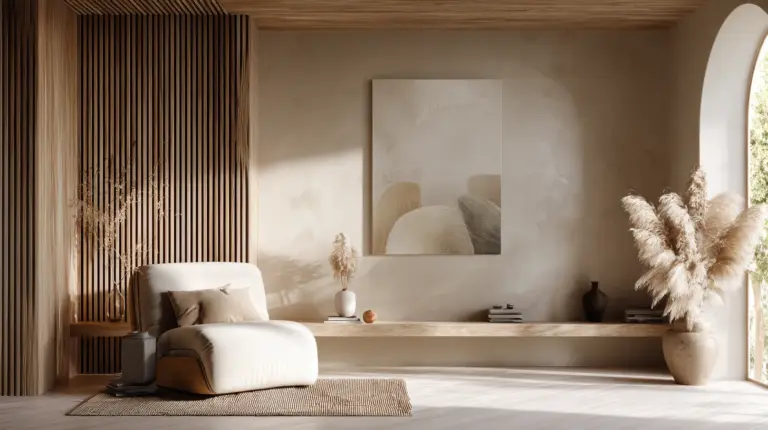
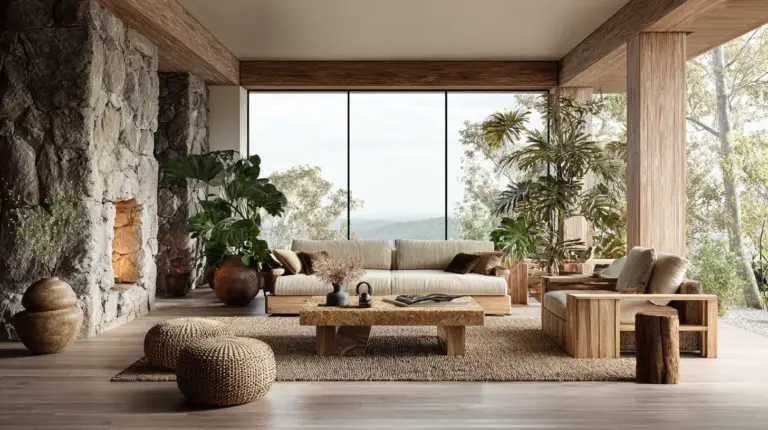
- A reclaimed wood panel wall — sustainable, sensory, and richly textural against clean modern lines
A focal wall works best when it sits behind the primary seating or directly opposite the room’s entry point. This is the wall your eye finds first — honor it.
The Gallery Wall: Layered, Personal, Alive
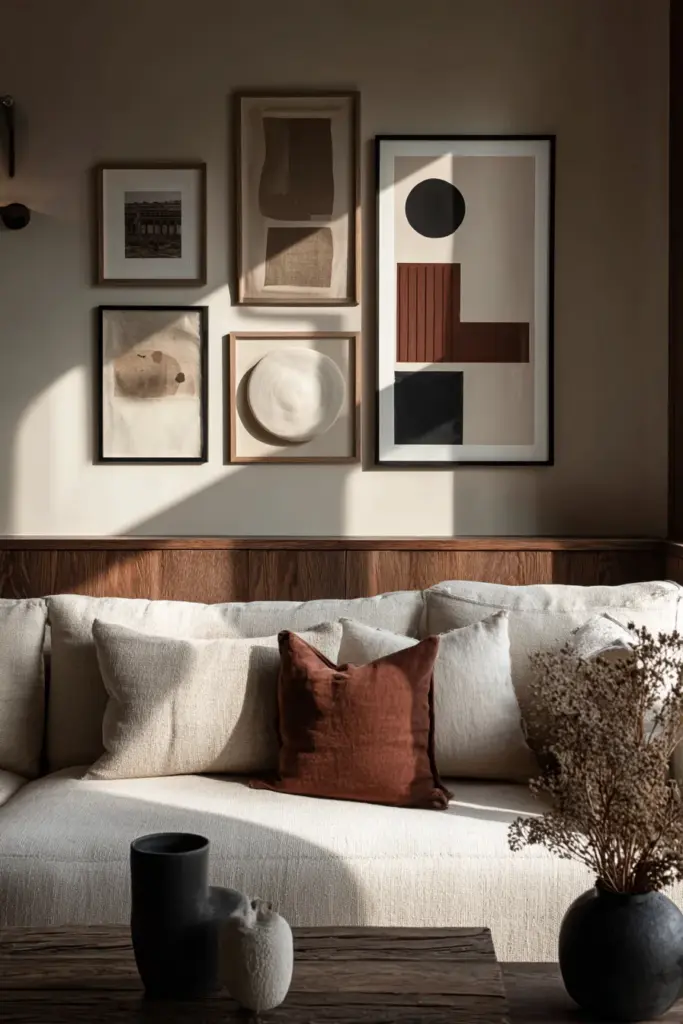
A gallery wall is not just art — it is a story told in frames. Arranged with intention, it becomes one of the most personal and visually rich focal points in a modern living room.
Group artwork in odd numbers. Mix textures — a linen-framed print beside a raw wood sketch, a ceramic plate beside a black-and-white photograph. Keep your palette cohesive: two to three tones that echo the room’s main colors.
Leave breathing room between each piece. White space is not emptiness — it is emphasis.
The Statement Mirror: Light, Depth, Drama
A large mirror does something no other focal point can: it multiplies light and expands space. In a smaller living room, a statement mirror is both a design choice and a spatial strategy.
Choose an oversized round mirror with a natural rattan or brushed brass frame. Place it opposite a window to reflect the light and the landscape. The room doubles in warmth and depth.
A mirror anchored above a console table or low sideboard creates an elegant, layered moment — especially beautiful when styled with a ceramic lamp and a trailing plant.
The TV Wall: Styled, Not Surrendered
The television is the most-used focal point in most modern living rooms — and the least celebrated. Styled well, a TV wall becomes an intentional design moment rather than a concession.
How to make your TV a beautiful focal point:
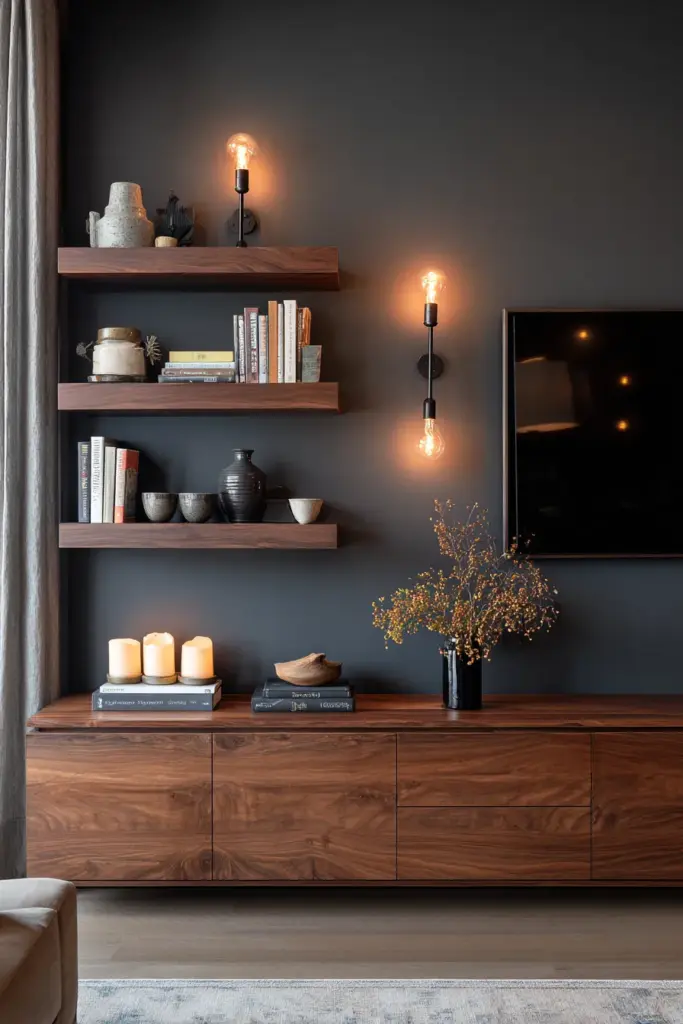
- Mount it on a deep charcoal or forest green painted wall — the dark color recedes, making the screen feel intentional rather than dominant
- Frame the TV with floating shelves styled with books, ceramics, and plants — the TV becomes part of a composition, not the whole picture
- Consider a TV cabinet with cane or fluted glass doors — closed, it reads as furniture; open, it reveals the screen
The goal is integration, not concealment. Let the TV belong to the room rather than rule it.
Sculptural Furniture as a Focal Point
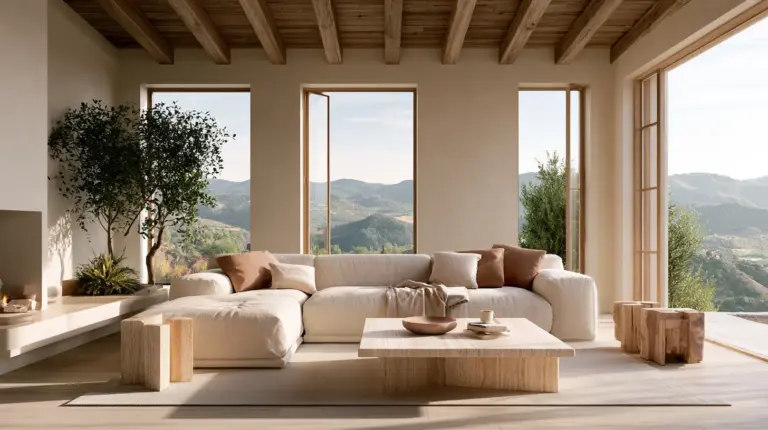
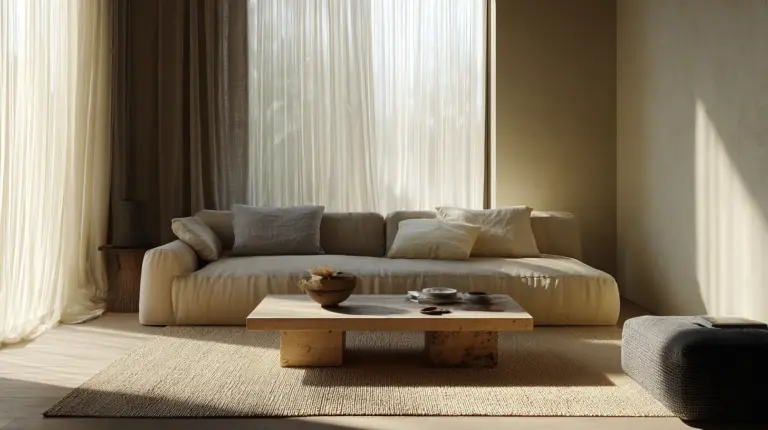
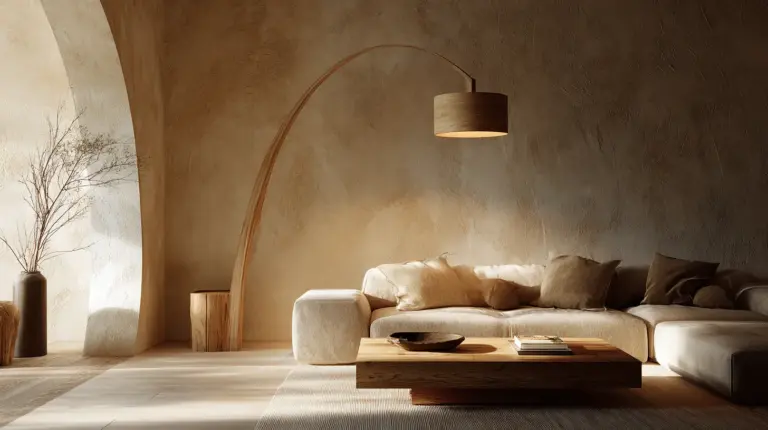
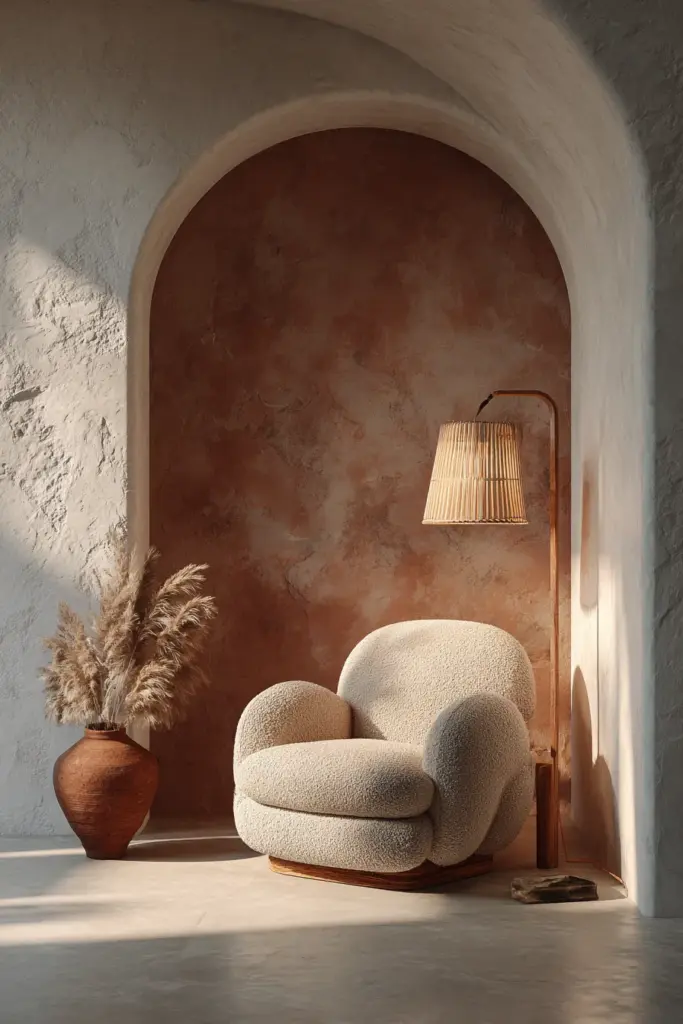
Sometimes the focal point is not on the wall at all — it is in the center of the room. A dramatic curved sofa, an architectural coffee table in solid teak or travertine, or a sculptural lounge chair in bouclé fabric can become the visual anchor of an entire space.
This approach works especially well in open-plan living rooms where walls are limited or shared. The furniture arrangement itself becomes the composition.
Modern Living Room Focal Point Ideas for Small Spaces
Small living rooms under 20 square meters need focal points that work harder and take up less room.
Go Vertical
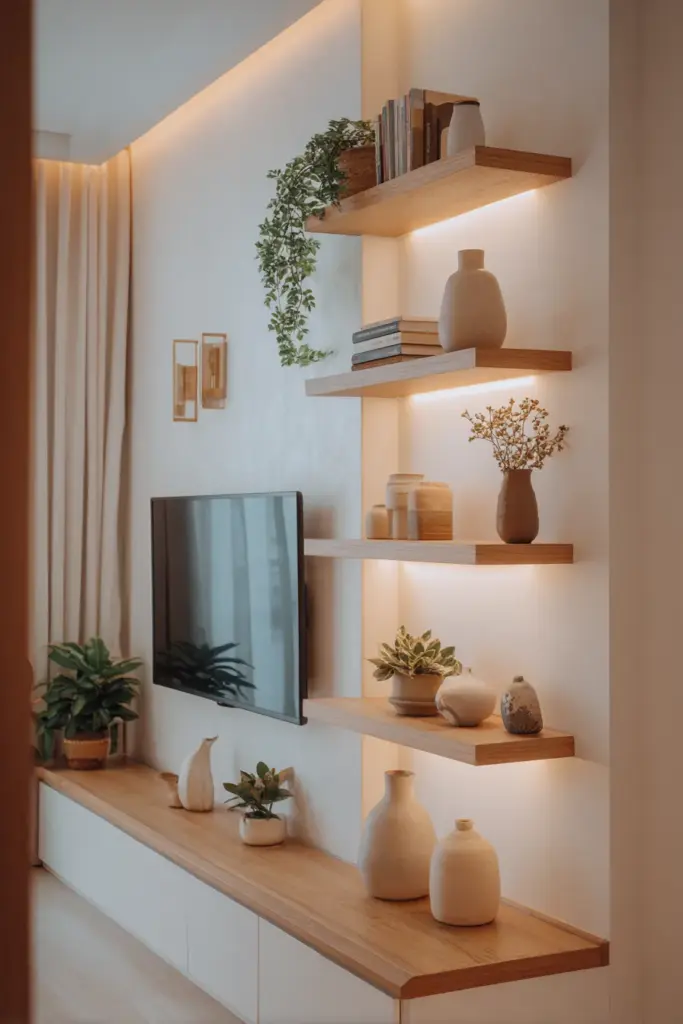
When floor space is limited, the eye needs to travel upward. A tall gallery wall, a floor-to-ceiling bookshelf, or a vertically oriented artwork draws the gaze up and makes the room feel taller and more expansive.
Wall-mounted shelves styled with books and objects serve double duty — they are both a focal point and storage, which is essential in compact spaces.
Scale Matters More Than Size
In a small living room, an oversized piece of art — a single large canvas in muted tones — creates more impact than a cluster of small frames. One bold gesture reads as confident; many small gestures read as cluttered.
Choose one focal point and let it breathe. Resist the urge to add a second.
Multifunctional Focal Points
A built-in bench with storage beneath and a decorative panel above. A sideboard with a statement mirror. A fireplace with integrated shelving on either side. In small spaces, the best focal points earn their place twice over — once as visual anchors, once as functional storage.
Focal Point Ideas Without a Fireplace
Not every modern living room has a fireplace — and that is not a limitation. It is an invitation to be more creative.
| Focal Point | Best For | Estimated Cost |
|---|---|---|
| Large statement mirror | Small or dark rooms | ₱3,000–₱12,000 |
| Removable wallpaper accent wall | Renters, trend-conscious | ₱2,500–₱8,000 |
| Gallery wall | Personal, layered spaces | ₱1,500–₱10,000+ |
| Styled TV wall | Everyday living rooms | ₱2,000–₱15,000 |
| Sculptural sofa or chair | Open-plan, furniture-forward rooms | ₱15,000–₱60,000+ |
| Architectural plant (large fiddle leaf or olive tree) | Biophilic, Japandi rooms | ₱1,500–₱6,000 |
| DIY floating shelves | Budget-conscious, minimalist | ₱800–₱3,000 |
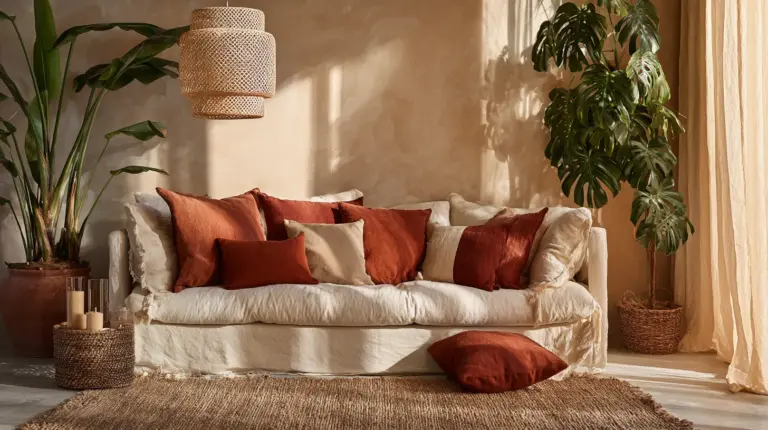
An architectural plant — a large fiddle leaf fig, a sculptural monstera, or a potted olive tree — is one of the most underused focal points in modern interiors. It brings life, texture, and biophilic warmth to any corner. Placed in a woven basket or a matte ceramic pot, it becomes a living work of art.
Lighting Your Focal Point: Layer with Intention
Lighting is what transforms a focal point from day to night, from functional to atmospheric. Without deliberate lighting, even the most beautiful focal wall disappears after sundown.
The Three-Layer Approach
Ambient lighting — your room’s general illumination — sets the base tone. Task lighting — lamps, pendants above reading chairs — serves function. Accent lighting is where the magic happens for focal points.
Direct a narrow-beam spotlight (PAR16 or GU10 bulb, 2700K warm white, 300–500 lumens) at your focal wall, artwork, or architectural feature. The beam draws the eye directly to the anchor and creates depth through shadow.
A wall sconce placed on either side of a gallery wall adds warmth and symmetry. A picture light mounted above a single statement canvas mimics gallery-quality presentation.
Smart Lighting for Mood Shifting
Dimmable accent lighting allows you to shift the atmosphere of your living room entirely. At full brightness, the focal point is bold and energizing. Dimmed to 30%, it becomes intimate and warm — a completely different room, same space.
Consider smart bulbs on your focal point circuit so you can shift the mood without leaving the sofa.
Color Psychology for a Modern Living Room Focal Point
Color is the fastest way to establish a focal point — and the easiest to get wrong.
Warm focal point colors — terracotta, amber, deep rust, warm taupe — work beautifully in south- and west-facing rooms that already receive golden light. They amplify warmth and draw the eye with gentle authority.
Cool focal point colors — sage green, slate blue, smoky charcoal — create drama in bright, east- or north-facing rooms. They provide contrast without aggression.
The 60-30-10 rule applies beautifully here: 60% of the room in your dominant neutral, 30% in a supporting tone, and 10% as the bold accent at the focal point. That 10% does all the visual work.
Avoid matching your focal point exactly to existing furnishings — contrast is what creates pull. The focal point should respond to the room, not repeat it.
Focal Point Mistakes to Avoid
In small rooms:
- Avoid oversized furniture that blocks sightlines and competes for attention
- Do not create two competing focal points — a bold gallery wall AND a dramatic TV wall will exhaust the eye
- Avoid dark accent walls in already dim rooms — they shrink the space further
In large rooms:
- Do not choose a focal point that is too small for the scale — a tiny mirror on a vast wall reads as an afterthought
- Avoid symmetry so perfect that the room feels like a hotel lobby — one asymmetric element keeps the space human and alive
Your Modern Living Room Focal Point Checklist
- Choose one primary focal point and commit to it fully
- Arrange furniture to face and frame the focal point — not to fight it
- Apply the two-thirds / one-third rule: your focal element should occupy roughly two-thirds of the wall it anchors
- Layer accent lighting to illuminate the focal point after dark
- Use the 60-30-10 color rule to give the focal point visual priority
- In small rooms, go vertical and choose multifunctional focal points
- Avoid competing elements — one anchor, many supporting players
- Add a living element (plant, candle, natural material) to soften and warm the focal point
- Style with restraint — negative space is part of the design
Conclusion
A beautiful focal point is not about spending more or filling more. It is about choosing one thing — one honest, considered, yours element — and letting it speak.
When you walk into your living room and your eye knows exactly where to go, when the space feels settled and intentional and quietly alive, that is the work of a focal point done well. That is the feeling ERYLIN designs toward: rooms that hold you, rooms that breathe, rooms that feel like home the moment you step inside.
Start with one wall. One anchor. One beautiful choice. The rest will follow.
Frequently Asked Questions
What is a focal point in a living room?
A focal point is the dominant visual element in a room — the first thing your eye is drawn to when you enter the space. It acts as a visual anchor that gives the room structure, intention, and a sense of calm. Common focal points include fireplaces, accent walls, statement mirrors, gallery walls, and styled TV walls.
What should be the focal point of a living room without a fireplace?
Without a fireplace, your focal point can be a large statement mirror, a bold accent wall in limewash or wallpaper, a styled TV wall, a gallery of artwork, or even a dramatic sculptural plant. The key is choosing one element and arranging your furniture to face and frame it deliberately.
How do you create a focal point in a small living room?
In a small living room, focus on vertical elements — tall artwork, wall-mounted shelves, or a floor-to-ceiling bookshelf — to draw the eye upward and make the space feel larger. Choose one focal point only, keep surrounding décor minimal, and opt for multifunctional pieces (storage + visual anchor) to maximize every square meter.
Can you have two focal points in a living room?
You can have a primary and a secondary focal point — for example, a fireplace as the main anchor and a styled bookshelf as a supporting element — but they should not compete equally for attention. The primary focal point should always be stronger in scale, color, or placement. Two equally dominant elements create visual conflict and make a room feel unsettled.
What color works best for a living room focal point wall?
The best color for a focal point wall depends on your room’s light orientation and existing palette. Warm tones (terracotta, amber, dusty rose) work beautifully in golden-lit rooms; cool tones (sage, slate, charcoal) create elegant contrast in bright spaces. Apply the 60-30-10 rule: let the focal point wall carry your 10% bold accent color so it stands out without overwhelming the room.