
Table of Contents
By ERYLIN — your calm, design-savvy guide to beautiful, livable spaces.
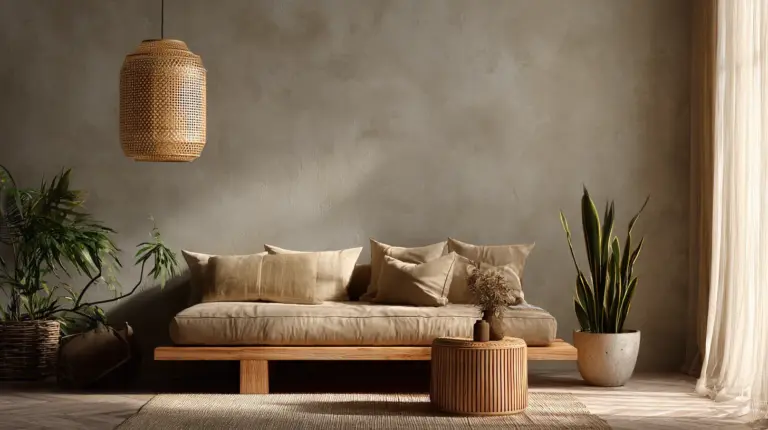
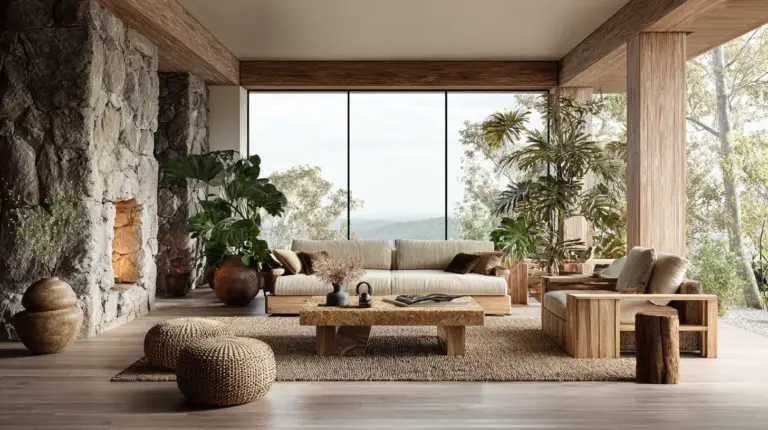
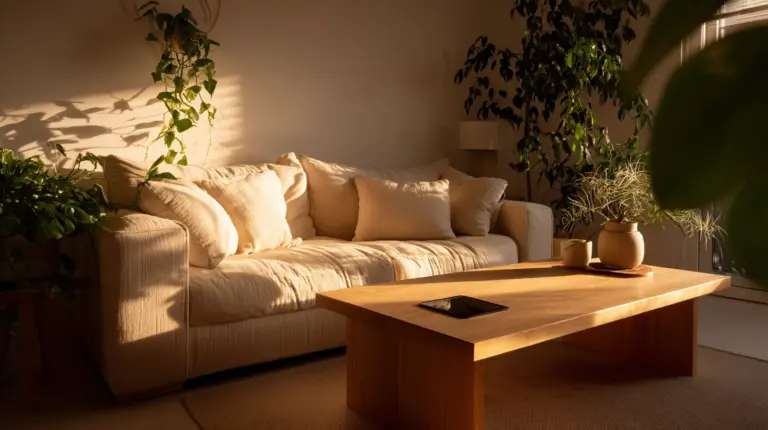
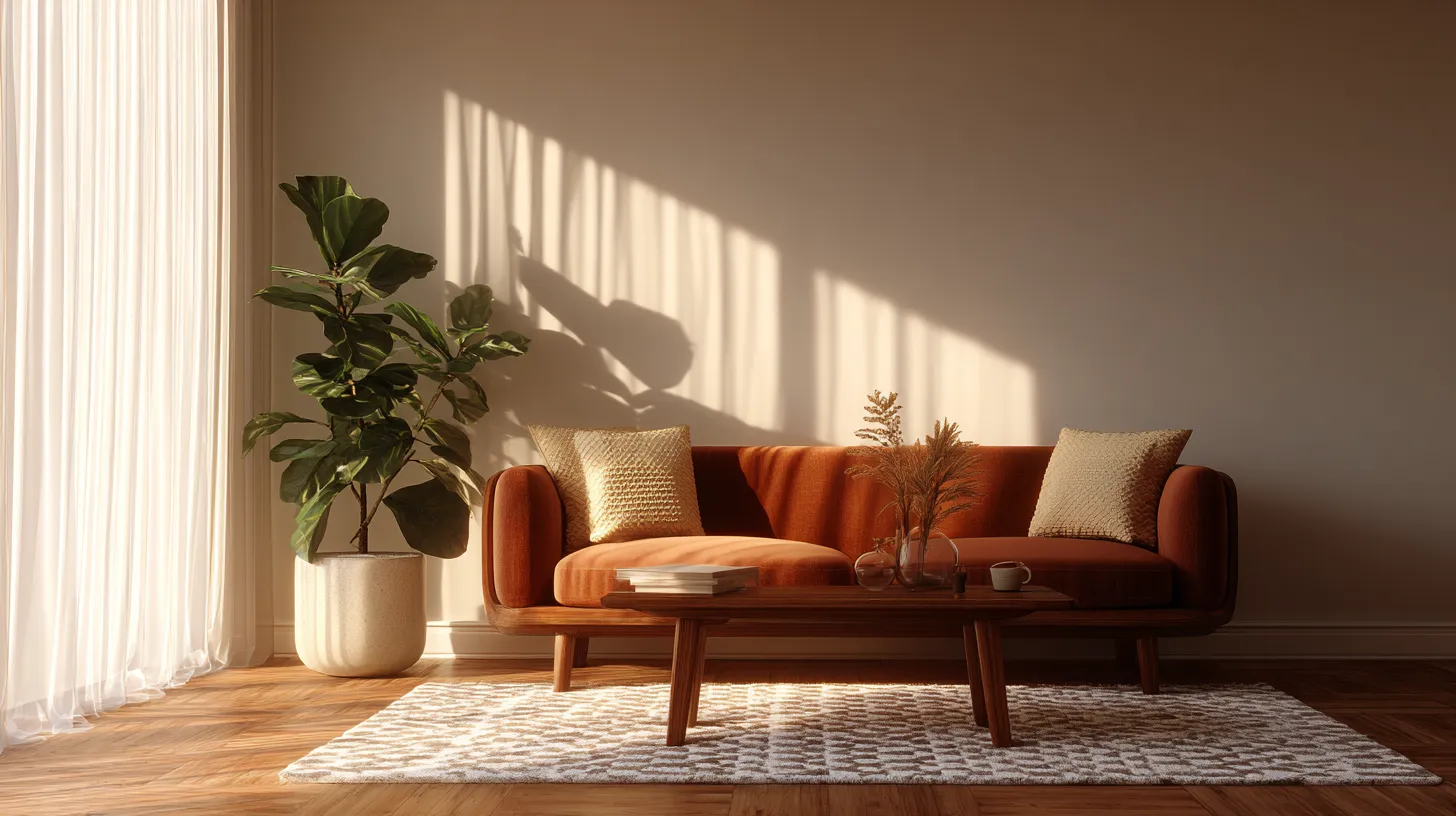
There is something quietly magnetic about a mid-century modern living room. The low-slung silhouettes, the warm walnut grain, the way afternoon light pools on a curved sofa — it feels both timeless and deeply now.
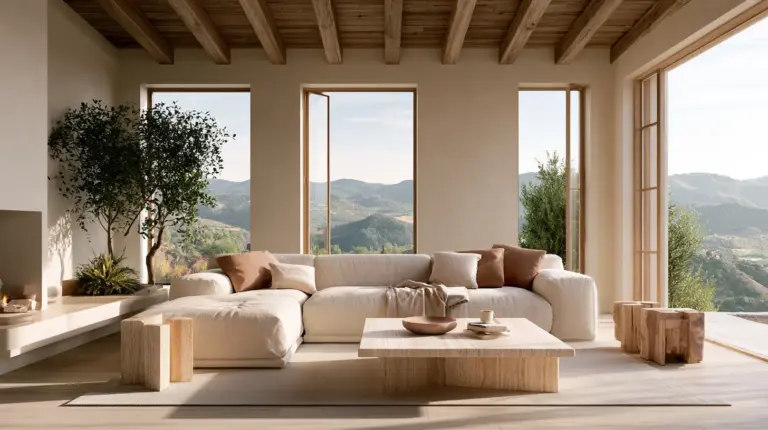
Mid-century modern design, born in the post-war optimism of the 1950s and 60s, never really left. It simply waited for the rest of the world to catch up. Today, it blends effortlessly with Japandi minimalism — that peaceful marriage of Japanese wabi-sabi and Scandinavian hygge — creating something even more livable and serene.
And the best part? You do not need a grand open-plan home or a designer’s budget. Even the smallest room can hold this kind of beauty. We will show you exactly how.
Whether you are renting, decorating on a budget, or working with a compact space, this guide will walk you through every element — furniture, lighting, color, plants, and even a budget breakdown under $500.
What Defines a Mid-Century Modern Living Room
Mid-century modern (MCM) is grounded in a few essential principles: clean lines, organic shapes, functional beauty, and an honest use of materials. Think tapered wooden legs, low-profile seating, geometric accents, and a palette that pulls from nature.
It is not fussy. It is not maximalist. But it is not cold, either. At its best, a mid-century modern living room feels like stepping into a room where someone actually lives — and loves beauty quietly.
The Japandi Connection
Japandi takes mid-century’s love of natural materials and simplifies it even further. The result is a space that breathes: neutral walls, muted earth tones, raw textures, and intentional negative space.
When you layer Japandi restraint over MCM’s warmth — the teak, the amber light, the organic curves — something special happens. The room becomes a sanctuary, not just a style statement.
Color Palettes That Work
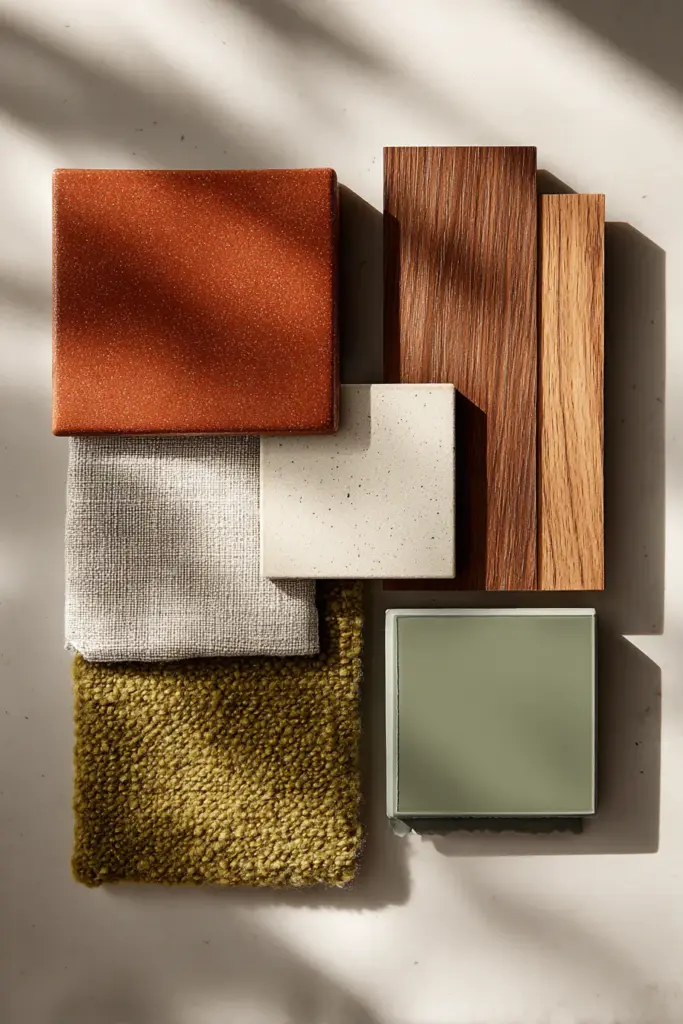
Color is where the mood lives. Mid-century modern leans into a warm, grounded palette that feels rich without being heavy.
Primary palette:
- Warm whites and creamy off-whites (think Benjamin Moore “White Dove” or “Chantilly Lace”)
- Terracotta and burnt sienna for accent walls or cushions
- Olive green, mustard yellow, and rust — the classic MCM triad
- Teak brown and walnut as your natural neutrals
Japandi fusion adjustments:
- Soften mustard to ochre
- Swap bold rust for dusty clay
- Add sage green as a grounding accent
For small rooms, keep walls light and warm — a 3000K warm white paint temperature reads as creamy, not clinical. Save bold color for a single accent wall, a statement rug, or your throw pillows.
Furniture: Low, Warm, and Purposeful
The furniture is the heart of any MCM living room. And in a small space, every piece needs to earn its place.
Sofas and Seating
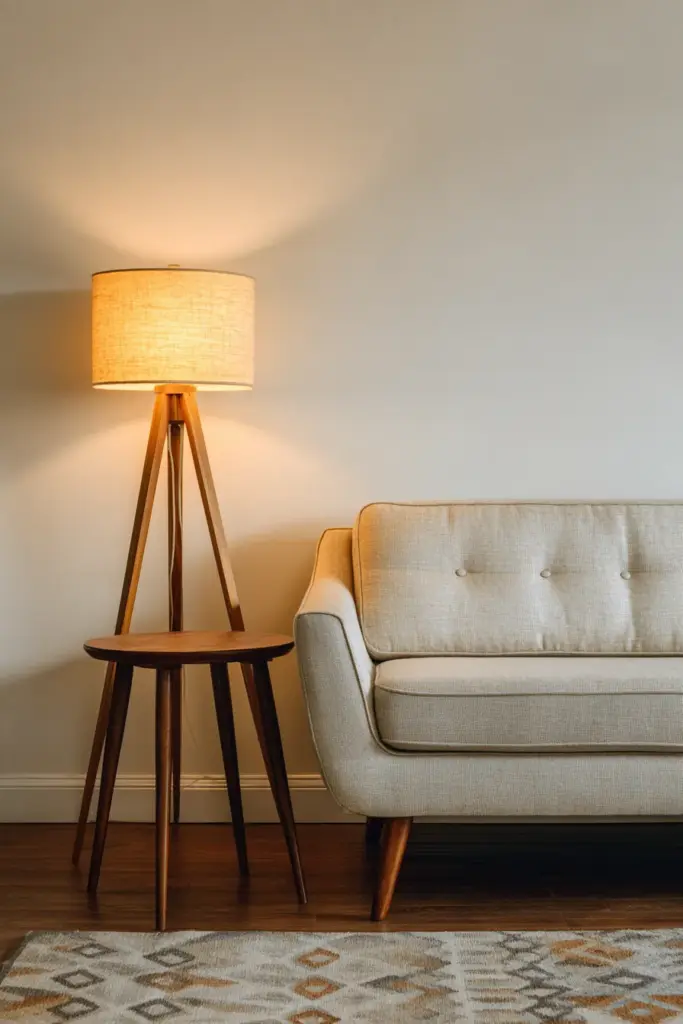
Choose low-profile sofas with tapered legs — the visual breathing room beneath the frame makes the room feel larger. Look for clean, boxy silhouettes in bouclé, linen, or a warm-toned fabric.
Best finds under budget:
| Piece | Retailer | Approx. Price |
|---|---|---|
| Low-profile sofa (2-seater) | IKEA ÄPPLARYD | $650 |
| MCM accent chair | Target (Project 62) | $250 |
| Tapered wood coffee table | Wayfair | $180 |
| Modular shelving unit | IKEA KALLAX | $90 |
For a room under $500, prioritize the coffee table and accent chair — these two pieces carry the most visual MCM weight. Use what you already have for seating and layer with new textiles.
Under $500 MCM Room Starter Kit
| Item | Source | Cost |
|---|---|---|
| Walnut-finish coffee table | Wayfair/Amazon | $180 |
| MCM accent chair | Target Project 62 | $200 |
| Geometric throw rug (5×7) | IKEA / Ruggable | $60 |
| Tapered lamp with warm bulb | Amazon | $40 |
| Linen throw + 2 cushions | H&M Home | $35 |
| Total | ~$515 |
Swap the accent chair for a secondhand find and you land comfortably under $500.
DIY: Upcycle Your Furniture the MCM Way
You do not need to buy new to achieve this look. Some of the most beautiful MCM rooms are built on smart upcycling.
Refinish a coffee table in 20 minutes:
- Sand lightly with 220-grit sandpaper
- Wipe clean with a damp cloth and let dry
- Apply one coat of Minwax “Dark Walnut” stain with a foam brush
- Let sit for 5 minutes, then wipe off the excess
- Seal with a matte polyurethane for durability
Swap sofa legs for tapered wood ones: Most sofas have removable legs. Replacement tapered walnut legs are available on Etsy for $30–$60 for a set of four. This single change transforms a generic sofa into something that reads unmistakably mid-century.
Lighting: The Layer That Changes Everything
Lighting is where most people stop too early. A single overhead fixture is not enough — not for a room that wants to feel warm and alive.
The Three-Layer Method
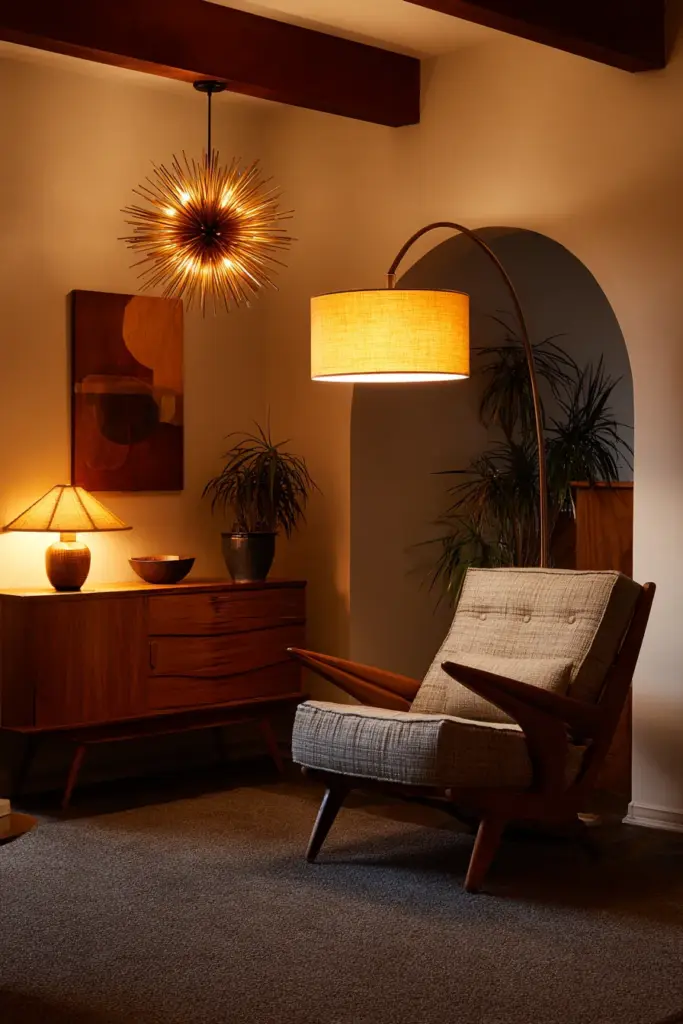
Layer 1 — Ambient (ceiling): A statement pendant or Sputnik chandelier at 3000K warm white. This casts even, golden light and anchors the room’s MCM identity.
Layer 2 — Task (floor lamp): A tripod floor lamp or arched lamp at 2700K — slightly warmer, more amber. Position it beside your reading chair for a halo of coziness.
Layer 3 — Accent (table lamp): A low ceramic or brass table lamp at 3000K on a side table or console. This layer does the most emotional work — it is the glow that makes a room feel like home.
Avoid cool white bulbs (4000K+) entirely. They strip warmth from wood tones and flatten the textures that make MCM rooms beautiful.
Rugs: Grounding the Space
A rug is not just floor covering — it defines the room’s footprint and ties every element together.
For MCM spaces, look for:
- Geometric patterns — diamonds, chevrons, abstract shapes in muted tones
- Natural fibers — jute, wool, or a wool-blend for texture underfoot
- Low pile — keeps the visual field clean and low-profile
In a small room, go larger than you think you need. A 5×8 or 6×9 rug that tucks under the front legs of the sofa creates a cohesive “zone” that makes the room feel intentional and grounded.
Plants: The Living Layer
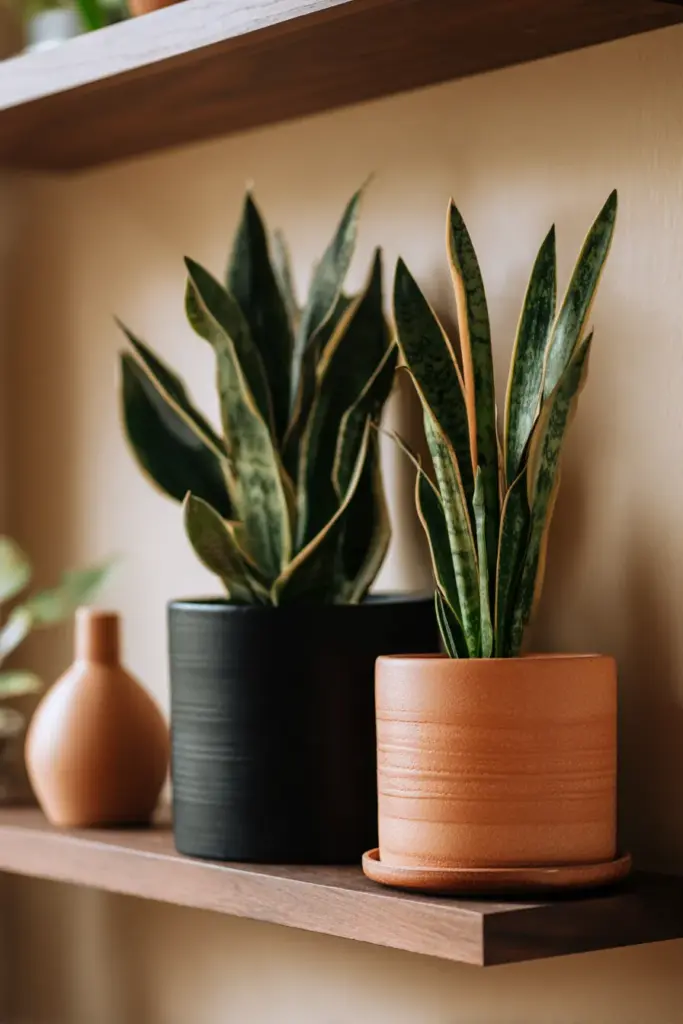
Plants and mid-century modern design were made for each other. The organic forms of a rubber tree or fiddle-leaf fig echo the curves of MCM furniture in the most natural way.
Best MCM Plants + Care Guide
| Plant | Light | Water | Pet Safety |
|---|---|---|---|
| Snake plant | Low to bright indirect | Monthly | Safe for pets |
| Rubber tree | Bright indirect | Every 1–2 weeks | Mildly toxic |
| Fiddle-leaf fig | 6+ hours bright indirect | Weekly | Toxic to pets |
| Pothos | Low to medium | Every 1–2 weeks | Mildly toxic |
| ZZ plant | Low light | Every 2–3 weeks | Toxic to pets |
If you have pets, snake plant and pothos are your safest choices. The fiddle-leaf fig, despite being a MCM icon, is toxic to cats and dogs — keep it elevated or choose a rubber tree instead.
Styling Your TV and Media Console
The television is the elephant in the mid-century modern room. But it does not have to break the aesthetic.
Choose a media console with clean lines and tapered legs — teak-finish options at IKEA (BESTÅ with wood legs) or Wayfair work beautifully. Keep it low-profile, in line with MCM’s floor-hugging philosophy.
Hide cables using a fabric cable sleeve or routing them through the wall. Nothing disrupts the MCM calm faster than a cascade of black cords.
Consider the Samsung Frame TV — when not in use, it displays artwork and reads as a framed canvas. In a Japandi-MCM space, this integration feels completely intentional.
Sustainable Materials: Beauty With Integrity
Sustainability is rarely discussed in MCM guides — but it should be. Teak and walnut are the backbone of this style, and sourcing matters.
What to look for:
- FSC-certified teak — ensures responsibly harvested wood
- GREENGUARD-certified paints and finishes — low VOC, safer for indoor air quality
- Reclaimed walnut — available through local sawmills or specialty furniture shops; each piece carries unique grain and history
For buyers in the Philippines — particularly in humid regions like Silang, Calabarzon — teak is an excellent choice precisely because of its natural oil content, which resists moisture and humidity. Treat teak furniture annually with teak oil to maintain its color and prevent drying in tropical conditions.
Avoid untreated pine or MDF veneer pieces in high-humidity spaces; they swell, warp, and lose their finish quickly.
Renter-Friendly MCM Solutions
Living in a rental does not mean surrendering your design vision. These changes require no nails, no painting, and no landlord permission.
- Peel-and-stick wallpaper in warm terracotta or geometric MCM prints — transforms an accent wall in an afternoon
- Removable adhesive shelving (Command strips, IKEA LACK wall shelf with removable strips) for displaying ceramics and books
- No-drill curtain rods — tension rods or adhesive hooks let you hang linen curtains that add warmth and height
- Area rugs over existing flooring — instantly define and warm any space
- Furniture with removable/swappable legs — no modifications, full MCM look
Key Takeaways: Your MCM Checklist
- Choose a warm, neutral palette — creamy whites, terracotta, ochre, olive
- Anchor the room with a low-profile sofa and tapered-leg coffee table
- Layer lighting in three levels: 3000K ceiling, 2700K floor lamp, 3000K table lamp
- Use a geometric rug larger than you think you need
- Add one or two plants — snake plant and rubber tree are low-maintenance and beautiful
- Source FSC-certified teak or reclaimed wood where possible
- In humid climates (like Calabarzon, PH), maintain teak with annual oiling
- Renters: use peel-and-stick wallpaper, removable shelves, tension rod curtains
- Style your media console low and hide cables for seamless MCM integration
- Try a $30 DIY leg swap or walnut stain refresh before buying new
Closing
A mid-century modern living room is not about perfection. It is about intention — choosing things that are beautiful and made to last, arranging them with care, and leaving room for light to move through.
You do not need a big space. You do not need a big budget. You need a quiet eye and a willingness to slow down and choose well.
That is the ERYLIN way. And it will always be in style.
Frequently Asked Questions
What defines a mid-century modern living room?
A mid-century modern living room is defined by clean lines, low-profile furniture with tapered wooden legs, organic shapes, and a warm palette of teak, walnut, terracotta, and mustard. The style, rooted in 1950s–60s design, balances functional simplicity with warmth and natural materials.
What colors are best for a mid-century modern living room?
Warm off-whites, creamy neutrals, and earth tones work best. Accent with terracotta, mustard yellow, olive green, and rust. For small rooms in the Japandi-MCM style, keep walls light and warm (3000K paint temperature equivalents) and reserve bold tones for cushions and rugs.
How do I decorate a small mid-century modern living room?
Choose low-profile furniture with tapered legs to create visual space. Use a larger rug to ground the room, add mirrors to bounce light, and keep clutter minimal. A Japandi-MCM fusion — neutral palette, natural textures, intentional negative space — works beautifully in compact rooms.
What plants work best in a mid-century modern living room?
Snake plants, rubber trees, pothos, and ZZ plants all complement MCM aesthetics. If you have pets, stick with snake plants and pothos — they are the safest choices. Fiddle-leaf figs are an MCM classic but are toxic to cats and dogs, so place them out of reach or choose an alternative.
Can you mix mid-century modern with other styles?
Absolutely. The most livable MCM rooms today blend the style with Japandi minimalism — borrowing clean lines, neutral palettes, and natural materials from both traditions. You can also layer in eclectic touches: a woven basket, a vintage ceramic, a printed linen cushion. The key is restraint — let each piece breathe.