
Table of Contents
By ERYLIN — Home Décor & Interior Styling
There is something quietly powerful about a room that tells a story. Not the kind you frame on a wall, but the kind you feel — in the weight of a hand-loomed textile, the flicker of a lantern at dusk, the earthy scent of a clay pot holding a trailing plant.
Modern living rooms are no longer defined by a single aesthetic. The most soulful spaces today draw from many worlds — a Japanese cedar tray here, a Moroccan wool cushion there, a Ghanaian kente runner anchoring the whole scene. This is the beauty of global influences in interior design: they let your home speak many languages at once.
And here is the part no one is saying loudly enough: you do not need a large home or a large budget to do this well. Some of the most beautiful globally-inspired living rooms belong to studio apartments and rented flats. With the right approach, a few intentional pieces can transform even the smallest space into something deeply felt.
This guide is your companion through all of it — from Japandi-Moroccan fusion to budget-conscious sourcing, renter-friendly styling, and the living room lighting that makes every cultural piece glow.
Why Global Influences Are Reshaping the Modern Living Room
Design has always followed curiosity. As more of us travel, connect globally, and grow more conscious of craftsmanship, our homes are reflecting that wider world.
Global interior design isn’t about collecting souvenirs or decorating with a theme. It’s about bringing in living traditions — the geometry woven into a Berber rug, the negative space honoured in a Japanese shoji screen, the colour rituals embedded in Indian block-print textiles. These are not trends. They are stories made tangible.
The modern living room benefits from this depth. A neutral base with one or two globally-sourced anchor pieces feels grounded, worldly, and quietly original.
The Japandi-Global Fusion: Where Minimalism Meets Warmth
What Is Japandi, and Why Does It Work with Global Elements?
Japandi blends Japanese minimalism with Scandinavian hygge — clean lines, natural materials, purposeful restraint. It prizes wabi-sabi, the Japanese philosophy of finding beauty in imperfection and simplicity.
On its own, Japandi can feel cool. But when you layer in a single Moroccan wool throw or a hand-embroidered Indian cushion, the whole room softens. The contrast is what makes it sing.
How to Build a Japandi-Global Living Room
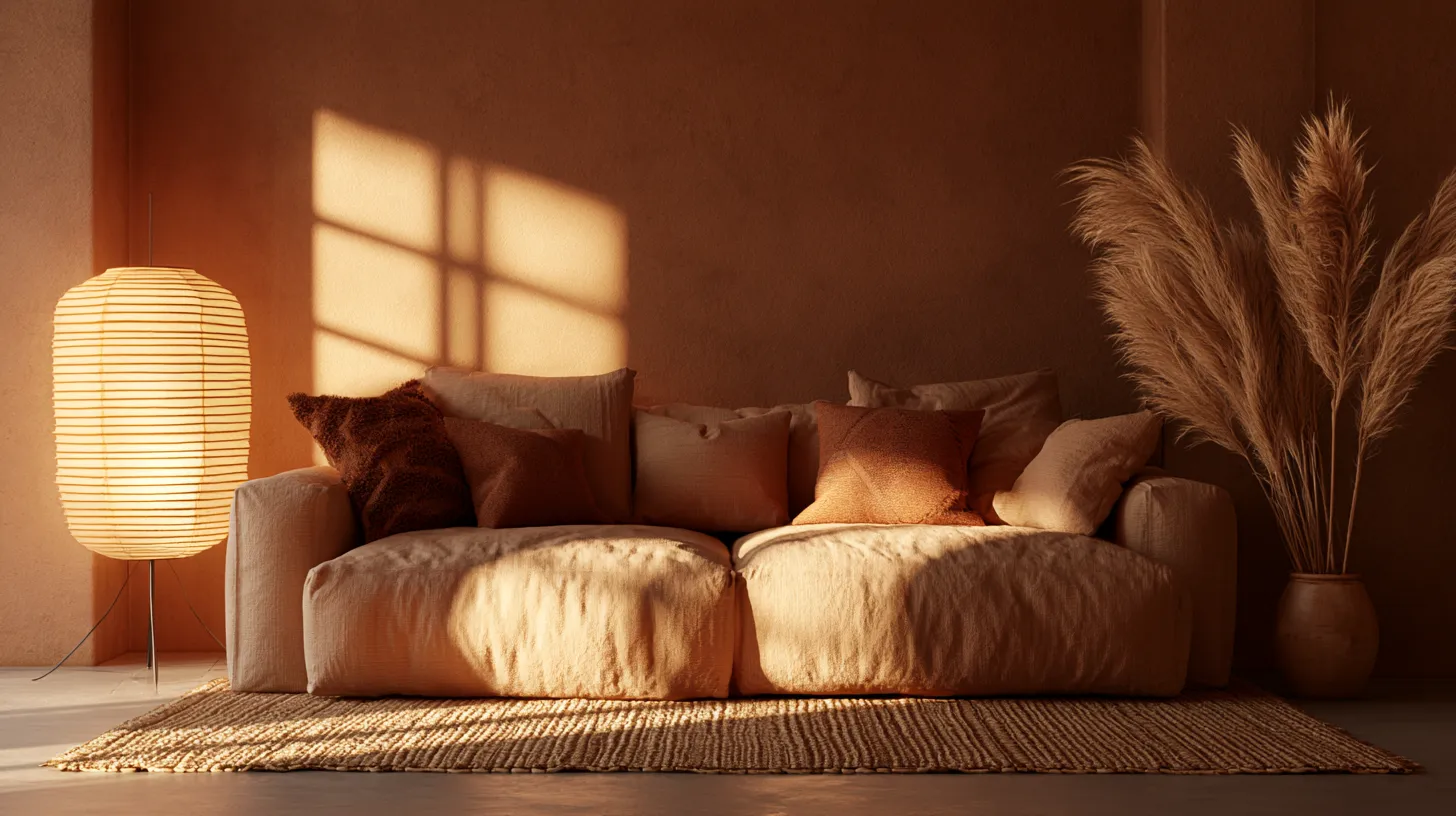
Start with a low-profile Japanese-inspired sofa in a warm linen or natural cotton. Keep the colour palette close to the earth — cream, warm sand, soft terracotta, muted sage.
Then bring in one vibrant global accent. A deep indigo Moroccan cushion. A rust-orange Ghanaian kente throw folded over the armrest. A hand-thrown ceramic bowl from a local artisan placed on a cedar tray. One piece. Let it breathe.
Complete the look with a natural fibre rug — jute, seagrass, or a low-pile wool flatweave — and a simple Japanese paper floor lamp that casts soft, diffused light across the room.
The Wabi-Sabi Approach to Global Collecting
Not everything needs to match. In fact, the beauty of wabi-sabi is that it celebrates variation — a slightly uneven edge, a faded textile, a handmade irregularity. This makes it the perfect philosophy for mixing global pieces without the fear of “getting it wrong.”
Collect things that move you. Trust that they will find their harmony in your space.
Small Space, Global Soul: Styling for Apartments and Compact Rooms
The Myth That Global Décor Requires Space
Most design articles feature sprawling open-plan living rooms. But the truth is, global influences work especially well in small spaces — because they add depth, texture, and story without requiring square footage.
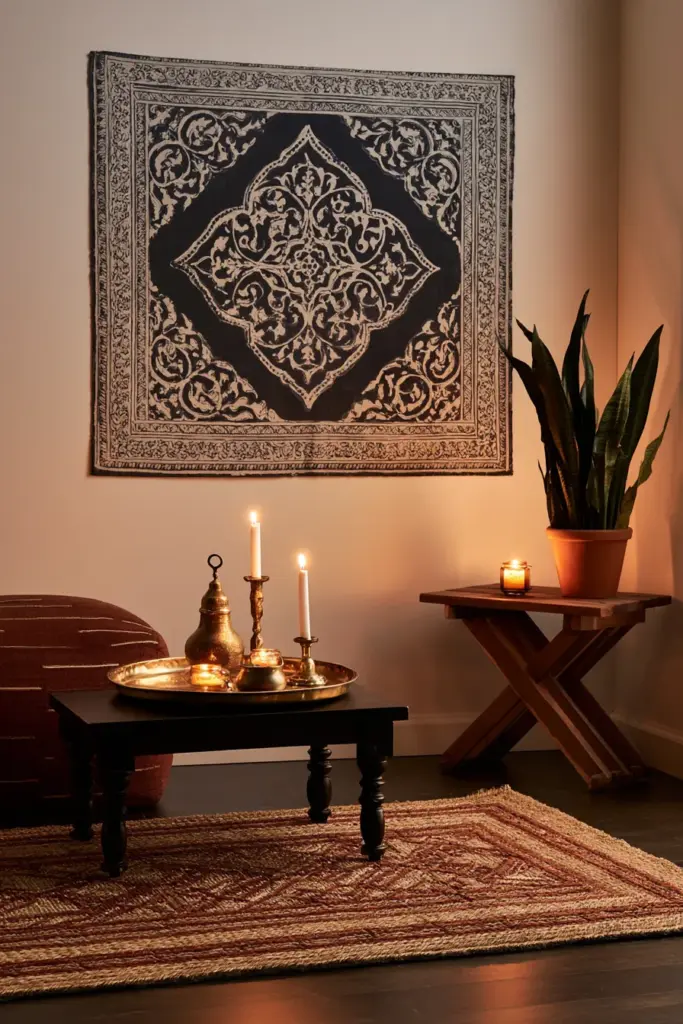
A single wall-mounted Moroccan tapestry can make a compact room feel richly layered. A folding Moroccan side table — cedar wood inlaid with geometric patterns — pulls double duty as both function and art, and tucks away when not needed.
Small-Space Global Styling Ideas
- Hang a hand-block-printed Indian textile as wall art instead of framing a print. It adds warmth, texture, and colour all at once.
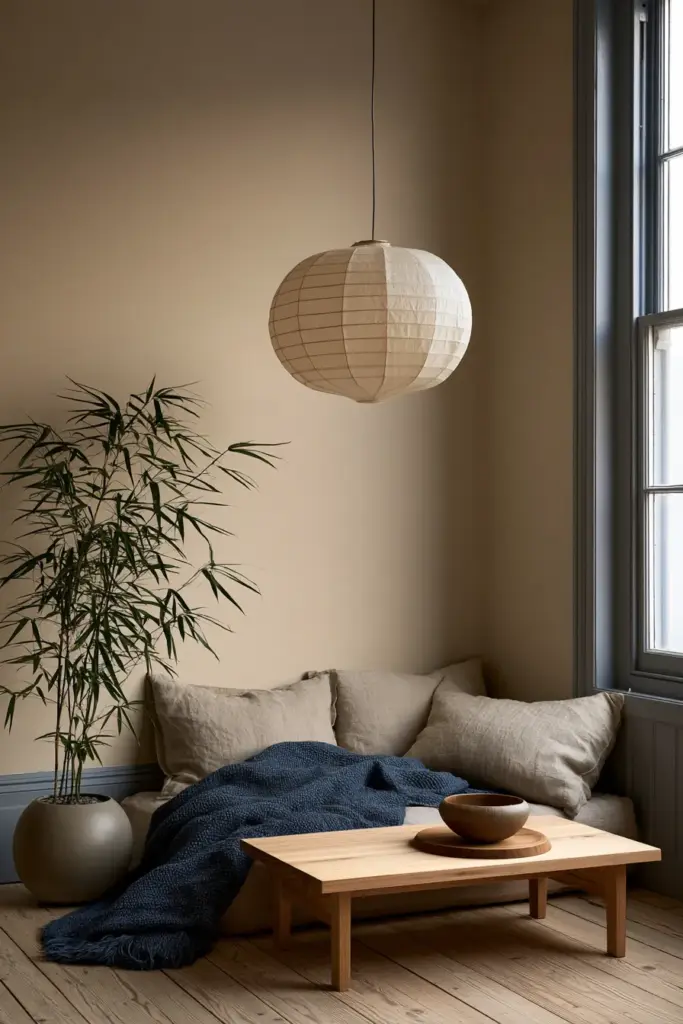
- Use a slim Japanese paper lantern or pendant lamp to draw the eye upward and create the illusion of height.
- Layer two small globally-inspired cushions on a neutral sofa rather than investing in large furniture pieces.
- Place a compact Moroccan brass tray on a coffee table or floor cushion as a styling vignette — candles, a small plant, a found object.
- Choose a small seagrass or flatweave rug with global geometric motifs to anchor the space without overwhelming it.
Global Influence Placement in Small Rooms
| Element | Placement | Effect |
|---|---|---|
| Moroccan wool cushion | Sofa corner | Texture + colour anchor |
| Japanese paper lamp | Floor or hanging | Soft, diffused ambient glow |
| Indian block-print throw | Draped over armchair | Warmth + pattern |
| Woven wall textile | Empty wall above sofa | Visual height + story |
| Moroccan brass tray | Coffee table centre | Styled vignette focal point |
| Geometric flatweave rug | Under coffee table | Grounding pattern |
Budget-Conscious Global Sourcing: Beauty Without the Expense
The Secret the Design World Doesn’t Tell You
Beautifully curated global living rooms are not always expensive ones. The curation is what costs nothing — the eye, the intention, the patience to find one perfect piece rather than filling a room quickly.
Here is how to source globally without overspending.
Where to Find Global Décor on a Budget
Secondhand and marketplace finds are some of the richest sources for globally-inspired pieces. Facebook Marketplace, thrift stores, and estate sales regularly surface vintage Turkish rugs, Indian brass pieces, and handwoven textiles at a fraction of retail prices. The imperfection that comes with age only adds to their beauty.
DIY adaptations let you achieve the feeling of a global piece with a modern budget. Moroccan tile-inspired patterns can be recreated with removable peel-and-stick tiles — perfect for a fireplace surround or a kitchen backsplash. A $20 Indian cotton throw styled well reads as intentional and elevated.
Local ethnic markets and artisan fairs are often overlooked as design sources. A hand-thrown ceramic piece from a local artist inspired by Japanese pottery traditions costs far less than an imported original — and supports your local creative community.
Budget Global Décor: Approximate Cost Guide
| Global Element | Budget Option | Approximate Cost |
|---|---|---|
| Turkish-inspired rug | Secondhand vintage flatweave | $30–$80 |
| Moroccan lantern | Local homeware or marketplace find | $15–$40 |
| Indian block-print throw | Cotton throw, marketplace or discount retailer | $15–$30 |
| Japanese paper lamp | Flat-pack pendant lamp | $20–$50 |
| Moroccan-style side table | Folding cedar replica, online marketplaces | $40–$90 |
| Woven wall textile | Secondhand market or DIY loom weaving | $10–$50 |
Renter-Friendly Global Décor: No Drilling Required
Styling Without Permanent Changes
Renting a home should never mean sacrificing beauty. The best renter-friendly global décor is portable, layerable, and reversible — it transforms a space completely, and leaves no trace when you go.
This is actually a gift in disguise. It teaches you to style with intention rather than permanence.
Renter-Friendly Global Styling Strategies
- Non-adhesive tapestry hanging: Use tension rods, curtain clips, or decorative wooden dowels to hang global textiles without putting a single hole in the wall.
- Removable Moroccan tile panels: Peel-and-stick tile sheets in classic Moroccan patterns are available online and lift cleanly from most surfaces.
- Portable Japanese paper lamps: Floor-standing paper lanterns need no installation at all — place them in a corner, plug them in, and the room transforms.
- Layered rugs: Place a globally-patterned rug over a neutral base rug to ground the space and protect the flooring beneath.
- Freestanding cultural displays: A bamboo shelf, a cedar tray, a woven basket — create styled vignettes on existing furniture without touching the walls.
Lighting the Global Living Room: The Psychology of Warmth
Why Lighting Is the Most Overlooked Global Element
You can have the most beautifully sourced Moroccan rug, the most exquisite Indian embroidered cushion, and the most elegant Japanese ceramic — and cold, harsh lighting will flatten every single one of them.
Lighting sets the mood of a globally inspired room more than almost any other element. It is the invisible layer that makes everything else come alive.
The Right Colour Temperature for Global Spaces
Aim for warm white light between 2700K and 3000K. This colour temperature mimics candlelight and golden-hour sunshine — it enriches terracotta tones, deepens indigo textiles, and makes wooden surfaces glow.
Avoid cool white or daylight bulbs (4000K and above) in a globally-inspired living room. They strip warmth from natural materials and make handcrafted pieces look flat.
Layered Lighting for a Global Living Room
The most inviting global spaces use three layers of light working together.
Ambient light provides the base — a ceiling fixture, a pendant, or a floor lamp that fills the room softly. A Japanese washi paper pendant shade is a beautiful choice here; it diffuses light evenly and casts a warm, even glow.
Accent lighting highlights your global pieces. A small spotlight aimed at a wall textile, or a candle placed near a Moroccan lantern, draws the eye to the things that matter most.
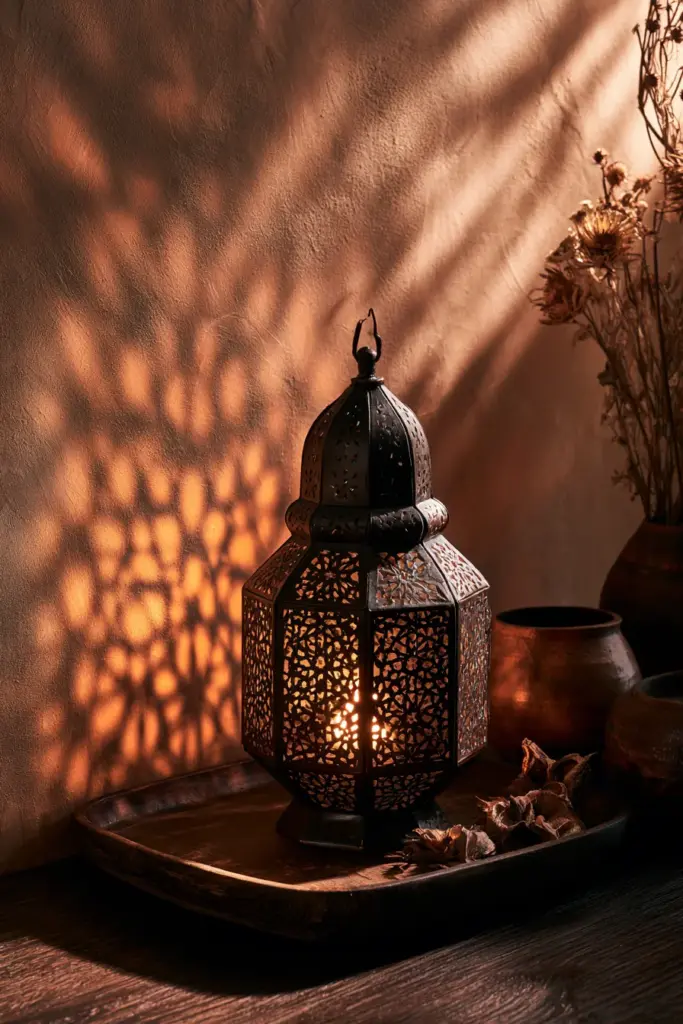
Moroccan lanterns deserve their own mention. Their pierced metalwork throws intricate shadow patterns across walls and ceilings, creating the kind of atmospheric layering that no other light source replicates. Place one on a floor tray or hang it in a corner for maximum effect.
Bringing Nature In: Plants and Global Aesthetics
Biophilic Design Meets World Traditions
Global design traditions have always honoured the natural world — from the Japanese practice of ikebana (the art of flower arrangement) to the Mediterranean tradition of courtyard olive trees to the West African reverence for living materials.
Bringing plants into your globally-influenced living room is not just aesthetic. It connects your space to something older and deeper.
Plants That Complement Global Styles
- Snake plant (Sansevieria): Its architectural uprightness pairs beautifully with Moroccan tiles and geometric textiles.
- Bamboo in a ceramic pot: A natural companion to Japanese and East Asian-inspired spaces.
- Trailing pothos or monstera: Their lushness complements the maximalist warmth of Indian or African-influenced interiors.
- Olive tree in a terracotta pot: The perfect anchor for a Mediterranean or Moroccan-inspired living room corner.
- Dried pampas grass or eucalyptus: Understated and elegant alongside Japandi or Scandinavian-global fusion aesthetics.
Sourcing with a Conscience: Ethical and Sustainable Global Décor
The Question Behind Every Beautiful Object
Every handcrafted piece carries a story — and sometimes, that story includes exploitative supply chains, underpaid artisans, or unsustainable practices. The most beautiful globally-influenced living room is one built with awareness.
Ethical sourcing does not mean limiting your choices. It means making them more meaningful.
How to Source Global Décor Ethically
Look for fair-trade certification when purchasing Moroccan rugs, Indian textiles, or African crafts. Fair-trade brands ensure artisans receive fair wages and work in safe conditions.
Support direct artisan platforms — marketplaces that connect buyers directly with makers in Morocco, India, Ghana, Japan, and beyond. The price point is often similar to mainstream retailers, but the impact is entirely different.
When purchasing online, check for sustainable shipping practices — carbon-neutral options, minimal plastic packaging, and brands that plant trees or offset emissions.
When possible, buy locally made interpretations of global styles. A local ceramicist inspired by Japanese forms, or a local weaver working with African geometric patterns, supports your community while honouring the global tradition.
Smart Home Meets Global Aesthetic
Hidden Technology, Visible Beauty
A globally-inspired living room does not have to sacrifice modern convenience. The key is concealment — integrating smart technology in ways that honour the aesthetic rather than disrupting it.
Tuck a smart speaker inside a woven Moroccan basket on a shelf. Use voice-controlled Japanese paper lamps that dim to your preferred warm setting. Choose smart curtains in a globally-inspired textile pattern that opens and closes with a gentle command.
The goal is a home that feels ancient and alive — and quietly, invisibly, very much of the present.
Your Global Living Room Checklist
- Choose a neutral base — walls, sofa, and rug in warm cream, sand, or soft grey
- Select one or two anchor global pieces — a rug, a textile, a lantern, a ceramic object
- Layer texture over colour — prioritise handmade, natural materials
- Use warm white lighting at 2700K–3000K; add a Moroccan lantern for atmosphere
- Incorporate one or two plants that complement your chosen global style
- For small spaces, choose wall-mounted textiles, folding furniture, and compact vignettes
- For renters, use tension rods, peel-and-stick tiles, and freestanding displays
- Source secondhand, fair-trade, or from local artisans where possible
- Integrate smart technology discreetly inside natural, handcrafted vessels
- Trust the wabi-sabi principle — imperfection and variation are the point
Conclusion
A globally-influenced living room is not a project you complete. It is a space you grow into — slowly, tenderly, one found object at a time.
You do not need to visit every continent or spend a fortune to bring the world into your home. You need only to look with intention, choose with care, and trust that beauty is not the property of the wealthy or the widely-travelled.
It belongs to anyone willing to sit quietly with a single handmade thing and let its story become part of theirs.
At ERYLIN, we believe your home is your most personal form of expression. Let it speak with warmth, depth, and the quiet confidence of a space that knows exactly who it is.
Frequently Asked Questions
How do I incorporate global influences into my living room without it looking cluttered?
Start with a neutral base — walls, sofa, and flooring in calm, natural tones — and introduce global elements one at a time. Choose pieces with intention: one rug, one textile, one ceramic object. Restraint is what gives each piece room to breathe and be noticed.
Can I do global decor in a small apartment?
Absolutely. Small spaces often benefit most from global influences because a single well-chosen piece — a wall-hung textile, a Moroccan lantern, a Japanese floor lamp — creates enormous impact without requiring scale. Focus on vertical styling, folding furniture, and layered textiles rather than large statement pieces.
What are the best global decor elements for a modern living room?
A Turkish or Moroccan flatweave rug, an Indian block-print throw, a Japanese washi paper pendant lamp, a hand-thrown ceramic bowl, and a woven basket or tray are all versatile global pieces that work beautifully in modern interiors without overwhelming the space.
How do I mix Moroccan, Japanese, and Scandinavian styles without clashing?
Ground the room in a Scandinavian-style neutral palette — warm whites, soft linens, natural wood. Layer in Japanese elements through furniture silhouette and lighting (low-profile, simple, natural materials). Then introduce Moroccan warmth through textiles, lanterns, and geometric pattern. The neutral base is what allows the three traditions to coexist gracefully.
Where can I find affordable global decor on a budget?
Secondhand marketplaces (Facebook Marketplace, thrift stores, estate sales) are excellent sources for vintage rugs, brass pieces, and handwoven textiles at low prices. Ethnic markets and artisan fairs often offer handmade global pieces at accessible price points. DIY adaptations — such as peel-and-stick Moroccan tile sheets or hand-dyed Indian cotton throws — can achieve the same visual warmth at a fraction of the cost.