
Table of Contents
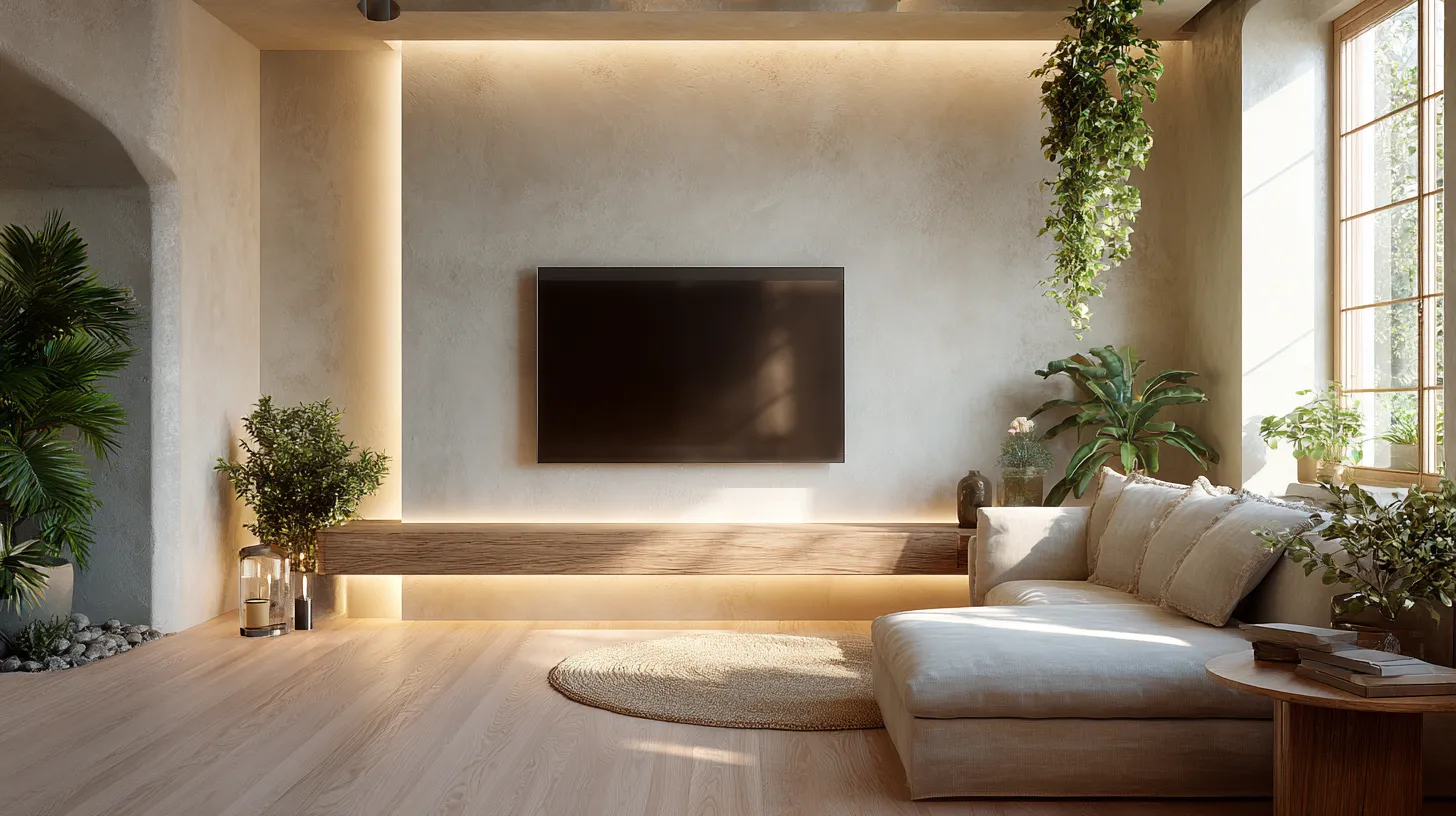
There’s something quietly magical about a living room that feels both lived-in and intentional. The soft warmth of a linen sofa, the grounding scent of wood, the glow of a screen nestled into a wall that was clearly designed with love — this is the room where your family exhales at the end of the day.
The television has long been the centerpiece of the living room, yet it’s also the one element that designers wrestle with most. How do you make something so utilitarian feel beautiful? How do you let it anchor the space without overwhelming it?
At ERYLIN, we believe the modern living room TV is not a problem to be solved — it’s an opportunity. It’s a chance to play with texture, proportion, lighting, and storage in ways that reflect your personal style and the quiet rhythms of your home.
Whether you’re working with a compact condo in Manila, a rented apartment you can’t drill into, or a spacious family sala you’re ready to transform — this guide is for you.
Small Living Room TV Layouts: Working With What You Have
Small spaces reward intention. When every centimetre matters, your TV layout choices become your design strategy.
The golden rule: viewing distance equals 1.5 to 2.5 times your TV’s screen size. A 43-inch TV works beautifully at 1.6 to 2.7 metres away. A 55-inch needs at least 2 metres of breathing room.
TV Size vs. Room Dimensions Guide
| TV Size | Ideal Viewing Distance | Best For |
|---|---|---|
| 32 inches | 1.2 – 1.6 m | Bedroom, studio, small nook |
| 43 inches | 1.6 – 2.7 m | Small living room, condo |
| 55 inches | 2.1 – 3.4 m | Medium sala, open-plan |
| 65 inches | 2.5 – 4.0 m | Spacious family living room |
In a small room, resist the urge to go bigger. A well-placed 43-inch screen with a low floating console beneath it will feel far more composed than an oversized TV that crowds the wall.
Mounting height matters too. The centre of your screen should sit at eye level when you’re seated — roughly 100 to 130 cm from the floor for most sofa heights. Mounting too high strains your neck and disrupts the natural sightline of the room.
For tight spaces, consider a slim wall mount with a floating console at knee height. This lifts the eye, creates a sense of airiness, and leaves floor space open — making even a small room feel uncluttered and calm.
Japandi TV Wall Design: The Art of Quiet Minimalism
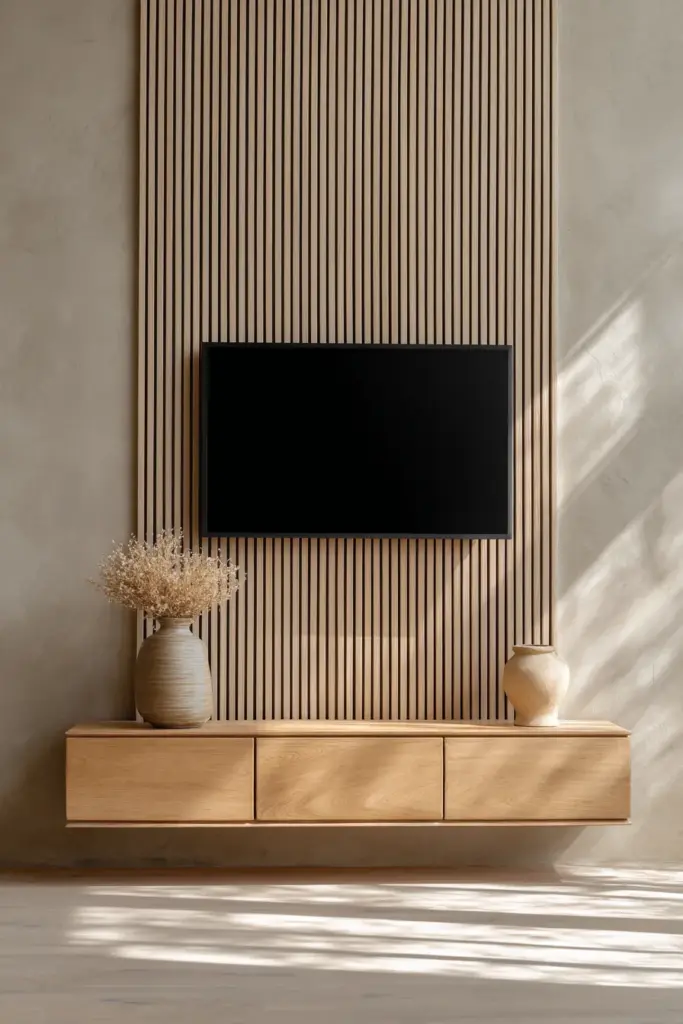
Japandi — the beautiful meeting of Japanese wabi-sabi and Scandinavian hygge — is perhaps the most soulful aesthetic for a modern living room TV wall. It asks for restraint, for natural materials, and for every element to earn its place.
Think light ash wood panels, a wall-mounted screen with no visible cables, a low teak console with closed storage, and nothing more. The beauty is in what you leave out.
Materials and Textures for a Japandi TV Wall
- Light wood tones: ash, oak, or bamboo for the TV console or backdrop panel
- Matte plaster or clay-finish walls: in warm white, greige, or soft sage
- Linen or jute textiles nearby — a throw, a cushion, a small woven basket
- Stone or ceramic accents: a small vase, a tray, a candle in matte black
The Japandi TV wall does not rely on gallery walls or maximalist styling. Instead, it uses negative space as a design element. Leave the wall around the TV intentionally bare. Let the texture of the wood or plaster do the quiet work.
For cable management in a Japandi setup, an in-wall cable conduit is the gold standard — a single slim channel runs from the TV down to the console, painted to match the wall, and disappears entirely. If you’re in a rental, a paintable cable raceway in the same tone as your wall achieves nearly the same result without a single drill hole.
Hidden Storage in a Japandi Console
The best Japandi TV consoles have closed-door storage for streaming devices, routers, game consoles, and remotes. Choose a console with solid panel doors rather than glass — it keeps visual noise to a minimum and maintains that sense of serene, unbroken calm.
Cable Management: The Detail That Changes Everything
No matter how beautiful your TV wall, exposed cables can undo it completely. Cable management is the unsung hero of a polished living room — and yet it’s the detail most guides skip over entirely.
Here are your four best options, from most seamless to most accessible:
Option 1: In-Wall Cable Conduit (Best for Owned Homes)
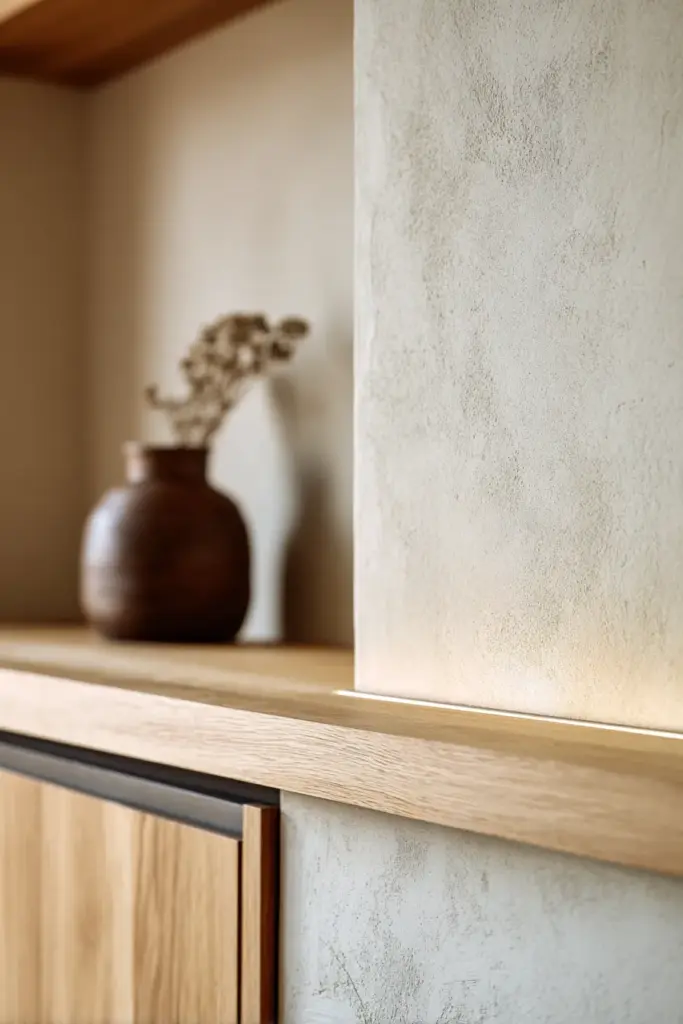
A licensed electrician runs a conduit behind the drywall, feeding cables from the TV mount down to an outlet or console. It’s the cleanest solution — completely invisible, permanent, and professional. Cost in the Philippines typically ranges from ₱1,500 to ₱4,000 for the labour and materials.
Option 2: Paintable Cable Raceway (Best for Renters)
A slim plastic channel adheres to the wall using removable adhesive strips. Paint it the exact colour of your wall. From any normal viewing distance, it vanishes. Available at hardware stores and on Shopee for ₱150 to ₱600 per strip.
Option 3: Under-Console Cable Routing
Use velcro cable ties and adhesive cable clips to run all cords neatly along the back and underside of your TV console. Group cords by device, bundle them together, and attach them to the console frame so they never pool on the floor.
Option 4: Wireless and Cable-Free Tech
A soundbar with wireless rear speakers, a streaming stick plugged directly into the TV’s USB port, and a WiFi-enabled router tucked inside your console can reduce visible cables to nearly zero. Pair with a smart power strip for clean, single-cord management.
Budget DIY TV Wall Under ₱5,000: Beautiful on Any Budget
You do not need a renovation budget to create a TV wall that feels designed. Some of the most serene and considered living rooms we’ve seen at ERYLIN were built with resourcefulness and patience — not money.
DIY Wood Slat Backdrop
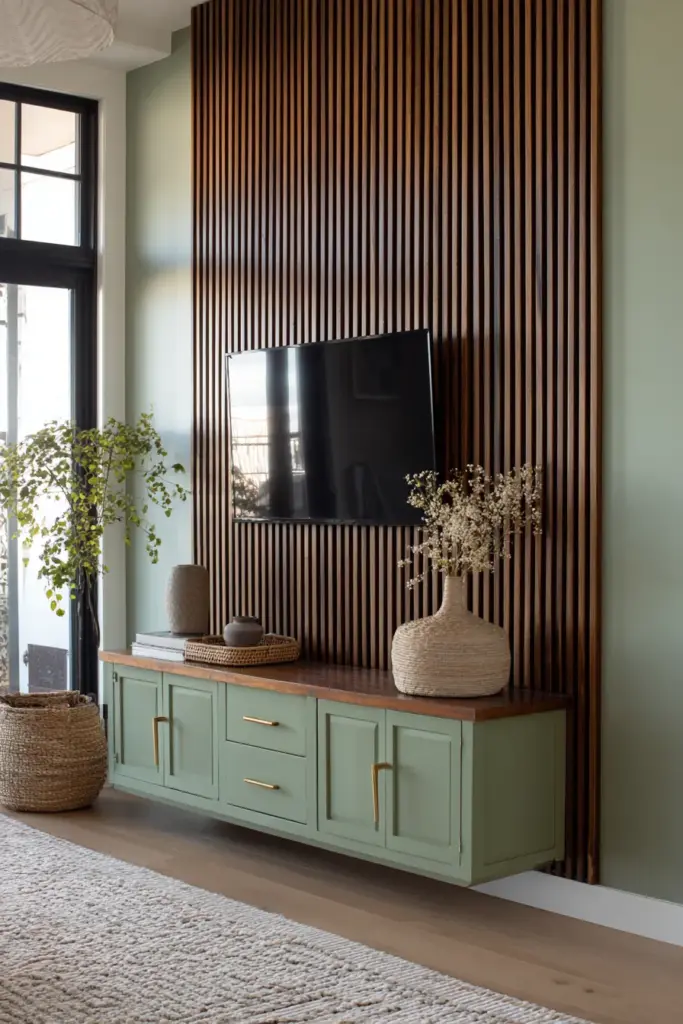
Cut thin strips of pine or finger-jointed wood (available at Cebu Lumber, True Value, or your local hardware store) to equal lengths. Sand lightly, stain in a warm walnut or natural oak tone, and mount horizontally or vertically directly onto the wall behind your TV using construction adhesive. No drilling into the TV, no major structural work — just texture, warmth, and the quiet drama of natural material.
Estimated cost: ₱1,800 to ₱3,500 depending on wall size.
Thrift-Flip TV Console
A secondhand sideboard or low dresser from Shopee ukay or Facebook Marketplace can become a beautiful TV console with a coat of matte chalk paint in warm white or deep sage. Replace hardware with brushed brass or matte black pulls. Add hairpin legs if the height needs adjusting.
Estimated cost: ₱800 to ₱2,500 all-in.
LED Bias Lighting Strip
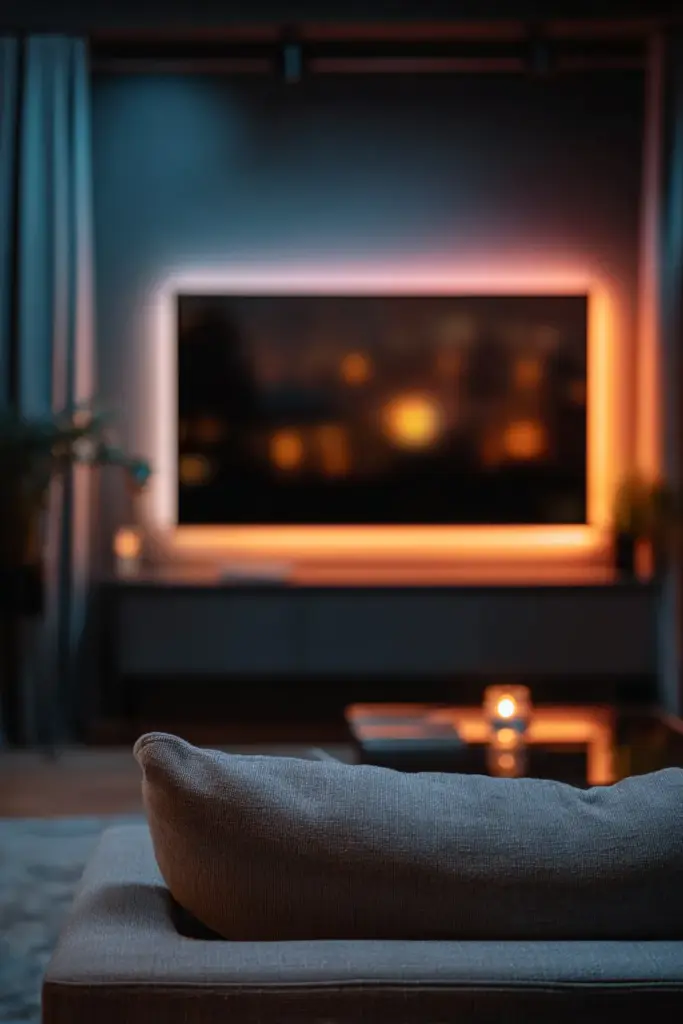
Mount an LED strip light (available on Lazada for ₱200 to ₱600) to the back perimeter of your TV frame, facing the wall. This creates a soft halo of light behind the screen — beautiful, functional, and kinder on your eyes than a dark room.
Bias Lighting: The Science of Comfortable Viewing
Bias lighting — the soft glow behind a TV — is one of the most practical yet underappreciated elements of a modern living room setup. It reduces the harsh contrast between a bright screen and a dark wall, which is the primary cause of eye fatigue during long viewing sessions.
What to Look for in Bias Lighting
- Colour temperature: 6500K (daylight white) most closely matches screen output and reduces eye strain. Warmer tones (3000K) feel cosier but can slightly skew your perception of colours on screen.
- Placement: attach the strip to the back of the TV frame, not the sides. This creates an even ambient glow against the wall.
- Brightness: aim for a soft, diffused glow — not a spotlight. Bias lighting should be felt more than seen.
For a smart home upgrade, RGBIC bias lighting strips (like Govee or TP-Link Tapo strips, available on Lazada) can sync with your screen content and shift colour in real time. It’s a small addition that makes the entire wall feel alive.
Smart Home Integration: Invisible Technology
The most sophisticated living rooms make technology disappear. A few simple upgrades can take your modern TV setup from functional to quietly extraordinary.
- Voice control: Pair your TV with an Alexa or Google Nest device for hands-free operation. Place it inside your console, out of sight — the microphone still picks up commands easily.
- Motorized TV lifts: For the truly hidden TV aesthetic, a lift mechanism conceals the screen inside a console or cabinet until you need it. Available from specialty furniture suppliers in Manila and online.
- Cable-free soundbars: Modern soundbars with HDMI ARC or eARC connect through a single cable and deliver immersive audio without a tangle of wires.
- Smart plugs and power strips: Schedule your entertainment system to power down automatically at a set time — less energy, less clutter, more peace of mind.
Where to Shop in the Philippines: Local Sources We Love
You don’t need to import your living room. The Philippines has a growing ecosystem of beautiful, affordable furniture and materials for a modern TV setup.
| Source | What to Find |
|---|---|
| IKEA Manila (ARCA) | BESTÅ TV units, LACK floating shelves, cable management accessories |
| Shopee / Lazada | LED strips, cable raceways, floating console brackets, low-profile TV mounts |
| Cebu Lumber / True Value | Pine and finger-joint wood for DIY wood slat walls |
| Facebook Marketplace / OLX | Secondhand sideboards and console tables for thrift-flip projects |
| Local carpenters (diskarte!) | Custom floating consoles in solid wood, built to your exact dimensions |
A local carpenter can often build a custom floating TV console — the exact width, height, and finish you want — for ₱3,000 to ₱8,000 depending on material and complexity. It is one of the most impactful home investments you can make.
Renter-Friendly TV Solutions: No Drill, No Drama
If you’re renting, you don’t have to settle for a screen propped on a box. There are beautiful, damage-free options that still deliver that considered, styled look.
- Freestanding TV stands with cable management channels: sleek, stable, and portable when you move
- No-drill TV mounts: tension-fit floor-to-ceiling poles that hold a wall mount bracket without touching the drywall
- Removable peel-and-stick wallpaper panels: create a dramatic backdrop behind your TV without permanent commitment
- Portable easel TV stand: a natural wood easel styled as a display stand — surprisingly elegant for a smaller screen in a relaxed, boho-rustic space
Pair any of these with a cable raceway in your wall colour, and your rental will feel like a considered, designed home.
Quick Checklist: Modern Living Room TV Essentials
- Mount your TV so the screen centre sits 100–130 cm from the floor (eye-level when seated)
- Use the viewing distance formula: TV size in inches × 1.5–2.5 = ideal distance in metres
- Choose a floating console or low-profile unit to keep the layout airy and grounded
- Run cables through an in-wall conduit, a paintable raceway, or bundle neatly beneath the console
- Add bias lighting (6500K LED strip) to the back of your TV frame for eye-comfort and ambience
- Incorporate natural materials — wood, linen, clay — around the TV for warmth and texture
- Integrate smart home tools (voice control, smart plugs, wireless audio) to reduce visible tech clutter
- For renters: use no-drill mounts, removable wallpaper, and freestanding consoles
A Gentle Conclusion
The living room is the heart of the home — the place where light changes through the day, where conversation lingers, where comfort is not a luxury but a daily practice. Your television does not have to disrupt that. With the right placement, materials, lighting, and a little thoughtful styling, it can become part of the story your room tells.
At ERYLIN, we believe beautiful living is accessible to everyone. Whether you spend ₱500 on a cable raceway or commission a custom console from your neighbourhood carpenter, every considered choice brings you closer to a home that feels like yours.
Take your time. Trust your instincts. And enjoy every quiet evening in front of a screen that finally feels at home.
Frequently Asked Questions
What height should I mount my TV in the living room?
Mount your TV so the centre of the screen is at eye level when you’re seated — typically 100 to 130 cm from the floor. Mounting too high is one of the most common mistakes in living room design and can cause neck strain over time.
What size TV is best for a small living room?
A 43-inch TV is ideal for most small living rooms and condos. Use the viewing distance formula: multiply your TV’s screen size (in inches) by 1.5 to 2.5 to find your ideal seating distance in metres. For a 43-inch TV, that’s roughly 1.6 to 2.7 metres.
How do I hide cables from a wall-mounted TV?
The best options are: an in-wall cable conduit (permanent, most seamless), a paintable cable raceway (renter-friendly, nearly invisible), or under-console cable bundling with velcro ties. For the tidiest look, combine a cable raceway in your wall colour with a console that has closed-door storage for devices.
What is the best lighting to put behind a TV?
Bias lighting — an LED strip attached to the back of your TV frame — is the best option. Choose 6500K daylight white for the most eye-friendly experience, or RGBIC strips that sync with your screen content. Bias lighting reduces the contrast between the bright screen and dark wall, significantly cutting eye fatigue during long viewing sessions.
Should the TV be the focal point of the living room?
It doesn’t have to be. A well-integrated TV wall — with natural materials, thoughtful lighting, and intentional styling — can make the screen feel like one part of a larger, beautiful composition rather than the dominant feature. In Japandi and minimalist interiors especially, the TV recedes into the design rather than commanding it.