
Table of Contents
There is a certain magic that happens when light touches a room at the right angle. It softens the edges of a long day, makes a worn leather chair feel like a sanctuary, and turns an ordinary evening into something worth remembering.
Eclectic living room lighting is not about owning the most interesting fixture. It is about understanding how light lives in your space — how it moves, where it pools, and what it brings alive.
At ERYLIN, we believe good lighting is the quiet soul of a well-designed room. It does not compete for attention. It holds everything together, even when everything is intentionally mismatched.
This guide will walk you through how to mix lighting styles with confidence, choose the right fixtures for your ceiling height, layer light for every mood, and bring modern function into vintage forms — all without losing that warm, grounded feeling that makes a living room feel like yours.
What Is Eclectic Living Room Lighting, Really?
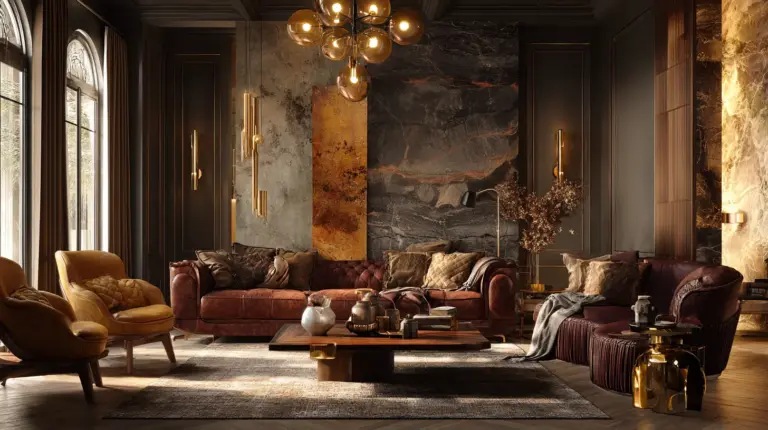
Eclectic lighting is the art of combining fixtures from different eras, materials, and design languages so that they feel curated rather than chaotic. Think a hand-forged iron chandelier hanging above a linen sofa, softened by the glow of a mid-century ceramic floor lamp nearby.
The result should feel collected over time — like each piece has a story. But without intention, eclecticism quickly becomes visual noise.
The key is in the balance.
The 70/30 Eclectic Balance Formula
A reliable starting point for any eclectic lighting scheme is the 70/30 formula: 70% of your fixtures should share a unifying quality — a metal finish, a warm tone, a general scale — while the remaining 30% can break the rules.
That 30% is where the personality lives. A sculptural brass pendant in a room full of matte black and natural wood. A vintage rattan shade alongside sleek ceramic table lamps. These contrasts should feel chosen, not accidental.
Use this formula as your anchor before you shop, thrift, or upcycle.
How to Layer Lighting in an Eclectic Living Room
Layered lighting is what separates a room that feels designed from one that just has lights in it. Every well-lit living room draws from three distinct layers, working together like instruments in a quiet ensemble.
Ambient Lighting: The Foundation
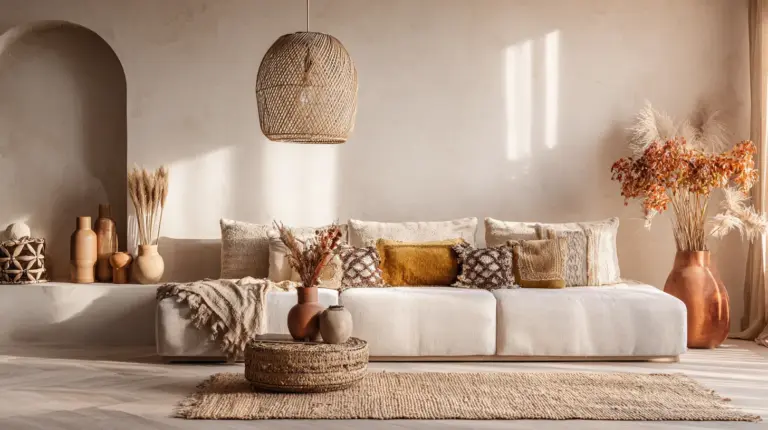
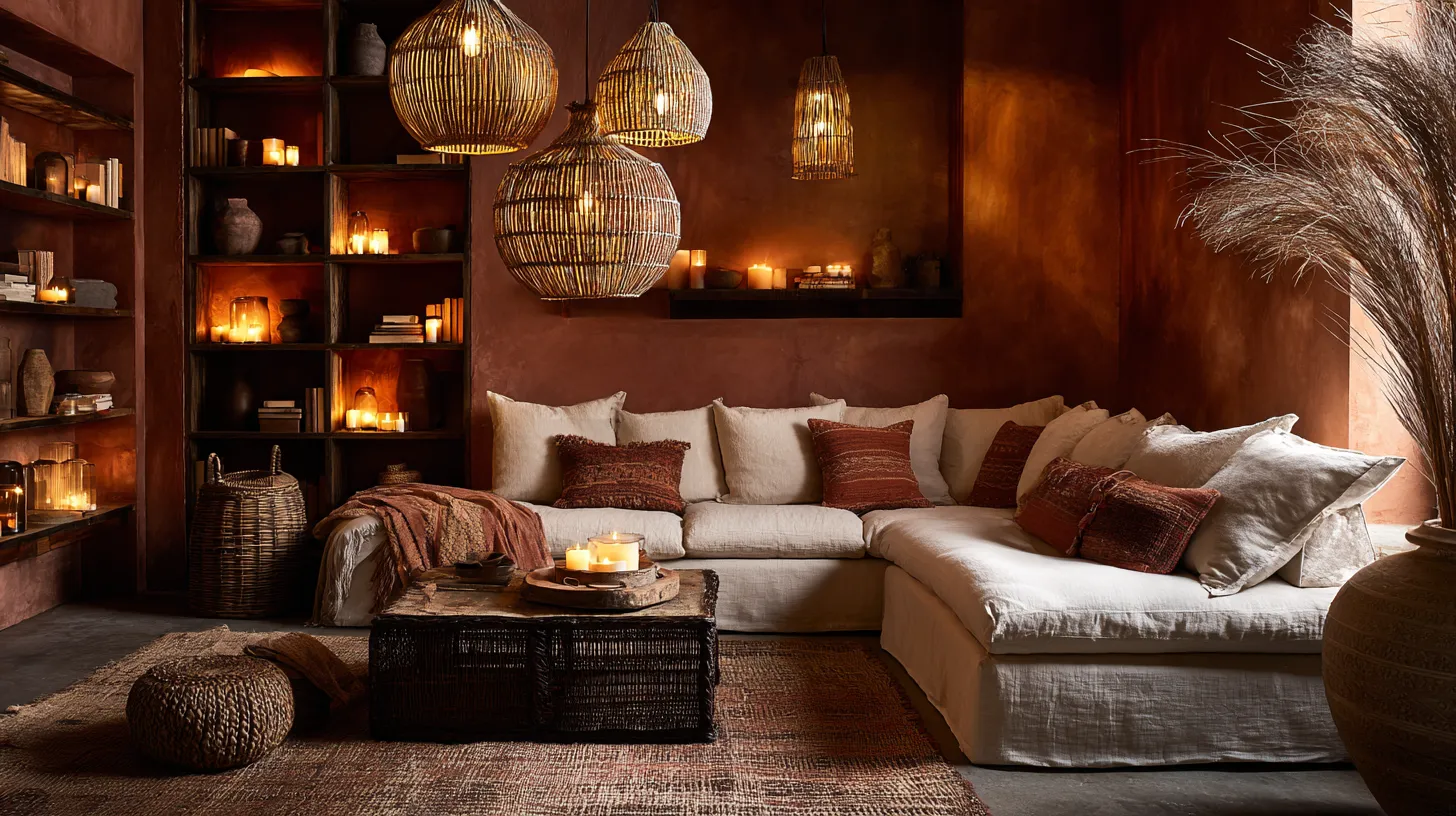
Ambient light is the room’s base glow — soft, diffuse, and all-encompassing. In an eclectic space, this often comes from a statement overhead fixture: a vintage chandelier with aged brass arms, a rattan pendant with warm-toned Edison bulbs, or a cluster of mismatched pendants hung at varying heights.
Aim for a color temperature of 2700K–3000K for ambient sources. This range produces a warm, golden light that flatters natural materials like wood, linen, and terracotta — the backbone of modern rustic eclectic style.
For lumen requirements, a living room of approximately 200 square feet benefits from 1,500–3,000 lumens of total ambient light, scaled up or down based on your ceiling height and natural light intake.
Task Lighting: The Practical Layer
Task lighting serves a purpose — reading, working, folding, talking. In an eclectic living room, task lighting is your chance to introduce character without overwhelming the space.
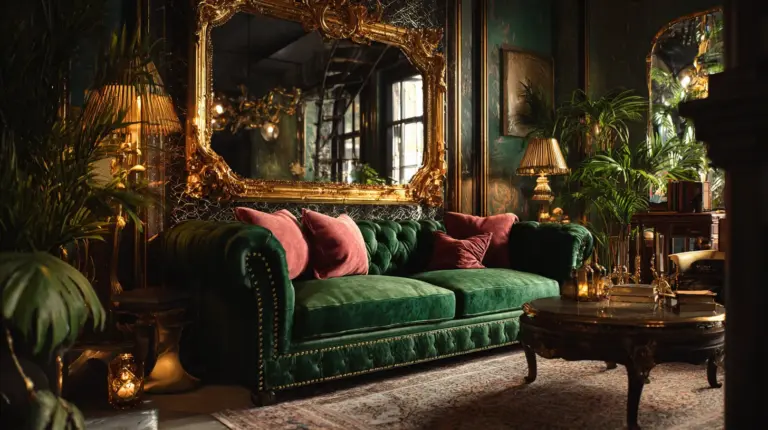
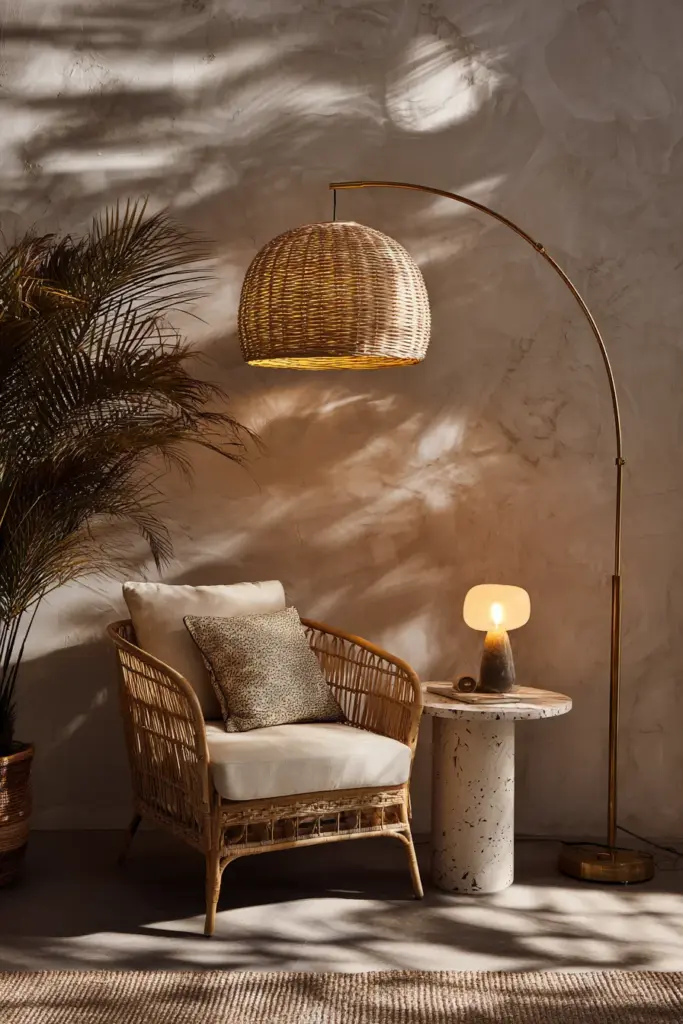
An articulated brass reading lamp beside an armchair. A vintage banker’s lamp with a green glass shade on a side table. A pair of wall sconces flanking a bookshelf. These pieces should be interesting enough to notice and functional enough to use every day.
Keep task lighting sources dimmable wherever possible. Flexibility is everything.
Accent Lighting: The Soul of the Room
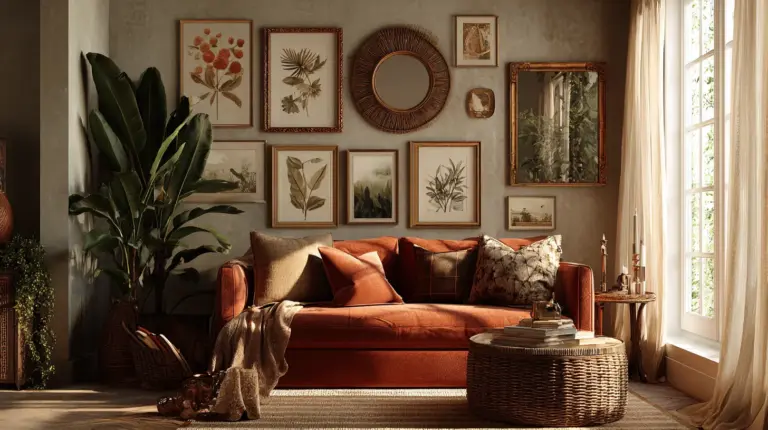
Accent lighting highlights what matters — a gallery wall, a sculptural plant, a stack of art books, a woven textile hung as art. This layer adds dimension and shadows, which are just as important as the light itself.
Picture lights, directional recessed spotlights, and small table lamps tucked into shelving all work beautifully in eclectic spaces. They reward the eye with discovery: something new to notice every time you enter the room.
Choosing Fixtures Based on Ceiling Height
Not every fixture works in every room. Ceiling height is one of the most important and most overlooked variables in eclectic lighting design.
High Ceilings (9 Feet and Above)
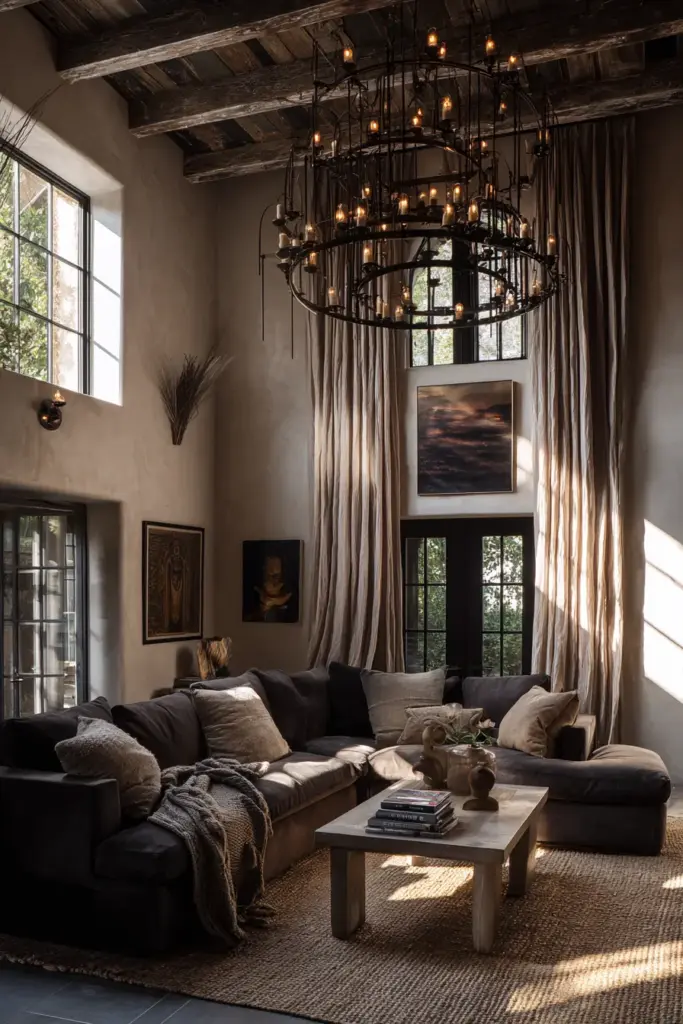
High ceilings invite drama. This is where oversized pendants, multi-tiered chandeliers, and long-drop statement fixtures earn their place. A grand chandelier in a room with high ceilings creates vertical rhythm, drawing the eye upward and making the space feel intentional rather than empty.
For fixture sizing, use this simple guide: add the room’s length and width in feet, and that number in inches approximates the ideal fixture diameter. A 12 x 14 foot room calls for a fixture roughly 26 inches wide.
Hang pendant lights so the bottom of the fixture sits 7 feet above the floor as a general rule, adjusting upward for dramatic effect in very tall rooms.
Low Ceilings (8 Feet and Below)
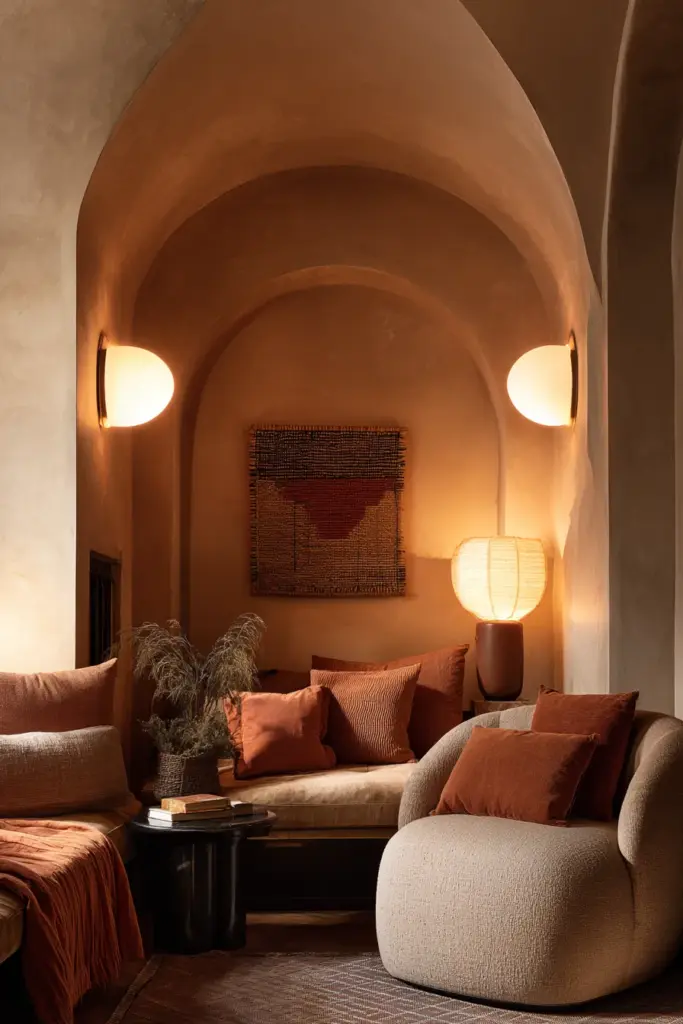
Low ceilings require restraint — but they do not require boring lighting. Flush-mount fixtures with interesting silhouettes, semi-flush pendants with visual texture, and wall sconces that push light outward rather than downward are your best allies.
In a low-ceilinged eclectic room, the magic comes from the layers beneath the ceiling — floor lamps in warm-toned ceramic or turned wood, table lamps with sculptural bases, and accent lighting that draws attention to the details at eye level and below.
How to Mix Lighting Styles Without Creating Chaos
Mixing styles is where eclectic design earns its name — and its reputation for being difficult. But with a few guiding principles, it becomes one of the most rewarding parts of designing a living room.
Use One Unifying Material or Finish
Even when your fixtures come from different eras, tying them together through a shared material creates visual calm. Brass appears in both a 1940s floor lamp and a modern geometric pendant. Rattan shows up in an overhead shade and a small table lamp. The repetition of even one element creates cohesion across contrast.
| Unifying Element | Works With |
|---|---|
| Warm brass finish | Industrial, vintage, mid-century |
| Matte black | Boho, Scandinavian, contemporary |
| Natural rattan or wicker | Coastal, rustic, global eclectic |
| Aged bronze | Victorian, Arts & Crafts, earthy modern |
| White ceramic | Japandi, farmhouse, modern minimal |
Keep Scale in Conversation
A tiny pendant in a vast room feels lost. An oversized floor lamp in a small space feels suffocating. When mixing eclectic fixtures, ensure they share a visual weight that makes sense together — even if their styles diverge dramatically.
A large rattan pendant paired with a slender brass floor lamp and a compact ceramic table lamp can coexist beautifully because their scale is in conversation, even if their origins are not.
Limit Your Metals to Two or Three
One of the fastest ways to create visual chaos in an eclectic space is to introduce too many competing metal finishes. Choose two — perhaps brass and matte black — and allow a third as a whisper accent. This restraint will make each fixture feel deliberate.
Lighting Scenes for Every Mood
One of the greatest joys of a well-layered lighting scheme is the ability to shift the atmosphere of a room without moving a single piece of furniture. Lighting scenes — preset combinations of your layers at specific intensities — make this effortless.
Reading Mode
Brighten the task lighting above or beside your reading chair to approximately 400–600 lumens at close range. Dim the ambient overhead to around 30–40% to reduce eye strain and create a cozy cocoon effect. Leave accent lighting on low to keep the rest of the room from going dark.
Entertaining Mode
Raise ambient lighting to 70–80% for energy and ease of movement. Bring task lighting down or off entirely. Let accent lighting do its quiet work — highlighting art, plants, or objects that become conversation starters.
Movie Night Mode
Dim everything except one or two soft accent sources at floor level. This reduces screen glare while maintaining just enough light to feel safe and comfortable. A single warm-toned floor lamp set behind the television creates a beautiful bias glow effect.
Smart bulbs and plug-in dimmers make switching between these scenes simple, even within vintage or ornate eclectic fixtures that were not designed with technology in mind.
Sustainable and Upcycled Eclectic Lighting
Some of the most beautiful eclectic fixtures are not bought — they are found and transformed. Thrift stores, estate sales, and antique markets are full of bones-good vintage lighting waiting for new life.
A vintage chandelier with a dated finish can be spray-painted in satin brass or matte black. An old industrial factory pendant can be rewired and paired with a warm Edison LED bulb. A ceramic vase can become a table lamp base with a simple lamp kit from a hardware store.
LED retrofit bulbs are a quiet revolution for eclectic collectors. They slide into vintage sockets, draw a fraction of the energy, and emit the same warm, amber glow of incandescent light. Choose bulbs in the 2700K range for the most honest warmth.
Upcycling is not just sustainable — it guarantees your lighting will be genuinely one of a kind.
Smart Bulbs in Vintage Fixtures: Making It Work
Modern smart-bulb technology and antique fixtures are not natural companions, but they can coexist gracefully with a little planning.
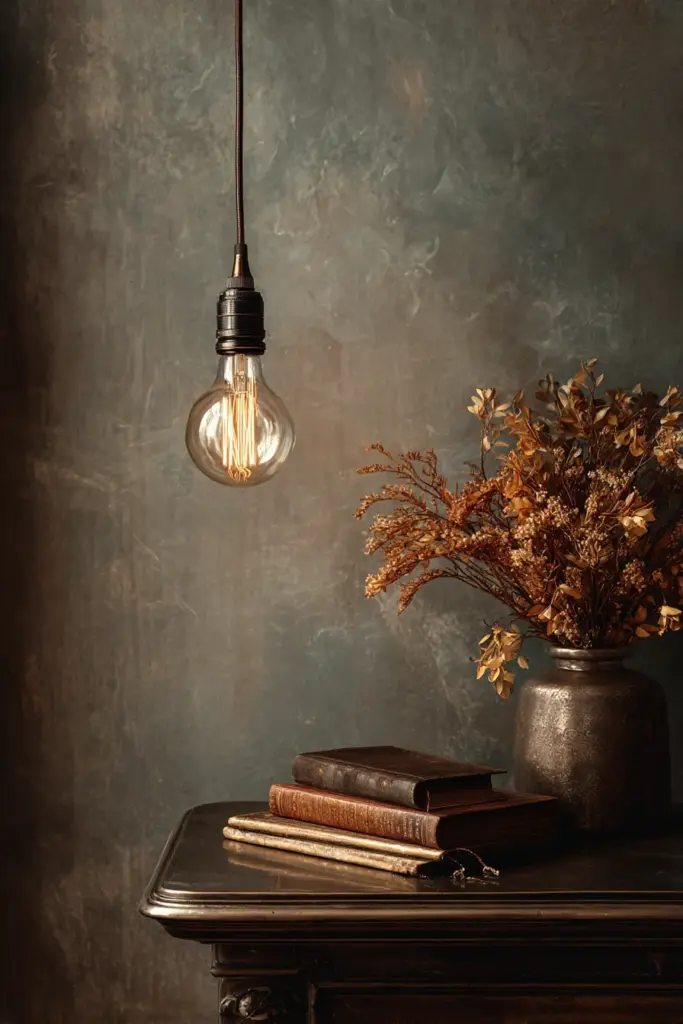
Most standard Edison-base smart bulbs fit into vintage sockets without modification. Choose a bulb with a warm white range (2700K–3000K) that can dim smoothly — harsh color shifting in smart bulbs can feel jarring against antique finishes and natural materials.
Use smart plugs on floor and table lamps to bring them into your lighting ecosystem without touching the original wiring. Pair them with a simple app or a voice assistant, and your 1950s ceramic lamp becomes part of a modern, scene-ready lighting scheme.
The aesthetic never has to suffer for the sake of function.
Eclectic Living Room Lighting: Key Takeaways
- Use the 70/30 formula: 70% cohesive foundation, 30% statement eclecticism
- Layer all three levels — ambient, task, and accent — for depth and flexibility
- Choose a color temperature of 2700K–3000K for warm, flattering light
- Size fixtures to the room: length + width in feet = ideal diameter in inches
- For high ceilings, lean into drama — oversized pendants, chandeliers, long drops
- For low ceilings, choose flush mounts, sconces, and floor lamps that build layers at eye level
- Unify eclectic fixtures through one shared material, finish, or tonal quality
- Limit metal finishes to two or three across the room
- Create lighting scenes for reading, entertaining, and movie nights using dimmers or smart bulbs
- Upcycle vintage finds with LED retrofits for sustainable, irreplaceable character
- Smart bulbs in standard sockets and smart plugs bring old fixtures into modern lighting systems
Conclusion
A living room lit well is a room that breathes. It shifts with the hour, settles with you at the end of the day, and gently holds every gathered moment — the laughter, the quiet, the long conversations that stretch into late evenings.
Eclectic lighting does not demand perfection. It asks only for intention: a willingness to mix thoughtfully, layer generously, and let warmth lead the way.
At ERYLIN, we believe the most beautiful rooms are those that feel lived in and loved. The light you choose tells that story quietly, one warm glow at a time.
Trust the layers. Trust the warmth. And trust the room to become exactly what you imagined.
Frequently Asked Questions
How do you mix lighting styles in an eclectic living room?
Start with the 70/30 rule — let 70% of your fixtures share a unifying quality such as a metal finish or warm tone, and let the remaining 30% be your expressive statement pieces. Consistency in one element (like brass hardware or a warm bulb temperature) creates cohesion across very different fixture styles.
What are the best types of lights for an eclectic living room?
The most versatile choices are warm-toned pendant lights for overhead ambiance, articulated or ceramic floor lamps for task lighting, and wall sconces or small accent lamps for depth. Mixing these three types across different design eras creates the layered, collected feeling at the heart of eclectic style.
How do I choose the right lighting for a room with high or low ceilings?
For high ceilings, choose oversized pendants or multi-tiered chandeliers and hang them so the bottom sits roughly 7 feet above the floor. For low ceilings, opt for flush or semi-flush mounts with interesting textures, and build visual richness through floor lamps and table lamps at eye level.
What is the best color temperature for living room lighting?
A color temperature of 2700K to 3000K produces warm, golden light that flatters natural materials, skin tones, and the layered textures common in eclectic interiors. Avoid cool white bulbs (4000K and above) in living spaces — they disrupt the warmth that makes a room feel inviting.
How do I layer lighting for ambiance and task work in the same room?
Use dimmers on your ambient overhead fixture, set task lamps close to where you actually read or work, and let accent lighting operate independently on smart plugs or separate switches. This allows you to build lighting scenes — like a bright, energetic hosting setup or a soft, dimmed reading nook — without rearranging a single fixture.