
Table of Contents
There is something quietly transformative about a well-placed rug. It anchors a room the way a deep breath anchors a moment — suddenly, everything settles into place. The furniture stops floating. The light finds somewhere soft to land.
At ERYLIN, we believe your living room deserves that kind of intention. Modern living room rug placement is not guesswork. It is a practice — one part measurement, one part feeling, and entirely yours to get right.
Whether you are working with a small city apartment, an open-plan space, or a Japandi-inspired sanctuary, this guide will walk you through every decision with warmth and clarity. You will find exact measurements, honest trade-offs, and the sensory details that turn a good room into a great one.
Let this be your starting point. Pull up your floor plan, set down your coffee, and let us begin.
The Golden Rule: Front Legs on the Rug
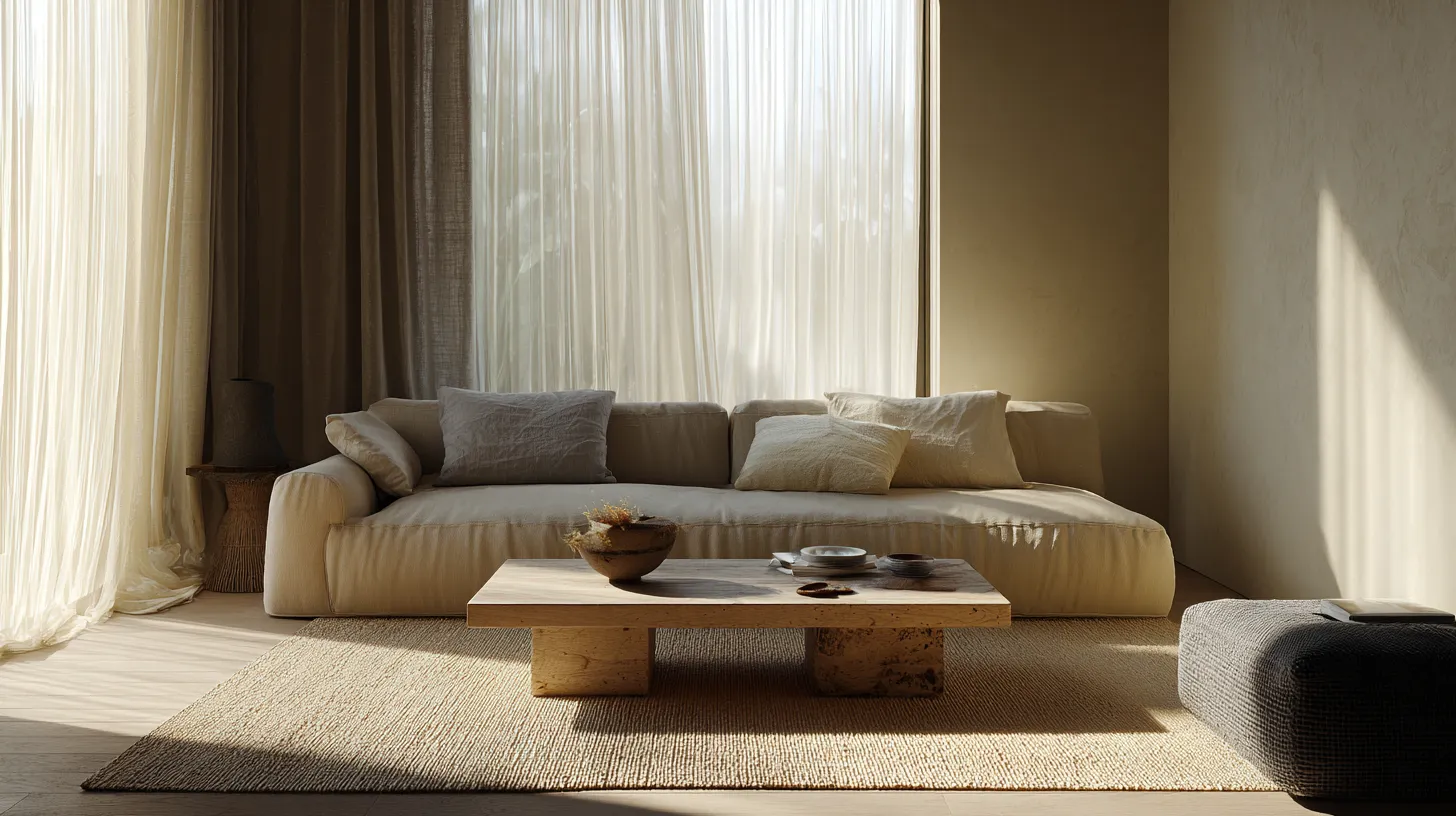
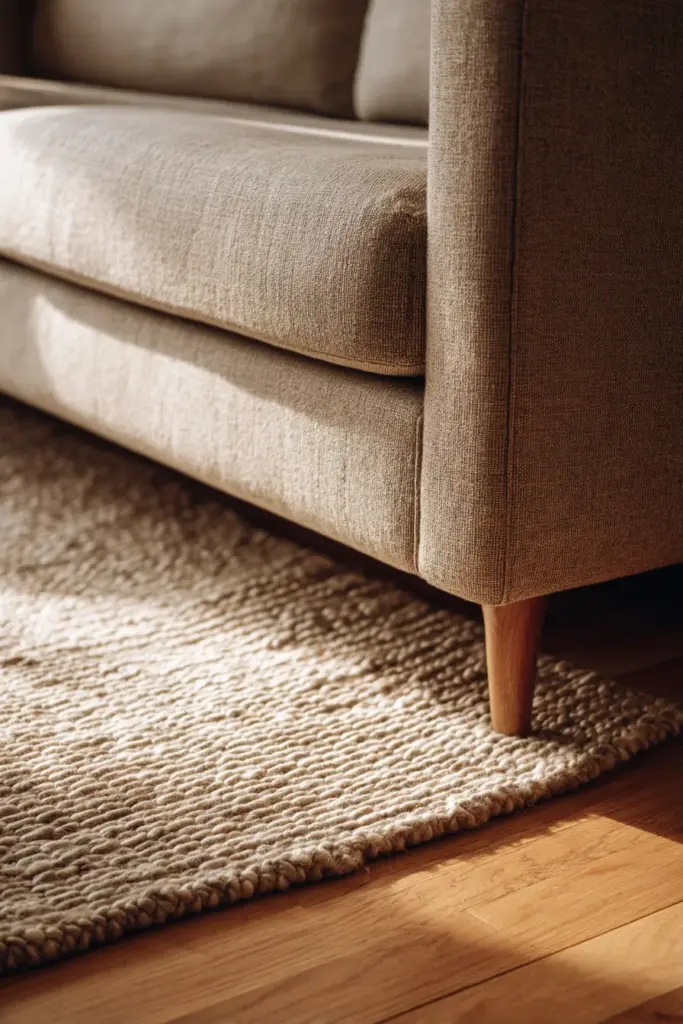
Every designer has their non-negotiables. This is ours: at minimum, the front legs of your sofa must rest on the rug.
This single rule changes everything. It visually connects your seating to the rug, creating a cohesive conversation zone instead of a collection of isolated furniture. The rug becomes the stage; the sofa steps onto it.
In practical terms, a standard three-seater sofa sits comfortably with its front two legs on the rug. The texture shift — from cool hardwood to warm wool or jute — creates an instinctive sense of arrival when you sit down.
All Furniture On vs. Front Legs Only vs. No Furniture On
Understanding which approach suits your space is the first decision you will make.
| Placement Style | Best For | Minimum Rug Size (for 3-seat sofa) |
|---|---|---|
| All furniture on rug | Larger rooms, open-plan zones | 270 × 360 cm (9 × 12 ft) |
| Front legs only | Most living rooms | 200 × 290 cm (8 × 10 ft) |
| No furniture on rug | Very small rooms, decorative use | 150 × 230 cm (6 × 8 ft) |
All furniture on the rug reads as generous and grounded — ideal when you have the floor space to spare. Front legs only is the most versatile approach and works beautifully in rooms under 4 × 4 metres. No furniture on rug can work as a visual accent but risks making the rug feel like an island adrift in the room.
Finding the Right Rug Size: A Room-by-Room Formula
Sizing is where most people hesitate, and understandably so. The wrong size is the most common rug mistake — and the easiest to avoid with a simple formula.
The rule: Your rug should be at least as wide as your sofa and ideally 20–30 cm wider on each side. Leave 40–50 cm of bare floor between the rug’s edge and the wall. In smaller rooms, 20–30 cm is sufficient.
The Small Living Room Formula
For rooms under 3.5 × 3.5 metres, precision matters most.
- Room width 3 m → choose a 200 cm wide rug
- Room width 3.5 m → choose a 230–240 cm wide rug
- Room width 4 m → choose a 250–270 cm wide rug
Always measure your actual traffic paths before purchasing. Leave a minimum of 60 cm of walkway between the rug’s edge and any doorway or passage.
Quick Size Reference Table
| Room Size | Recommended Rug | Border from Wall |
|---|---|---|
| Under 3 × 3 m | 150 × 230 cm | 20–25 cm |
| 3.5 × 4 m | 200 × 290 cm | 30–40 cm |
| 4 × 5 m | 240 × 340 cm | 40–50 cm |
| 5 m+ / open plan | 270 × 360 cm + | 50 cm minimum |
The Coffee Table Rule: All Legs On, Always
If your sofa’s front legs are on the rug, your coffee table must sit entirely on the rug — all four legs, centred. This is non-negotiable for visual harmony.
A coffee table with only two legs on the rug creates a subtle tension that most people feel before they can name it. The table looks like it is trying to escape. Centering it fully on the rug completes the grouping and makes the space feel resolved.
As a practical check: the coffee table should leave at least 40–45 cm of walking space between itself and the sofa. If your rug cannot accommodate both the table and that clearance, size up your rug before compromising on placement.
Rug Alignment: Sofa, Fireplace, or Window?
This is one of the most common living room dilemmas — especially when your room has multiple focal points competing for attention.
When the fireplace is the focal point (traditional or transitional rooms): Centre the rug with the fireplace opening, not the sofa. The sofa will naturally align within that zone.
When the TV or window is dominant (modern and Japandi spaces): Centre the rug with the sofa and the viewing axis. This grounds the seating arrangement and draws the eye inward.
When both compete equally: Use a 50/50 approach — position the rug so its centre point falls between the two focal points. This works best in rooms with symmetrical furniture layouts.
Japandi Rug Placement: Stillness as a Design Principle
Japandi interiors are built on restraint — low-profile furniture, natural materials, and a deep respect for negative space. Rug placement in a Japandi living room follows the same philosophy.
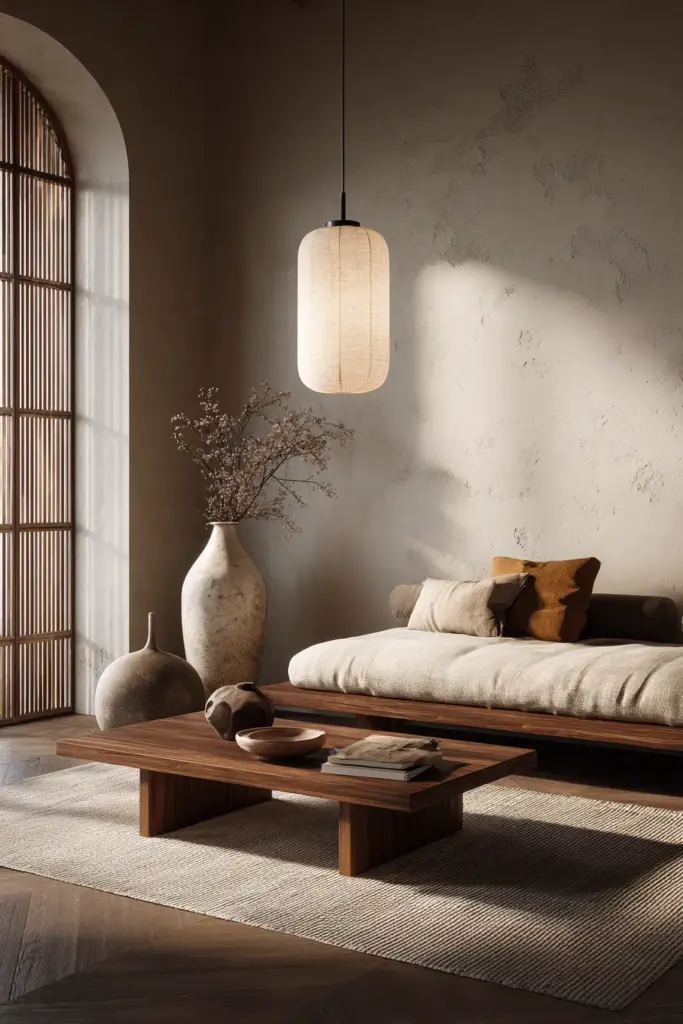
Japandi-Specific Rules
- Floor coverage: Aim for 60–70% of the seating area. Do not cover everything. The bare floor is part of the composition.
- Rug materials: Choose natural fibres — undyed wool, hand-woven jute, linen, or seagrass. Avoid synthetic pile; it disrupts the tactile integrity of the space.
- Colour palette: Warm stone, raw linen, pale ash, or soft charcoal. Nothing that competes with the furniture.
- Pile height: Keep it low. A flat-weave or low-pile rug suits Japandi proportions and photographs beautifully in natural light.
- Placement: Centre precisely. Even a few centimetres off-axis reads as careless in a minimal room.
If you are working with a Japandi small living room, consider a round rug under a round coffee table. The softness of the curve echoes the organic shapes often found in Japandi ceramics and seating.
Open-Plan Spaces: Using Rugs to Zone Without Walls
An open-plan living area without a rug is a room without a heartbeat. The rug defines where the living room begins and the dining area ends — no walls required.
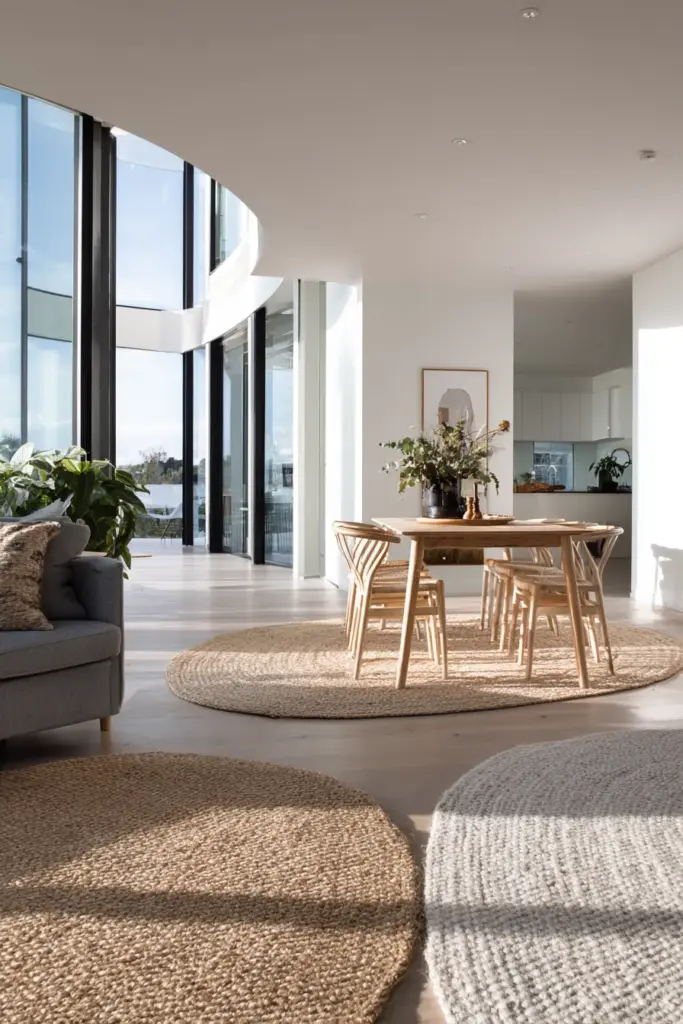
Zoning Rules for Open-Plan Layouts
- Leave a minimum 90 cm walkway between the edge of the living room rug and the dining table or kitchen island.
- Each zone (living, dining) should have its own rug — do not try to use one large rug to cover both. It muddies the zones and disrupts traffic flow.
- Choose rugs in the same colour family but different textures to create visual rhythm without chaos. A wool flatweave in the living area pairs beautifully with a jute runner in the dining space.
- The living room rug should be large enough that your sofa reads as clearly inside the zone, not hovering at its edge.
Rug Placement for Sectionals: The T-Shape Approach
Sectionals require a different spatial logic. A standard sofa-centric placement rarely works — the chaise extension changes the geometry of the room entirely.
For L-shaped sectionals, place the rug so the corner of the sectional aligns with the centre of the rug. Front legs of both arms should rest on the rug. Minimum rug size: 260 × 360 cm.
For chaise extensions, the chaise itself does not need to sit on the rug — but the main seating section should have its front legs fully on it. Let the chaise float slightly; it reads as intentional in a contemporary space.
Avoid: positioning the rug so it runs parallel to only one arm of the sectional. This breaks the visual unity of the arrangement.
Protecting Your Hardwood Floors: What Goes Beneath
The conversation about rug placement is never complete without addressing what sits beneath. A quality non-slip underlay protects both your floors and your investment.
- For hardwood and timber floors: Choose a felt-and-rubber underlay, at least 6 mm thick. It cushions, grips, and allows the floor to breathe underneath.
- For floor vents: Leave a 8–10 cm clearance around any vent opening. Use a low-pile rug near vents — high-pile traps heat and restricts airflow.
- For underfloor heating: Select a rug with a tog rating of 1.4 or lower. Natural wool rugs are ideal; dense synthetics can overheat.
Change your underlay annually if your rug sees heavy foot traffic. A sliding rug on hardwood is both a safety risk and a slow way to scratch a beautiful floor.
Budget Hack: Layering Two Smaller Rugs
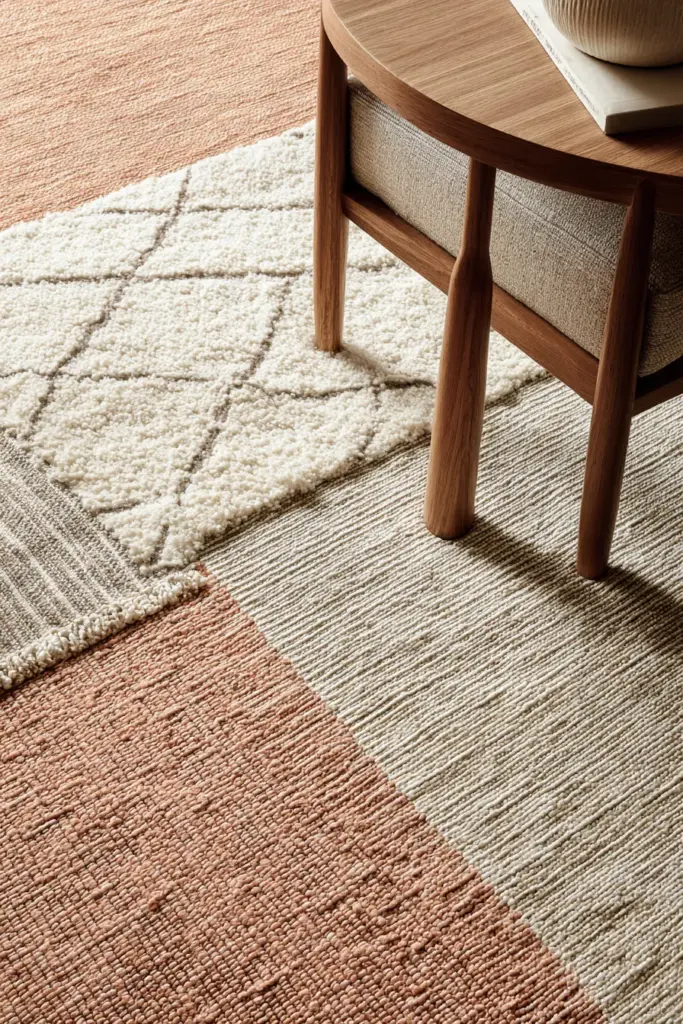
One of the most underused techniques in rug styling is also one of the most cost-effective: layering two smaller rugs to create the visual effect of one large one.
Start with a flat-weave base rug in a neutral tone — jute, sisal, or a plain cotton flatweave works beautifully. Layer a smaller, textured or patterned rug on top, offset slightly toward the seating area. Use double-sided rug grip tape between the layers to prevent shifting.
This approach lets you:
- Achieve a larger-looking floor zone without the price of an oversized rug
- Mix textures (rough weave + soft pile) for a layered, editorial look
- Swap the top rug seasonally while keeping the base constant
The key is contrast — a smooth base beneath a shaggy or geometric top layer reads as intentional and styled.
Diagonal Placement: When the Room Is Narrow or Irregular
Most rug guides assume a rectangular room with square furniture. Real homes are rarely that cooperative.
For narrow rooms (under 2.8 m wide), placing the rug at a slight diagonal — 15 to 20 degrees off-axis — widens the perceived space. It draws the eye across the room rather than down its length.
For irregular rooms (alcoves, L-shaped floor plans, rooms with structural columns): anchor the rug to the most-used seating area, not the room’s geometry. The rug creates its own zone; the walls become secondary.
One caution: diagonal placement requires precise furniture arrangement to avoid visual chaos. Every piece of furniture near the rug should either align with the rug’s angle or be positioned completely away from it. Mixing angles within one zone feels unresolved.
Common Rug Placement Mistakes (and How to Fix Them)
| Mistake | What It Does to the Room | The Fix |
|---|---|---|
| Rug too small | Furniture floats, space feels unanchored | Size up; minimum rug = width of sofa |
| All furniture off the rug | Creates an isolated “postage stamp” effect | Move front legs onto the rug |
| Rug pushed to wall | Eliminates breathing room and visual border | Leave 20–50 cm from wall |
| Coffee table half on rug | Creates visual tension and imbalance | Centre table fully on rug |
| Rug not centred with sofa | Room reads as asymmetrical without intention | Re-centre or reposition sofa |
| Wrong pile near floor vents | Restricts airflow, potential heat buildup | Switch to low-pile within 30 cm of vent |
| No underlay on hardwood | Rug slides, floor scratches | Add felt-rubber underlay, 6 mm minimum |
Lighting and Your Rug: The Evening Effect
Here is something rarely discussed: how your rug looks at night is as important as how it looks by day.
Natural daylight reveals texture and depth in a rug — a hand-knotted wool pile will shimmer differently at 8am than at 3pm. But once the sun sets, the rug’s relationship with your lighting design changes completely.
Warm ambient light (2700–3000K) deepens the tones of earthy rugs and brings out the golden warmth in jute or undyed wool. Cool overhead lighting flattens texture and can make a beautiful rug look flat and lifeless.
Position a floor lamp at the edge of your rug zone — not overhead — to create a soft pool of light that wraps around the seating area. This technique is especially effective in Japandi rooms, where a single warm light source reinforces the contemplative quality of the space.
Key Takeaways: Your Rug Placement Checklist
Before your rug arrives, or before you rearrange what you have, run through this:
- Front legs of sofa on the rug — always, as a minimum
- Coffee table entirely on the rug — all four legs, centred
- Rug extends 20–30 cm beyond the sofa on each side
- 40–50 cm of bare floor visible between rug edge and wall (20 cm minimum in small rooms)
- Rug aligned with primary focal point — fireplace in traditional rooms, sofa/TV in modern
- Open-plan zones each have their own rug — 90 cm walkway between zones
- Non-slip underlay in place — 6 mm felt-rubber on hardwood
- Floor vents clear — 8–10 cm clearance, low-pile nearby
- Japandi rooms: 60–70% floor coverage, natural fibres, low pile, precise centring
- Layering option: flat-weave base + textured top, secured with grip tape
Conclusion
A rug is not just a floor covering. It is the first thing bare feet find on a cold morning. It is the edge of the conversation, the softness beneath the coffee table, the quiet centre of everything.
When placed with intention, your living room rug does what the best design always does — it disappears into the room and becomes the room.
We hope this guide gives you not just the measurements, but the confidence to trust your instincts. Your floor is a canvas. Let your rug be the first brushstroke.
At ERYLIN, we are always here when you are ready to take the next step — whether that is choosing your first natural-fibre rug, layering textures in a small space, or designing your first true Japandi living room.
Frequently Asked Questions
Should all furniture be on the rug in a living room?
Not necessarily. In larger rooms, all furniture on the rug creates a grounded, cohesive look. In most living rooms, placing only the front legs of the sofa and chairs on the rug is the most practical and widely recommended approach. The key is that no piece of furniture should sit completely off the rug while another sits fully on it.
How much rug should show around a sofa?
Your rug should extend at least 20–30 cm beyond the sofa on each side. Between the rug’s edge and the wall, leave 20–50 cm of bare floor visible. In small rooms, 20 cm is acceptable; in larger rooms, 40–50 cm reads as more intentional and spacious.
Should the front legs of the sofa be on the rug?
Yes — this is the universal baseline rule for area rug placement. The front legs on the rug visually anchor the seating arrangement to the rug and create a unified zone. It works in rooms of almost any size and is the most forgiving placement option.
What size rug do I need for my living room?
A general formula: your rug should be at least as wide as your sofa and ideally 20–30 cm wider on each side. For a standard three-seat sofa in a mid-sized living room, a 200 × 290 cm (8 × 10 ft) rug is usually the minimum. Larger rooms benefit from 240 × 340 cm or above.
Should a coffee table be fully on the rug?
Yes. The coffee table should sit entirely on the rug, all four legs centred. Placing a coffee table half on and half off the rug creates visual imbalance and subtle tension that disrupts the cohesion of the seating zone. If your rug cannot fit both the table and adequate walking clearance around it, choose a larger rug.
How far should a rug extend from the wall?
Leave at least 20 cm between the rug’s edge and the wall in small rooms, and 40–50 cm in larger rooms. This border of bare floor gives the rug visual breathing room and prevents the space from feeling overcrowded.