
Table of Contents
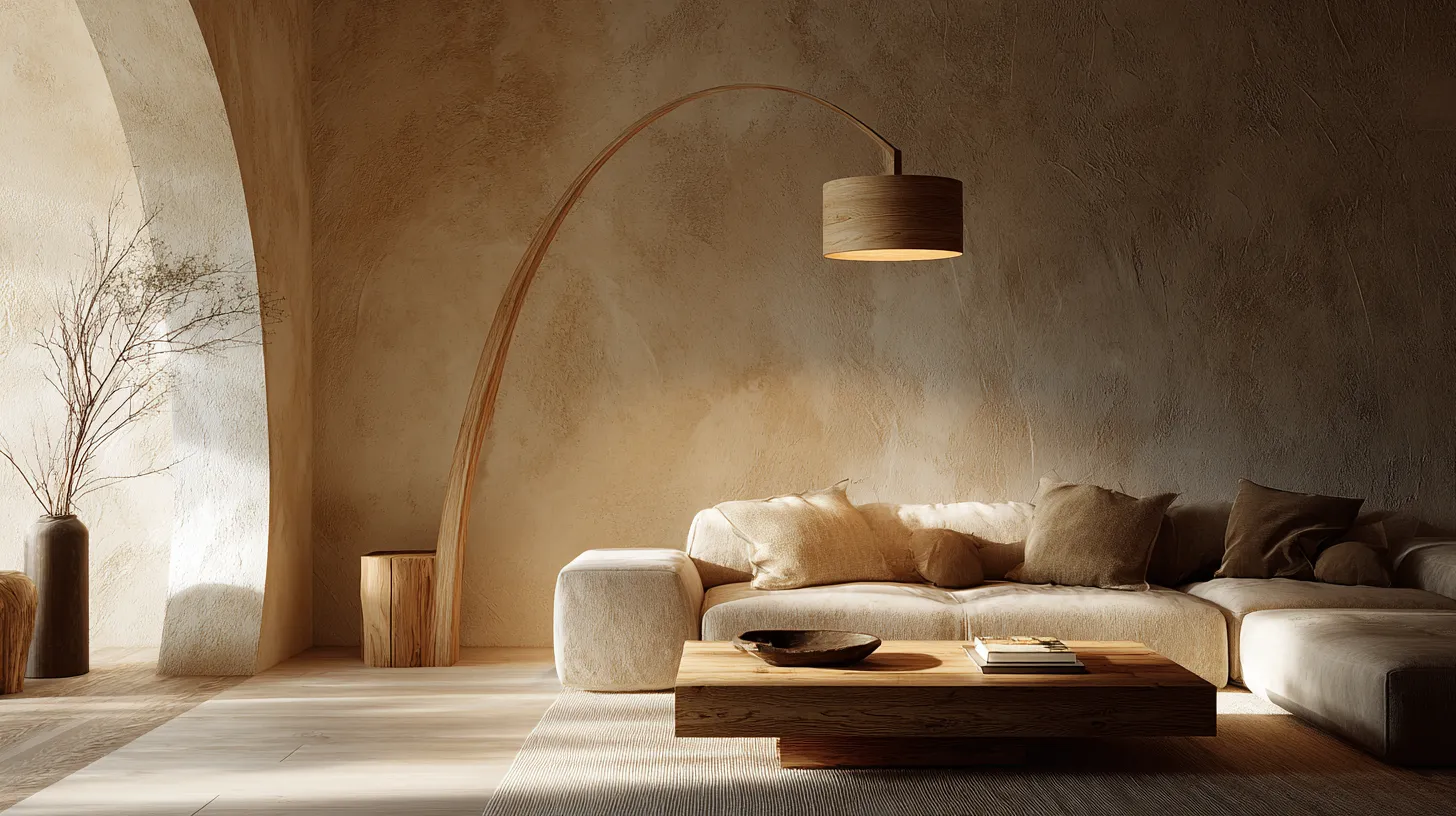
There is a moment in every well-lit room where everything feels exactly right. The light is warm without being heavy. The shadows fall softly. You sink into the sofa and feel, without quite knowing why, that you are home.
That feeling is not accidental. It is designed — quietly, intentionally, with care.
Modern living room lighting is one of the most powerful tools in interior styling, and one of the most overlooked. Most of us stop at a single ceiling fixture and call it done. But light, when layered thoughtfully, transforms a room the way nothing else can.
At ERYLIN, we believe beautiful lighting is not a luxury. It is a necessity — and it is more achievable than you think. Whether your living room is sun-drenched and spacious or compact and rented, this guide will show you exactly how to light it with intention.
What Modern Living Room Lighting Actually Means
Modern lighting is not about cold, clinical brightness or gallery-white walls. It is about atmosphere. It is about choosing light that moves with you through your day — from the soft gold of a slow morning to the warm amber of an evening gathering.
A truly modern living room lighting plan is layered, dimmable, and human-scaled. It works with your architecture, your furniture, and your routines. It does not fight for attention. It holds the room together.
Think of lighting less like a fixture and more like a material — as considered as linen, as textured as wood, as warm as candlelight.
The Three Layers Every Living Room Needs
Great lighting always starts with layers. Each layer serves a different purpose, and together they create the depth and flexibility a living room demands.
Ambient Lighting: The Base Layer
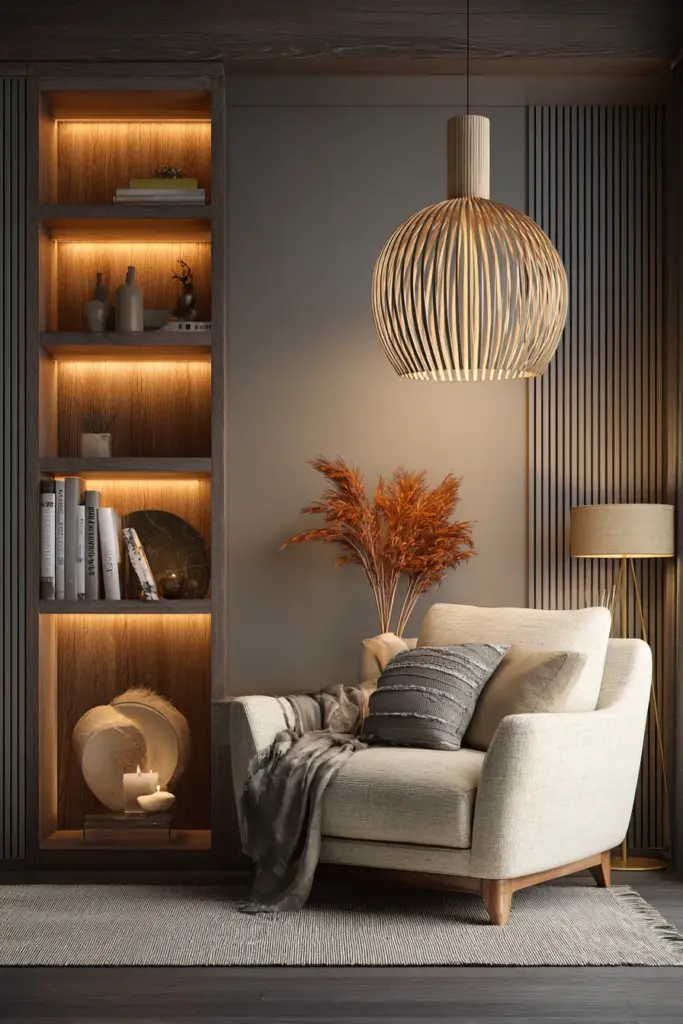
Ambient light is your room’s foundation. It fills the space evenly and replaces natural light when the sun goes down.
In a modern living room, ambient light works best when it is soft and diffused — never harsh. Think flush-mount fixtures with frosted glass, recessed downlights on a dimmer, or a sculptural pendant that casts light upward and outward.
Avoid the single overhead bulb trap. One ceiling light creates flat, unflattering light that flattens texture and kills atmosphere.
Task Lighting: Light That Works With You
Task lighting serves a purpose. It targets a reading chair, a side table, a desk corner. It is precise, practical, and often beautiful.
A well-placed floor lamp beside the sofa is one of the most hardworking pieces in a living room. A swing-arm sconce above a reading nook brings both light and character. A table lamp on a console anchors a wall and adds warmth at eye level.
The goal is to light activities, not just areas.
Accent Lighting: Light as Décor
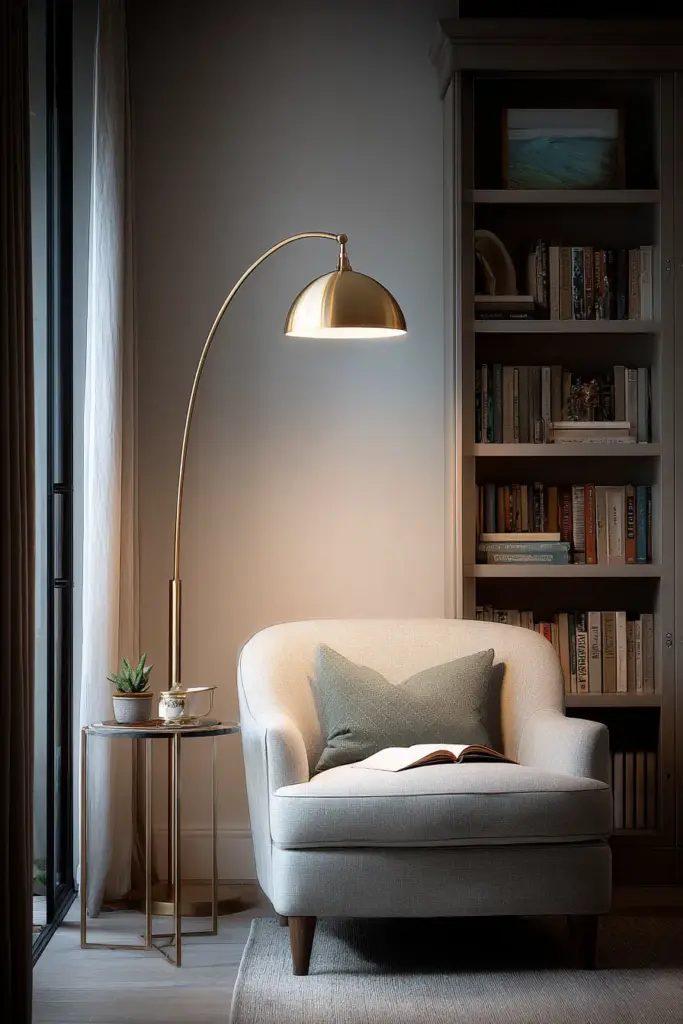
Accent lighting is where personality lives. It highlights what you love — a piece of art, a textured wall, a shelf of curated objects — and creates visual rhythm across the room.
Picture lights, directional spotlights, and LED strip lighting tucked behind shelving or under a media unit all count as accent lighting. They are the jewellery of the room: small, intentional, and deeply impactful.
Choosing the Right Fixtures for a Modern Living Room
Every fixture in your living room should earn its place — aesthetically and functionally.
Pendant Lights and Chandeliers
A statement pendant above a coffee table or seating area anchors the room and draws the eye upward. Choose one that complements your ceiling height and room scale.
Sizing rule: For an open-plan living room, aim for a pendant diameter (in inches) that roughly equals the room’s dimensions in feet added together. A 12 × 15 ft room suits a pendant around 27 inches wide.
Hang pendants so the bottom sits approximately 7 feet from the floor in rooms with standard ceiling height.
Floor Lamps
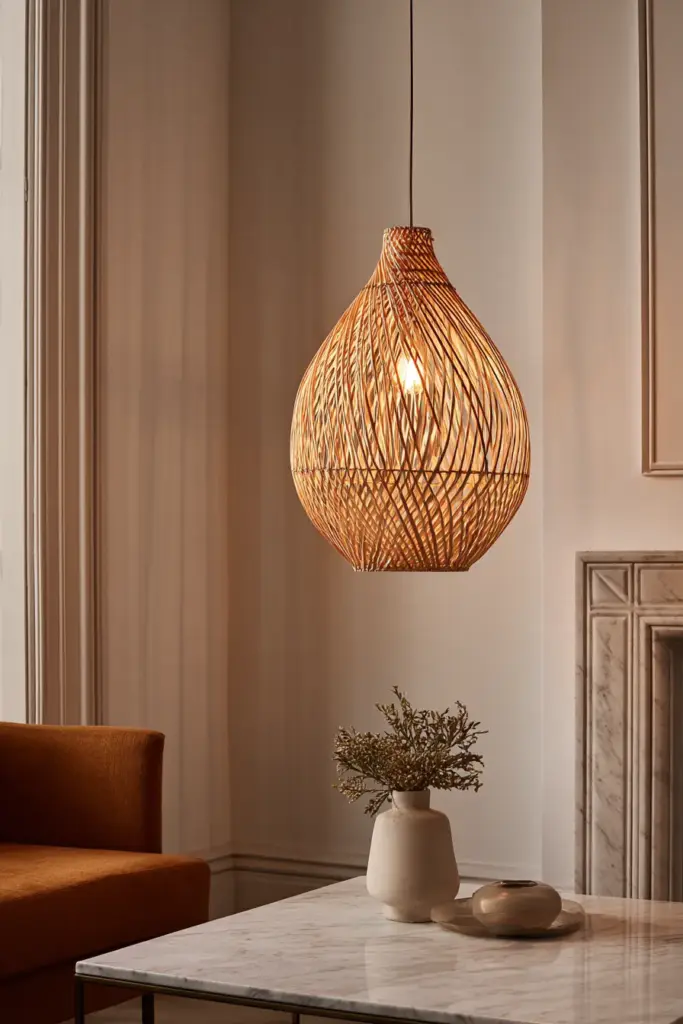
Floor lamps are the most versatile fixture in a living room. They move, they adapt, and they do not require an electrician.
An arching floor lamp over a reading chair creates a canopy of warmth. A tripod floor lamp in a corner adds sculptural interest. A torchière lamp bounces light off the ceiling to soften a whole room.
Wall Sconces
Wall sconces add layered light without taking floor space. Flanking a fireplace, framing a doorway, or sitting at picture-rail height, they create a sense of symmetry and intention.
For renters, plug-in sconces are a game-changer. They install in minutes, require no wiring, and look every bit as polished as hardwired versions.
LED Strip Lighting
Tucked beneath a floating shelf, behind a TV unit, or along the toe kick of a built-in, LED strips add depth and a sense of architectural glow. Keep the color temperature warm — 2700K to 3000K — for a result that feels designed rather than tech-driven.
Picture Lights
If you display art, a picture light is non-negotiable. It directs focused, flattering light onto your work without washing the whole wall. In a modern living room, a slim brass or matte-black picture light reads as both functional and refined.
How Bright Should Your Living Room Be? A Lumens Guide
Most people think about wattage. Lumens are what actually matter.
| Room Size | Recommended Lumens |
|---|---|
| Up to 100 sq ft | 1,000 – 2,000 lumens |
| 100 – 200 sq ft | 2,000 – 4,000 lumens |
| 200 – 300 sq ft | 4,000 – 6,000 lumens |
| 300+ sq ft | 6,000+ lumens |
These numbers are your total room target — spread across all your fixtures, not produced by a single bulb. A living room with a pendant (800 lm), two table lamps (400 lm each), and a floor lamp (600 lm) already reaches 2,200 lumens — a comfortable total for a medium-sized room.
Always use dimmers. The ability to move between 100% brightness for cleaning and 20% brightness for a film night is what makes a living room truly livable.
Color Temperature: Warm vs. Neutral vs. Cool Light
Color temperature is measured in Kelvin, and it shapes the entire emotional quality of a room.
| Kelvin Range | Quality | Best For |
|---|---|---|
| 2700K | Warm amber glow | Evening ambience, cosy living rooms |
| 3000K | Warm white | Balanced everyday light, modern interiors |
| 3500K | Neutral white | Reading, focused tasks |
| 4000K+ | Cool, crisp | Kitchens, offices — not ideal for living rooms |
For a modern living room, 2700K to 3000K is the sweet spot. It flatters skin tones, softens textures, and makes everything from timber floors to linen sofas glow.
Avoid mixing warm and cool bulbs in the same room. The visual conflict reads as unsettled, even if you cannot name why.
Lighting Layout for Every Room Size
Where you place light matters as much as what you choose.
Small Living Rooms
In a compact space, vertical lighting is your best friend. Wall sconces, tall floor lamps, and uplighters draw the eye upward and make ceilings feel higher.
Avoid large, low-hanging pendants that eat into visual floor space. Instead, choose flush mounts or semi-flush ceiling fixtures for ambient light, and use lamps to create warm pockets rather than flooding the whole room.
Reflective surfaces — mirrors, glass, polished metal — multiply light without adding a single fixture.
Medium Living Rooms (150–250 sq ft)
A medium living room can carry one central ambient fixture — a pendant or semi-flush mount — supported by floor lamps, table lamps, and at least one accent layer.
Create two or three distinct light zones: one around the sofa grouping, one near a reading or side chair, and one on the TV or feature wall. This zoning makes the room feel intentional and large.
Large and Open-Plan Living Rooms
Large rooms require multiple ambient sources — never just one central fixture. Think recessed downlights in a grid, supplemented by statement pendants over specific furniture clusters.
Define zones with lighting: a chandelier or grouped pendants over the main seating area, a floor lamp at the room’s edge, and picture lights or shelf lighting to create warm focal points that give the eye places to rest.
Day-to-Night Lighting Scenes
A truly well-designed living room changes with the light — and with your mood.
Morning: Bright, neutral light (3000K) to wake the space. Open blinds and let natural light do the work, supplemented by task lighting over a coffee corner or reading chair.
Working or Reading: Full ambient light plus a directed task lamp. Layer in your floor lamp beside the sofa or a swing-arm sconce at shoulder height.
Entertaining: Dim the overheads to 40–60%. Let table lamps and accent lighting carry the warmth. Light a candle. Let the room breathe.
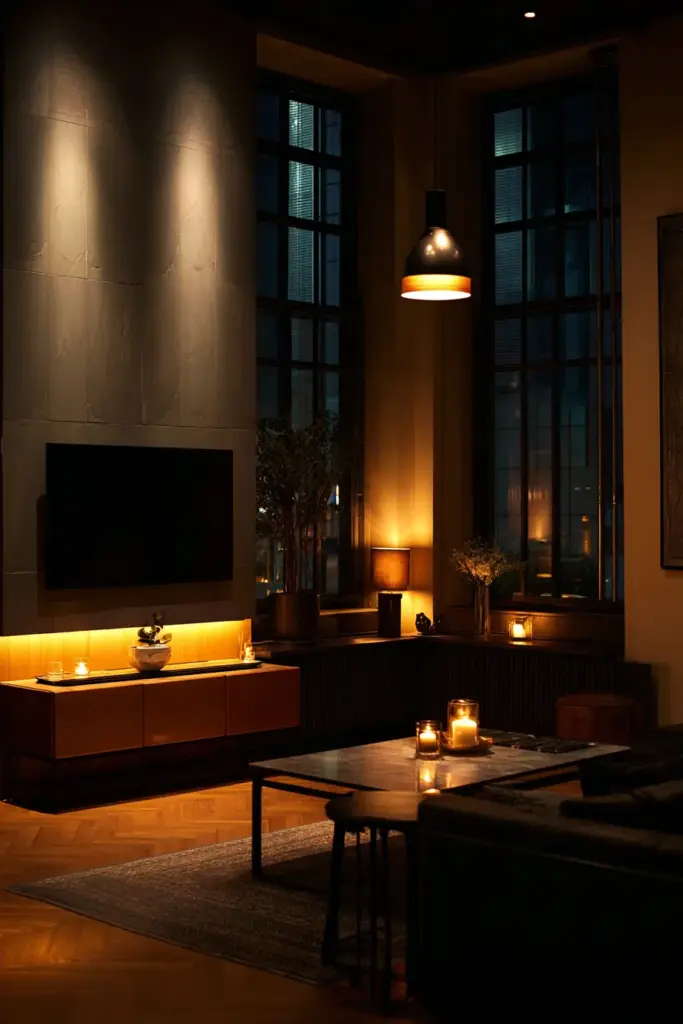
Movie Night: Overheads off. A strip of warm LED behind the television reduces eye strain without darkening the room completely. One low lamp in a far corner keeps the space from feeling like a cinema.
Common Lighting Mistakes to Avoid
Even beautiful rooms can be undone by lighting errors. Here are the most common ones.
- Relying on a single ceiling light. One source creates flat, shadowless light that reads as unfinished.
- Skipping dimmers. Fixed-brightness lighting gives you one mood. Dimmers give you all of them.
- Wrong fixture scale. A tiny pendant in a large room disappears. An oversized chandelier in a small room overwhelms. Always size for the space.
- Ignoring the TV wall. A bright overhead light behind a screen causes glare and eye strain. Backlight the TV with a warm LED strip to balance the contrast.
- Mixing color temperatures. Cool and warm bulbs in the same room create visual tension. Commit to one range throughout.
- Forgetting the corners. Dark corners make a room feel smaller and colder. A floor lamp or wall sconce in the corner expands the perceived space.
Renter-Friendly and Budget-Conscious Lighting Ideas
You do not need to own your home — or spend a fortune — to have beautiful lighting.
- Plug-in wall sconces mount with two screws and look identical to hardwired versions. Cord covers keep them tidy.
- Rechargeable table lamps go anywhere, no outlet required. Perfect for floating shelves or areas far from sockets.
- LED strips with adhesive backing add glow behind TVs, under shelves, and along skirting boards without a single tool.
- Clip-on spotlights directed at art or shelves create the effect of track lighting without installation.
- Smart bulbs in existing fixtures let you control color temperature and brightness from your phone — a low-cost way to add scene-setting capability to any lamp.
Quick Checklist: Modern Living Room Lighting Done Right
- Use at least three layers: ambient, task, and accent
- Choose warm bulbs between 2700K and 3000K
- Install dimmers on all overhead fixtures
- Light specific zones — sofa, reading corner, art wall — not just the room as a whole
- Match fixture scale to room size
- Add a warm LED strip behind your TV to reduce screen glare
- Use mirrors and reflective surfaces to multiply light in small spaces
- Explore plug-in and rechargeable options if you rent
Conclusion
Light is the quietest form of design — and the most transformative. It does not shout. It simply settles over a room, softening edges, warming surfaces, and turning a collection of furniture into a home.
The right lighting does not just help you see. It helps you feel.
Start with one layer. Add another. Adjust the warmth. Reach for the dimmer. You will notice the difference the first evening you sit down in the glow of a room that finally feels like yours.
That is what we believe at ERYLIN — that beautiful interiors are built slowly, thoughtfully, and with love. And it always starts with the light.
Frequently Asked Questions
How many lumens do I need for a living room?
Aim for roughly 10–20 lumens per square foot as a starting point. A 200 sq ft living room needs between 2,000 and 4,000 lumens in total, spread across multiple fixtures. Always pair your lighting plan with a dimmer so you can adjust brightness for different times of day.
What color temperature is best for a modern living room?
The ideal range is 2700K to 3000K. This produces a warm white to soft amber light that flatters textures, feels inviting in the evening, and complements natural materials like timber, linen, and stone. Avoid anything above 3500K in a living space — it reads as clinical rather than comfortable.
Should I use recessed lights or a chandelier in a modern living room?
Both can work beautifully, but for different rooms. Recessed downlights suit low-ceilinged or minimal spaces where a pendant would feel heavy. A chandelier or statement pendant works best in rooms with ceiling heights of 8 feet or more and adds immediate visual impact. In many modern living rooms, the best answer is both — recessed lights for ambient coverage and a pendant as a focal point.
How do I light a living room without ceiling wiring?
Plug-in sconces, floor lamps, table lamps, rechargeable lamps, and adhesive LED strips are all wiring-free solutions. A well-placed arc floor lamp can anchor a seating area the same way a ceiling pendant would. Add a plug-in sconce on either side of a sofa or fireplace for a layered, polished look — no electrician needed.
How do I avoid TV glare in living room lighting?
Position light sources to the sides of the screen rather than directly behind or in front of it. Adding a warm LED strip to the back of your TV unit softens the contrast between a bright screen and a dark wall, which reduces eye strain significantly. Dim overhead lights during viewing and let your accent lamps carry the room.
What is the best lighting for a small living room?
In a small living room, prioritise vertical light — wall sconces, tall floor lamps, and uplighters that draw the eye upward. Choose flush-mount or semi-flush ceiling fixtures rather than hanging pendants to preserve visual headroom. Use mirrors to bounce light and make the space feel larger, and layer your sources so the room feels warm and full without feeling crowded.