


Table of Contents
Updated June 2026
There is something deeply restorative about a living room that holds silence well. Not dead silence — but the soft, settled kind where you can hear yourself breathe, hear the rustle of a page turning, hear the warmth of your own home.
Modern living rooms are designed to open up, to flow, to connect. But open-plan spaces and hard contemporary finishes can turn everyday sound into exhausting noise. Traffic hum, a neighbor’s television, footsteps above — they seep in and steal the calm you’ve worked so hard to create.
The good news is that modern living room soundproofing doesn’t mean tearing down walls or sacrificing the clean, layered aesthetic you love. In fact, the most effective solutions are the ones that disappear quietly into your décor.
At ERYLIN, we believe your home should feel like a sanctuary. This guide will show you how to weave sound absorption into beauty — practically, affordably, and with intention.
Understanding Sound in Your Living Room
Before you reach for materials, it helps to understand what kind of noise you’re fighting.
Sound travels in two ways: airborne noise (voices, music, television) and impact noise (footsteps, furniture dragging, dropped objects). Each requires a slightly different approach, and most living rooms need to address both.
The STC rating — Sound Transmission Class — is the standard measure of how well a material blocks sound. The higher the STC, the quieter your space. Think of it as a quiet scale, from whispering rugs to solid-core doors.
Where Is the Noise Coming From?
Knowing the direction of your noise helps you treat the right surfaces first.
| Noise Source | Primary Solution | Supporting Layer |
|---|---|---|
| Neighbor through shared wall | Mass Loaded Vinyl + resilient channels | Acoustic panels, bookshelf wall |
| Footsteps from above | Acoustic ceiling tiles + insulation | Soft rugs, upholstered furniture |
| Street noise through windows | Soundproof curtains + acoustic caulk | Double-pane glass, window seals |
| Below (hollow floors) | Cork underlay + thick wool rugs | Floating furniture placement |
| General echo in room | Fabric panels + layered textiles | Curtains, cushions, wall art |
The Layered Approach: Sound Meets Style
Good soundproofing, like good interior design, is about layers. No single element does everything. But when you stack soft textiles, strategic furniture, and a few hidden acoustic materials, the result is a room that feels — and sounds — completely transformed.
Think of it the way you’d dress a bed: a rug as the foundation, upholstered pieces as the body, curtains and cushions as the finishing warmth.
Rugs and Flooring: The First Line of Quiet
Hard floors are beautiful and impossible to give up. But they reflect sound with remarkable efficiency.
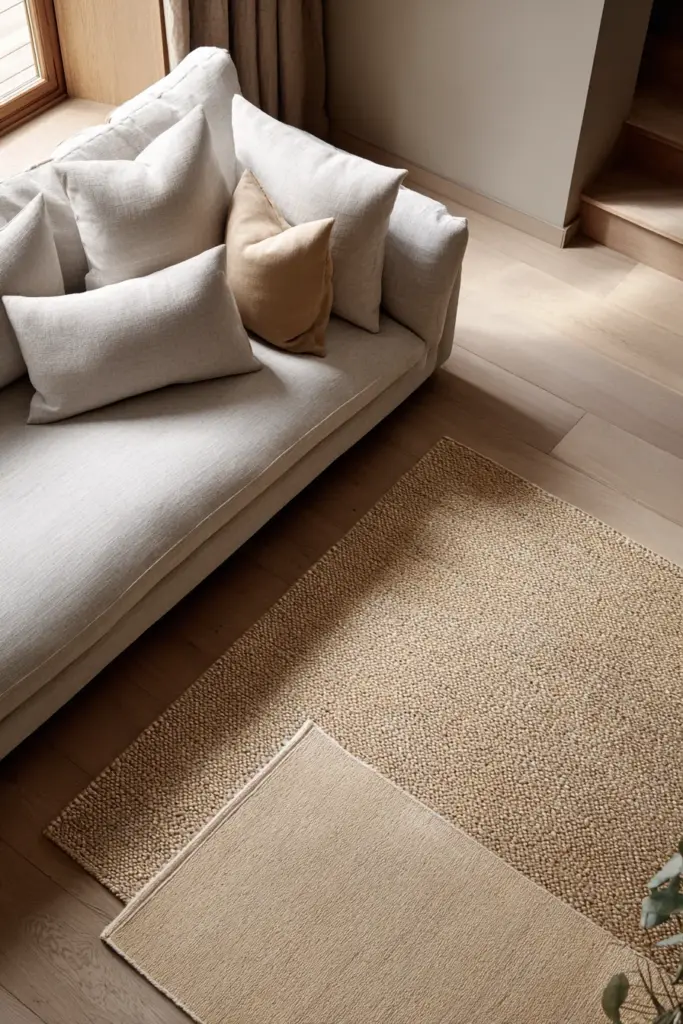
A thick wool rug — ideally with a dense underlay — is one of the single most impactful investments for sound absorption in a living room. Wool rugs in the $30–$80 range can reduce floor-bounce noise by a meaningful amount, especially in high-traffic areas.
- Choose rugs with a pile height of at least 10mm for best absorption
- Layer a cork or felt underlay beneath for impact noise from below
- In small spaces, a large single rug (covering 70–80% of the floor area) outperforms several smaller ones
- Natural fibres — wool, jute, sisal — absorb better than synthetic options
Curtains and Windows: Softening the Loudest Gaps
Windows are the most common entry point for outside noise. Even beautiful, well-fitted windows have gaps — and sound finds every one of them.
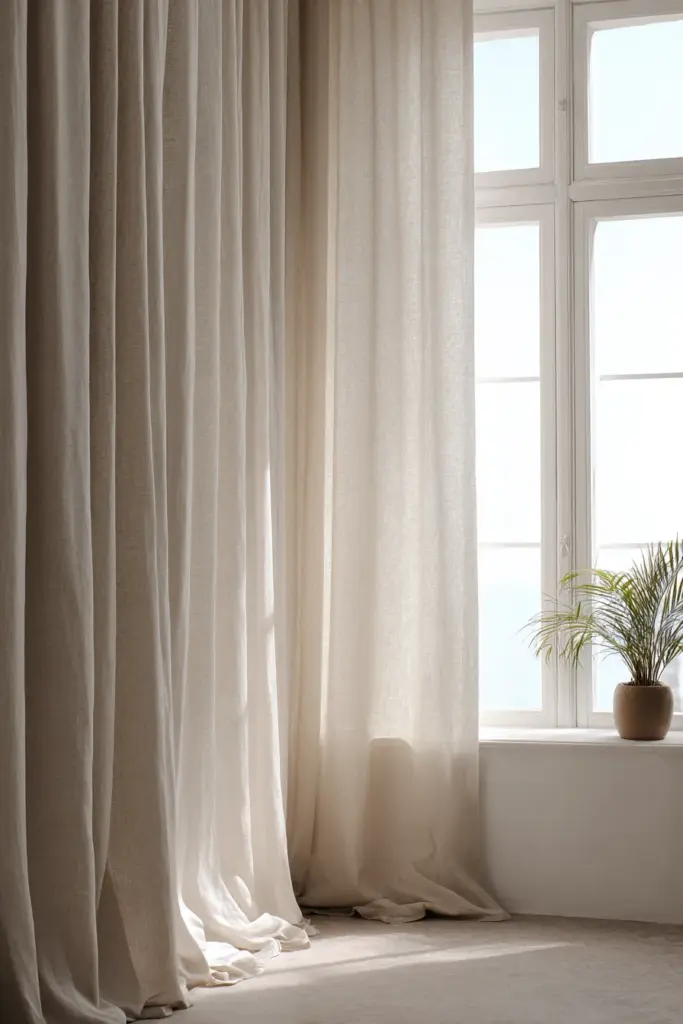
Acoustic lining blackout curtains in the $40–$100 range add both thermal and sound insulation without demanding a renovation. Hang them ceiling to floor, extending 15–20cm beyond the window frame on either side, so they create a full seal of softness.
For a more elevated look, layer sheer panels behind heavier drapes. The double layer traps a pocket of air — nature’s own acoustic buffer.
Don’t overlook acoustic caulk around window frames. A $10–$15 tube of acoustic sealant applied around gaps can make a noticeable difference, particularly for high-frequency noise like voices and traffic.
Upholstered Furniture: Beauty That Absorbs
Every soft surface in your living room is doing quiet, invisible work. A deep linen sofa, a tufted ottoman, cushion-stacked armchairs — they all absorb sound waves that would otherwise bounce between hard walls and ceilings.
When selecting pieces, lean toward:
- High-back sofas that interrupt sound paths across the room
- Upholstered headboards or panels used as feature walls
- Generous cushion quantities — not just for comfort, but for absorption
- Natural linen, velvet, and boucle fabrics, which absorb more sound than smooth synthetics
In small living rooms, floating your sofa 5–10cm off the wall creates a subtle sound buffer — sound waves pass behind the piece rather than reflecting directly off the shared wall.
Acoustic Panels: The Hidden Design Statement
Decorative acoustic panels have come a long way from grey foam squares. Today they’re available in natural wood wool, felt, linen-wrapped frames, and sculpted plaster — each one as much a design decision as a functional one.
Wood Wool Panels for a Japandi Aesthetic
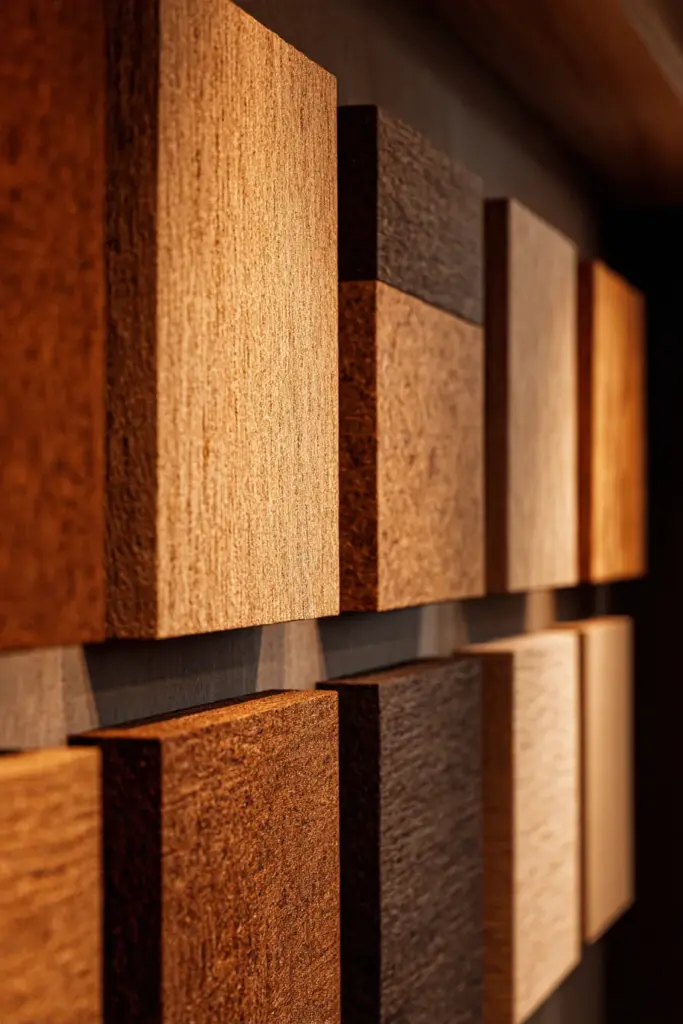
If your living room follows Japandi or modern rustic principles, wood wool acoustic panels are perhaps the most natural fit. Their warm, textured surface absorbs mid and high frequencies while echoing the organic warmth of natural wood furniture and linen upholstery.
Hang them as a gallery wall arrangement, flank your television, or use them to build a quiet feature behind a reading chair. At $20–$50 for DIY wood wool panels, they’re one of the most cost-effective acoustic investments you can make.
Acoustically Transparent Fabric Panels
For a cleaner, more gallery-like look, fabric-wrapped panels give you full creative control. Stretch acoustically transparent linen, bouclé, or even a favourite textile over a timber frame filled with acoustic batting.
These panels disappear into the wall in the best possible way. They read as art, as warmth, as intention — while quietly absorbing the noise that would otherwise live between your walls.
Comparing Acoustic Materials
| Material | Cost Range | Ease of Install | STC Improvement | Aesthetic Fit |
|---|---|---|---|---|
| Wool rug + underlay | $40–$120 | Easy | Moderate | All styles |
| Blackout acoustic curtains | $40–$100 | Easy | Moderate | All styles |
| Wood wool panels | $20–$80 | Moderate | Good | Japandi, rustic, modern |
| Mass Loaded Vinyl (MLV) | $80–$200 | Difficult | Excellent | Hidden (behind walls) |
| Fabric-wrapped panels | $30–$100 | Moderate | Good | Minimal, contemporary |
| Solid-core doors | $150–$400 | Professional | Excellent | All styles |
The Forgotten Details That Make All the Difference
Electrical Outlets and Socket Sealing
This is one of the most overlooked gaps in any soundproofing plan — and one of the cheapest to address.
Electrical outlets cut clean holes through your walls, and sound travels through them freely. Acoustic putty pads and outlet box seals cost just $5–$15 and can reduce noise transmission by up to 10%. Press acoustic putty behind each outlet box before replacing the cover, and use foam gaskets behind the face plates.
It takes twenty minutes and makes the kind of difference you feel rather than see.
Doors: The Quiet You Didn’t Know You Were Missing
Hollow-core interior doors are one of the biggest acoustic liabilities in a modern home. They’re lightweight, common, and nearly transparent to sound.
Solid-core doors — with an STC rating of 30–35 versus a hollow door’s STC of 20 — are one of the most effective single upgrades you can make. Pair them with door sweeps at the base and acoustic seal tape around the frame, and you’ve addressed an enormous percentage of airborne sound transfer.
For those not ready to replace doors, a heavy fabric door curtain hung on the interior side makes a meaningful aesthetic and acoustic difference.
Silent Ventilation: Keeping Fresh Air Without the Noise
One of the paradoxes of soundproofing is that sealing your space can compromise air circulation. The solution isn’t to leave gaps — it’s to choose ventilation thoughtfully.
Acoustic vent covers are designed to allow airflow while interrupting the direct path of sound. Silent extraction fans with acoustic insulated ducting prevent mechanical noise from travelling between rooms. These are small investments that protect both air quality and the quiet you’ve worked to create.
Lighting and the Perception of Quiet
This connection is more powerful than most people expect: the quality of your lighting directly affects how quiet a room feels.
Warm light in the 2700K–3000K range — the golden amber of a late afternoon — signals rest to the nervous system. It softens visual contrast and makes hard edges feel gentler, which in turn reduces the sense of acoustic pressure in a space.
Diffused light sources — fabric lampshades, indirect cove lighting, frosted pendants — scatter light the way soft furnishings scatter sound. A room lit softly with layered sources feels larger, calmer, and inherently quieter than one lit with a single overhead fixture.
Pair warm lighting with your acoustic layers and the effect is cumulative: the room doesn’t just sound quieter, it feels quieter.

Budget Soundproofing: What to Do First
You don’t need a renovation budget to make a meaningful difference. Here is a practical priority order for budget-conscious soundproofing:
- Under $50: Acoustic outlet seals, door sweep, acoustic caulk around windows and skirting gaps
- $50–$150: Large wool rug with felt underlay, acoustic lining curtains
- $150–$300: DIY fabric-wrapped acoustic panels or wood wool panels, solid-core door
- $300–$500: Mass Loaded Vinyl for the loudest shared wall, professional sealing of window frames
- $500+: Resilient channel drywall, double-pane window upgrades, professional acoustic treatment
Start at the bottom of the list. The most affordable steps — sealing gaps, adding soft furnishings — often deliver the most noticeable improvement relative to cost.
Soundproofing Checklist: Your Quiet Living Room
- Lay a thick wool rug (with underlay) over the primary seating area
- Hang acoustic-lined curtains, floor to ceiling, beyond the window frame
- Apply acoustic caulk around window frames and skirting boards
- Seal electrical outlets with acoustic putty pads ($5–$15)
- Add door sweep and acoustic seal tape to primary doors
- Float sofa 5–10cm off shared walls for a sound buffer
- Hang wood wool or fabric-wrapped acoustic panels as a feature wall
- Choose upholstered, high-back furniture over hard-edged pieces
- Layer cushions and throws generously across seating
- Switch overhead lighting to warm, diffused sources (2700K–3000K)
- Install acoustic vent covers if ventilation is a concern
- Consider solid-core door replacement for the highest-traffic noise path
A Final Thought
Quiet is not emptiness. It’s presence — the presence of warmth, of texture, of thoughtful design that holds sound rather than scattering it.
The living room you’re imagining already knows what it wants to become. A little wool, a little warmth, a layer of intention at every surface. You don’t have to choose between a beautiful home and a quiet one.
Explore ERYLIN’s collection of natural textiles, layered lighting, and acoustic-friendly furniture to begin building the sanctuary your living room has always been reaching toward.
Frequently Asked Questions
Can you soundproof a living room without renovation?
Yes — and for most people, non-invasive methods deliver the most noticeable improvement. Start with thick rugs and underlay, acoustic curtains, outlet seals, door sweeps, and soft furnishings. These steps require no construction and can reduce ambient noise significantly, especially in apartments where impact and airborne sound are the main concerns.
What is the cheapest way to soundproof a living room?
The most affordable first steps are acoustic outlet seals ($5–$15), door sweeps ($10–$20), and acoustic caulk around window frames ($10–$15). A large wool rug with felt underlay ($40–$120) and acoustic-lined curtains ($40–$100) complete the budget tier and offer the best return for the cost.
Does acoustic foam actually soundproof a room?
Acoustic foam reduces echo and reverberation — it improves how sound behaves within a room. But it does not block sound from entering or leaving. For true soundproofing (preventing transmission), you need mass and decoupling: dense materials like MLV, solid-core doors, and sealed gaps. For most living rooms, a combination of both is the most effective approach.
Is soundproofing a living room worth it?
For anyone living with chronic noise — traffic, neighbors, shared floors — the answer is a clear yes. Even modest improvements compound: each layer of soft furnishing, each sealed gap, each added mass contributes to a cumulative reduction in noise. The mental and physical benefits of a quieter home are well-documented, and most acoustic improvements also add warmth and visual texture to your space.
What causes echo in a living room, and how do I fix it?
Echo is caused by sound reflecting off hard, parallel surfaces — bare floors, plain walls, large glass windows. The fix is surface softness and irregularity: rugs break up floor reflection, fabric panels interrupt wall bounce, and curtains soften window echo. Bookshelves filled with books are a surprisingly effective acoustic diffuser. The more varied and soft your surfaces, the less your room will echo.