
Table of Contents
There’s a particular kind of stillness that settles into a well-designed room — the kind you feel in your feet before you even look up.
Japandi living rooms have that quality. Born from the quiet philosophy of Japanese wabi-sabi and the cozy warmth of Scandinavian hygge, Japandi interiors are spaces that breathe. And the floor? It’s the first breath.
At ERYLIN, we believe that choosing the right Japandi flooring isn’t just a practical decision — it’s an act of intention. The floor sets the emotional temperature of the whole room. Get it right, and everything else — the soft linen sofa, the ceramic vase, the low teak shelf — falls into place with a kind of natural grace.
This guide walks you through everything you need to know about Japandi living room flooring matching: from the best materials and finishes, to how your floor speaks to your walls, furniture, and light.
What Makes a Floor Truly Japandi?
Before we dive into materials, let’s talk about feeling. A Japandi floor doesn’t shout. It grounds.
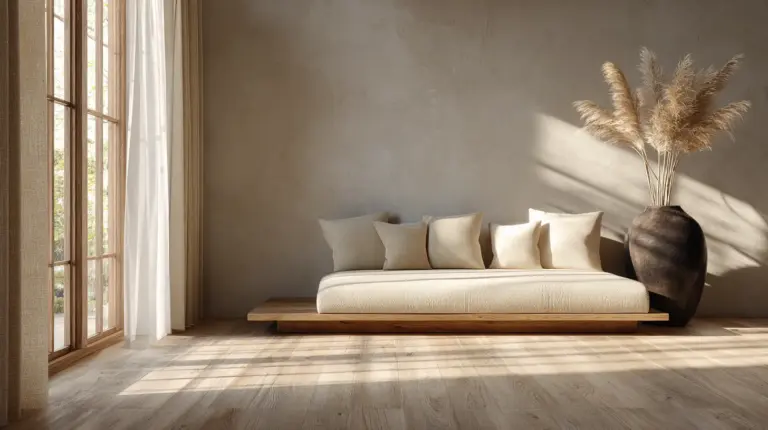
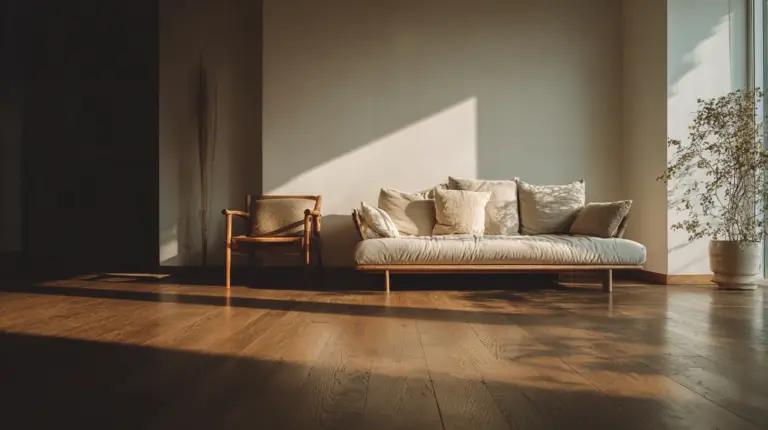
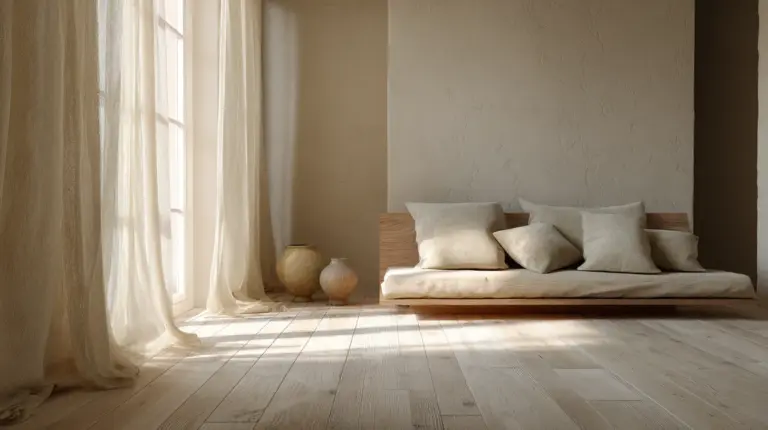
Japandi flooring tends toward light to mid-tone natural hues — the pale ash of a winter morning, the warm honey of aged bamboo, the cool stillness of brushed concrete. The finish is almost always matte, never glossy. A glossy floor is too energetic for a space that values calm.
The key qualities to look for are:
- Neutral or warm undertones (beige, greige, sand, warm grey)
- Matte or satin finish — never high-gloss
- Natural grain or texture — visible but not dramatic
- Minimal pattern — or a very subtle one, like a soft herringbone
- Sustainable materials when possible — Japandi is a philosophy, not just an aesthetic
Think of it this way: your floor should feel like the ground beneath a forest. Present, textured, alive — but never competing for attention.
The Best Flooring Materials for a Japandi Living Room
1. Light Oak and Ash Wood — The Classic Choice
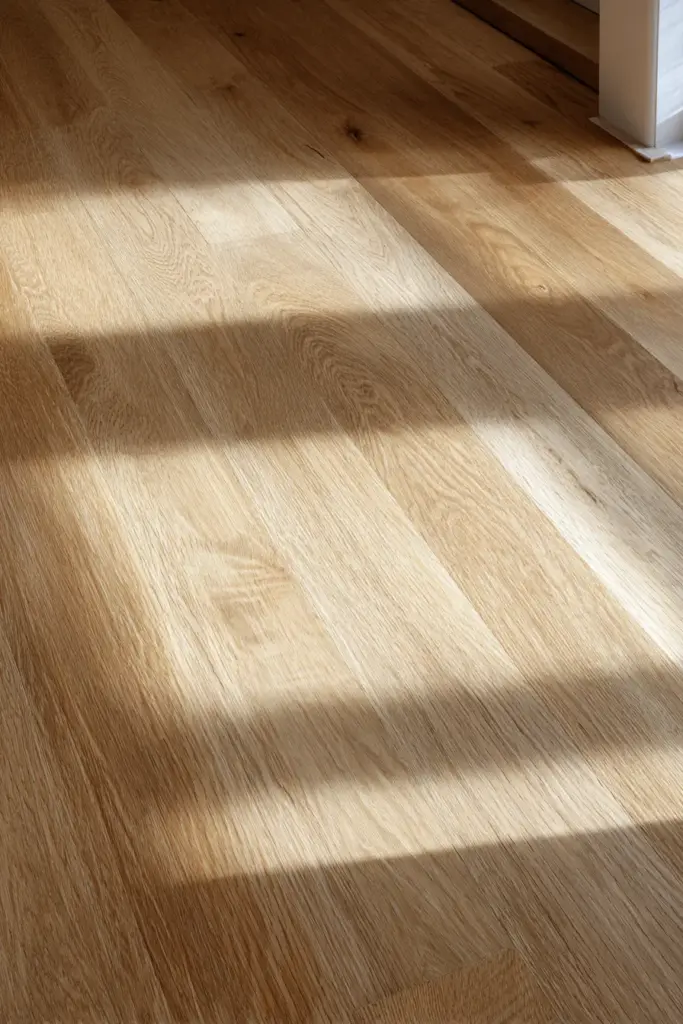
Nothing anchors a Japandi living room quite like wide-plank wood in a pale, natural finish.
Light oak and ash wood are the gold standard for Japandi flooring. Their subtle grain patterns bring organic warmth without visual noise. Wide planks — typically 150mm to 220mm — read as calm and spacious, especially in smaller rooms.
Look for engineered oak or ash with a wire-brushed or matte lacquered finish for durability without losing the natural feel. The wire-brushed texture adds a gentle tactile quality that feels intentional underfoot.
Matching tip:
Pair light oak floors with walls in warm white, linen, or greige. Avoid stark cool greys — they fight the wood’s warmth. A cozy Japandi sofa in undyed linen or soft charcoal will feel perfectly at home.
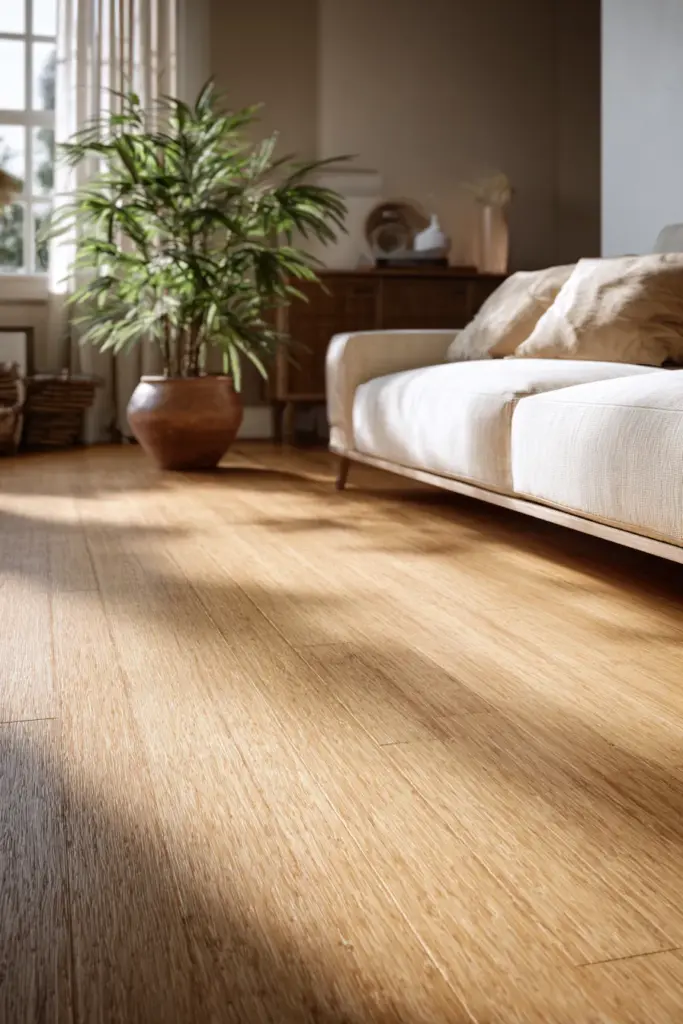
2. Bamboo Flooring — Sustainable and Serene
Bamboo floors carry a quiet honesty — grown fast, aged beautifully, designed to last.
Bamboo is one of the most eco-friendly flooring options available, and it fits Japandi interiors with an almost uncanny naturalness. Natural or carbonized strand-woven bamboo gives you a surface that’s harder than most hardwoods, with a fine, linear grain that reads as both minimal and warm.
For a true Japandi feel, choose horizontal-grain bamboo in natural tan tones. Avoid the very dark carbonized options — they lean too dramatic for the Japandi palette.
Look for bamboo with FSC certification to align with the sustainability values embedded in Japandi philosophy.
Small space tip:
In rooms under 25 square meters, lay bamboo planks lengthwise along the longest wall. This visual trick elongates the room and keeps the space feeling open and unhurried.
3. Concrete and Concrete-Look Tiles — For the Cool, Minimalist Room
Concrete floors have a kind of poetic austerity — like a clean breath before sunrise.
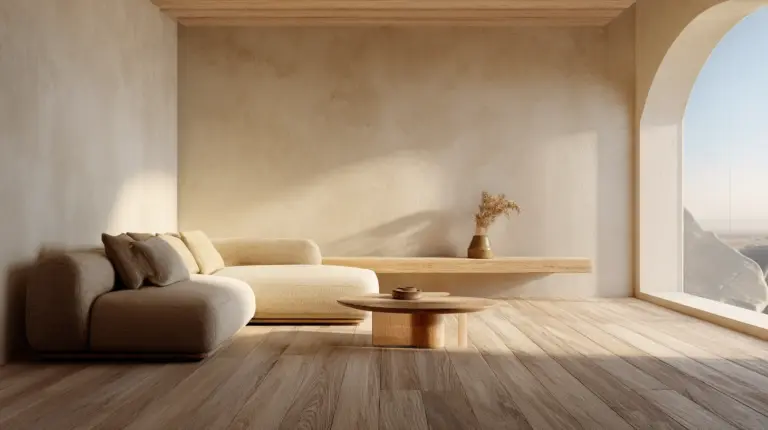
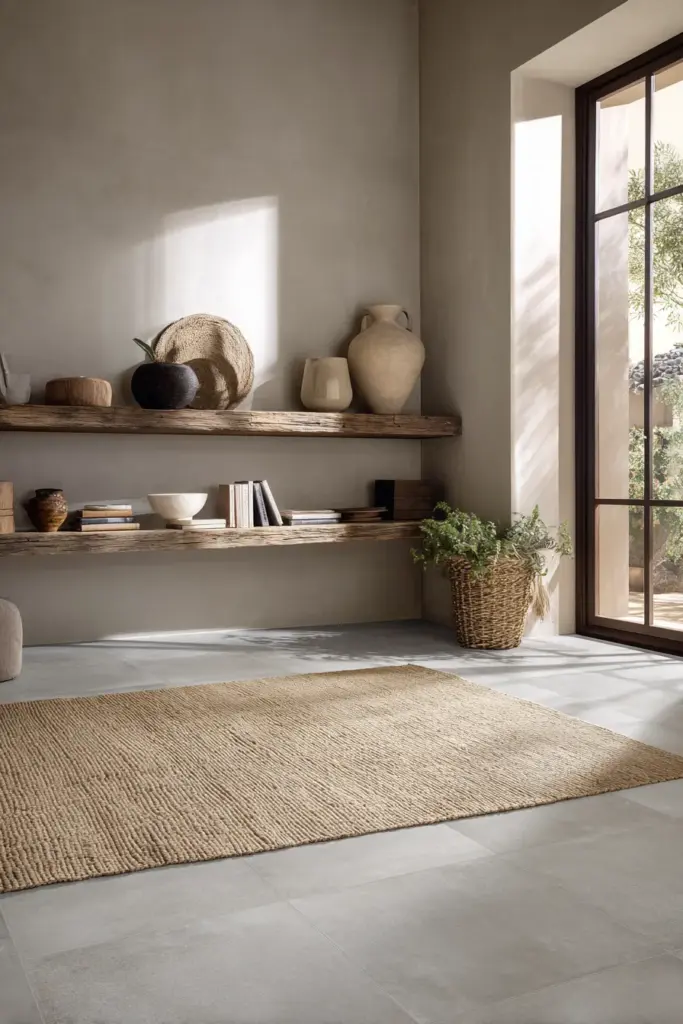
Raw or polished concrete brings the Japanese minimalist side of Japandi to the fore. It’s cool, smooth, and beautifully quiet. In living rooms, honed concrete or large-format concrete-look porcelain tiles are more practical — warmer underfoot (especially with underfloor heating), easier to maintain, and available in a range of Japandi-perfect tones from pale dove grey to warm sand.
For a softened effect, layer a natural fiber rug — jute, seagrass, or a low-pile wool blend — over a portion of the floor. The contrast of cool concrete and warm textile is deeply Japandi.
| Concrete Option | Best For | Warmth Level | Maintenance |
|---|---|---|---|
| Polished raw concrete | Large, open rooms | Low | High |
| Honed concrete | Minimalist interiors | Medium | Medium |
| Concrete-look porcelain tiles | All room sizes | Medium-High | Low |
| Large format matte grey tiles | Budget-friendly look | Medium | Low |
4. Cork Flooring — The Underrated Gem
Cork feels like walking on a whisper. It’s warm, it’s quiet, and it’s alive in the best possible way.
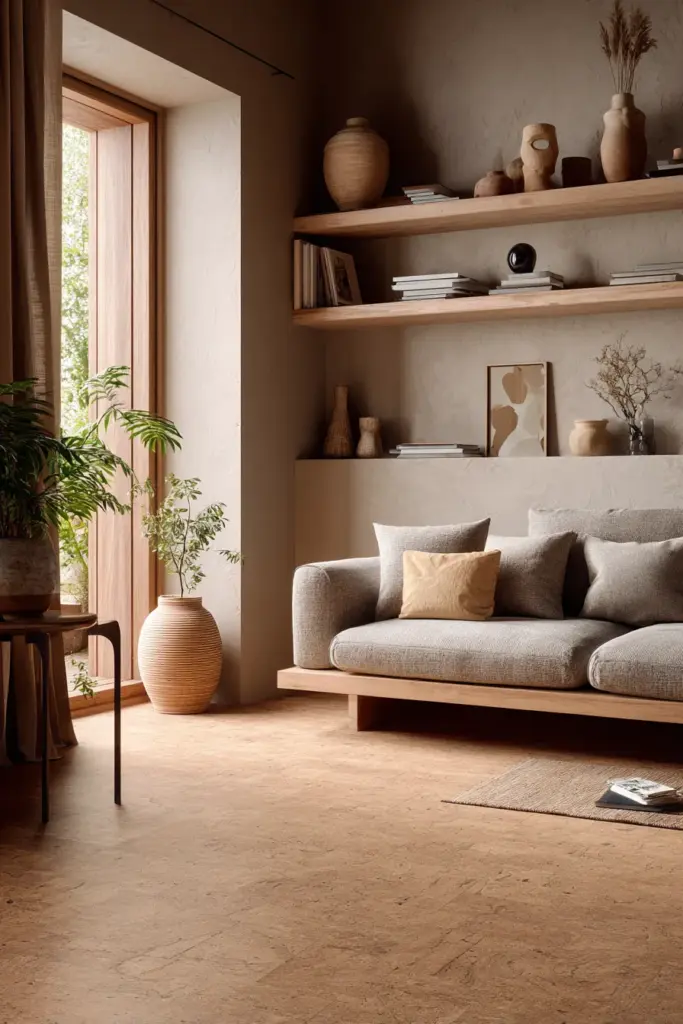
Cork is still underused in Japandi design — which makes it a beautiful differentiator. It’s naturally insulating (warm in cooler months, cool in tropical climates), soft underfoot, and has a subtle cellular texture that reads as organic and intentional.
Choose cork in natural sand or warm taupe tones, sealed with a matte finish. Avoid bright or unfinished cork — it can read as craft-room rather than curated living space.
Cork is also one of the most sustainable flooring choices available. Harvested from bark without cutting the tree, it regenerates every nine years. For a brand like ERYLIN — and a design philosophy like Japandi — that matters.
5. Stone and Stone-Effect Flooring — Grounded in the Earth
There is something ancestral about stone underfoot. It reminds us, gently, where we come from.
Limestone, travertine, and slate all have a place in the Japandi vocabulary. Light travertine in a honed finish brings warmth and organic variation. Pale slate offers cooler, more Japanese-leaning tones. Both pair beautifully with natural wood furniture and wabi-sabi-inspired decor.
For warmer climates (like the Philippines or Southeast Asia), large-format stone-effect tiles are the practical answer. They’re cooler underfoot in summer, easy to clean, and offer the stone aesthetic without the maintenance demands of real stone.
How to Match Your Japandi Flooring to Walls and Furniture
The floor doesn’t live in isolation. It’s in constant conversation with every other surface in the room.
Floor-to-Wall Matching
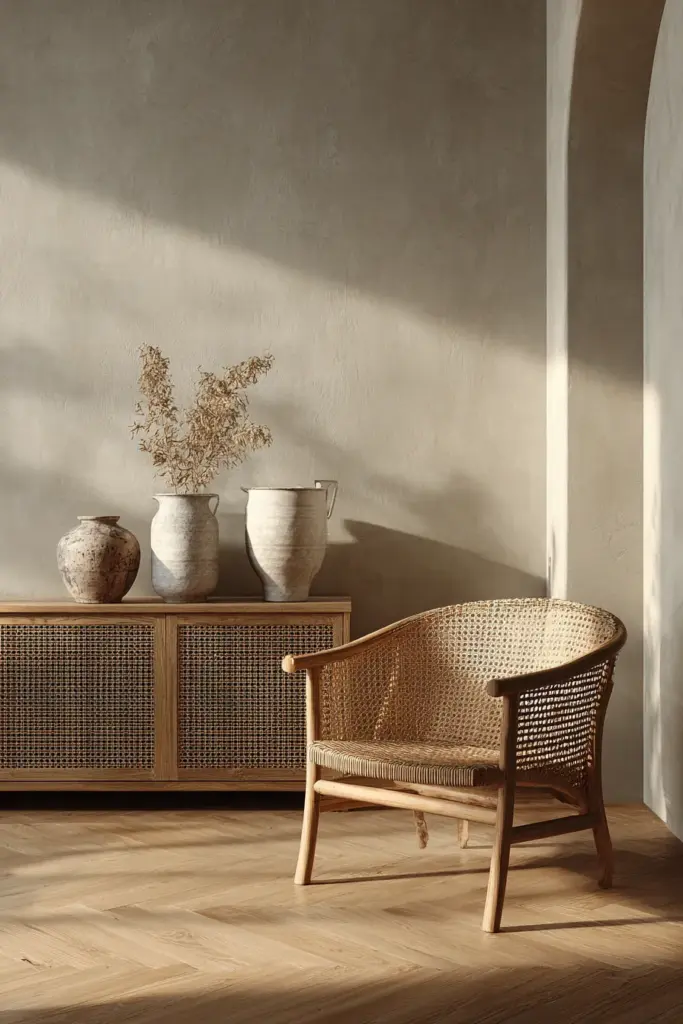
The most harmonious Japandi interiors use a tonal approach — walls and floors within the same color family, with subtle variation for depth. Here are the pairings that work beautifully:
| Floor Tone | Wall Color | Effect |
|---|---|---|
| Light oak (warm honey) | Warm white or soft cream | Serene, luminous |
| Natural bamboo (tan) | Greige or pale sand | Earthy, grounded |
| Concrete grey (cool) | Warm white or clay | Balanced contrast |
| Cork (warm taupe) | Linen white or oat | Cocoon-like warmth |
| Light travertine | Soft sage or dusty white | Spa-like calm |
Avoid high-contrast pairings — dark floor with brilliant white walls, for example — unless you’re leaning heavily into the Japanese minimalist end of the spectrum.
Floor-to-Furniture Matching
Your flooring should complement, not match your furniture. The goal is a layered, natural harmony — not a showroom suite.
- Light oak floor + rattan or natural cane furniture — timeless, warm, endlessly Japandi
- Bamboo floor + low-profile teak or walnut pieces — tonal depth with organic variation
- Concrete floor + linen sofa + raw wood coffee table — cool base, warm layers
- Cork floor + pale ash shelving + ceramic accents — soft, tactile, poetic
For lighting ideas that complement your Japandi floor, consider warm-temperature bulbs (2700K–3000K) in pendant or floor lamp forms. The way light falls across a matte wood or concrete floor in the late afternoon is one of Japandi design’s quiet joys.
Japandi Flooring for Small Living Rooms
Small spaces ask only one thing of their floors: don’t make us feel smaller.
In compact living rooms, your flooring choices become even more important. A few principles that genuinely help:
- Choose wide planks or large tiles — fewer grout lines or seams make the eye travel further
- Run planks lengthwise toward the main window or focal point to draw the eye outward
- Keep floor and wall tones close — this blurs the boundary and expands the perceived space
- Avoid dark floors in small rooms — they absorb light and shrink the space
- Use a single, well-placed rug rather than multiple smaller ones — it anchors the seating area without fragmenting the floor plane
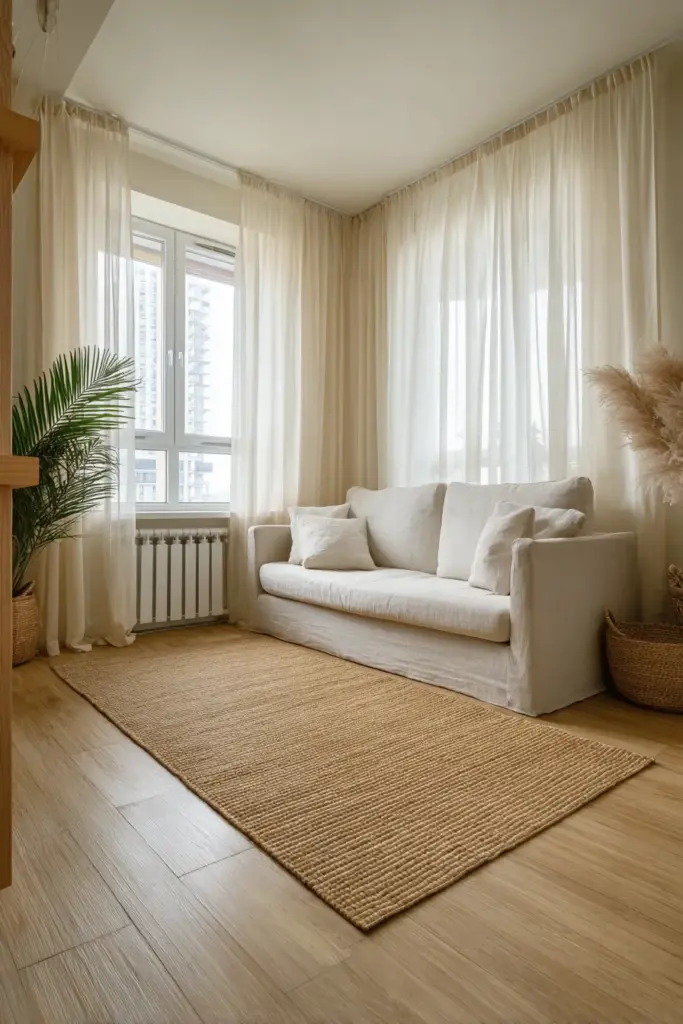
A 20–30 sqm Japandi living room with light oak floors, greige walls, and a single jute rug can feel remarkably spacious — and deeply, quietly beautiful.
Climate Considerations: Flooring in Humid Environments
Wood and humidity have a complex relationship. Understanding it helps you choose wisely.
If you’re designing a Japandi living room in the Philippines, Southeast Asia, or any tropical climate, humidity is a real consideration. Here’s what holds up:
- Engineered hardwood (over solid wood) — the layered construction resists warping and expansion
- Strand-woven bamboo — denser and more dimensionally stable than traditional bamboo
- Porcelain tile (concrete-look or stone-look) — completely unaffected by humidity
- Vinyl plank (SPC or WPC core) — 100% waterproof, excellent for humid climates, and now available in beautifully realistic wood and stone finishes
For solid wood or natural cork in humid climates, ensure proper vapor barriers, maintain indoor humidity between 40–60%, and use silica gel dehumidifiers or air conditioning to manage moisture levels. Acclimatize all natural flooring for 48–72 hours before installation.
Can I Use Vinyl or Laminate for Japandi Floors?
Yes — and done well, no one will know the difference.
Budget-conscious design doesn’t have to compromise on soul. SPC (Stone Plastic Composite) vinyl plank flooring has reached a level of realism that genuinely impresses. Look for:
- Wide-plank formats (6 inches or wider)
- Embossed-in-register texture — the texture aligns with the printed grain for a realistic feel
- Matte finish — essential for the Japandi look
- Warm wood tones — natural maple, pale ash, or whitewashed oak
Quality vinyl plank is also 100% waterproof, scratch-resistant, and click-lock installable — making it a smart choice for rental apartments, high-traffic living rooms, or homes with pets.
Japandi Flooring: Quick-Reference Checklist
Use this before you finalize your flooring decision:
- Does the floor tone fall within the Japandi palette? (light to mid-range neutrals, warm or cool)
- Is the finish matte or satin? (avoid gloss)
- Does the material feel natural, or convincingly so?
- Does it complement — not match — the planned wall color?
- Is it appropriate for your climate? (especially important in tropical regions)
- Have you considered a natural fiber rug as a layering element?
- Is the material sustainably sourced or certified? (FSC, GREENGUARD, etc.)
- For small rooms: are the planks or tiles large enough to avoid a busy surface?
- Is it compatible with underfloor heating if relevant?
- Does walking on it feel good? (This matters more than people admit)
Conclusion: The Floor Beneath Your Life
A Japandi living room is not assembled. It’s cultivated.
The floor you choose becomes the ground your daily life moves across. The place where bare feet land on a quiet morning. Where soft afternoon light spreads into long gold rectangles. Where the texture of natural wood or stone whispers something true about the way you want to live.
Choose slowly. Touch the samples. Bring them home and live with them in your own light. A floor is not just a surface — in a Japandi space, it’s a statement of calm.
At ERYLIN, we design with this belief at the center: that the most beautiful interiors are the ones that feel most like you. May your floor be the foundation of a home you truly love.
Frequently Asked Questions
What is the best flooring for a Japandi living room?
Light oak, ash, and bamboo are the most popular choices — they bring warmth, natural grain, and neutral tones that are core to the Japandi aesthetic. For warmer or more humid climates, engineered hardwood, strand-woven bamboo, or concrete-look porcelain tiles are excellent alternatives. The key is a matte finish and a tone in the light-to-mid neutral range.
What flooring goes with Japandi style?
Japandi style pairs best with flooring that has natural textures and neutral tones — think pale wood, natural bamboo, honed concrete, or stone-look tiles. Wide planks in warm beige, sand, greige, or soft grey are ideal. The finish should always be matte; glossy floors conflict with the calm, unhurried mood of Japandi interiors.
How do I match Japandi flooring with walls and furniture?
Use a tonal approach: keep your floor and wall colors within the same color family with subtle contrast. Light oak floors pair beautifully with warm white or greige walls. For furniture, aim for natural materials — rattan, teak, linen, and ceramic — that echo your floor’s organic quality without matching it exactly. The goal is layered harmony, not a matched set.
Can I use vinyl or laminate for Japandi floors?
Yes — SPC vinyl plank and quality laminate in wide-plank, matte-finish formats work very well in Japandi living rooms. Look for embossed-in-register textures in natural wood tones (pale maple, ash, or whitewashed oak). These options are also waterproof and more affordable, making them practical for tropical climates and high-traffic spaces.
How do I choose Japandi flooring for a small living room?
In small rooms, choose wide-plank formats and run them lengthwise toward the main focal point or window. Keep the floor and wall tones close in value to blur boundaries and expand the perceived space. Light tones always make small rooms feel larger. Anchor the seating area with a single natural fiber rug rather than multiple smaller ones.