
Table of Contents
Technology doesn’t have to disrupt the peace of your home. In fact, when woven thoughtfully into a small Japandi living room, it can deepen the sense of calm you’ve worked so hard to create.
The Japandi aesthetic — that beautiful marriage of Japanese minimalism and Scandinavian warmth — thrives on intentionality. Every object earns its place. Every surface breathes with purpose.
And technology? It belongs here too, as long as it remains invisible to the eye and effortless to the soul. In small spaces especially, smart devices can expand your room’s potential without cluttering its spirit.
Let’s explore how to integrate technology into your compact Japandi sanctuary with grace, warmth, and a touch of poetry.
Why Technology Belongs in Your Small Japandi Living Room
Japandi design isn’t about rejecting the modern world — it’s about curating it with intention.
In a small living room, smart technology becomes your silent partner. It manages light when natural sun fades. It adjusts temperature without bulky radiators. It plays music from speakers you’ll never see.
The key is seamless integration. Hidden cables, wood-covered devices, voice-activated controls — these are the modern tools that honor traditional simplicity. Your tech should feel like part of the room’s soul, not an interruption of it.
Smart Lighting: The Heart of Japandi Ambiance
Layered Light for Small Spaces
Light in a Japandi room is never harsh, never singular. It pools in corners, filters through paper, glows softly from unexpected places.
Smart lighting systems like Philips Hue (available under $100 for small rooms at Lazada Philippines) let you orchestrate this dance. Adjust brightness from your phone. Schedule lights to mimic sunrise. Create scenes for reading, resting, or welcoming guests.
In Manila’s dense urban landscape, circadian lighting can be transformative. Program your bulbs to shift from cool morning tones to warm amber by evening, supporting your body’s natural rhythms even when you’re far from nature.
Natural Light Enhancement
Layer your smart lights with what already exists. Use automated sheer curtains or smart window treatments that adjust throughout the day. They preserve privacy during afternoon heat while maximizing golden hour glow.
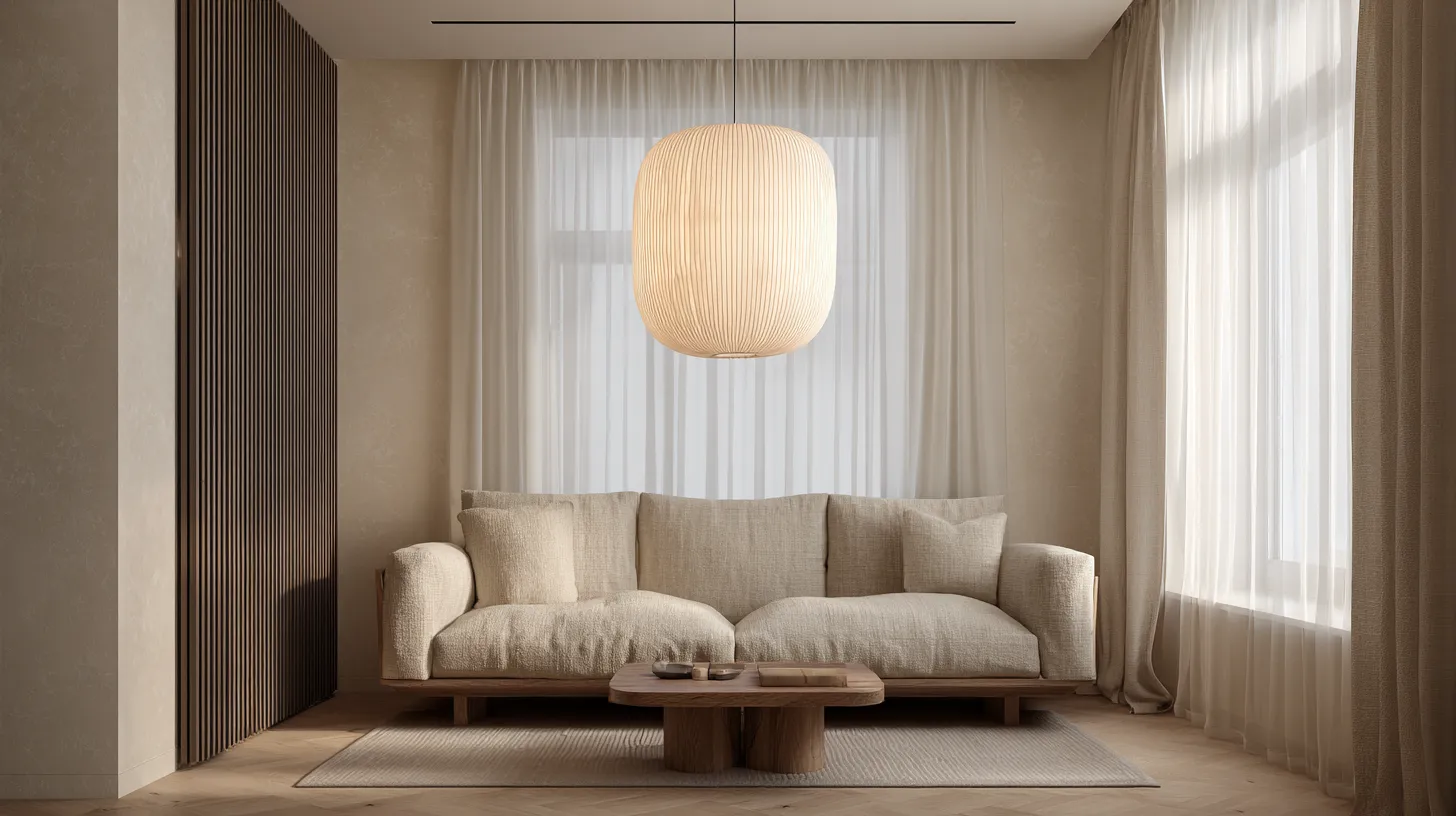
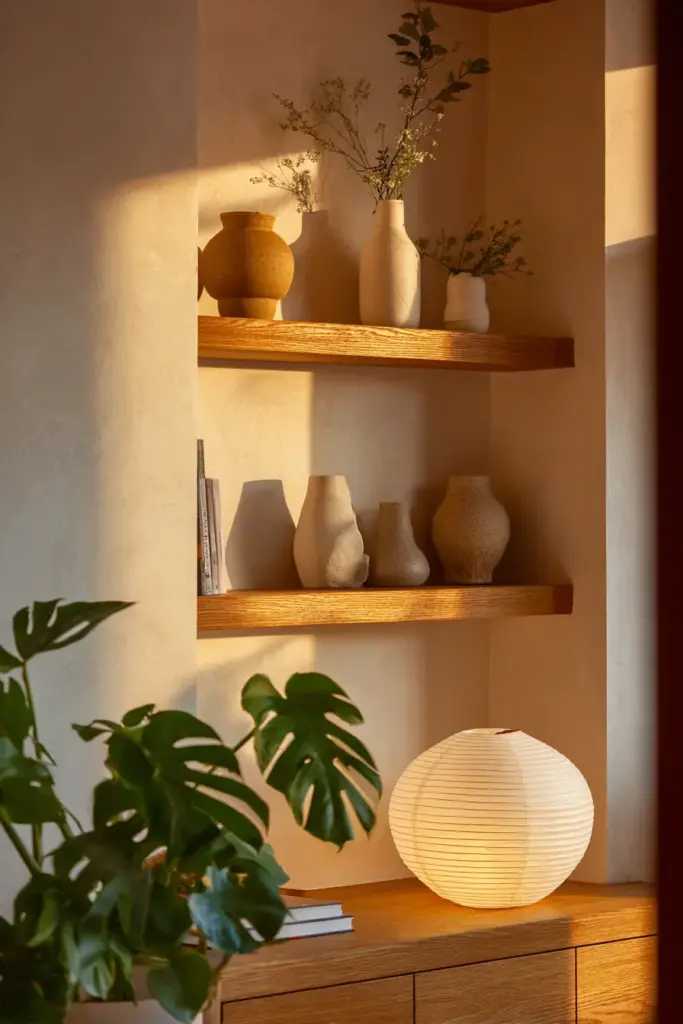
Paper lanterns — those iconic Japandi fixtures — now come with integrated smart bulbs. The texture remains organic, the control entirely modern. You get tradition and technology in one gentle sphere of light.
For renters in compact Manila apartments, consider battery-powered smart puck lights under floating shelves. No wiring needed. Instant warmth activated by voice or timer.
Hidden Technology: Maintaining Visual Calm
The Art of Concealment
Minimalism demands that technology stays out of sight until summoned.
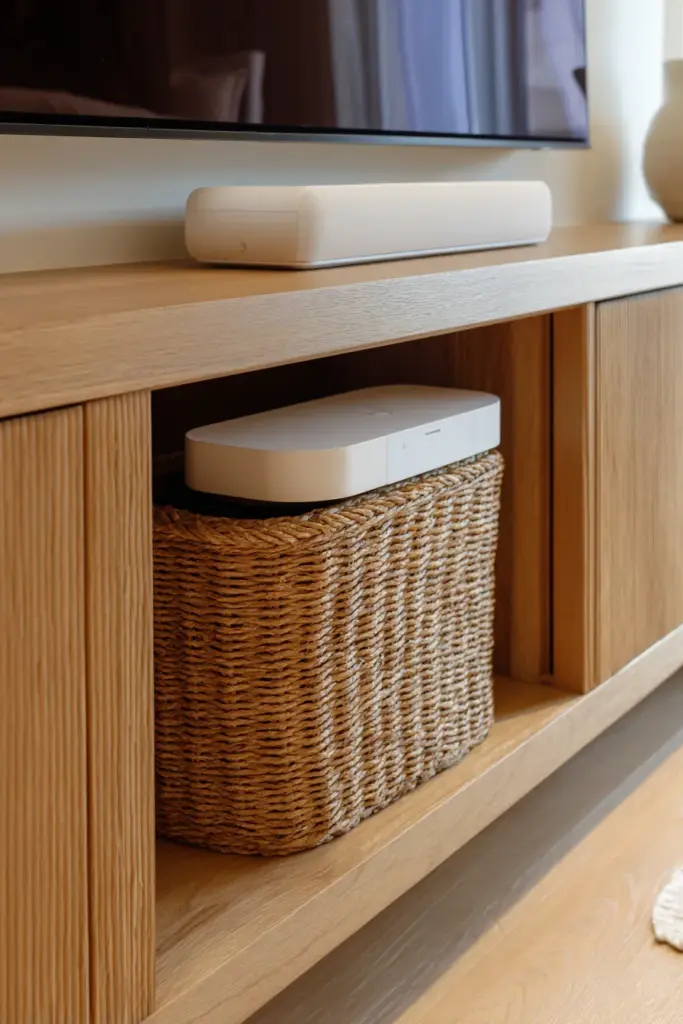
Mount your TV inside a custom wood-paneled frame that blends with your wall when turned off. Sites like my-inspo suggest soundbars wrapped in natural fabric or recessed into floating media consoles made from light oak or walnut.
Cable management is poetry in practice here. Use under-sofa cable channels or drill discrete holes in furniture to route wires invisibly. Bamboo cable boxes blend seamlessly on shelves, disguising charging stations and power strips.
Fabric-covered speakers from brands like Sonos integrate into Japandi interiors beautifully. Choose linen or cotton in sand, clay, or charcoal. They become sculptural elements rather than tech intrusions.
Tech-Integrated Furniture
Multifunctional pieces are essential in small spaces, and technology can amplify their usefulness.
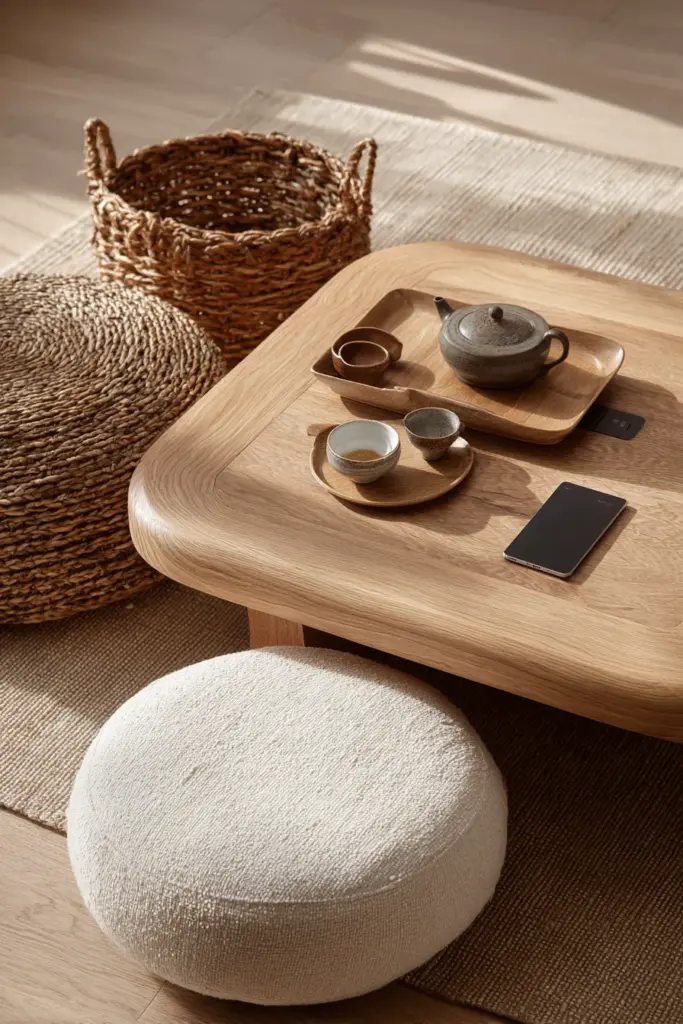
Consider ottomans with built-in wireless chargers. Your phone powers up while resting on handwoven rattan or natural linen. The technology is there, working silently, while the aesthetic remains pure.
Low Japanese-style coffee tables now come with hidden power outlets and USB ports tucked beneath their wooden surfaces. You gain function without sacrificing the clean lines that define Japandi design.
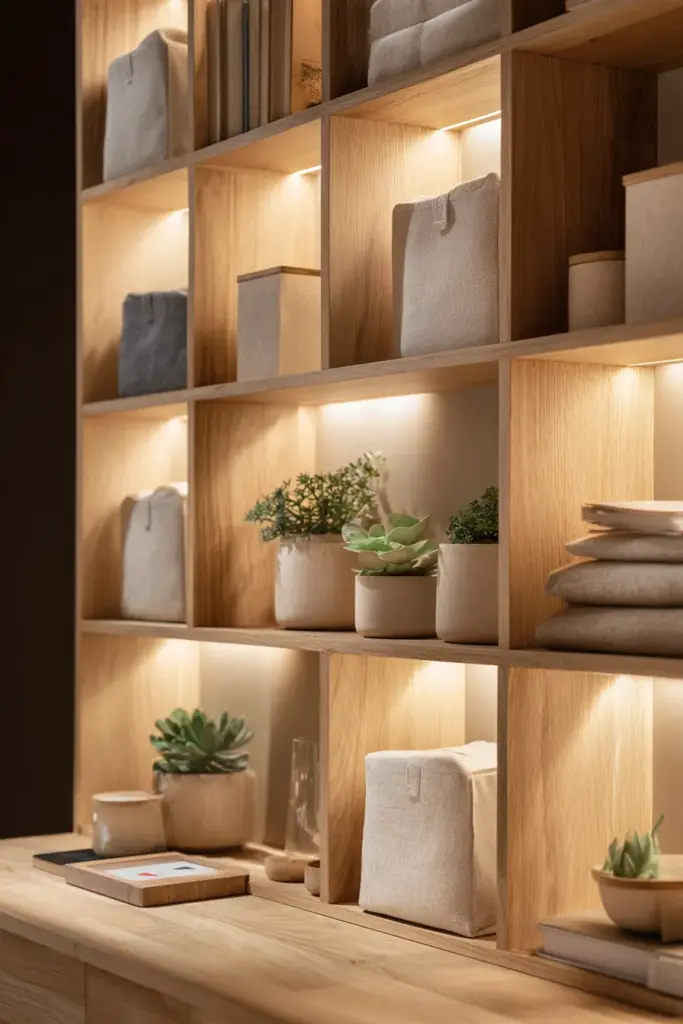
Modular shelving systems can incorporate LED backlighting on motion sensors — practical for nighttime navigation while creating gentle ambient glow that highlights your ceramics and plants.
Smart Climate Control for Small Humid Spaces
Temperature and Air Quality
Manila’s humidity can challenge even the most carefully designed interiors. Smart technology offers elegant solutions.
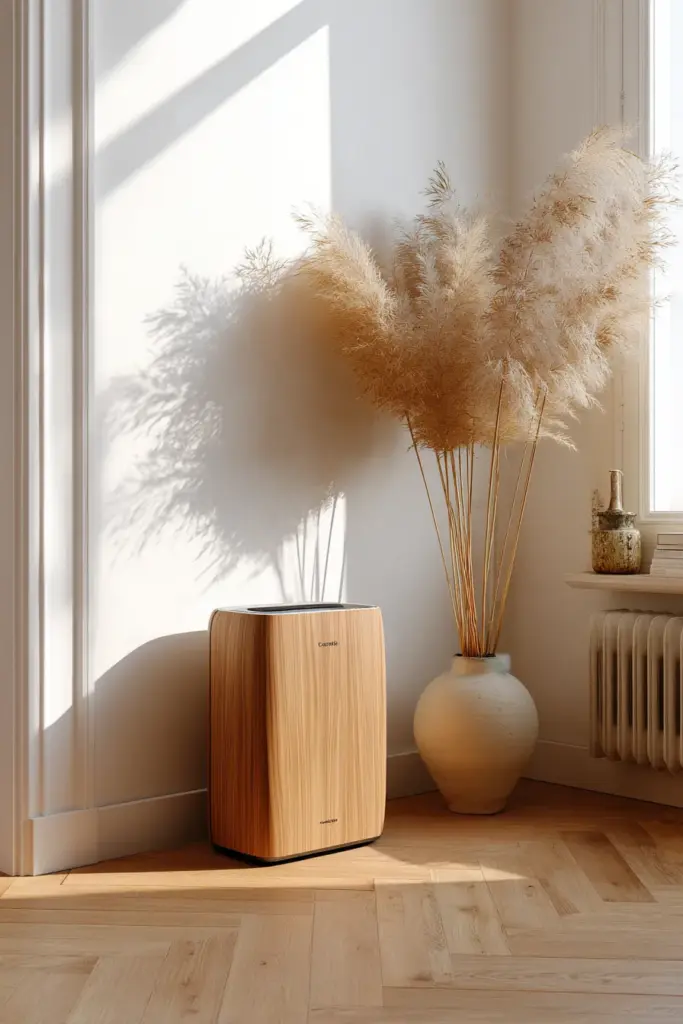
Smart dehumidifiers monitor air moisture levels automatically, running only when needed. Choose models in muted whites or wood-grain finishes that disappear into your palette. They protect your natural materials — preventing mold on linen cushions or warping in bamboo furniture.
Smart thermostats might seem excessive for smaller spaces, but voice-controlled fans and automated air purifiers make sense. Program them to run before you arrive home, so you walk into clean, comfortable air without constant manual adjustment.
For monsoon season, smart vents with humidity sensors alert you before moisture damage occurs. This is practical technology serving the longevity of your beautiful space.
Energy Efficiency Meets Philosophy
Japandi principles align naturally with sustainability. Smart plugs made from recycled materials let you monitor energy use and schedule devices to power down.
Solar-powered sensors for lighting or security embrace both eco-consciousness and the Japandi love of natural elements. They reduce dependence on grid power while maintaining your home’s serene aesthetic.
Track your consumption through simple apps. There’s something deeply satisfying — almost meditative — about understanding how your home breathes and uses energy.
Voice Assistants: Invisible Helpers
The best technology in a Japandi home is the kind you never touch.
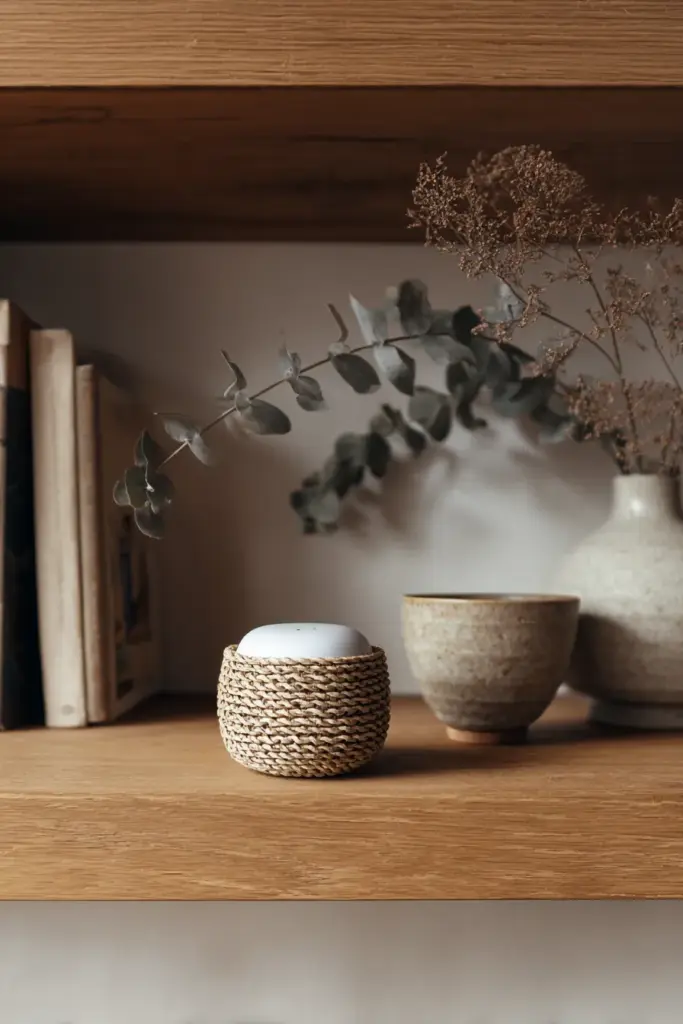
Voice assistants (Google Home, Alexa in compact, neutral-toned speakers) let you control everything without disrupting your clean surfaces with remotes and switches. Ask for music. Dim lights. Adjust temperature. All while your hands remain free for tea or a book.
Place these assistants strategically — perhaps inside a woven basket on a low shelf, or behind a ceramic planter. The voice remains, but the device itself becomes part of the textured landscape.
For small apartments, use smart home hubs that consolidate control. One discrete device manages lights, locks, climate, and entertainment. Fewer gadgets, more cohesion.
Sound Systems That Whisper
Integrated Audio Solutions
Music is texture in Japandi interiors — it should fill space without announcing its source.
Ceiling-mounted speakers or in-wall systems disappear entirely. For renters, explore portable smart speakers in natural materials. Bang & Olufsen and Marshall offer designs that feel at home beside pottery and plants.
Connect your system to streaming services focused on ambient, instrumental, or nature sounds. Let rain sounds ease you into evening. Let minimal piano accompany your morning coffee.
The point isn’t volume — it’s atmosphere. Technology that serves stillness.
Small-Space Smart Storage Solutions
Organization Meets Innovation
In compact Japandi living rooms, storage must work harder while looking effortless.
Smart storage ottomans do triple duty: seating, hidden storage, and wireless charging surfaces. Opt for natural linen or leather in warm neutrals.
Woven baskets can house small smart devices — routers, charging stations, backup batteries. They’re accessible but invisible, maintaining visual calm.
Consider modular furniture with app integration. Some contemporary Japanese furniture companies create pieces where drawers open via touch sensors, or shelves adjust height through smartphone controls. This is next-level minimalism — technology as invisible infrastructure.
Cable-Free Living
Wall-mounted wireless charging shelves eliminate visible cords while providing landing spots for phones and tablets. Choose wood or concrete finishes that echo Japandi materiality.
Use flat-profile surge protectors that tuck completely beneath furniture. Route remaining cables through furniture legs hollowed for this exact purpose.
The fewer wires you see, the more spacious your small room feels. Technology should add breathing room, not clutter.
Planning Your Tech-Enhanced Small Japandi Living Room
Layout Considerations
Start with AI design tools like those mentioned on arcadium3d. Upload your room dimensions and test layouts digitally before moving furniture.
Position tech-integrated pieces strategically:
- Smart TV opposite your seating, hidden when not in use
- Voice assistant centrally located but visually camouflaged
- Lighting controls accessible from main seating area
- Charging stations near where you naturally sit
Maintain flow and negative space. Technology should enhance your room’s openness, not interrupt it.
Budget-Friendly Tech Integration
You don’t need thousands to achieve this look. Here’s a realistic Manila-based breakdown:
| Item | Purpose | Est. Cost (PHP) | Where to Find |
|---|---|---|---|
| Philips Hue Starter Kit | Smart lighting | ₱3,500–₱5,000 | Lazada, Shopee |
| Smart plug set (4-pack) | Energy control | ₱1,200–₱2,000 | Ace Hardware, online |
| Fabric-covered speaker | Hidden audio | ₱4,000–₱8,000 | Sonos retailers, Spotify bundles |
| Wireless charging pad | Cable-free surface | ₱800–₱1,500 | Local tech shops |
| Smart dehumidifier | Climate control | ₱3,000–₱6,000 | SM Appliance, Abenson |
Total entry-level investment: ₱12,500–₱22,500
Start with lighting and climate — these deliver immediate atmosphere shifts. Add audio and charging as budget allows.
For Renters: Non-Permanent Solutions
Rent in Manila? Your tech can still be sophisticated.
Choose battery-powered or plug-in devices that require no installation. Smart bulbs screw into existing fixtures. Portable speakers move with you. Wireless everything.
Use 3M strips and adhesive clips for cable management that won’t damage walls. Opt for freestanding room dividers with integrated LED strips rather than built-in shelving.
When you move, your smart ecosystem travels intact. Japandi design, by its nature, is portable and thoughtful.
2026 Trends: What’s Coming in Smart Japandi Living
The technology landscape keeps evolving, and some developments align beautifully with Japandi principles.
Matter-compatible devices are arriving in 2026 — a universal smart home standard meaning your devices communicate seamlessly regardless of brand. Less complexity, more cohesion. Very Japandi.
AI-powered anticipation learns your patterns and adjusts automatically. Lights dim when you typically relax. Temperature shifts before you feel discomfort. Your home becomes intuitive, not just responsive.
Sustainable smart sensors made from recycled or biodegradable materials will finally merge eco-consciousness with innovation. Solar-powered motion sensors. Bamboo-cased air quality monitors. Technology that honors the earth it occupies.
Expect to see more health-focused integrations — circadian lighting to combat urban stress, air quality tracking for better sleep, soundscapes calibrated to reduce anxiety. Your small living room becomes a wellness sanctuary enhanced, not diminished, by thoughtful tech.
Essential Checklist: Small Japandi Living Room Tech Integration
Before you begin, consider these foundational elements:
- Assess your space’s specific needs — humidity levels, natural light availability, existing electrical access
- Choose a primary smart ecosystem (Google, Apple, Amazon) and stick with it for cohesion
- Prioritize invisible integration — hidden cables, wood-covered devices, voice control over visible switches
- Layer your lighting — combine smart bulbs, automated curtains, and natural sources
- Select multifunctional furniture — ottomans with charging, tables with hidden ports
- Install climate controls appropriate for Manila’s weather — dehumidifiers, smart fans
- Opt for natural-material tech — fabric speakers, bamboo accessories, recycled-material plugs
- Plan for future upgrades — choose Matter-compatible devices when possible
- Test before committing — many retailers offer return periods; experiment with placement
- Maintain visual calm — if you can see it, can you hide it better?
Bringing It All Together with Soul
Technology in a Japandi space isn’t about having the newest gadgets. It’s about creating an environment that responds to your needs before you articulate them.
It’s the lights that soften as evening approaches, matching your body’s natural wind-down. The music that fills your small room with warmth but never intrudes. The temperature that adjusts so subtly you don’t notice — you simply feel comfortable.
In small spaces especially, every choice must be deliberate. Smart technology, when chosen with care, makes small rooms feel larger, calmer, more yours.
Think of your devices as quiet servants of atmosphere. They don’t demand attention. They don’t clutter surfaces. They work in the background, holding space for what matters — your peace, your rituals, your life unfolding in beautiful simplicity.
This is the promise of technology in Japandi design: not more, but better. Not louder, but deeper. Not visible, but essential.
Your small living room can be a sanctuary where ancient principles of minimalism meet modern tools of comfort. Where wood meets wire in invisible harmony. Where you control everything while touching nothing.
Start small. Add one smart light. Notice how it changes your evening. Build slowly, always asking: Does this serve my calm, or disrupt it?
Let technology be the invisible thread that ties your small space into something expansive, something whole, something unmistakably yours.
Frequently Asked Questions
What are the key elements of a Japandi living room with integrated technology?
The foundation remains unchanged: muted colors, clean-lined furniture, natural wood textures, soft lighting, and living plants. Technology layers in through smart lighting systems, hidden speakers in fabric housings, automated climate control, and voice assistants tucked into woven storage. The key is invisibility — devices should disappear into the aesthetic while enhancing functionality.
How do I integrate smart technology in a small Japandi living room without cluttering the space?
Focus on hidden integration. Mount TVs inside wood panels that close when not in use. Run cables through furniture or under-sofa channels. Choose fabric-covered speakers and smart bulbs that replace standard ones. Use voice control to eliminate visible switches and remotes. Select furniture with built-in wireless charging and hidden ports. The rule: if technology is visible, it should look like natural decor.
What’s the best budget-friendly smart lighting for small Japandi spaces in the Philippines?
Start with Philips Hue starter kits (₱3,500–₱5,000 on Lazada or Shopee) which include bulbs and a hub for full control. For even tighter budgets, Xiaomi smart bulbs (₱500–₱800 each) work well and connect to Google or Alexa. Pair these with battery-powered puck lights under shelves for layered ambiance. Focus on warm white tones (2700K–3000K) that complement natural materials.
How can renters add smart technology to small Japandi living rooms without permanent installation?
All your tech should be portable. Use smart bulbs that screw into existing fixtures, plug-in smart speakers, wireless charging pads, and battery-powered accent lights. For cable management, use adhesive clips and 3M strips that remove cleanly. Choose freestanding furniture with integrated tech rather than built-ins. Everything should disconnect and travel with you when you move.
What smart home features work best in Manila’s humid climate for Japandi interiors?
Prioritize humidity control with smart dehumidifiers that auto-adjust based on moisture levels — essential for protecting natural materials like wood, linen, and rattan. Smart air purifiers help during traffic-heavy hours. Automated fans provide cooling without bulky AC units. During monsoon season, water leak sensors near windows prevent damage. Solar-powered devices reduce energy load during hot months while aligning with sustainable Japandi values.