
Table of Contents
By ERYLIN — your design-savvy companion for soulful, intentional spaces
There’s a particular kind of quiet that a well-designed room can hold. Not the cold silence of an empty space — but the soft, breathing stillness of somewhere that simply feels right. That’s the promise of Japandi design, and it’s a promise that gets even more intimate when the room is small.
A small Japandi living room isn’t a compromise. It’s an invitation to be deliberate — to choose only what you love, keep only what serves you, and let the rest exhale.
Whether you’re working with a 20-square-meter apartment in Calabarzon or a cozy condo unit in the metro, this guide will walk you through everything: the materials, the furniture, the light, and even the budget-friendly local finds that make this style truly yours.
We believe great design isn’t reserved for large spaces or large budgets. It’s for every room that deserves to feel like home.
What Is Japandi Style — And Why Does It Work So Well in Small Spaces?
Japandi is the quiet meeting point between Japanese wabi-sabi and Scandinavian hygge. It blends Japan’s reverence for imperfection and natural materials with Scandinavia’s love for functionality, warmth, and clean lines.
The result is a design language that feels both grounding and light — earthy but never heavy, minimal but never cold.
For small living rooms, this is practically a superpower. Japandi’s core principles — negative space, low-profile furniture, natural textures, and a muted palette — are the exact tools that make compact rooms feel open, serene, and intentional.
The Core Rules of Japandi Interior Design
| Principle | What It Means in Practice |
|---|---|
| Function first | Every piece earns its place |
| Natural materials | Wood, rattan, linen, stone, jute |
| Neutral palette | Warm whites, soft clay, greige, deep charcoal |
| Negative space | Empty space is design — don’t fill it |
| Low-profile furniture | Keeps the eye low, ceilings feel higher |
| Quiet art | One meaningful piece over a gallery wall |
These aren’t restrictions — they’re liberations. Fewer decisions, more harmony.
Does Japandi Work for Small Living Rooms?
Absolutely — in fact, small rooms might be where Japandi shines brightest. The style’s natural bias toward restraint means you’re never tempted to overdo it.
Scale-matched furniture, intentional negative space, and a cohesive neutral tone can visually expand a compact room without adding a single square meter. The key is choosing pieces that are appropriately proportioned — not tiny, but low and lean.
Think of it this way: in a small Japandi space, the room doesn’t feel small. It feels curated.
Building Your Small Japandi Living Room: Where to Start
1. Choose a Calm, Cohesive Color Palette
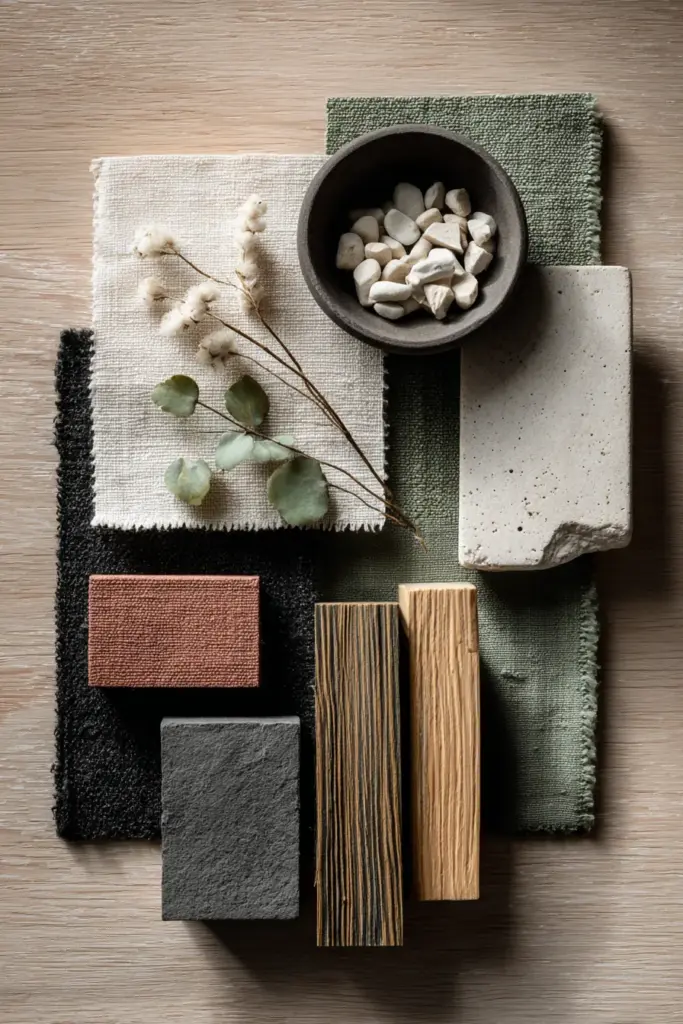
The foundation of any Japandi space is its palette. Think warm whites, soft greige, clay, dusty sage, or deep charcoal — never stark, never loud.
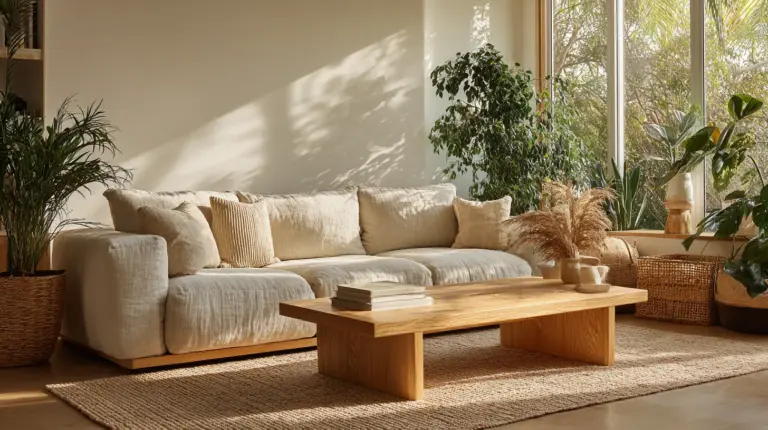
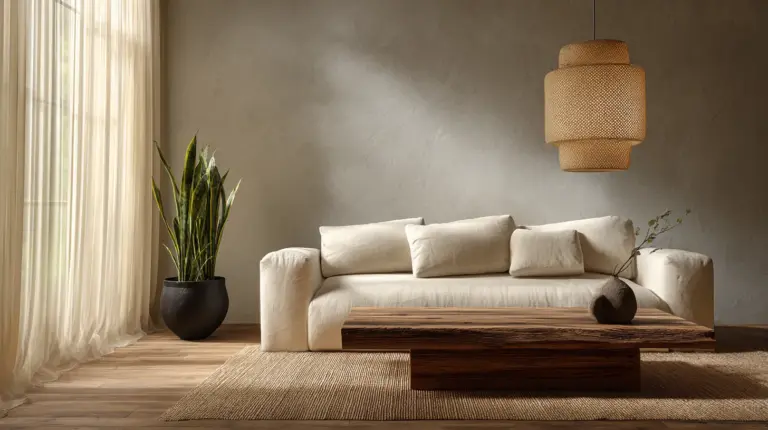
For small rooms specifically, keep 80% of the room in your lightest tone and use 20% for depth through textiles and one or two darker accents. A linen sofa in warm oat, a jute rug underfoot, a single matte black lamp — that’s enough contrast to feel intentional without feeling busy.
Avoid cool greys and overly sterile whites. Japandi warmth comes from the slight yellow or brown undertones that make a room feel lived-in and breathing.
Japandi Color Palette Quick Guide
| Role | Color Example | Use For |
|---|---|---|
| Base | Warm white, greige | Walls, ceiling |
| Primary neutral | Oat, sand, clay | Sofa, rug |
| Accent (warm) | Terracotta, dusty sage | Cushions, pottery |
| Anchor | Charcoal, deep walnut | Table, lamp, frame |
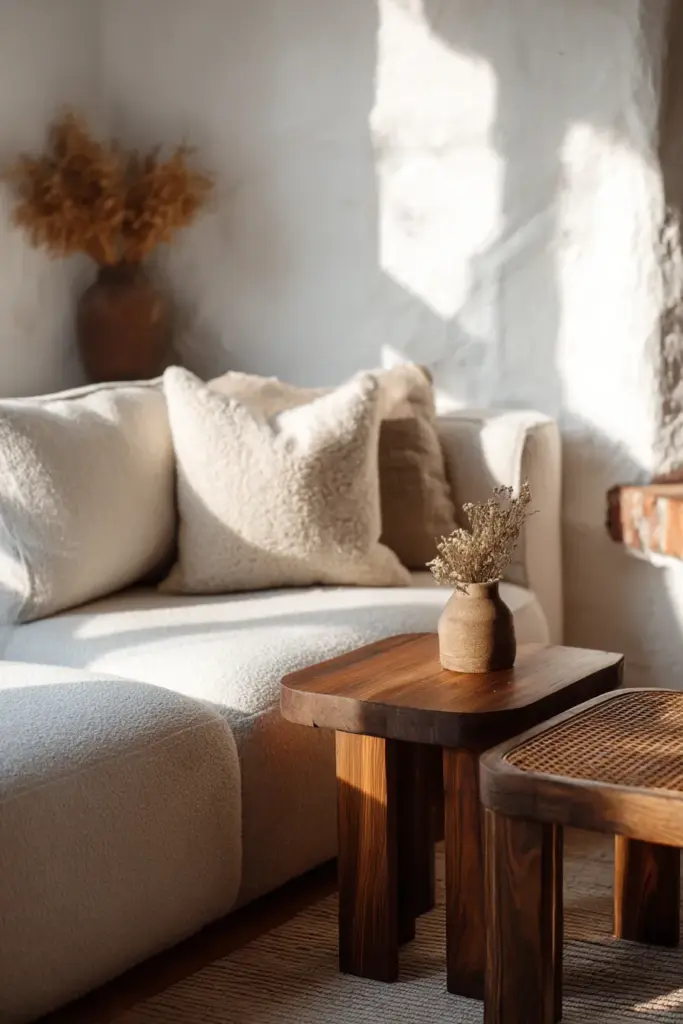
2. Choose the Right Furniture for a Small Japandi Living Room
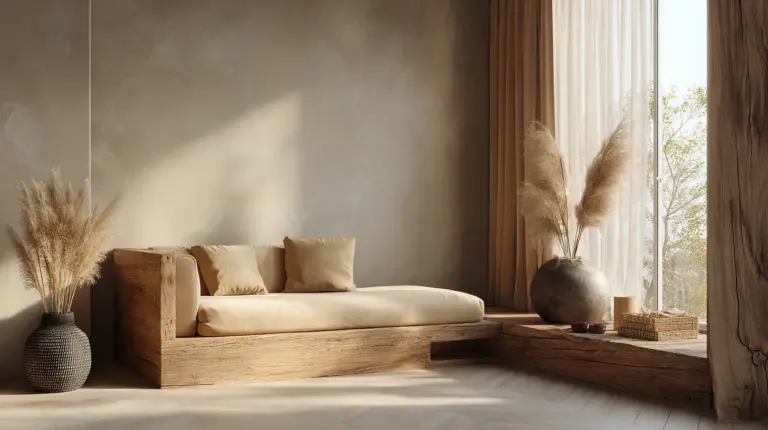
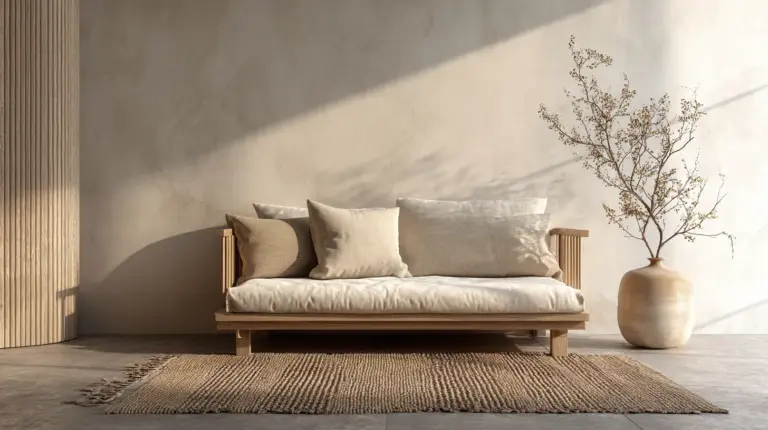
Low-profile furniture is the single most impactful choice you can make in a compact space. When furniture sits closer to the floor, the eye reads more of the wall — making ceilings feel higher and the room feel airier.
Look for low-slung sofas with clean lines and natural fabric upholstery — linen, cotton canvas, or sherpa wool. Avoid ornate legs, tufting, or anything with heavy visual weight.
Best Furniture Pieces for a Small Japandi Space
- Low-profile sofa in linen or woven fabric, 65–75 cm in height
- Nesting coffee tables in light oak or bamboo (tuck away when not needed)
- Storage-integrated pieces — ottomans with hidden compartments, TV consoles with closed doors
- Floor cushions or zabuton for flexible, low seating when guests visit
- Slim shelving in natural wood — one or two shelves, never a full wall of display
Multi-purpose furniture is your best friend here. A storage bench at the foot of a sofa serves as extra seating, a footrest, and a place to tuck away throws or remote controls. Every piece should work twice.
What to Avoid
- Sectional sofas that swallow the room
- Glass coffee tables (they add visual clutter, not clarity)
- Tall bookshelves filled edge-to-edge
- Too many leg styles in one room (keep it cohesive)
3. Layer Your Textures Thoughtfully
Japandi rooms feel rich precisely because of texture, not color. In a small living room, this is how you create warmth without visual noise.
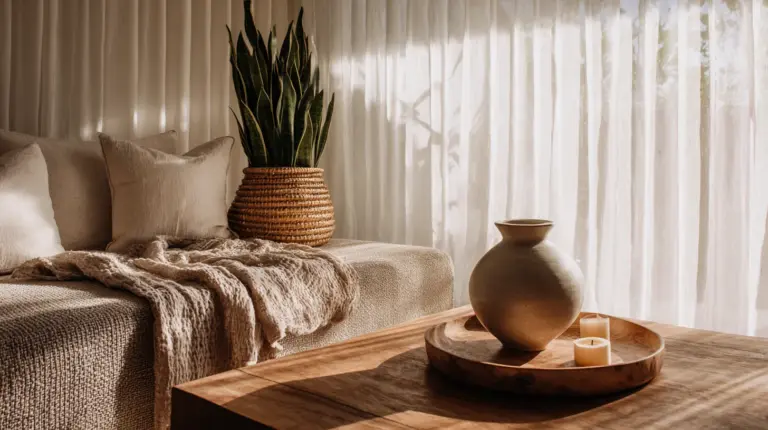
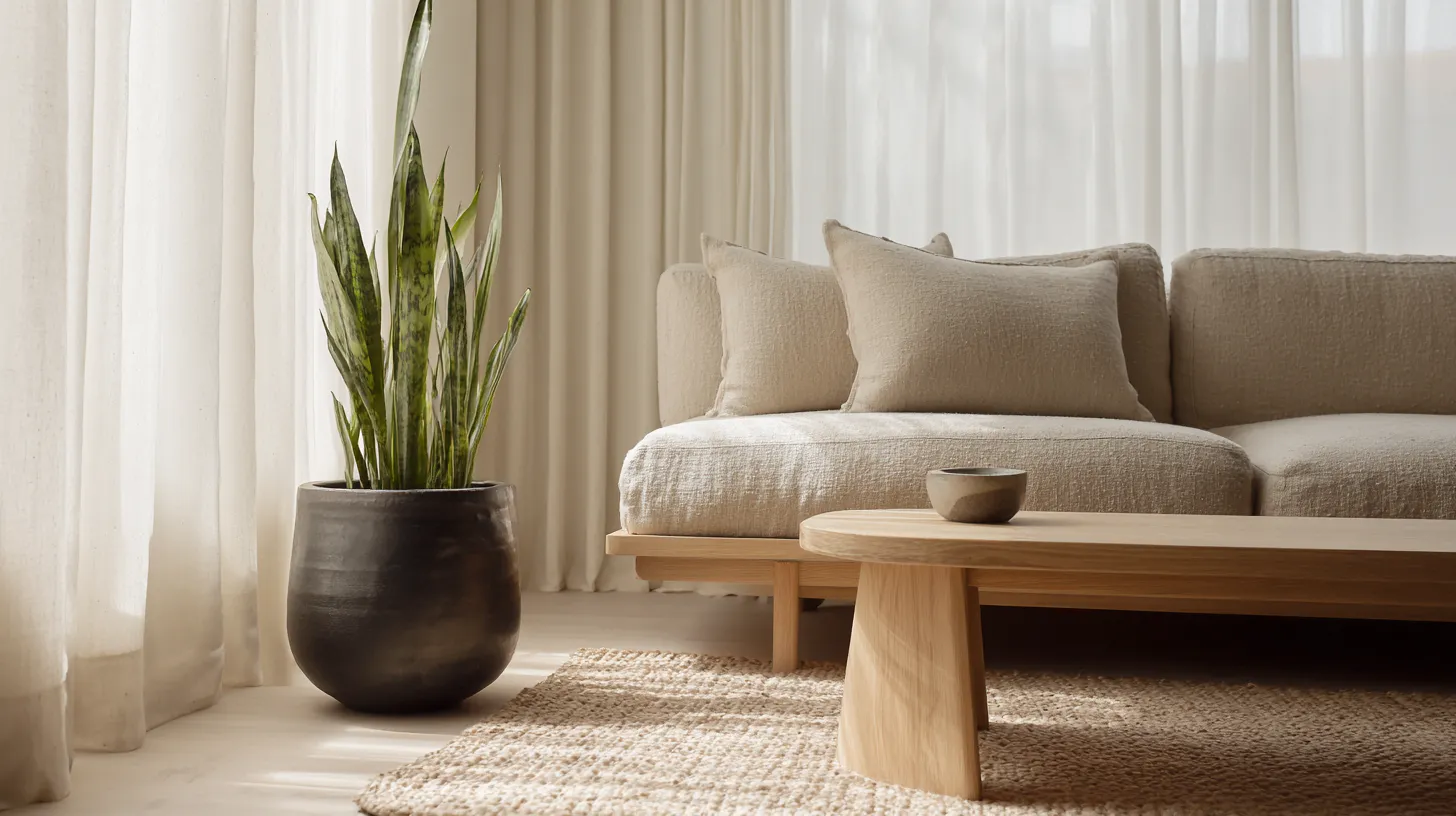
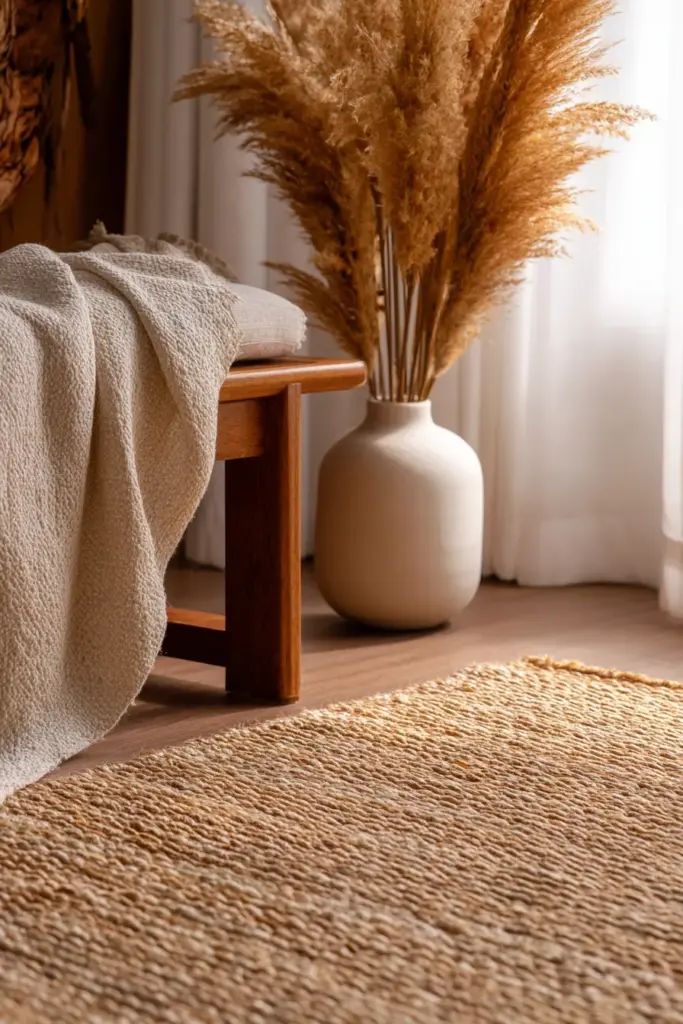
Think of your room as a composition of tactile layers. A jute rug grounds the space and adds natural grain underfoot. A linen throw draped over the sofa arm catches the light differently at noon versus dusk. A rattan side table adds organic texture without bulk. A ceramic vase in matte white adds subtle sculptural weight.
Each texture should feel intentional — like it was placed there by someone who noticed how it would feel to the hand, not just the eye.
Texture Layering Formula for Japandi
- Floor: Jute, seagrass, or low-pile wool rug
- Seating: Linen, cotton, or sherpa upholstery + woven cushion covers
- Surface: Raw wood, bamboo, or stone
- Softness: Knitted or waffle-weave throw
- Organic detail: Dried pampas, a ceramic bowl, a smooth river stone
4. Light Your Small Japandi Living Room with Intention
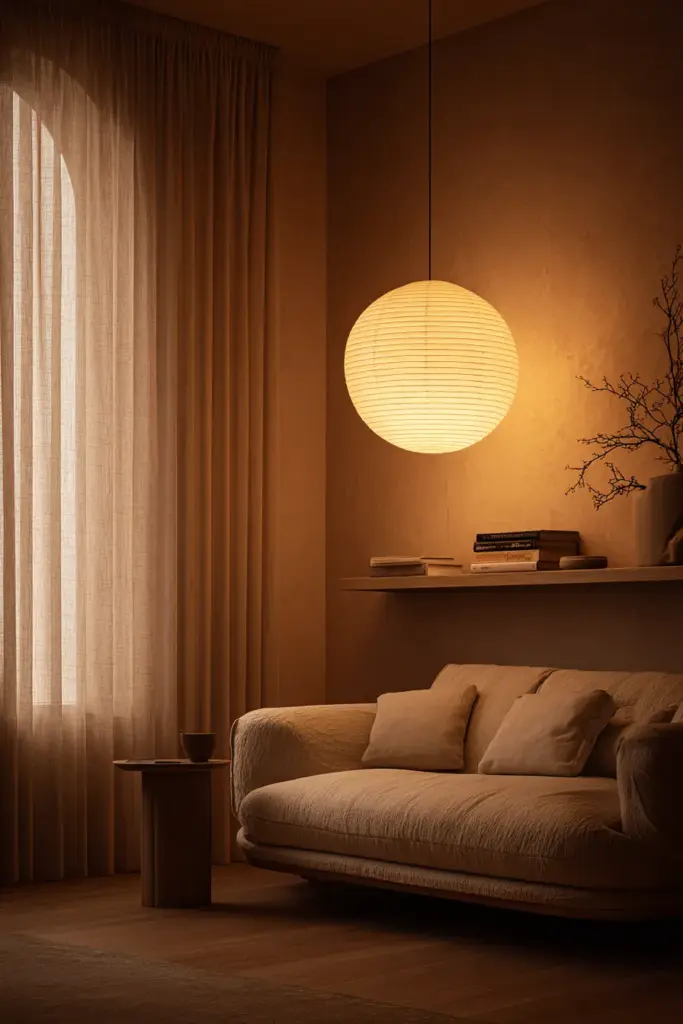
Lighting is where a Japandi room moves from “nice” to atmospheric. And in a small space, thoughtful lighting layers do more heavy lifting than almost anything else.
Natural light is always the first priority. Use sheer linen curtains or light-filtering bamboo blinds to soften sunlight without blocking it. Avoid heavy drapes — they eat both light and visual space.
For artificial lighting, think in three layers:
Three-Layer Japandi Lighting System
Ambient: A paper lantern pendant or a simple drum shade in natural linen keeps overhead light diffused and warm. Aim for bulbs in the 2700K–3000K range — warm, never clinical.
Task: A slim floor lamp under one meter in height placed beside the sofa creates a reading nook and adds visual depth. Look for matte black or natural wood finishes.
Accent: LED strips tucked beneath a floating shelf or behind a low TV console create a soft warm glow that grounds the room at night. Smart LED strips let you dim and shift tone depending on the hour — warmer in the evening, slightly cooler in the afternoon.
Pro tip for renters: Plug-in sconces mounted with Command strips give the look of hardwired wall lighting without drilling a single hole. A small table lamp with a linen shade on a side table costs almost nothing and changes everything.
5. Bring Nature Indoors: Plants for a Japandi Living Room
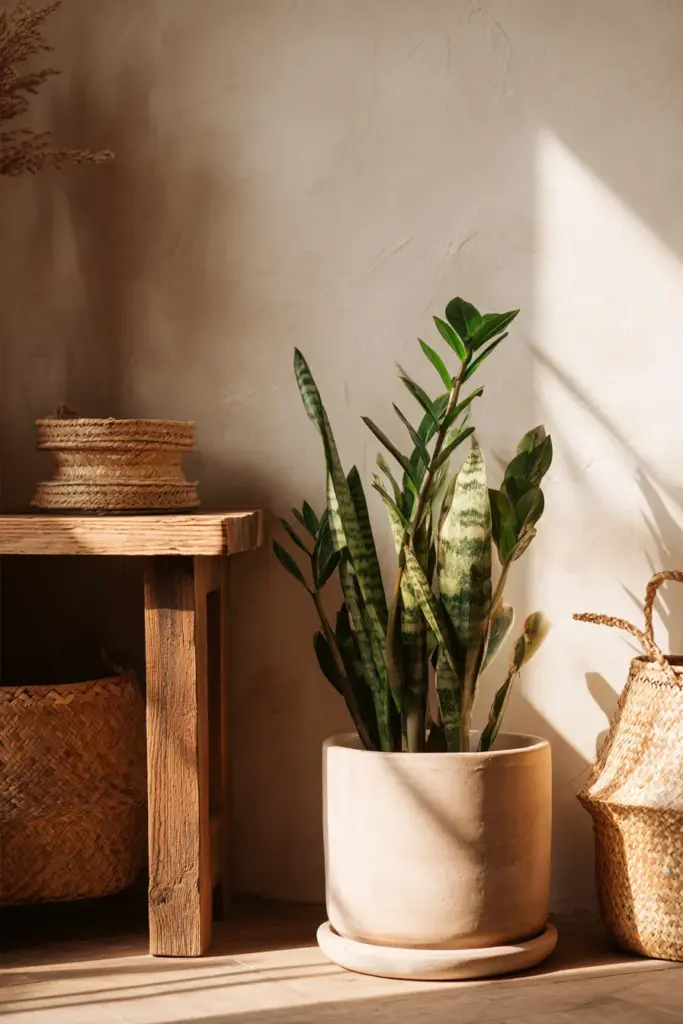
Biophilic elements — living plants, natural materials, and organic forms — are central to Japandi’s connection to the natural world. In small spaces, a single well-placed plant can anchor a corner and add life without clutter.
For the Philippines’ warm and humid climate, low-light and humidity-tolerant plants thrive without much effort:
- ZZ Plant (Zamioculcas zamiifolia) — nearly indestructible, sculptural, and thrives in low light
- Snake Plant (Sansevieria) — architectural and air-purifying, perfect for a corner
- Pothos in a hanging planter — trails beautifully and grows quickly from propagation
- Peace Lily — elegant, white-flowering, loves humidity
- Lucky Bamboo — a nod to Japanese aesthetics, minimal care needed
Choose simple, matte ceramic pots or woven baskets in natural tones. One large plant makes more impact than three small ones scattered around a small room.
6. Declutter with Intention: The Art of Negative Space
The most common mistake in small Japandi living rooms isn’t choosing the wrong furniture — it’s filling every surface and corner. Negative space isn’t empty. In Japandi philosophy, empty space is design.
Leave breathing room between pieces. A bare wall beside your sofa isn’t a problem — it’s a palette cleanser for the eye. One art piece, thoughtfully chosen and properly hung, speaks louder than a gallery wall of mismatched frames.
The Japandi Decluttering Checklist
- Remove everything from visible surfaces. Then add back only what brings you calm.
- Keep remote controls, cables, and chargers hidden — use a small woven basket or a console with doors.
- Limit decorative objects to three per surface (the rule of odd numbers still holds in Japandi).
- Choose art that feels quiet — a simple botanical print, a monochrome landscape, or a single piece of Japanese calligraphy.
- Store seasonal items out of the room entirely.
Budget Japandi Living Room Ideas for Philippine Homes
Good design doesn’t require a high budget — it requires good choices. Here’s how to build your small Japandi living room affordably, with local sourcing in mind.
| Item | Local Source | Estimated Cost (PHP) |
|---|---|---|
| Natural wood coffee table | Divisoria lumber shops, Taytay furniture | ₱1,500–₱4,000 |
| Jute or seagrass rug | Dapitan Arcade, local markets | ₱800–₱2,500 |
| Linen cushion covers | Shopee local sellers, Landmark | ₱200–₱600 each |
| Rattan side table | Bambike, local palengke furniture | ₱1,000–₱3,000 |
| Paper lantern pendant | Divisoria, Lazada | ₱300–₱800 |
| Snake plant or ZZ plant | Local garden centers, Shopee | ₱150–₱500 |
| Matte ceramic vase | Ukay-ukay, Dapitan Arcade | ₱200–₱800 |
| LED warm strip lights | Hardware stores, Shopee | ₱300–₱700 |
Total starter transformation: under ₱15,000. A complete room refresh with new sofa and rug can still be done for under ₱50,000 when sourced locally and thoughtfully.
Upcycling tip: Pallets from hardware stores can become low platform sofas or coffee table bases with minimal sanding, staining, and a few foam cushions. The result is genuinely Japandi — imperfect, handmade, and completely yours.
Small Japandi Living Room: Key Takeaways
- Start with the palette — warm neutrals on walls before any furniture decisions
- Go low — low-profile furniture keeps the room feeling open and airy
- Choose multi-purpose pieces — storage ottomans, nesting tables, console benches
- Layer textures, not colors — jute, linen, rattan, wood create richness without noise
- Light in layers — ambient, task, and accent lighting working together
- Add one plant — choose humidity-tolerant varieties like ZZ or snake plant
- Embrace negative space — empty corners are not failures; they are part of the design
- Source locally — Divisoria, Dapitan Arcade, and local markets are full of Japandi-ready materials
- Limit decorative objects — three per surface, maximum
- Keep it renter-friendly — Command strips, plug-in lamps, and no-drill mounting solutions work beautifully
A Final Thought
A small Japandi living room isn’t about having less. It’s about having exactly enough — enough warmth, enough texture, enough quiet beauty to make you exhale the moment you walk in.
You don’t need to redo everything at once. Start with one intentional swap: a jute rug instead of a synthetic one. A linen throw instead of a fleece blanket. A single plant in a clay pot where there used to be a stack of magazines.
Japandi grows slowly, like a practice. And the rooms that live inside it tend to feel like they’ve always been waiting for you.
ERYLIN — for homes that feel as good as they look.
Frequently Asked Questions
What are small Japandi living room ideas for beginners?
Start with your palette — choose warm white walls and one anchor neutral for your sofa or rug. Add a low-profile sofa, a natural wood coffee table, and a jute rug. Layer a linen throw and two textured cushions. Add one plant in a matte ceramic pot. That’s already a Japandi room. You can refine from there over time.
What furniture works best in a small Japandi living room?
Low-slung sofas, nesting coffee tables, and storage-integrated pieces work best. Look for clean lines, natural upholstery (linen, cotton, sherpa), and furniture that serves more than one purpose. Avoid oversized sectionals or glass tables — they add visual weight without practical benefit.
Can Japandi design work in a small apartment or condo?
Yes — it’s one of the best styles for compact spaces. Japandi’s use of negative space, scale-appropriate furniture, and a cohesive neutral palette all visually expand a small room. The key is choosing pieces proportioned for the space and resisting the urge to fill every corner.
How do I use natural light in a Japandi living room?
Use sheer linen or cotton curtains to filter sunlight softly without blocking it. Keep window sills clear. If privacy is a concern, light-filtering bamboo or paper blinds let in diffused light beautifully. For evening warmth, layer floor lamps and warm LED strips at 2700K–3000K.
What are the most common Japandi mistakes to avoid?
Overly bold accent colors, too many decorative objects on surfaces, cold grey palettes that feel sterile, and oversized furniture that crowds the floor. Also avoid mixing too many wood tones — stick to one or two complementary finishes. The biggest mistake is treating Japandi as purely minimalist: it should feel warm and lived-in, not sparse and cold.