
Table of Contents
There is something quietly magical about a well-placed mirror. It catches the morning light and throws it across a room like a slow exhale — brightening corners, softening edges, making a small space feel like it has room to breathe.
If you have a compact living room and you are searching for ways to make it feel larger, lighter, and more intentional, mirrors are one of the most powerful tools you have. Not just any mirror placed anywhere — but the right mirror, in the right spot, in the right frame.
This guide is not a simple list of pretty ideas. Think of it as your personal styling framework: a calm, practical companion that helps you choose, place, and style mirrors in a way that genuinely transforms how your small living room feels.
Let’s walk through it together.
Why Mirrors Work in Small Living Rooms
Mirrors do two things exceptionally well: they reflect light and they create visual depth. In a small room, both matter enormously.
Natural light is precious. A mirror placed strategically near a window can essentially double the amount of light in a room, making it feel warmer and more open. Meanwhile, the reflected image of a wall or window tricks the eye into perceiving more space than there actually is.
The result? A room that feels calm and airy — not cramped.
Mirror Placement Rules for Small Living Rooms
Placement is everything. A beautiful mirror in the wrong spot can actually make a small room feel more chaotic. Here is how to get it right.
Place a Mirror Opposite or Adjacent to a Window
This is the golden rule of mirror placement. When a mirror faces a window, it reflects natural light deep into the room, essentially creating a second source of brightness. Even on cloudy days, the room feels less closed-in.
If placing it directly opposite is not possible, an adjacent angle still works. The goal is to catch and redirect light, not just hang something on a wall.
Avoid Reflecting Clutter
A mirror reflects whatever sits in its line of sight — and that includes mess. Before mounting anything, stand in the mirror’s future position and look at what it would face.
Ideally, a mirror should reflect a window, a styled shelf, a plant, or open space. Avoid angles that reveal tangled cords, cluttered counters, or a busy hallway. What the mirror shows becomes part of your room’s visual story.
Mirror Behind the Sofa
A large horizontal mirror mounted above the sofa is one of the most classic and effective placements in a small living room. It anchors the seating area and visually extends the wall upward, giving the impression of a higher ceiling.
Pair it with a warm table lamp on a side table and the mirror will glow softly in the evening — turning a functional choice into something atmospheric.
Mirror on a Narrow Wall or in a Dark Corner
Narrow rooms and dark corners are where mirrors earn their place most dramatically. A floor-to-ceiling mirror on a short end wall can make a narrow room feel nearly twice as wide.
In a dim corner, even a smaller decorative mirror catches ambient light and bounces it around in ways that no paint color or overhead fixture can replicate.
How to Choose the Right Mirror Size
Size is where many people get it wrong — either going too small (which looks like an afterthought) or too large (which can overwhelm a delicate wall).
| Room Type | Recommended Mirror Size | Placement |
|---|---|---|
| Narrow room | Tall, vertical — at least 48 inches high | Lean against or mount on short end wall |
| Low-ceiling room | Wide, horizontal | Above sofa or console table |
| Dark room | As large as budget allows | Opposite or adjacent to window |
| Compact square room | Round, 24–36 inches | Centered above a focal point |
| Open-plan layout | Oversized statement mirror | Anchoring the living zone |
General rule: in a small living room, a mirror should be at least one-third to one-half the width of the furniture it sits above. Going smaller makes it feel like a decorative afterthought rather than a design decision.
Mirror Shapes and What They Do for a Room
Shape carries personality. The silhouette of a mirror communicates a design language before anyone even looks into it.
Round Mirrors
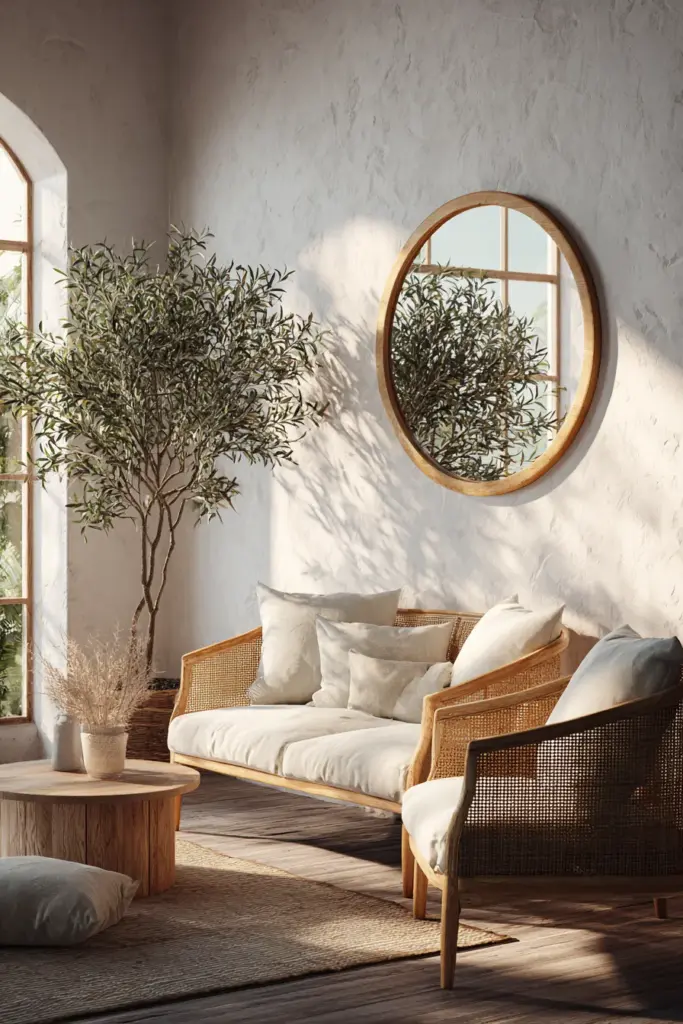
Round mirrors are endlessly versatile. They soften the hard angles that small rooms can feel full of — boxy furniture, square walls, rectangular windows. A single large round mirror above a sofa or fireplace feels both contemporary and calming.
For a modern rustic space, a round mirror in a raw wood or thin black metal frame is quietly perfect.
Arched Mirrors
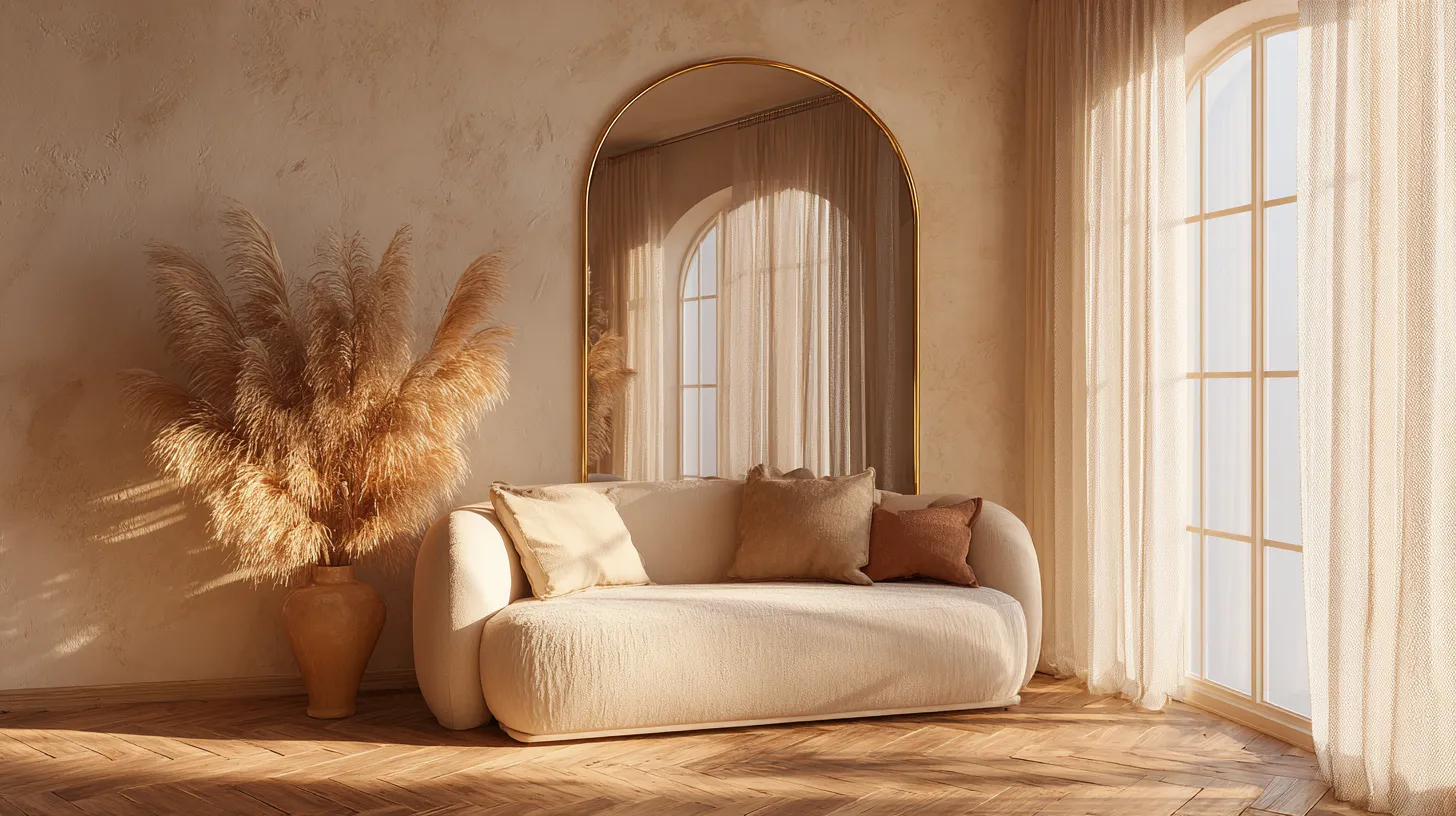
Arched mirrors have become a staple of modern interiors for good reason. Their curved top draws the eye upward, creating a sense of vertical space — particularly useful in rooms with lower ceilings.
They work beautifully leaned against a wall or mounted flush, and pair naturally with cozy furniture in linen, rattan, or warm wood tones.
Full-Length and Leaning Floor Mirrors
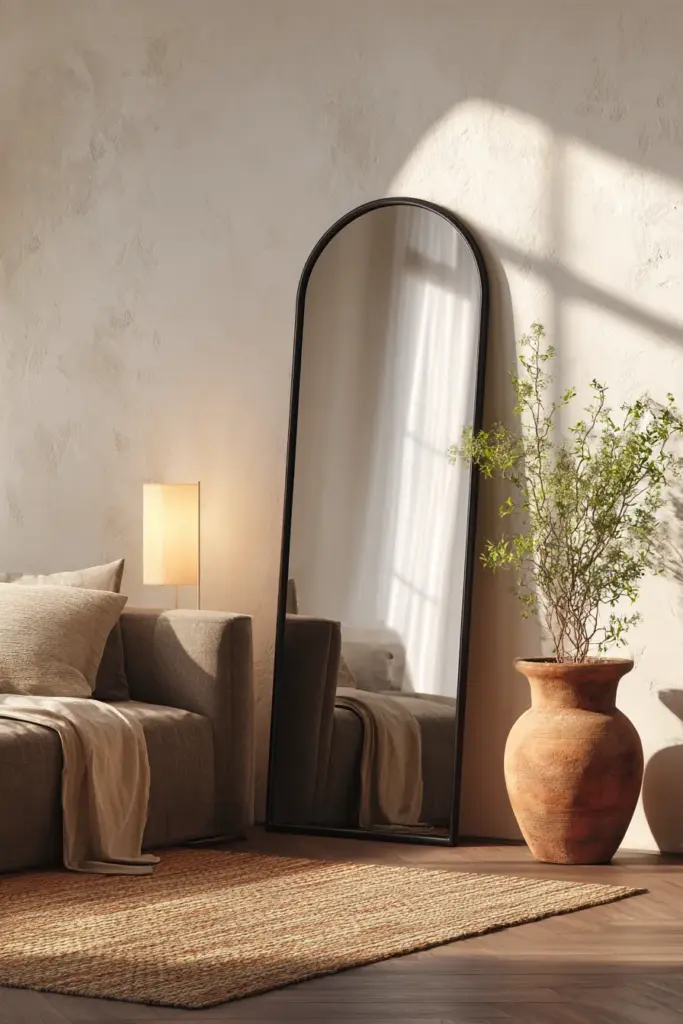
In a small living room without much wall real estate, a leaning floor mirror is a renter-friendly, commitment-free solution. It takes up no wall anchors and can be moved as the room evolves.
A tall leaning mirror in a slim frame adds length to a room, making the ceiling feel farther away and the floor plan feel wider. Place one beside a sofa or in an empty corner and watch the room expand.
Rectangular Mirrors
Horizontal rectangles above a sofa or mantel anchor a room with clean, architectural lines. Vertical rectangles beside a doorway or on a narrow wall add height. Both shapes are understated and easy to style around — the reliable workhorses of mirror design.
Sunburst and Decorative Mirrors
For rooms that lean bohemian, eclectic, or maximalist, a sunburst or ornate decorative mirror doubles as wall art. Use it as the single statement piece on a feature wall rather than clustering it with other objects. Let it breathe.
Mirror Style Guide by Interior Aesthetic
Not every mirror suits every room. Here is a quick reference to help you match your mirror to your existing style.
| Interior Style | Mirror Shape | Frame Finish |
|---|---|---|
| Japandi | Round or simple rectangular | Light oak, matte black, or frameless |
| Modern Rustic | Arched or round | Raw wood, brushed brass, or woven rattan |
| Boho | Sunburst or organic shape | Natural jute, bleached wood, or terracotta |
| Minimalist | Frameless or thin rectangular | No frame or matte metal |
| Eclectic | Mixed gallery wall | Varied — vintage, painted, gilded frames |
| Modern Glam | Large round or arched | Polished gold or smoked glass |
Mirror Gallery Wall in a Small Living Room
A gallery wall of mirrors sounds like a bold commitment, but done thoughtfully, it is one of the most effective ways to add both light and personality to a small space.
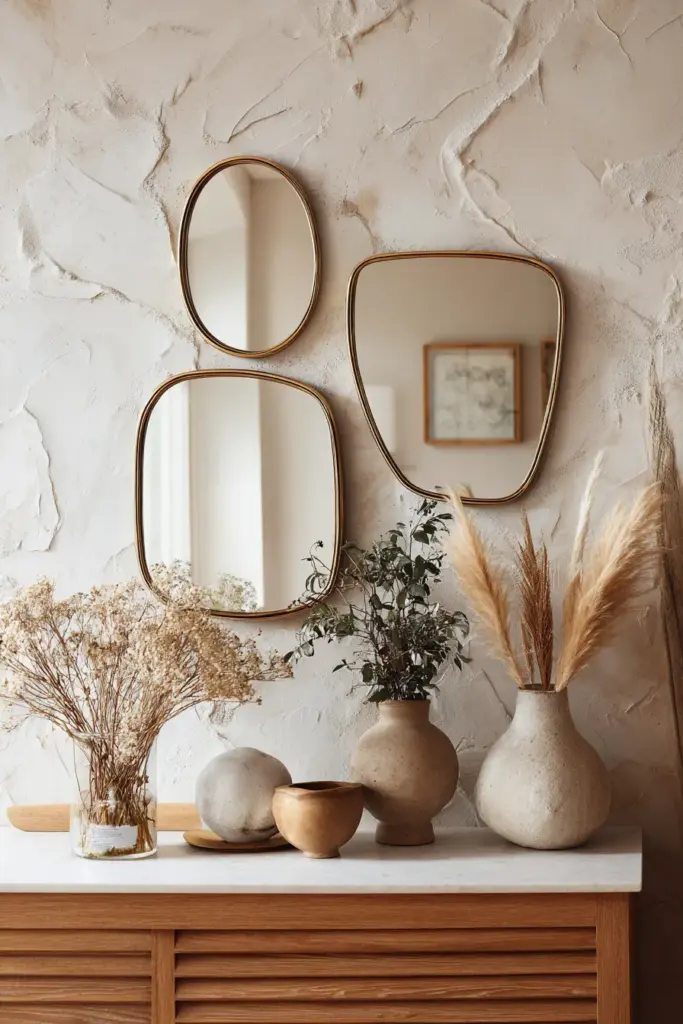
The key is cohesion over quantity. Choose mirrors with similar frame finishes — all brass, all black, all natural wood — even if the shapes vary. This creates visual rhythm without visual noise.
Odd numbers tend to feel more organic. A trio of mirrors — one larger, two smaller — arranged asymmetrically works beautifully above a console or along a hallway wall adjacent to the living room.
Avoid placing too many mirrors in a gallery wall if the room already has a lot going on. Simplicity, here, is elegance.
Room-Specific Mirror Solutions
For Narrow Rooms
Use a tall, vertical mirror — ideally at least 48 to 60 inches high — placed on the shortest end wall. This makes the room feel wider by drawing the eye across rather than along the narrow axis.
A leaning floor mirror in this placement is especially effective and requires no drilling.
For Dark Rooms
In a room with limited natural light, your mirror becomes a light amplifier. Go as large as your wall comfortably allows and place it directly opposite or at a 45-degree angle from your best light source.
A frameless or lightly framed mirror maximizes the reflective surface, giving the room its best chance to brighten.
For Rental Spaces
You want beautiful and non-committal. A leaning floor mirror, a lightweight adhesive-mounted mirror, or a mirrored panel on a stand all work without wall damage.
Choose a mirror with a finished back panel so it looks intentional from every angle.
For Low-Ceiling Rooms
Avoid wide horizontal mirrors that emphasize the width of the room at the expense of height. Instead, choose arched, tall rectangular, or floor mirrors that pull the eye upward.
Mounting a mirror slightly higher than you might typically hang art also signals vertical space to the eye.
Mistakes to Avoid
Even the most beautiful mirror can work against you. Watch out for these common missteps.
- Hanging it too high. The center of a wall-mounted mirror should generally sit at eye level — about 57 to 60 inches from the floor — unless it is a design choice to create height.
- Going too small. A mirror that is too small for the wall reads as indecisive. When in doubt, size up.
- Reflecting a cluttered view. Always preview what the mirror will show before mounting. A reflection of tangled cords or a messy corner is worse than no mirror at all.
- Choosing an ornate frame in a minimal room. Frame weight should match room personality. A baroque gilded frame in a spare, modern room creates visual tension — not the good kind.
- Mounting without proper anchors. Heavy mirrors require wall studs or appropriate anchors. Never hang a large mirror with adhesive strips alone.
Mirror vs. Art: When You Only Have One Wall
This is a question many small living rooms face. If you have one dominant wall and need to choose between a statement mirror and a piece of art, consider what the room lacks most.
Choose a mirror if: the room feels dark, cramped, or low-ceilinged.
Choose art if: the room has good light and what it needs is warmth, color, or personal expression.
A middle path: a mirror with a beautiful frame that functions as both. An arched mirror in aged brass or hand-painted ceramic is as much a work of art as anything framed on canvas.
Mirror Buyer’s Checklist
Before purchasing, run through this quick checklist:
- Size: Is it at least one-third the width of the furniture beneath it?
- Frame color: Does it complement your existing wood tones, metals, and textiles?
- Frame weight: Is the style appropriate for the room’s personality?
- Anti-rust coating: Especially important in humid climates or near windows.
- Mounting hardware included: Check for ease of installation.
- Weight: Do you have the right wall anchors for its weight?
- Renter-friendly option: If needed, does it lean, or is it lightweight for adhesive mounting?
- Reflection preview: Have you stood in the spot and looked at what it will reflect?
Key Takeaways
- Place mirrors opposite or adjacent to windows to maximize natural light.
- Always preview the mirror’s reflection before mounting — it should show something beautiful.
- Match mirror size to furniture scale; when in doubt, go larger.
- Use vertical mirrors in narrow rooms and wide mirrors in low-ceiling rooms.
- Round mirrors soften; arched mirrors lift; leaning mirrors add depth with no commitment.
- Frame style should align with your interior aesthetic — cohesion is everything.
- A gallery wall of mirrors works best with matching frame finishes and odd-numbered groupings.
- Avoid reflecting clutter, mounting too high, or choosing frames that conflict with the room’s tone.
A Quiet Closing Thought
A mirror is not just a practical object. It is a window into a version of your home that feels a little more open, a little more luminous, a little more yours.
In a small living room, the right mirror does not shout — it whispers. It catches a slant of afternoon light and holds it. It makes a corner feel discovered rather than forgotten. It turns a tight space into one that breathes.
Choose with intention. Place with care. And let the light do the rest.
That is the ERYLIN way.
Frequently Asked Questions
How do mirrors make a small living room look bigger?
Mirrors create the illusion of depth by reflecting the space back at you, making the eye perceive more room than is physically there. When placed near a light source, they also amplify brightness, which visually expands a space.
Where should you place a mirror in a small living room?
The most effective placement is opposite or adjacent to a window, where it can reflect natural light. Above a sofa, on a narrow end wall, or in a dim corner are also strong choices depending on your room’s specific challenges.
What size mirror is best for a small living room?
As a general rule, your mirror should be at least one-third to one-half the width of the furniture it sits above. For wall-mounted mirrors, the center should rest around 57 to 60 inches from the floor. In small rooms, leaning toward a larger size is almost always the better choice.
Are round mirrors good for small living rooms?
Yes — round mirrors are excellent for small spaces because they soften the angular geometry of walls and furniture, reducing the boxed-in feeling. A single large round mirror in a simple frame is one of the most versatile choices for a compact room.
What should a mirror reflect in a small room?
Ideally, a mirror should reflect a window, an open section of the room, a curated shelf, or a plant. Avoid angles that reflect cluttered surfaces, tangled cords, or busy corners — the reflection becomes part of the room’s visual experience, for better or worse.