
Table of Contents
There is something quietly powerful about an ottoman in a small living room. It grounds the space, softens the edges, and somehow makes a room feel more lived in — more intentional. It is the piece that says: this home was designed for real life.
If you have been staring at a tight floor plan and wondering how to make it feel both beautiful and functional, you are in the right place. At ERYLIN, we believe that small spaces deserve the most thoughtful choices — and the ottoman might be the most underestimated one of all.
A well-chosen ottoman can serve as your coffee table, your extra seat, your hidden storage, and your design anchor — all at once. That is a lot of work for one beautiful piece of furniture, and it does it without complaint.
This guide walks you through everything: the right size, the best shapes, the smartest materials, and the styling decisions that will make your small living room feel expansive, calm, and completely yours.
What an Ottoman Actually Solves in a Small Living Room
Before we dive into ideas, let us talk about why an ottoman works so well in compact spaces.
A traditional coffee table is rigid — it sits in one place, serves one purpose, and often feels like a barrier in a small room. An ottoman, by contrast, is fluid. You can push it aside when guests arrive, prop your feet on it after a long day, or set a tray of candles and books on top to style it like a table.
In a small living room, flexibility is everything. Every piece of furniture should earn its place by doing at least two things well — and an ottoman almost always does three or four.
Ottoman Use Cases: More Than Just a Footrest
Footrest
This is the obvious one, and it is worth honoring. After a long day, sinking into your sofa and lifting your feet onto a cushioned surface is one of the small, reliable joys of home. A firm yet padded ottoman at the right height makes this effortless.
Coffee Table Alternative
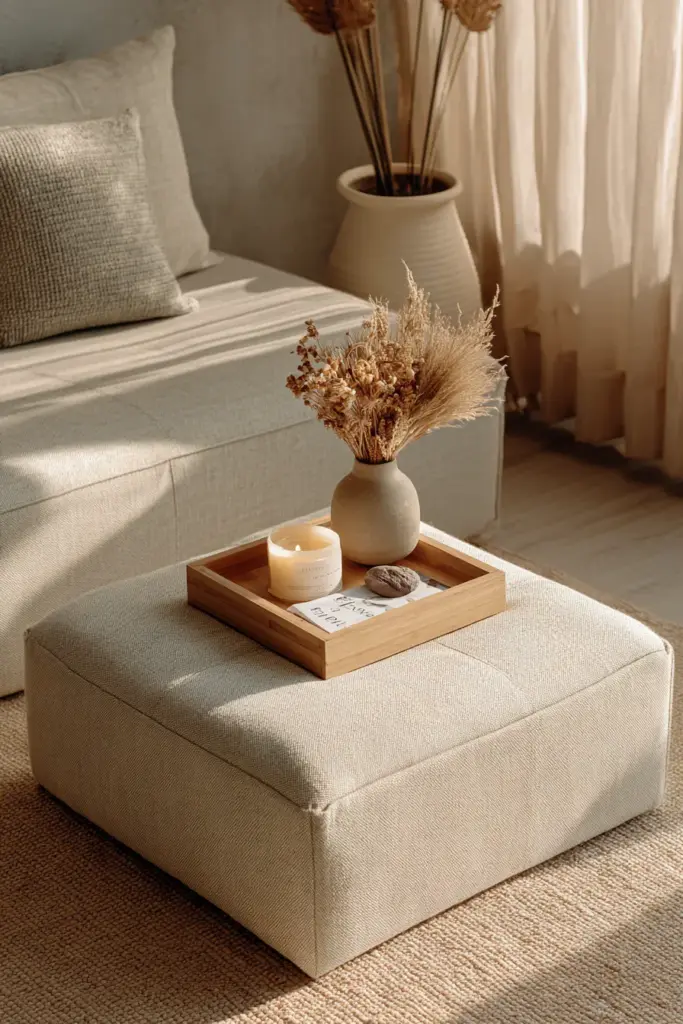
Place a wooden tray on top of your ottoman and suddenly you have a styled surface for your morning coffee, a stack of books, or a small vase of dried botanicals. This works especially well with firm, flat-topped ottomans. It is a soft solution in a room that does not have room for hard edges.
Extra Seating
When friends visit and your small sofa runs out of room, a generous ottoman becomes an extra seat without a moment’s fuss. Choose an ottoman with a firm cushion and sturdy base if this is a priority for your household.
Hidden Storage
A storage ottoman is one of the most practical pieces you can bring into a small home. Blankets, remote controls, charging cables, board games — tuck them all inside and close the lid. The room stays clutter-free, and no one has to know where the chaos lives.
Room Divider
In an open-plan studio or loft, a large rectangular ottoman can subtly define the seating zone from the rest of the space — no walls required. It is visual architecture, soft and unpretentious.
Ottoman Shape Guide for Small Living Rooms
The shape of your ottoman changes everything about how a room feels and flows. Here is a simple breakdown to help you decide.
| Shape | Best For | Why It Works in Small Spaces |
|---|---|---|
| Round | Apartments, studios, curved sofas | No sharp corners; easy to walk around |
| Square | Sectionals, symmetrical arrangements | Clean lines; doubles easily as a table |
| Oval | Loveseats, narrow rooms | Elongated but soft; avoids boxy feel |
| Rectangular | Storage needs, room dividers | Maximum surface area and storage volume |
| Nesting (set of 2–3) | Flexible seating, entertaining | Pull out when needed; tuck away after |
| Pouf | Accent seating, layered texture | Low profile; adds bohemian warmth |
Round Ottomans
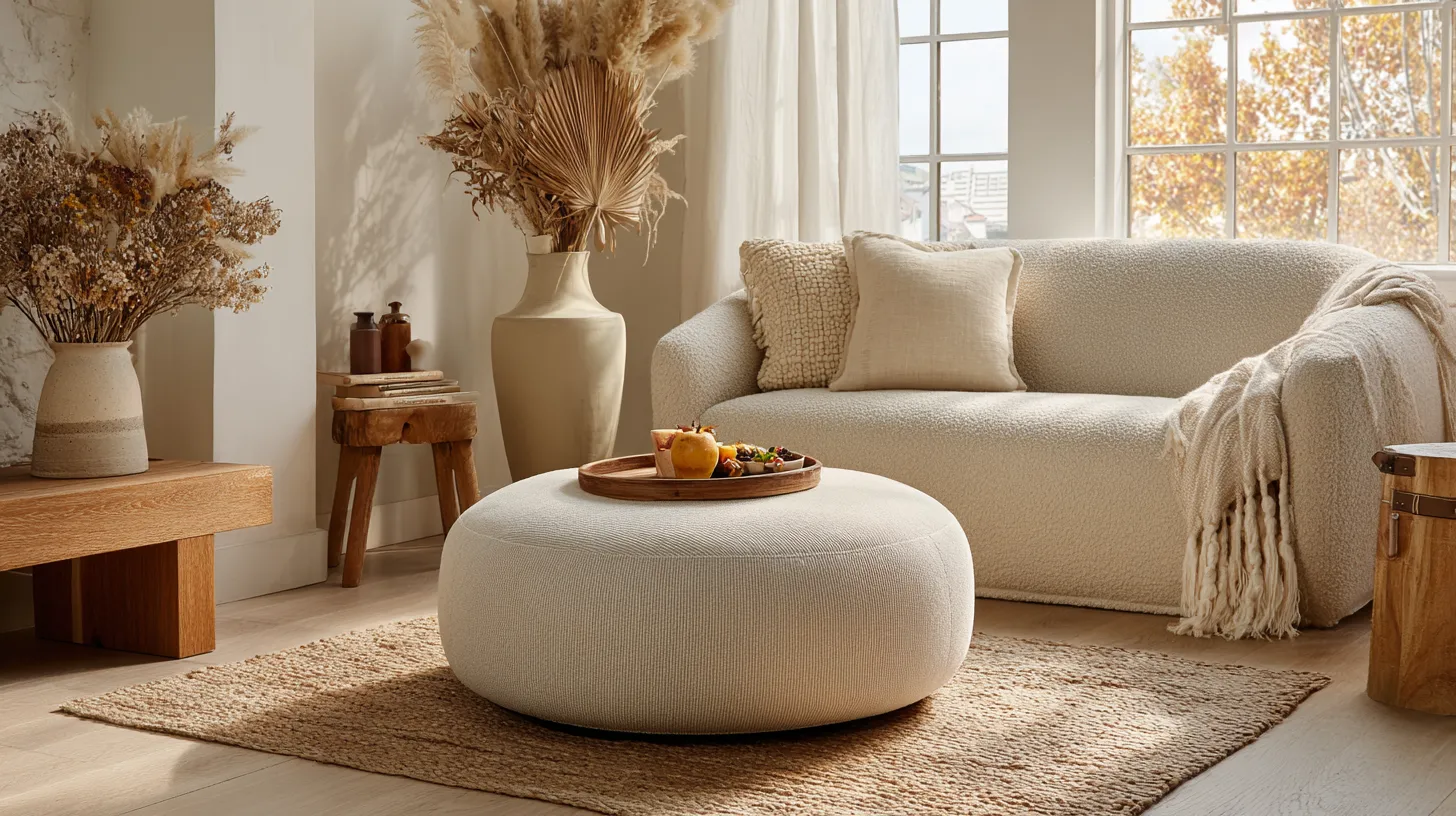
A round ottoman is often the kindest choice for a small living room. Its curved silhouette means no sharp corners cutting into narrow walkways, and it creates a natural flow around the seating area. It also softens the geometry of square rooms beautifully. Pair it with a linen slipcover in oat or sage for a look that feels effortlessly organic.
Square Ottomans
If you like symmetry and clean lines, a square ottoman is your match. It pairs well with sectional sofas and creates a strong visual anchor. Choose one with hidden storage and a tufted top in a warm cognac leather or a textured boucle for a look that is both polished and practical.
Nesting Ottomans
Nesting ottomans are the multitaskers of the ottoman world — a set of two or three that stack or slide beneath one another when not in use. On quiet evenings, tuck them away. When friends arrive, pull them out. They are particularly wonderful for small living rooms that double as entertaining spaces.
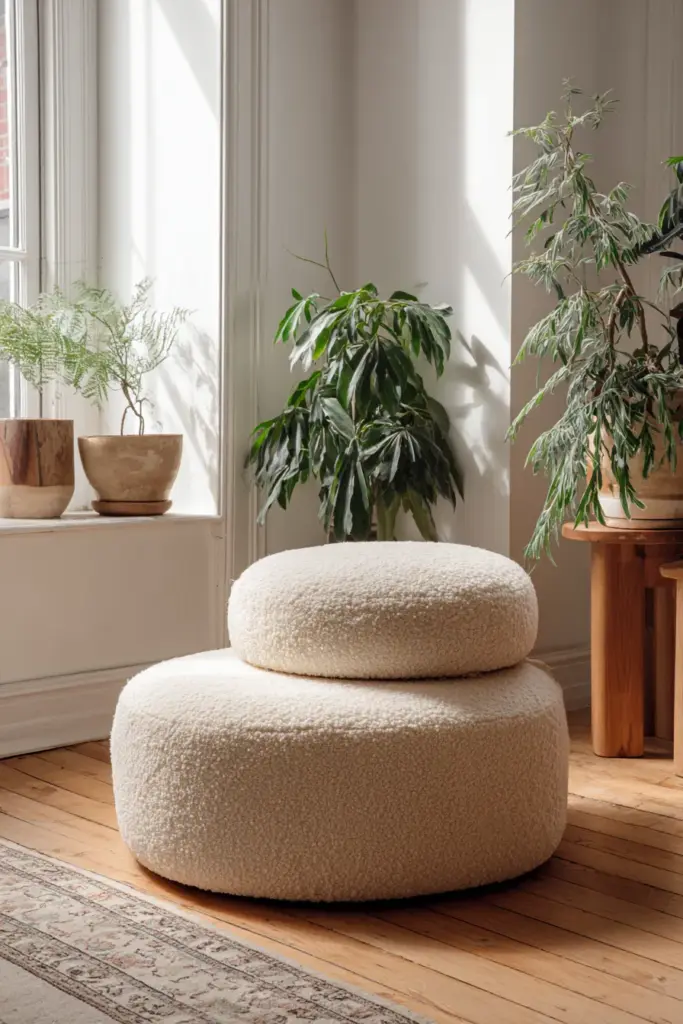
Poufs
A pouf is lower and more relaxed than a traditional ottoman — more of a landing pad than a seat. It brings a handcrafted, tactile energy to a room and works beautifully layered with a larger sofa and a statement rug. A woven jute or Moroccan leather pouf adds warmth and global texture without demanding much floor space.
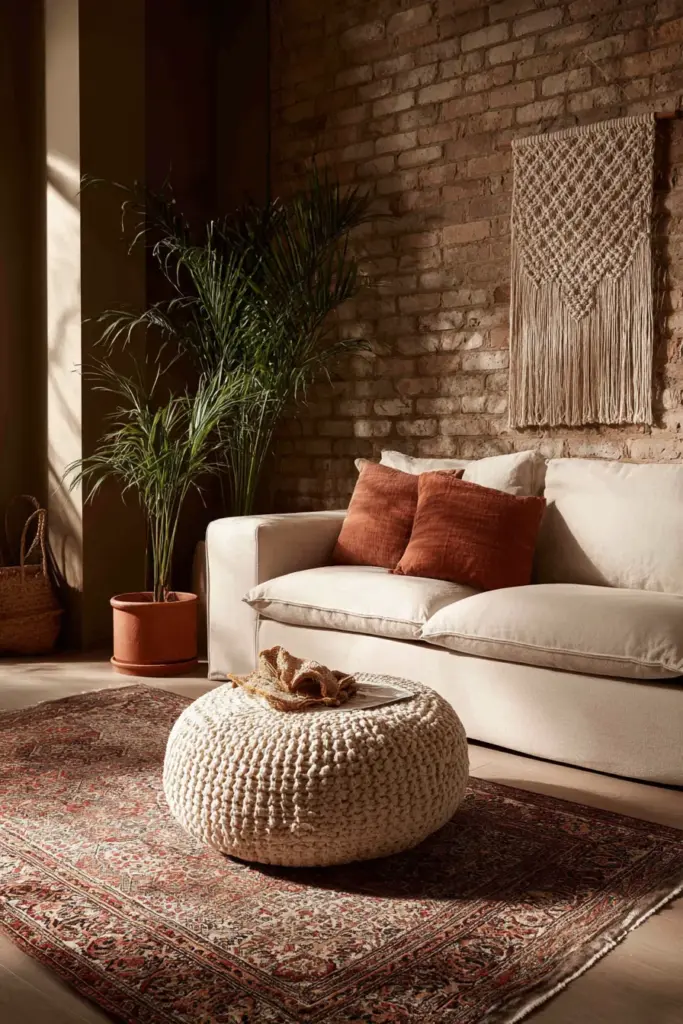
Ottoman Size Guide: How Big Should It Be?
Getting the size right is the most important practical decision you will make. An ottoman that is too large overwhelms the room; one that is too small feels lost.
General sizing rules for small living rooms:
- The ottoman should be roughly two-thirds the width of your sofa — no wider.
- Leave 18 inches of clearance between the ottoman and the sofa so you can move comfortably.
- Leave 24 to 30 inches between the ottoman and any opposing furniture or wall for a safe walkway.
- For a loveseat (typically 52–72 inches wide), an ottoman between 24 and 36 inches works well.
- For a standard three-seat sofa (72–90 inches), aim for an ottoman between 36 and 48 inches.
Height matters too. Your ottoman should sit within 2 inches — higher or lower — of your sofa seat height. This ensures it feels comfortable as a footrest and functional as a surface.
If you are unsure, err on the smaller side. A petite ottoman in a small room reads as intentional. An oversized one reads as a mistake.
Best Fabrics and Materials for Small Spaces
The material of your ottoman affects how it feels, how it wears, and how it contributes to the visual temperature of the room.
Linen and Cotton
Breathable, light, and beautifully textural, linen and cotton ottomans feel relaxed and natural. They suit modern rustic and Scandinavian-inspired rooms and come in an easy palette of oat, ivory, warm grey, and sage. They are best for low-traffic households or adults-only spaces, as they can stain more easily.
Boucle
Boucle is having a well-deserved moment, and for good reason. Its looped, nubby texture catches light warmly and feels luxurious underhand. A boucle ottoman in cream or warm white adds softness and dimension without overwhelming a small space. It also photographs beautifully, which matters when you love your home.
Leather and Faux Leather
Leather is the workhorse of ottoman fabrics — easy to wipe clean, durable, and effortlessly stylish. In a small room, a caramel or cognac leather ottoman adds richness and depth. Faux leather options have improved dramatically and offer a pet- and kid-friendly alternative that still looks polished.
Velvet
Velvet brings drama in the quietest way. A deep teal, dusty rose, or forest green velvet ottoman can be the color moment that makes a neutral small room feel curated and alive. Use it as an accent piece rather than a neutral if you want the room to feel layered and intentional.
Jute and Rattan
Woven natural materials like jute or rattan bring an earthy, grounding quality to a room. They are especially lovely in homes with lots of natural light and plant life. A jute pouf under a rattan side table creates a cohesive organic aesthetic that feels both relaxed and considered.
Styling an Ottoman in a Small Living Room
The Tray Method
A simple wooden or marble tray placed on top of a soft ottoman instantly transforms it into a styled coffee table. Stack a small candle, a plant cutting in a tiny vessel, and a design book on top. Keep it to three items — restraint is the most sophisticated styling choice you can make in a small space.
Layering with Rugs
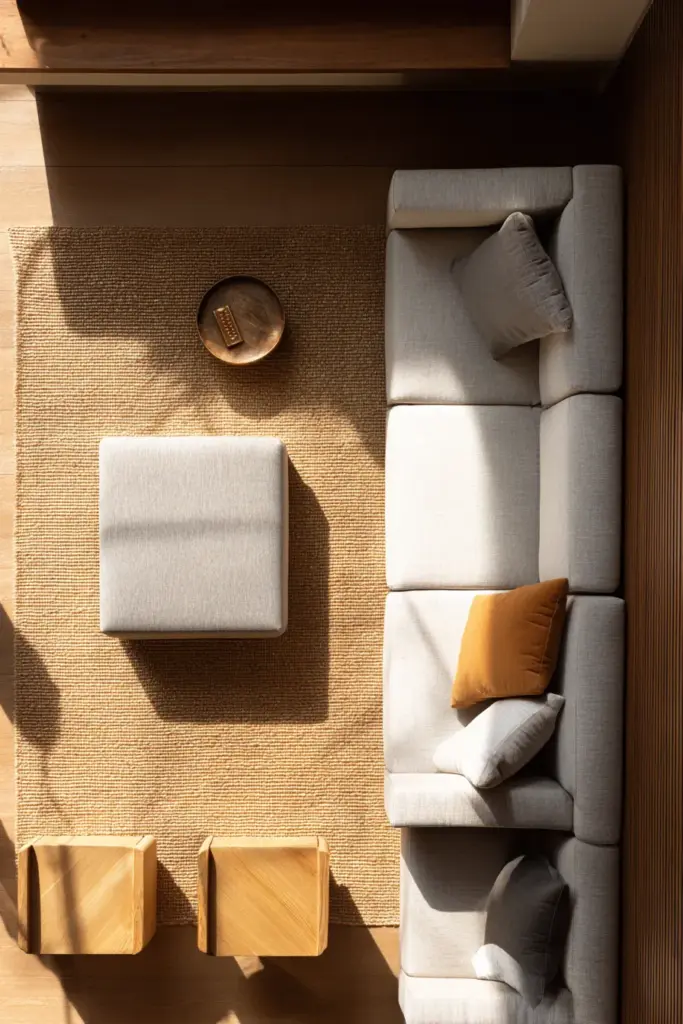
Place your ottoman on top of a rug that extends at least 12 to 18 inches beyond the sofa on all sides. The rug unifies the seating zone and makes the ottoman feel intentional rather than floating. A low-pile jute or wool rug in a warm neutral anchors everything without competing with the ottoman’s texture.
Using an Ottoman with a Sectional
If you have a sectional in a small room — likely an L-shaped one — a round or small square ottoman tucked into the inner corner of the L works beautifully. It fills dead space, provides a surface, and softens the geometric weight of the sectional.
Using an Ottoman with a Loveseat
A loveseat and a round ottoman is one of the most harmonious small living room combinations. The curves echo each other and the scale stays gentle. Choose an ottoman about half the width of your loveseat and position it 18 inches away for easy flow.
Leg Height and Visual Weight
An ottoman with slender, tapered legs feels lighter and less intrusive in a small room than one that sits flush to the floor. The exposed floor beneath creates visual breathing room — one of the easiest tricks for making a small space feel larger. Aim for legs in warm wood tones or brushed brass for an elevated touch.
When an Ottoman Beats a Coffee Table
There are moments when an ottoman is simply the better choice — full stop.
- When your room is too narrow for a standard coffee table and chairs to coexist comfortably.
- When you need flexible seating for occasional guests.
- When you have children or pets and want soft, forgiving surfaces.
- When you want storage that does not look like storage.
- When you want the room to feel softer, warmer, and less formal.
An ottoman invites you to relax in a way that a glass coffee table simply does not.
Buying Mistakes to Avoid
Choosing size over scale. A larger ottoman is not always better. In a small room, an oversized ottoman blocks flow, compresses the space, and becomes an obstacle rather than an asset.
Ignoring clearance. You need at least 18 inches between your sofa and ottoman and 24 to 30 inches of walkway around the perimeter. Measure before you buy.
Picking the wrong firmness. A very soft pouf will not work as a coffee table or extra seat — it will simply compress. Decide your primary use case first, then choose firmness accordingly.
Forgetting about legs. An ottoman without legs sits low and heavy on the floor. In a small room, this can make the space feel shorter and denser. Legs — even short ones — make a quiet difference.
Matching too perfectly. An ottoman in the exact same fabric as your sofa can flatten the visual interest of a small room. Try a complementary texture or a tone-on-tone variation instead.
Quick Summary: Your Small Living Room Ottoman Checklist
- Choose an ottoman that is two-thirds the width of your sofa or smaller
- Allow 18 inches between sofa and ottoman; 24–30 inches for walkways
- Match ottoman height to within 2 inches of sofa seat height
- For flexibility, consider nesting ottomans or a storage ottoman
- Use a tray to style the ottoman as a coffee table surface
- Choose legs to keep the piece feeling light and airy
- Select fabric based on lifestyle: leather or faux leather for families, linen or boucle for low-traffic rooms
- Place on a rug that extends beyond the seating zone for a pulled-together look
- In a sectional setup, try a round ottoman in the inner corner
- For loveseats, a round ottoman at half the sofa’s width is a beautiful match
A Final Word
A small living room is not a limitation — it is an invitation to choose well. Every piece matters more when there are fewer of them. The ottoman you choose will be looked at every day, sat on, rested on, gathered around.
Choose one that feels like you — a little warm, a little considered, a little beautiful. Place it with intention. Style it with restraint. And then pour yourself something lovely and enjoy the room you have made.
At ERYLIN, we believe that the most soulful spaces are not the largest ones — they are the most loved.
Frequently Asked Questions
What is the best ottoman for a small living room?
The best ottoman for a small living room is one that matches your primary use case — storage, extra seating, or footrest — and fits the scale of your sofa. A storage ottoman with a firm flat top is the most versatile choice for small spaces, as it serves multiple functions while keeping the room clutter-free. Look for one with tapered legs to keep the visual weight light.
Can an ottoman replace a coffee table in a small living room?
Yes — and in many small living rooms, it is the better choice. A firm, flat-topped ottoman with a decorative tray on top functions beautifully as a coffee table while offering the added benefits of soft edges, flexible placement, and optional storage. It is especially practical in homes with children, pets, or limited walkway space.
What size ottoman is best for a small space?
As a general rule, your ottoman should be about two-thirds the width of your sofa and sit within two inches of your sofa’s seat height. For a loveseat, aim for 24 to 36 inches wide. Always leave at least 18 inches of clearance between the ottoman and the sofa, and 24 to 30 inches of walkway around the room’s perimeter.
Should an ottoman be round or square in a small room?
A round ottoman is often the better choice for a small living room because it has no sharp corners, creates easier flow around the seating area, and softens the geometry of the room. A square ottoman works well if you prefer clean lines and plan to use it primarily as a coffee table surface. When in doubt, go round — it is forgiving in tight spaces.
What is the difference between a pouf and an ottoman?
A pouf is a lower, softer, and typically smaller version of an ottoman — it is more of an accent piece or casual footrest than a functional seat or table. Ottomans tend to be firmer, taller, and more structured, making them more versatile for everyday use. In a small living room, a pouf works best as a layering element alongside a sofa and rug, while a proper ottoman handles heavier functional lifting.
Are storage ottomans good for small living rooms?
Storage ottomans are one of the best investments for small living rooms. They keep blankets, remotes, books, and everyday clutter hidden inside while presenting a clean, styled surface to the room. Choose one with a firm lid that doubles as a seat or tray surface for maximum usefulness in a compact space.