
Table of Contents
There is something quietly transformative about a room filled with natural light. The way morning sun falls across a linen sofa, the way it warms the grain of a wood coffee table, the way it makes even the smallest space feel like it has room to breathe — it changes everything.
But what happens when your living room is small and the light barely reaches past the first two feet of floor? That tension — between a space you love and a space that feels closed in — is exactly what this guide is here to solve.
At ERYLIN, we believe that every room has the potential to feel open, warm, and beautifully alive. You do not need high ceilings or floor-to-ceiling windows to get there. You need the right layout, the right materials, and a few quiet decisions made with intention.
This is not a list of generic decorating tips. This is a room-planning guide — practical, specific, and rooted in the real experience of living in a small space that deserves to feel luminous.
Understanding Your Light Before You Decorate
Before you move a single piece of furniture, stand in your living room at different times of day and simply observe.
The direction your windows face determines the quality, color, and duration of the light you receive — and your entire decorating strategy should follow from that one fact.
Window Direction and Light Quality
| Window Facing | Light Quality | Best Strategy |
|---|---|---|
| South-facing | Bright, consistent all day | Sheer curtains to filter, not block |
| East-facing | Warm morning light, dim by afternoon | Maximize morning openness; layer lamps for evenings |
| West-facing | Strong afternoon and golden-hour light | Use UV-filtering sheers to prevent glare and fading |
| North-facing | Cool, even, diffused light | Prioritize high-LRV paint, mirrors, and warm artificial lighting |
A north-facing room is the most challenging — but also one of the most beautiful to work with once you understand it. Cool, diffused light is flattering, consistent, and deeply livable when you lean into it rather than fight it.
Seasonal and Climate Realities
If you live somewhere with long rainy seasons or overcast winters — as many of us in tropical or temperate climates do — your room needs to work beautifully without reliable sun.
Plan your space for its worst light days, not its best. That means layered artificial lighting, warm-toned materials, and reflective surfaces become non-negotiable, not afterthoughts.
Layout Rules: Keep the Window Zone Open
The single most common mistake in small living rooms is placing furniture in front of windows. Even a low sofa back can cut natural light by 30 to 40 percent before it ever reaches the center of the room.
How to Arrange Seating Around Windows
- Float seating away from windows when possible. Place your sofa on the wall perpendicular to the window, not directly against the glass.
- Use a low-profile sofa (under 32 inches tall) if your only option is a wall adjacent to the window. Lower backs interrupt less light.
- Leave 18 to 24 inches of clearance between window sills and any furniture piece — enough for light to spill forward onto the floor.
- Face seating toward the light source, not away from it. This draws the eye outward and makes the room feel connected to the outside world.
Traffic Flow and the Light Corridor
Think of natural light as needing a path — a clear corridor from the window to the far wall. Furniture that blocks this corridor makes a small room feel not just dark but dense.
Keep the center of the room open. Push accent chairs and side tables to the perimeter. Let the light travel.
In a 10×12 ft living room, this might mean choosing a loveseat over a three-seat sofa, or swapping a large ottoman for a slim nesting table. Small adjustments in scale create enormous shifts in how light and air move through the space.
Window Treatments: Privacy Without Losing the Light
The right curtain can make a small living room feel like a sanctuary. The wrong one — heavy, dark, bunched low — turns a modest room into a cave.
Curtain Choices That Preserve Daylight
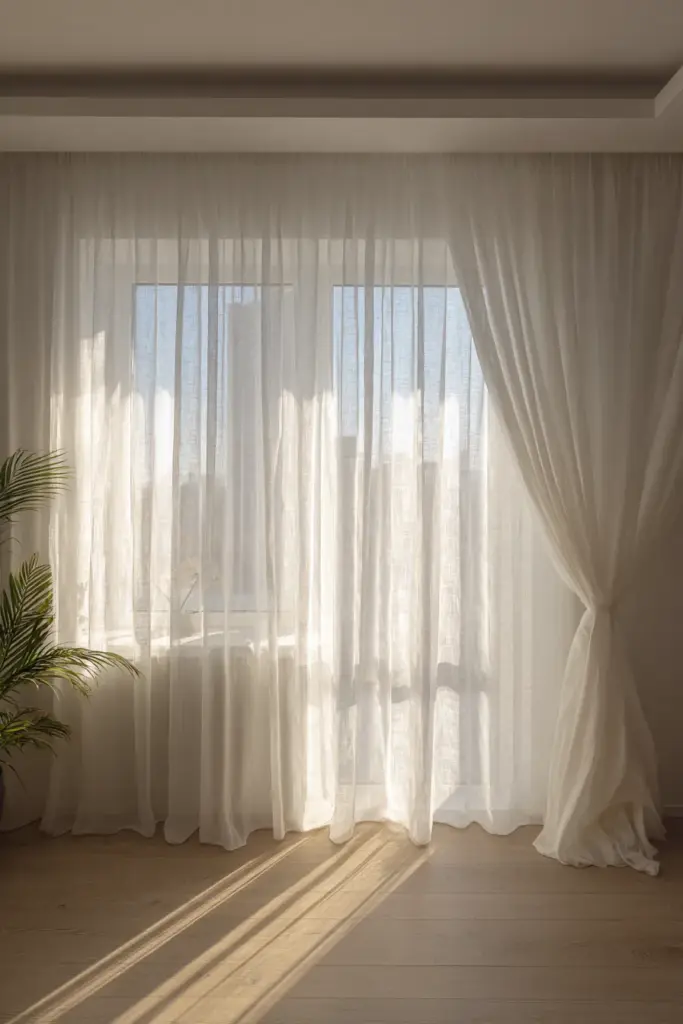
Sheer linen curtains are the gold standard for small rooms. They diffuse harsh light beautifully, create a soft luminous glow even on cloudy days, and maintain privacy without closing the room in.
Where to hang them matters as much as what you hang. Mount curtain rods as close to the ceiling as possible — ideally 2 to 4 inches below the crown molding — and extend the rod 6 to 12 inches beyond the window frame on each side. This makes windows appear larger and keeps the glass itself fully uncovered when curtains are drawn open.
Curtain length should always reach the floor. Curtains that hover mid-wall or stop at the sill visually compress the room. Floor-length panels draw the eye upward and make ceilings feel higher.
Blind and Shade Options
| Treatment | Light Control | Best For |
|---|---|---|
| Sheer roller shades | Filters, doesn’t block | South and west-facing windows |
| Top-down/bottom-up cellular shades | Privacy + light from above | Street-level apartments |
| Bamboo or woven wood blinds | Warm, filtered glow | Rustic and natural interiors |
| Heavy drapes | Full blackout | Not recommended for small rooms unless paired with a sheer |
Avoid thick, padded blinds or solid Roman shades as your only window treatment. They block light uniformly and leave nothing to work with on dim days.
Mirror Placement: Light Multiplication Done Right
Mirrors are often mentioned in decorating guides as a simple fix — “add a mirror and your room will feel bigger.” But the where matters far more than the what.
Exact Mirror Placement by Window Type
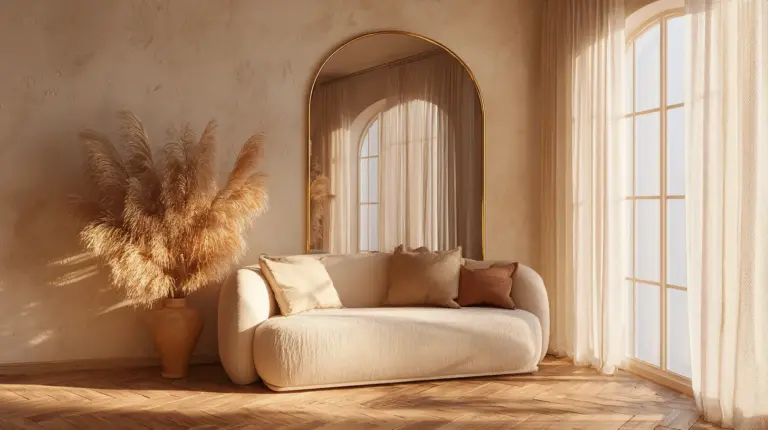
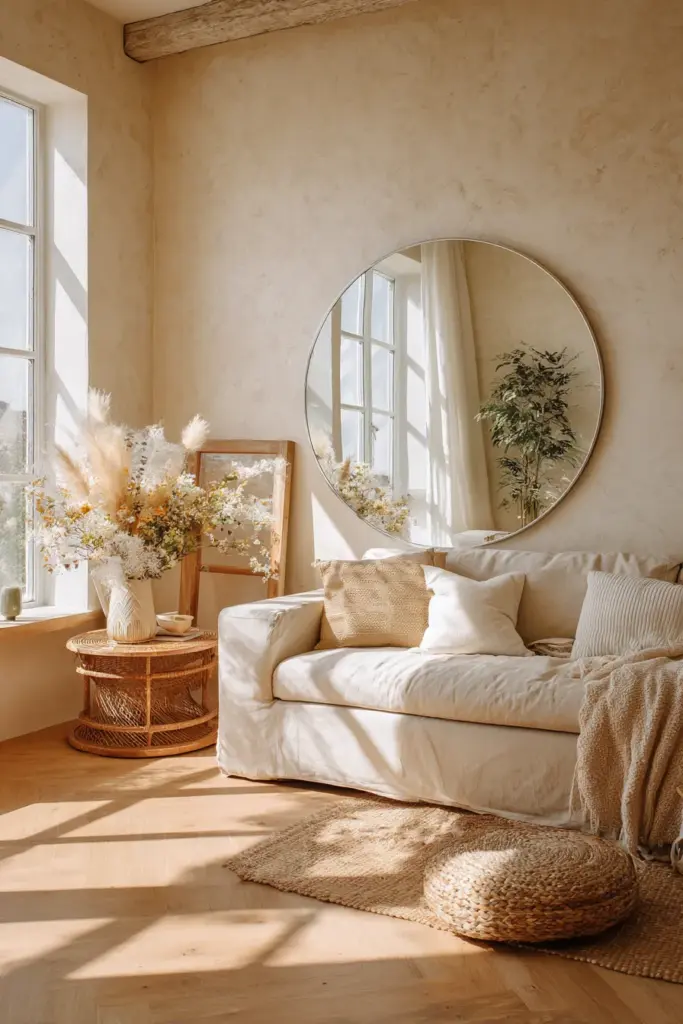
For rooms with one window: Place a large mirror on the wall directly opposite the window. This sends light bouncing back across the room and visually doubles the sense of depth. The mirror face should be at eye level or slightly above.
For corner windows or two adjacent windows: A mirror on the wall between the two windows reflects light in multiple directions and anchors the corner without blocking any glass.
For small or high windows: Use a floor-length leaner mirror angled slightly toward the window. This captures light at a lower angle and distributes it across the floor — a move that is especially effective in north-facing rooms.
Avoid placing mirrors: Directly beside or behind a window. Instead of reflecting light inward, they simply reflect the window back at you and offer no visual benefit.
One well-placed large mirror outperforms three small decorative ones every time.
Paint, Flooring, and Material Choices
Color does not just affect mood. It affects how much light a surface reflects — a measurement called Light Reflectance Value (LRV).
Understanding LRV for Small Rooms
LRV is scored from 0 (pure black, absorbs all light) to 100 (pure white, reflects all light). For small living rooms with limited natural light, aim for wall colors with an LRV of 70 or above.
Some beautiful high-LRV options that avoid sterile, clinical white:
- Warm whites with cream or greige undertones (LRV 80–90)
- Pale sage or dusty eucalyptus (LRV 72–78)
- Soft blush or barely-there pink (LRV 75–85)
- Light linen and driftwood tones (LRV 70–80)
Matte vs. eggshell finish: Use eggshell on walls in small rooms. It has a subtle sheen that reflects light more than flat matte without the clinical glare of satin or semi-gloss.
Flooring and Rug Choices
Light-toned flooring — pale oak, whitewashed wood, soft travertine — reflects light upward and visually expands the floor plane. Dark hardwood floors, while beautiful, absorb light and make rooms feel smaller.
Rug guidance for small living rooms:
- Choose rugs in cream, natural jute, pale wool, or warm oatmeal tones
- Avoid dark, heavily patterned rugs — they anchor the room visually and absorb precious light
- Size matters: a rug too small floats awkwardly; choose one large enough that at least the front legs of all major furniture pieces rest on it
- Low-pile or flat-weave rugs reflect more light than thick shag; save the plush textures for bedrooms
Furniture Materials That Work With Light
| Material | Light Behavior | Best Use |
|---|---|---|
| Light oak or ash wood | Warm, reflective grain | Coffee tables, shelving, media console |
| Rattan and woven cane | Filters light, adds texture | Accent chairs, side tables |
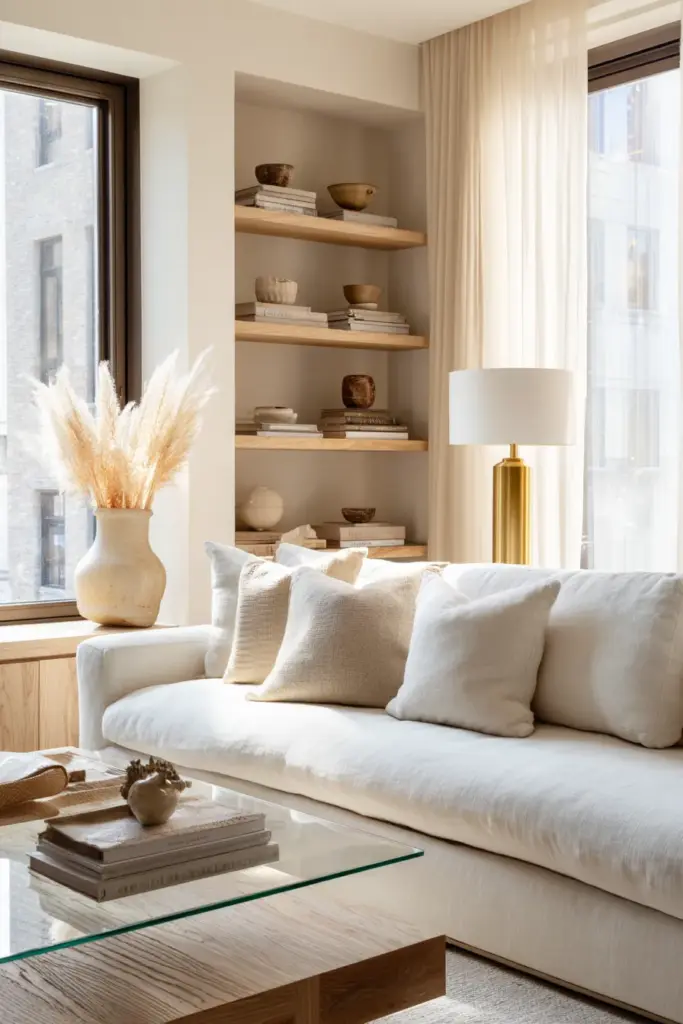
| Glass tabletops | Fully transparent, maximizes floor visibility | Coffee tables in very small rooms |
| Metal accents (brass, brushed gold) | Catches and redistributes light | Lamp bases, frame details, handles |
| White-painted wood | High reflectance | Bookcases, side tables |
| Velvet or dark upholstery | Absorbs light | Use sparingly as accent, not primary seating |
Artificial Light Layering: After the Sun Goes Down
Natural light articles rarely tell you what to do when the sun sets — or when three cloudy weeks arrive in a row. But your room lives at night too.
The Three-Layer Lighting Rule
Ambient light — the base layer. Avoid a single overhead fixture in a small room; it creates harsh shadows and flat, unflattering illumination. Instead, use a combination of a soft ceiling fixture and two to three floor or table lamps placed at different heights.
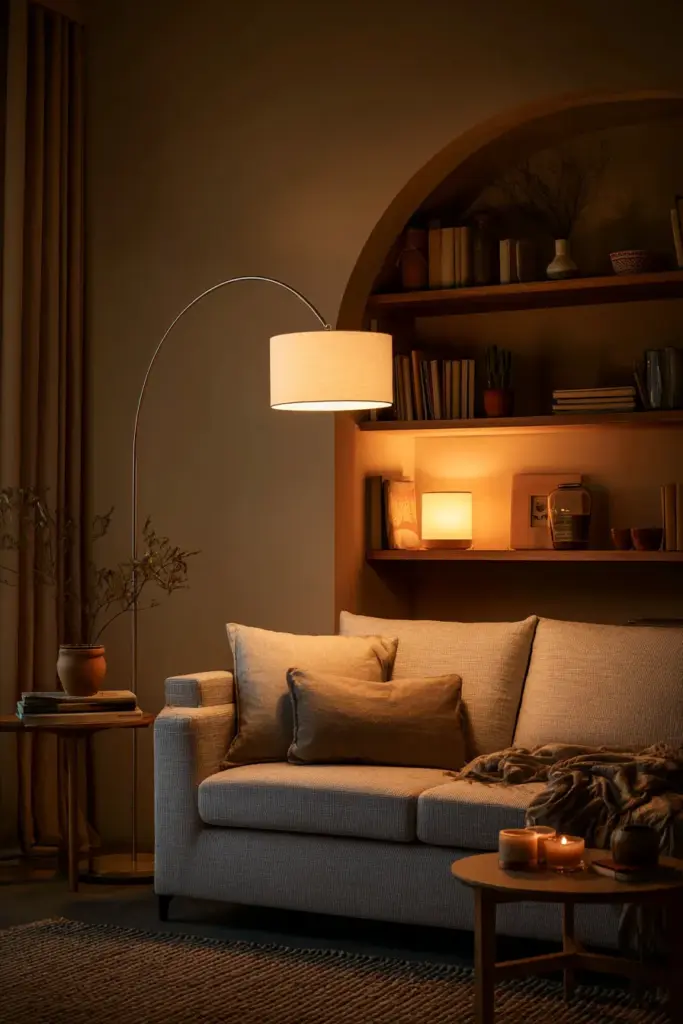
Task light — purposeful, directed. A reading lamp beside a chair, a pendant over a side table, a slim arc lamp that reaches over the sofa. These layers make the room functional and visually interesting.
Accent light — the warmth layer. LED strip lighting behind a media console, a backlit shelf, or a small table lamp tucked in a corner adds depth and turns a practical room into an intimate one. Warm bulb tones (2700K–3000K) mimic the quality of natural afternoon light and make the room feel golden even on dark evenings.
Common Mistakes to Avoid
Even well-intentioned decorating decisions can quietly drain light from a small room. Watch for these:
- Heavy blinds left permanently closed — even when privacy is not needed
- Dark-painted accent walls behind the sofa — they advance visually and shrink the room
- Oversized artwork placed low on walls — it pulls attention down and makes ceilings feel lower
- Bulky media consoles or entertainment units — replace with low floating shelves or slim media stands
- Too many throw pillows in dark or saturated colors — they collectively absorb light from your seating area
- Clutter on windowsills — candles, plants, decorative objects all block the very light you are trying to maximize
A clean windowsill is one of the most underrated design decisions in a small living room.
Room-Size Checklist: Small Living Room Natural Light
For rooms 10×12 ft or smaller
- Wall color LRV of 70 or above
- Curtain rod mounted within 4 inches of ceiling
- Curtain panels extend 6–10 inches beyond window frame on each side
- Sofa no taller than 32 inches in height
- One large mirror placed opposite the primary window
- Rug in pale or natural tone, low-pile
- Minimum two lamps in addition to overhead light
- Clear window zone — no furniture within 18 inches of glass
- Furniture with exposed legs to allow light to pass beneath
- No dark-painted accent walls
Quick Reference: Small Room Light Priorities
- First: Clear the window zone and mount curtains high and wide
- Second: Choose high-LRV paint in a warm neutral
- Third: Position one large mirror opposite the window
- Fourth: Layer warm artificial lighting for evenings
- Fifth: Select light-toned, low-profile furniture with reflective or natural materials
Conclusion
A small living room bathed in natural light is not a lucky accident. It is the result of quiet, considered decisions — a curtain hung just a little higher, a sofa pulled a few inches forward, a mirror placed with intention.
At ERYLIN, we believe that beauty lives in exactly these details. In the warm grain of a pale wood table. In the way sheer linen softens afternoon sun into something that feels almost golden. In the stillness of a room that knows how to hold light.
Your room is ready to be that space. You just have to let the light in.
FAQs
How can I make my small living room look brighter with natural light?
Start by clearing your window zone — remove any furniture placed directly in front of or beside windows. Mount curtains high and wide to maximize the amount of glass exposed. Choose wall colors with a Light Reflectance Value (LRV) of 70 or above, and place a large mirror on the wall directly opposite your primary window to bounce light back across the room.
What colors make a small living room look bigger and brighter?
Warm whites, pale greiges, soft sage greens, and light blush tones all perform well because they combine high LRV (light reflectance) with warmth that prevents the space from feeling clinical. Avoid cool, stark whites if your room receives limited natural light — they can feel gray and flat without abundant sunlight to activate them.
What curtains are best for a small living room with natural light?
Sheer linen or voile curtains in white, cream, or natural tones are the best choice. They filter harsh light, maintain privacy, and create a soft luminous glow throughout the day. Always hang them floor-length and extend the rod well beyond the window frame so the full glass surface remains uncovered when curtains are open.
Where should I place a mirror in a small living room?
Place a large mirror on the wall directly opposite your main window — this is the position that most effectively reflects natural light back into the room. For corner or side windows, place the mirror on the wall perpendicular to the glass. Avoid placing mirrors beside or behind windows, where they simply reflect the window rather than distributing light inward.
How do I decorate a dark small living room with no direct sunlight?
Focus on three things: high-LRV paint, warm layered lighting, and light-reflective materials. Choose pale, warm wall tones and layer your lighting with ambient, task, and accent sources using warm bulbs (2700K–3000K). Use glass-topped tables, light wood furniture, rattan accents, and metallic details to catch and distribute whatever light exists. A large mirror opposite even a small window makes a meaningful difference.