
Table of Contents
There’s something magical about a bookshelf that feels intentional. Not cluttered, not empty—just right. A place where your favorite novels rest alongside a ceramic vase, where light plays across natural wood grain, where every object has earned its space.
This is the heart of Japandi living room bookshelves. A marriage of Japanese minimalism and Scandinavian hygge, where clean lines meet cozy textures, and where less truly becomes more.
If you’ve been dreaming of shelves that breathe calm into your space, that hold your stories without shouting for attention, you’re in exactly the right place. Let’s explore how to bring this serene aesthetic into your home.
What is Japandi Style for Bookshelves?
Japandi is a design philosophy that honors two beautiful traditions. From Japan, it borrows wabi-sabi—the appreciation of imperfection, the beauty in simplicity, the power of negative space. From Scandinavia, it draws warmth, functionality, and that untranslatable concept of hygge: comfort that wraps around you like soft linen.
When applied to bookshelves, this means choosing pieces in natural materials like oak, bamboo, or walnut. Low-profile designs that sit close to the floor or mount seamlessly against walls. Clean silhouettes free from ornate details, where the wood itself becomes the decoration.
Think of a ladder shelf leaning gracefully against your wall, its rungs displaying just three carefully chosen books and a single trailing pothos. Or floating shelves in pale ash, their grain catching afternoon light, holding a handful of neutral-toned objects with generous space between each one.
The Japandi bookshelf doesn’t demand attention—it invites contemplation.
Why Japandi Bookshelves Transform Living Rooms
The Power of Intentional Storage
In a world of visual noise, Japandi shelving creates breathing room. These aren’t storage units designed to pack in every possession—they’re curated displays that celebrate what matters.
A minimalist wooden shelf becomes a meditation on choice. Each book you display, each ceramic piece, each woven basket tells a story. The negative space between objects isn’t empty—it’s restful, allowing your eyes (and mind) to settle.
This approach works beautifully in small living rooms where clutter can overwhelm. A single bamboo corner shelf styled with five beloved items creates more impact than an overcrowded bookcase screaming for attention.
Natural Materials That Ground Your Space
Japandi bookshelves bring the outdoors in. Light-colored woods like birch and ash reflect natural light, making rooms feel larger and more open. Rattan details add organic texture without visual weight. Bamboo introduces subtle warmth and sustainability.
These materials age beautifully—developing patina, telling time through their grain. In tropical climates like the Philippines, choosing humidity-resistant bamboo or locally sourced narra wood ensures your shelves remain stable and gorgeous for years.
The warmth of natural wood softens minimalism’s sometimes-stark reputation, creating spaces that feel lived-in rather than sterile.
Types of Japandi Living Room Bookshelves
Floating Wall-Mounted Shelves
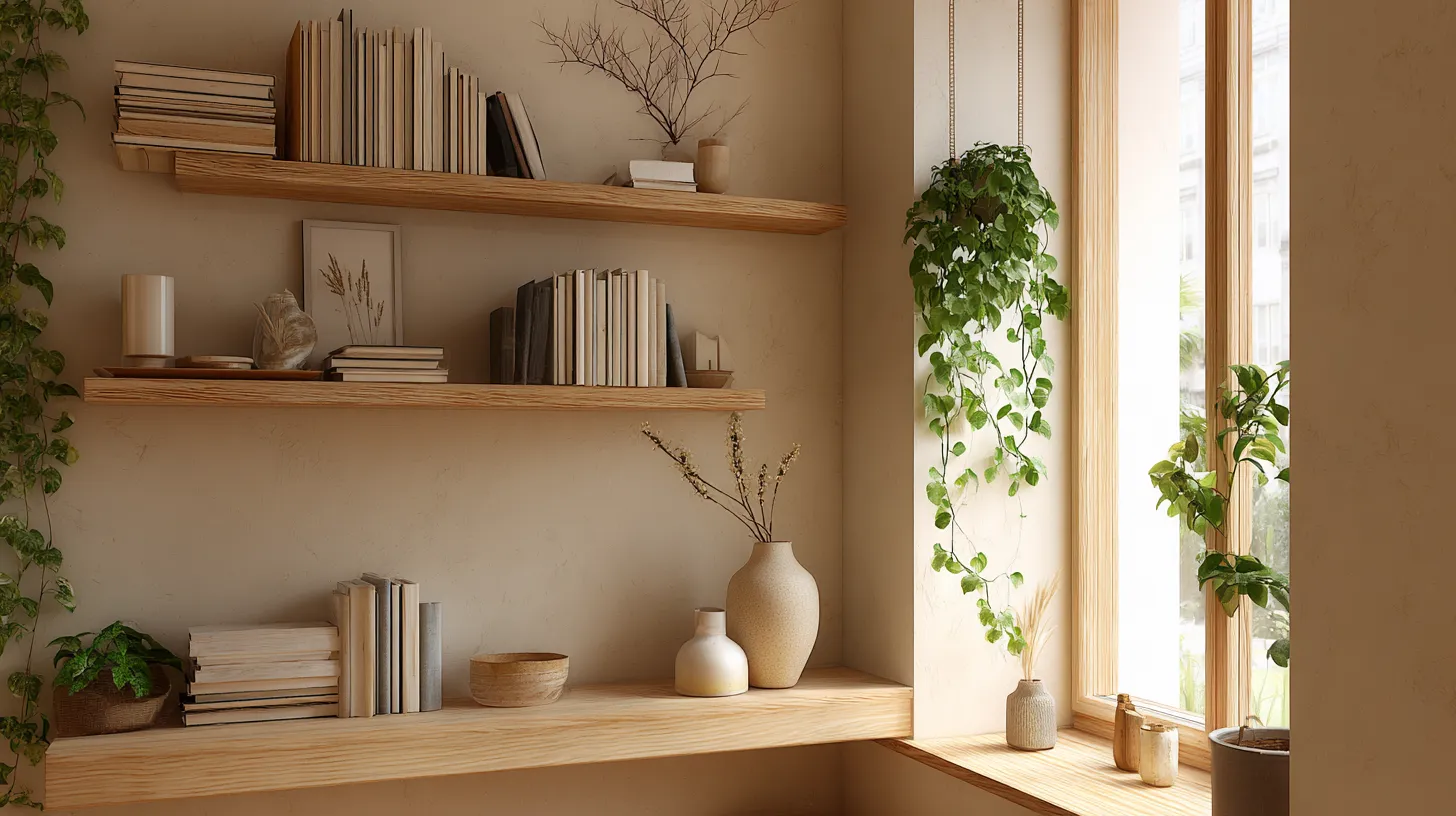
These are the invisible workers of Japandi design. Mounted flush against walls with hidden brackets, floating shelves appear to defy gravity—creating clean horizontal lines that elongate your space.
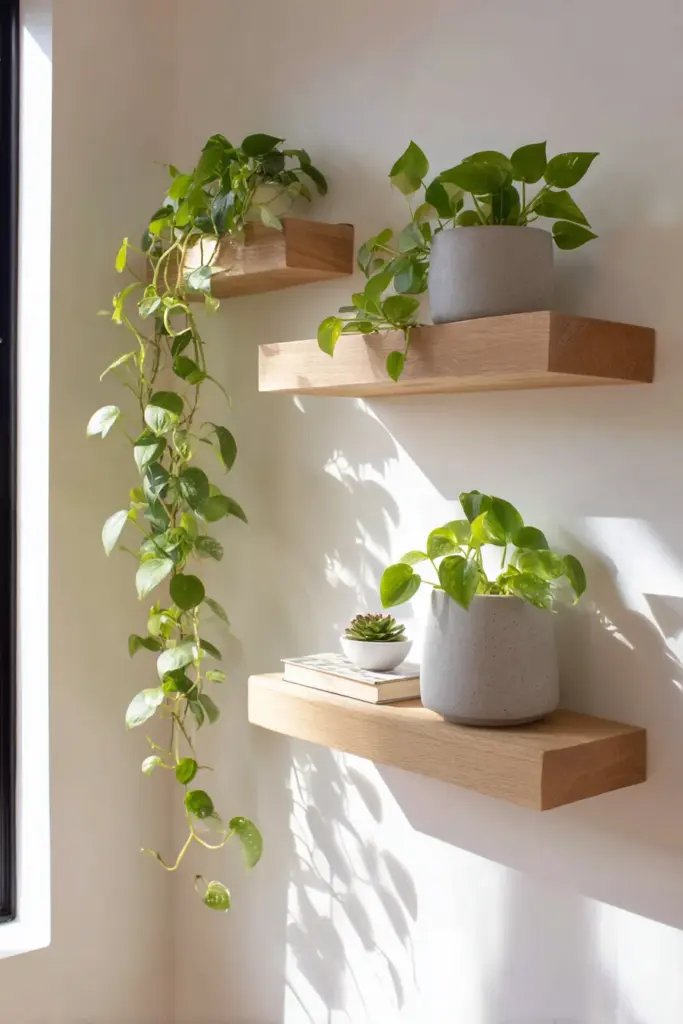
Choose shelves in pale oak or white-washed pine, keeping them thin (1-2 inches thick) for that streamlined look. Install them asymmetrically at varying heights rather than in rigid grids—this adds visual interest while maintaining balance.
Perfect for renters, many floating shelf systems require minimal drilling. They’re ideal for displaying art books horizontally, small plants, or handmade ceramics that deserve spotlight.
Ladder Shelf Designs
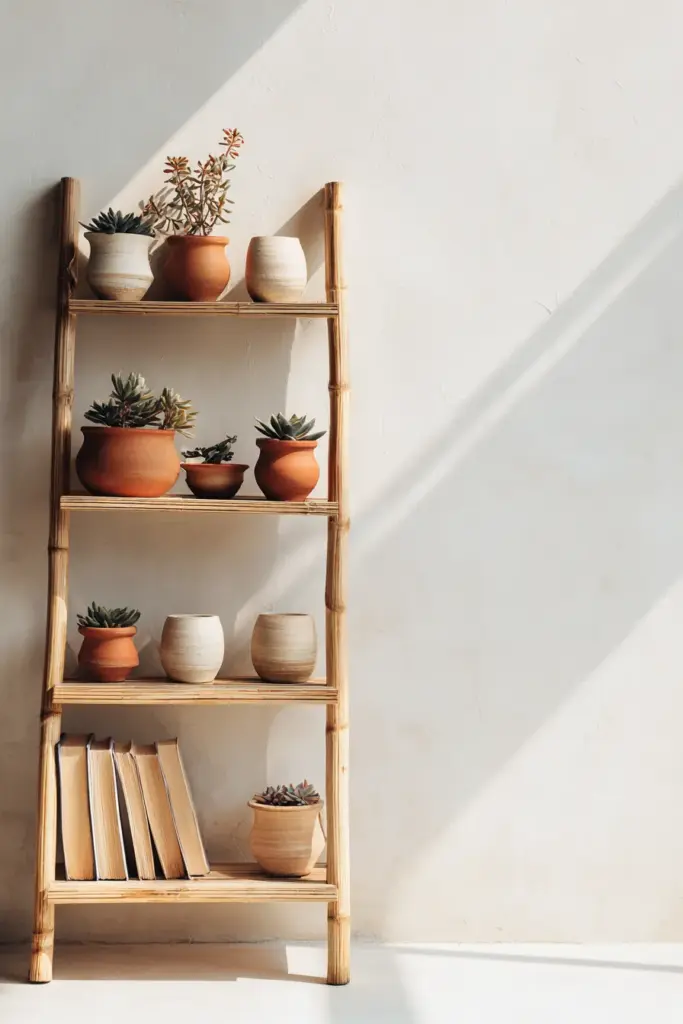
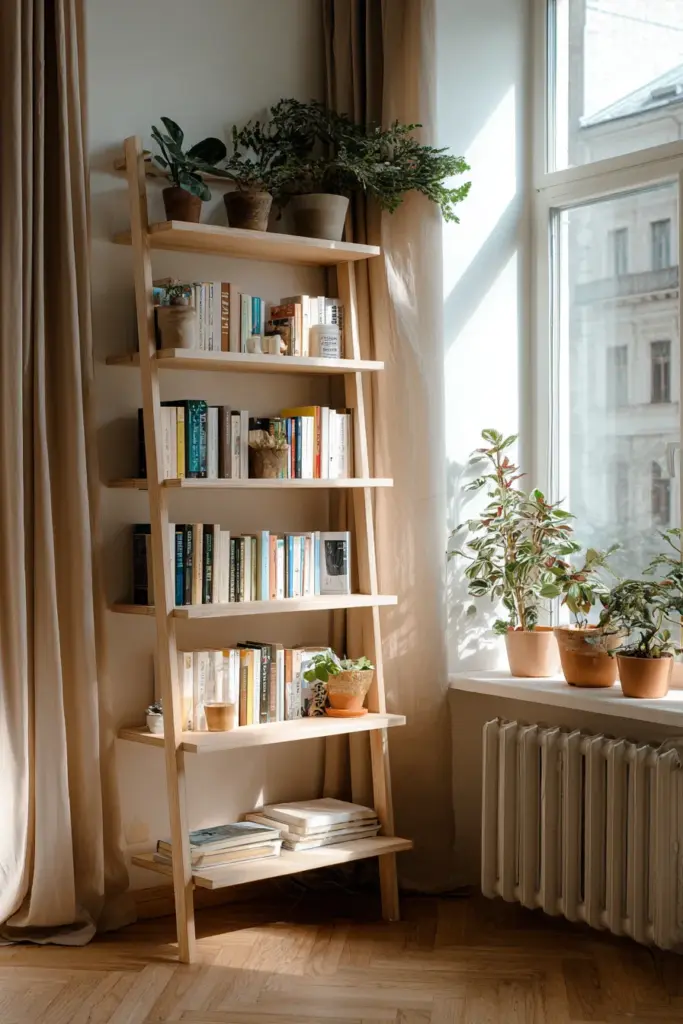
The minimalist ladder shelf leans elegantly against your wall, its angled silhouette adding architectural interest. Unlike traditional bookcases, ladder shelves taper as they rise—wider at the base, narrower at the top—creating natural visual flow.
Look for designs in natural wood finishes with clean-welded metal frames in matte black or brushed brass. The open construction prevents visual heaviness, essential in smaller living rooms.
Style the bottom rungs with larger items like baskets or stacked coffee table books. As you move upward, display gets lighter—a single bud vase, a small sculpture, or simply beautiful emptiness.
Low-Profile Floor Shelves
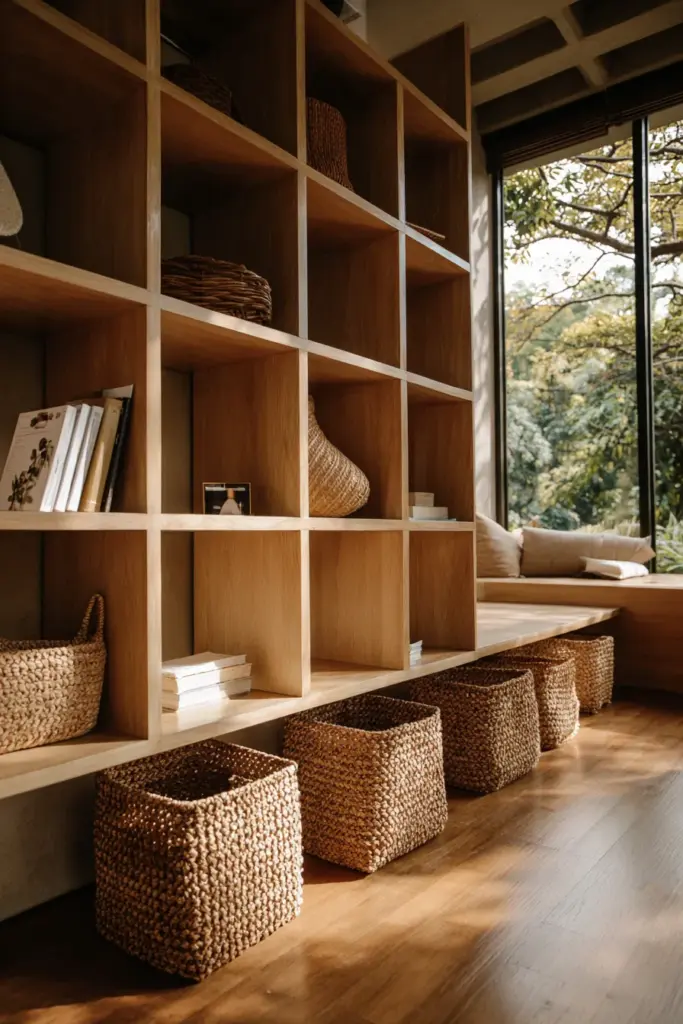
Japanese design philosophy celebrates furniture that sits close to the earth. Low-profile bookshelves—often no taller than 30 inches—create horizontal calm and make ceilings feel higher by contrast.
These modular cube shelves can be configured in countless ways. Three units side by side become a media console. Stack them vertically for narrow spaces. Their versatility makes them perfect for renters or those who love to refresh their layouts.
Choose designs with open backs to prevent that heavy, boxy feeling. This also allows you to use them as room dividers, creating zones without walls—the bookshelf becomes both storage and architectural element.
Bamboo and Rattan Corner Shelves
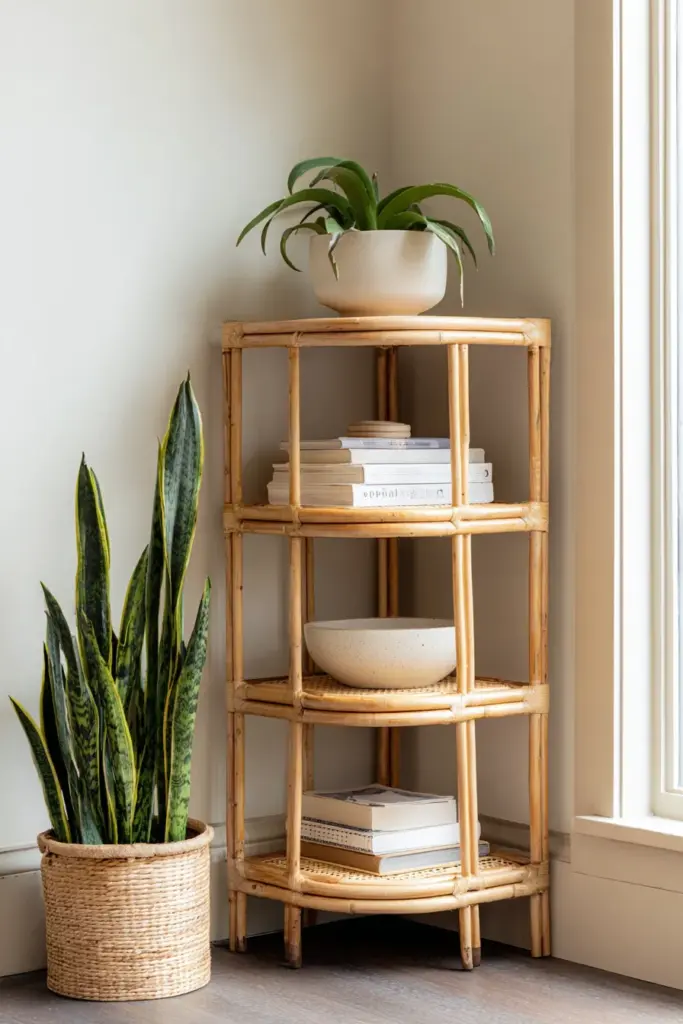
Corners are often wasted space, but a corner shelf transforms them into focal points. Bamboo corner units bring organic warmth, their natural texture creating visual interest without pattern or color.
Rattan details—perhaps woven cabinet doors or basket inserts—add subtle depth. These materials are naturally humidity-resistant, making them ideal for tropical climates where solid wood might warp.
A five-tier bamboo corner shelf can hold books on lower levels, plants and decor above. The vertical design maximizes storage while maintaining that essential Japandi quality: lightness.
How to Style Japandi Bookshelves in Your Living Room
Embrace Negative Space
The Japanese concept of ma—the space between objects—is your secret weapon. When styling your shelves, leave at least 40% empty. Yes, really.
This breathing room allows each displayed item to shine. Three books stacked horizontally with a ceramic bowl resting on top creates more impact than twenty books crammed spine-to-spine.
Think of negative space as an active design element, not absence. It’s the pause between musical notes, the silence that makes sound meaningful.
Choose a Neutral Color Palette
Japandi thrives in earthy tones: warm whites, soft grays, beiges, taupes, and gentle greens. When selecting books to display, consider wrapping mismatched covers in neutral linen or kraft paper.
This isn’t about hiding your colorful book collection—it’s about creating visual calm. Store bright-covered books in closed cabinets or baskets, displaying only those with naturally neutral spines.
Your decorative objects should follow suit. Cream ceramics, natural stone, raw wood, matte black metal. The palette becomes a soothing backdrop for living, not a source of visual stimulation.
Layer Textures Thoughtfully
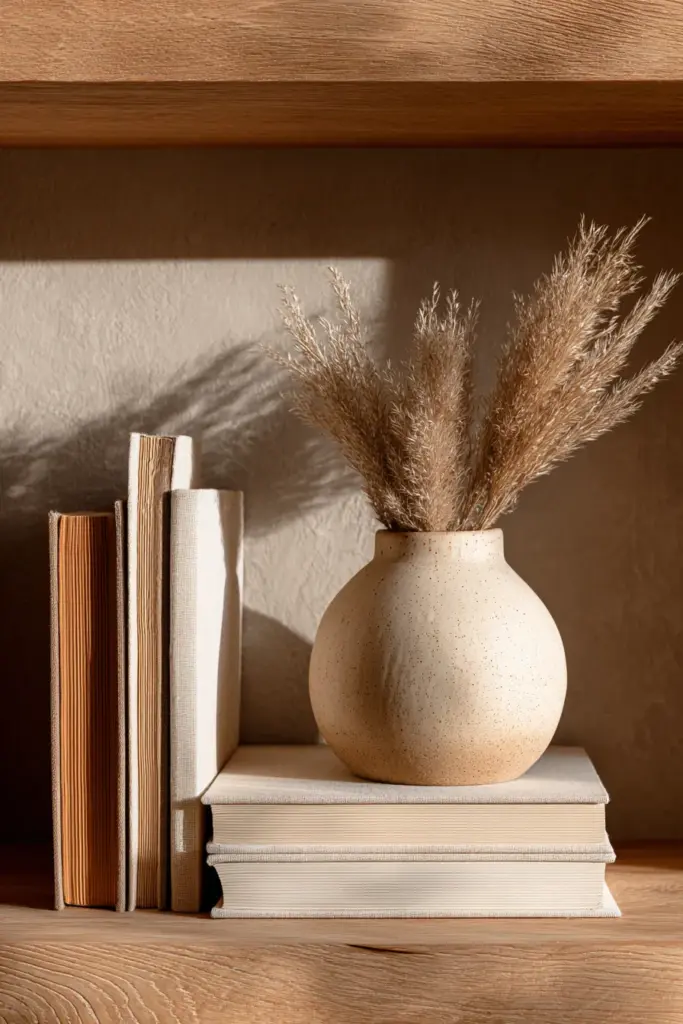
While colors stay neutral, textures can—and should—vary. Smooth glazed pottery beside rough linen-bound books. Woven rattan baskets against sleek wood grain. A stone sculpture next to soft dried pampas grass.
These textural contrasts create interest without breaking your color story. Run your hand along your styled shelf—it should feel like a landscape of surfaces, each distinct yet harmonious.
In tropical humidity, choose materials that weather well. Sealed ceramics, treated woods, and natural fibers like seagrass all develop beautiful patina rather than deteriorating.
Practice the Rule of Three
Odd numbers create visual balance. Style your shelves in groupings of three or five items—never perfectly symmetrical arrangements.
A small stack of books, a ceramic vase, and a trailing plant form a complete vignette. Three shelves might hold one vignette, one completely empty shelf (your negative space), and one with a single sculptural object.
This rhythm—full, empty, minimal—guides the eye through your display without overwhelming it.
Incorporate Living Elements
Plants breathe life into minimalism. Pothos trails gracefully from upper shelves. Snake plants stand architecturally on lower levels. Small succulents in handmade pots add organic texture.
Choose planters in materials that complement your shelves: terracotta for warmth, concrete for industrial edge, ceramic in matte finishes. Avoid plastic and overly decorative containers.
Living elements also improve air quality and introduce gentle movement as leaves sway in passing breezes—your shelf becomes a living composition, never static.
Japandi Bookshelf Materials Guide
| Material | Benefits | Best For | Maintenance |
|---|---|---|---|
| Light Oak | Warm grain, durable, ages beautifully | Floating shelves, ladder designs | Dust weekly, oil annually |
| Bamboo | Sustainable, humidity-resistant, lightweight | Corner shelves, tropical climates | Wipe with damp cloth, avoid soaking |
| Walnut | Rich tone, strong, premium feel | Statement pieces, low-profile units | Minimal care, occasional wood conditioner |
| Rattan | Organic texture, breathable, flexible | Cabinet doors, basket inserts | Vacuum to remove dust from weave |
| Ash | Pale finish, clean grain, Scandinavian aesthetic | Wall-mounted, minimalist frames | Dust regularly, protect from direct sun |
Sustainable and Local Sourcing in the Philippines
Filipino homes can embrace Japandi while supporting local craftsmanship. Look for shelves made from sustainably harvested narra or mahogany, both naturally humidity-resistant.
Local suppliers in areas like Naic, Cavite offer custom woodworking at accessible prices. Request FSC-certified bamboo when possible—it ensures your beautiful shelf doesn’t cost the planet.
Upcycling is deeply Japandi. An old wooden ladder can become a charming bookshelf with light sanding and natural oil finish. IKEA’s IVAR system, available locally, transforms beautifully with simple modifications: remove backing panels, add cane webbing, or refinish in soft white.
Small Space Japandi Bookshelf Solutions
Vertical Thinking for Apartments
When floor space is precious, build upward. Tall, narrow ladder shelves occupy minimal footprint while providing generous display area. Choose designs under 16 inches deep to avoid protruding too far into your room.
Wall-mounted shelves installed at varying heights create visual interest without consuming floor space. Mix long shelves (36 inches) with shorter ones (18 inches) for dynamic composition.
Consider the space above doorways or windows—unconventional, yes, but beautifully functional for displaying items you want seen, not frequently accessed.
Multi-Functional Designs
The best small-space furniture serves multiple purposes. A low-profile bookshelf becomes a console table behind your sofa, styled with lamps and books. Install integrated LED strips underneath for ambient lighting.
Use your bookshelf as a room divider between living and dining areas. Choose open-back designs that allow light through while defining zones. This creates the illusion of separation without the claustrophobia of walls.
Some modular cube systems include optional doors or fabric bins. Hide clutter in closed sections while displaying beauty in open ones—the Japandi balance of function and form.
No-Drill Solutions for Renters
Floating shelves don’t always require drilling. Modern adhesive mounting systems support significant weight—check ratings before installation. These work best on smooth walls, less reliably on textured surfaces.
Tension-mounted ladder shelves wedge between floor and ceiling, requiring zero wall damage. They’re surprisingly stable and completely removable when you move.
Freestanding modular units offer maximum flexibility. Rearrange them as your needs change, take them with you to your next home, and never lose your security deposit.
Styling Your Japandi Bookshelf: A Step-by-Step Guide
Step 1: Clear Everything
Start with empty shelves. This allows you to see the architecture of your piece and make intentional choices.
Step 2: Select Your Display Items
Gather only what truly belongs—books you love, objects with meaning, plants that thrive in your lighting. Be ruthless. If it doesn’t bring you joy or serve a function, it doesn’t make the cut.
Step 3: Create Anchor Points
Place your largest items first: stacks of books, substantial vases, larger plants. These become visual anchors around which smaller pieces orbit.
Step 4: Layer in Medium Objects
Add your mid-sized pieces: single books laid horizontally, medium planters, ceramic bowls. Vary heights by stacking books as pedestals.
Step 5: Add Delicate Touches
Finish with your smallest, most delicate items: a single dried flower stem, a small stone, a precious photograph. These are the grace notes.
Step 6: Step Back and Remove
View your work from across the room. What feels too busy? Remove it. Japandi styling often means taking away until you’re slightly uncomfortable—then stopping.
Step 7: Introduce Asymmetry
Shift items slightly off-center. Leave one shelf completely empty. Create intentional imbalance that somehow feels balanced.
Lighting Your Japandi Bookshelves
Lighting transforms good styling into magical moments. Natural light is ideal—position shelves perpendicular to windows so sunlight rakes across their surfaces, highlighting wood grain and creating gentle shadows.
For darker corners, install slim LED strips along shelf undersides. Choose warm white (2700-3000K) to complement natural materials. The light should be subtle, barely noticeable when viewing straight-on, but creating gentle illumination for objects.
Battery-operated picture lights mounted above shelves add focused drama without visible cords. Position them to highlight your most beautiful objects—handmade ceramics, special book collections, sculptural plants.
Avoid overhead spotlights that create harsh shadows. Japandi lighting should feel like the soft glow of dawn, not midday sun.
Common Japandi Bookshelf Mistakes to Avoid
Overcrowding: The easiest trap. Remember, negative space is active design. If your shelves feel full, they’re too full.
Matching Sets: Perfectly matched bookends, identical vases, uniform book heights—these create visual boredom. Japandi celebrates natural variation within a cohesive palette.
Ignoring Scale: A tiny object on a massive shelf looks lost. A huge vase on a delicate floating shelf looks precarious. Match object weight to shelf proportions.
All Books Vertical: Mix vertical and horizontal orientations. Stacks of 2-3 books laid flat create variation and platforms for smaller objects.
Hiding the Wood: Your beautiful shelf deserves to be seen. Don’t pack books so tightly that the natural material disappears.
Forgetting Maintenance: Dust accumulates on open shelves. Weekly gentle dusting prevents buildup. In humid climates, check monthly for moisture damage.
Budget-Friendly Japandi Bookshelf Ideas
DIY Transformations Under $100
Transform basic IKEA pieces into Japandi treasures. The IVAR shelf system starts affordable and accepts modification beautifully. Remove its backing, sand lightly, and apply natural oil or white stain for instant Scandinavian appeal.
Wooden crates from markets or hardware stores, cleaned and stacked, create rustic-industrial shelving. Secure them together, add L-brackets to walls, and you’ve built custom storage for minimal investment.
Reclaimed wood planks (often free from renovation sites) mounted with simple metal brackets become floating shelves with unique character. Each imperfection tells a story—deeply wabi-sabi.
Strategic Splurging
Invest in one beautiful anchor piece rather than multiple mediocre ones. A stunning bamboo ladder shelf becomes your room’s focal point, while surrounding storage can be more utilitarian.
Quality floating shelf brackets matter—cheap ones fail or damage walls. Spend here, save on the wood itself (which you can source locally and cut to size).
Second-hand and vintage shops often hold mid-century pieces that align perfectly with Japandi aesthetics. Teak shelving from the 1960s, properly cleaned and oiled, looks contemporary and timeless.
Maintaining Your Japandi Bookshelves in Tropical Climates
Humidity is both friend and foe to natural materials. In the Philippines, embrace it rather than fighting it.
Humidity Control: Place small silica gel packets behind books to prevent moisture absorption and page yellowing. Replace them quarterly. Ensure rooms have adequate ventilation—stagnant air encourages mold.
Wood Care: Wipe shelves monthly with barely-damp microfiber cloths. Never saturate wood. Apply food-safe mineral oil or specialized wood conditioner twice yearly to prevent drying and cracking.
Pest Prevention: Bamboo attracts certain insects. Treat with natural neem oil solution during humid season. Cedar blocks placed discreetly on shelves repel pests while adding subtle fragrance.
Seasonal Rotation: During monsoon season, remove precious books to climate-controlled storage. Display more decorative objects less vulnerable to humidity. This rotation keeps your styling fresh while protecting vulnerable items.
Quick Styling Checklist
Before you finalize your Japandi bookshelf display, run through this checklist:
- Negative space comprises 40-50% of total shelf area
- Color palette stays within neutral earth tones
- At least three different textures are represented
- Items are grouped in odd numbers (3, 5, 7)
- One shelf or section remains completely empty
- Books alternate between vertical and horizontal orientations
- Living elements (plants) are incorporated
- The shelf itself (wood grain, material) is visible
- No visible cords or clutter
- Each displayed item brings joy or serves a purpose
- Lighting highlights rather than overwhelms
- Viewing from across the room feels balanced and calm
Finding Your Personal Japandi Balance
Here’s the beautiful truth about Japandi: it’s not about rules, it’s about feeling. The aesthetic guidelines exist to serve you, not constrain you.
Maybe your version includes one bold ceramic in terracotta rather than strict neutrals. Perhaps you display more books than typical Japandi because you’re an avid reader—and that’s your authenticity showing through.
The goal isn’t magazine-perfect styling. It’s creating a bookshelf that makes you pause, breathe deeper, and feel at home. Where your favorite stories live alongside objects that matter. Where morning light catches wood grain in ways that shift with seasons.
Your Japandi bookshelf should feel like an exhale. Like you’ve finally given your belongings—and yourself—room to breathe.
You’ve created something intentional. Something that honors both minimalism and warmth, function and beauty. As you sit in your living room, watching afternoon light play across carefully chosen objects, notice how different this feels from clutter and chaos.
This is what Japandi offers: not deprivation, but liberation. Not emptiness, but spaciousness. Not coldness, but calm warmth that wraps around you like your favorite blanket.
Your shelves now tell your story—not loudly, but with quiet confidence. And that gentle presence transforms not just your living room, but how you move through your days.
Welcome home.
Frequently Asked Questions
What is the difference between Japandi and minimalist bookshelves?
While both embrace simplicity, Japandi adds warmth through natural materials and organic textures that pure minimalism often lacks. Minimalist shelves might be sleek metal or white lacquer, while Japandi chooses warm woods, bamboo, and rattan. Japandi also incorporates the Japanese concept of wabi-sabi—appreciating imperfection—whereas minimalism often pursues perfection. The result feels more lived-in and approachable.While both embrace simplicity, Japandi adds warmth through natural materials and organic textures that pure minimalism often lacks. Minimalist shelves might be sleek metal or white lacquer, while Japandi chooses warm woods, bamboo, and rattan. Japandi also incorporates the Japanese concept of wabi-sabi—appreciating imperfection—whereas minimalism often pursues perfection. The result feels more lived-in and approachable.
How many books should I display on Japandi living room shelves?
Quality over quantity defines Japandi. Rather than filling shelves completely, display 40-60% of shelf capacity. For a five-shelf unit, this might mean 15-25 carefully chosen books mixed with decorative objects and generous negative space. Wrap mismatched covers in neutral paper or choose books with naturally beautiful spines. The goal is intentional curation, not a library catalog.
Can I use IKEA furniture for authentic Japandi bookshelves?
Absolutely. IKEA’s IVAR system, BILLY bookcase, and EKET cubes can all be modified into Japandi pieces. Remove backings for openness, refinish in natural oils or soft white stains, replace hardware with minimalist pulls, or add cane webbing to cabinet doors. The key is choosing simple silhouettes and enhancing them with natural materials—IKEA provides the affordable bones for your creative vision.
What plants work best on Japandi bookshelves?
Choose low-maintenance plants with architectural shapes or graceful trails. Pothos and philodendron cascade beautifully from upper shelves. Snake plants and ZZ plants stand sculptural on lower levels. Small succulents in handmade ceramic pots add organic texture. Avoid flowers with busy patterns or very colorful foliage—stick to greens and silvery tones that complement your neutral palette.
How do I keep Japandi shelves from looking too empty or cold?
Layer textures to add warmth: smooth ceramics, woven baskets, linen-bound books, natural stone. Incorporate living plants for organic movement. Choose warm-toned woods like oak or walnut over cool grays. Add soft, ambient lighting underneath shelves. Remember that negative space should feel restful, not sparse—if your styling feels cold, add one textured element like a chunky knit throw draped nearby or a handwoven basket on a lower shelf.