
Table of Contents
The television doesn’t have to disrupt the poetry of a small Japandi living room. In fact, when placed with intention and surrounded by natural textures, it becomes part of the quiet rhythm you’ve created—a portal to stories and connection, softly integrated into your sanctuary.
Small spaces ask us to be thoughtful. Every choice matters when square footage is precious. But Japandi design has always understood this, blending Scandinavian simplicity with Japanese minimalism in ways that feel spacious even when the room itself is cozy.
Your TV can live beautifully here. With the right unit, placement, and styling, it becomes functional art—low-profile, natural, and unexpectedly calming.
Let’s explore how to create a small Japandi living room where your television belongs.
Understanding Japandi Style for Small Spaces
Japandi is the gentle marriage of two design philosophies that both revere simplicity. Scandinavian design brings warmth, hygge, and organic materials. Japanese aesthetics offer wabi-sabi, intentional emptiness, and profound respect for craft.
Together, they create rooms that breathe. Neutral colors—soft beiges, warm grays, creamy whites—form the foundation. Natural materials like oak, walnut, bamboo, and linen add texture without noise.
In a small living room, this philosophy becomes essential. You’re not filling space; you’re honoring it. Every piece should earn its place, including your TV.
The television, often seen as a modern intrusion, can actually support Japandi principles when approached correctly. It’s about low-profile design, thoughtful storage, and allowing negative space to frame what matters.
Choosing the Perfect TV Unit for a Small Japandi Living Room
The Foundation: Low-Profile Media Consoles
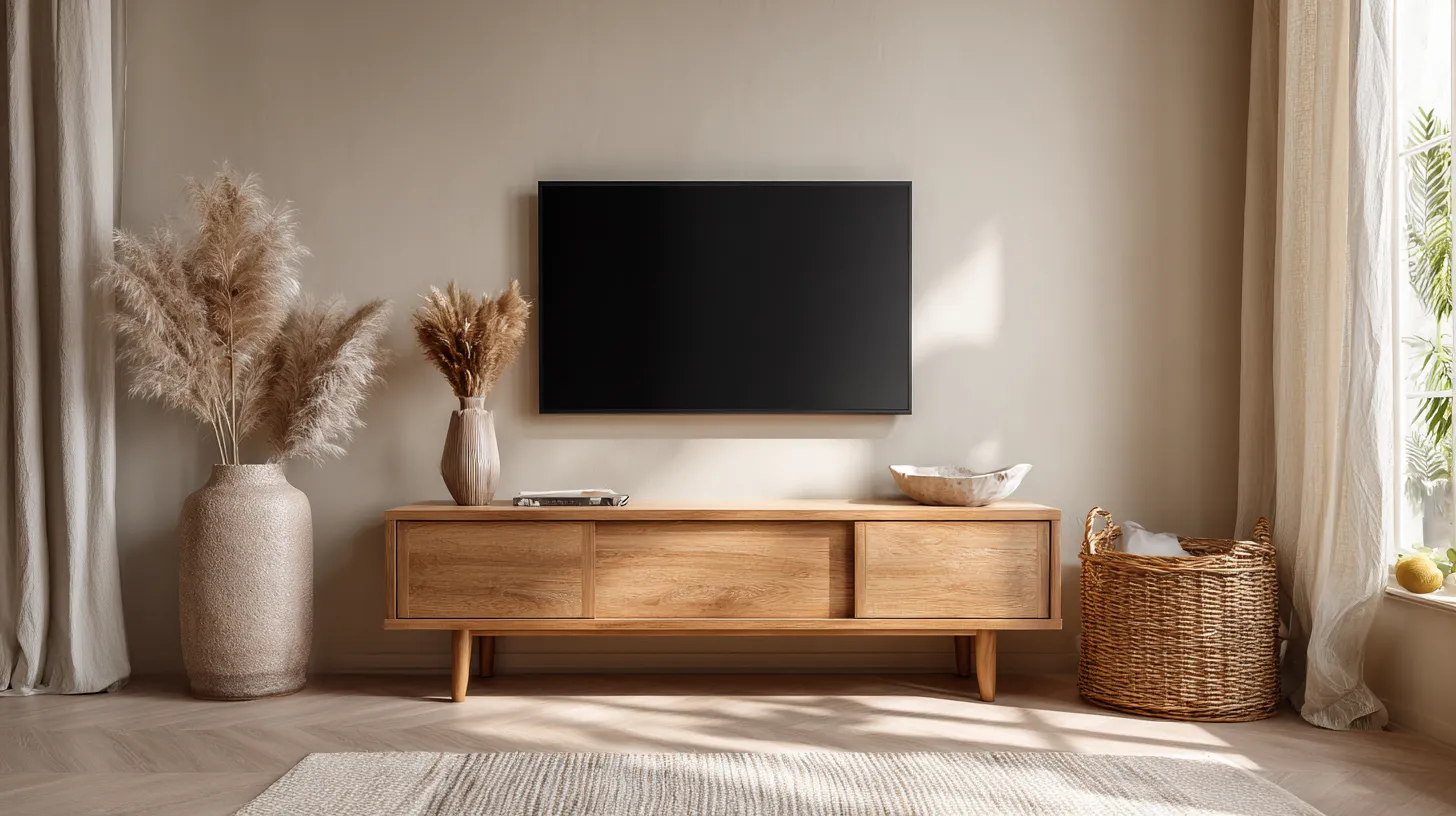
The best Japandi TV stands sit low to the ground, creating horizontal lines that make rooms feel wider. Look for pieces between 16 to 24 inches in height—enough for storage without visual weight.
Natural wood is non-negotiable here. Acacia, oak, or walnut with visible grain brings the organic warmth Japandi craves. The wood shouldn’t be overly polished; a matte or satin finish feels more authentic, more lived-in.
Tapered legs—those slender, angled supports characteristic of mid-century modern design—add lightness. They create space beneath the unit, letting light flow through and preventing the room from feeling anchored or heavy.
Storage That Disappears
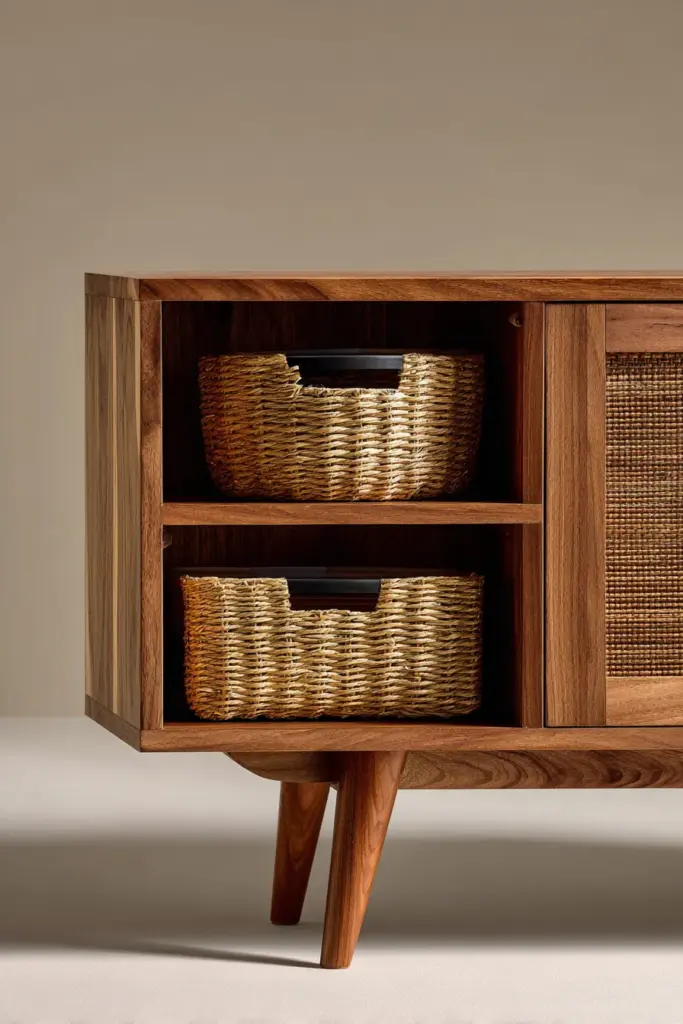
In small spaces, your TV unit must work harder. Choose pieces with slatted doors or open cubbies that provide storage while maintaining visual breathing room. Solid cabinet doors can feel blocky; perforations or wood slats filter the view without hiding everything.
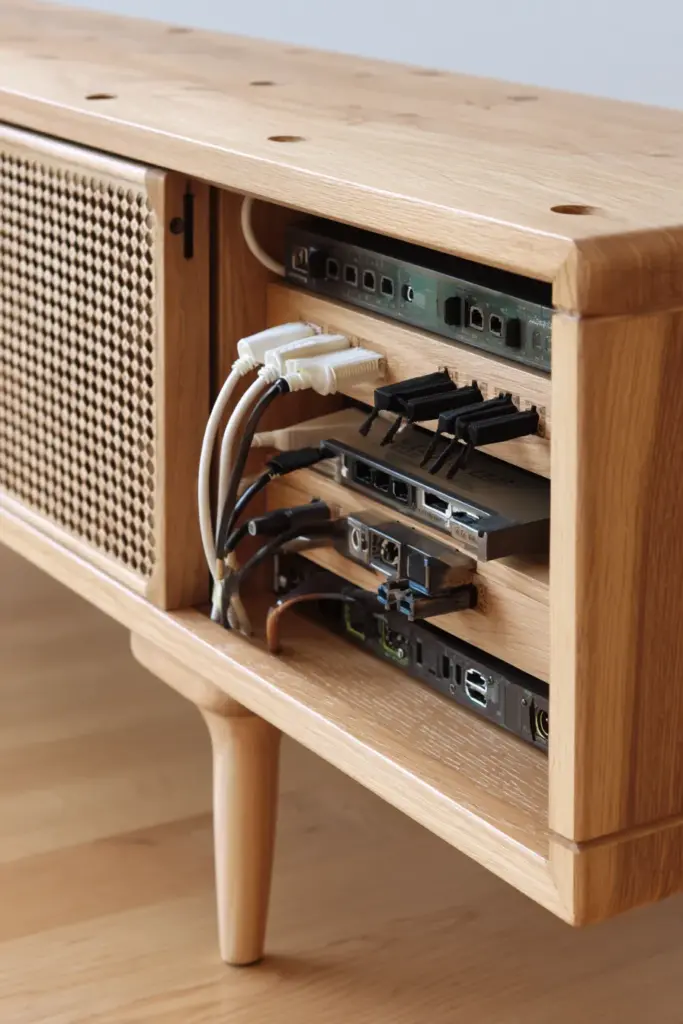
Cord management is where beauty meets function. The best Japandi units include built-in channels or rear cutouts for cables. Nothing disrupts minimalist calm quite like a tangle of black wires.
Consider multi-purpose designs—TV stands that incorporate shelving for books, small plants, or handwoven baskets. In a 150-square-foot living room, every surface should serve at least two purposes.
Budget-Friendly Options Under $200
You don’t need luxury pricing to achieve Japandi aesthetics. Look for simple wooden TV benches from brands like IKEA’s LISABO series or local Philippine furniture makers who work with sustainably sourced bamboo and rattan.
DIY projects work beautifully here. A simple floating shelf made from FSC-certified plywood, stained in warm walnut, can hold a modest TV while creating the illusion of floating in space. Pair it with woven baskets beneath for remote storage.
Thrift stores and vintage shops often carry mid-century pieces with the exact tapered-leg, natural-wood aesthetic Japandi loves. A coat of low-VOC natural oil can revive old teak into something timeless.
| Budget Option | Price Range | Japandi Features | Best For |
|---|---|---|---|
| IKEA LISABO console | $150-$180 | Ash veneer, slim legs, minimal design | Quick setup, renters |
| Local bamboo media bench | $100-$160 | Natural bamboo, handcrafted, eco-friendly | Supporting local artisans |
| DIY floating shelf + baskets | $60-$120 | Customizable, space-saving, floating effect | Small walls, creative projects |
| Vintage teak sideboard (refinished) | $80-$200 | Authentic wood grain, mid-century lines | Character and sustainability |
Where Should I Put the TV in a Small Japandi Living Room?
Placement is everything. In Japandi design, the television shouldn’t dominate—it should nestle into the landscape you’ve created.
The low wall position works best in compact spaces. Mount or place your TV on a unit along the room’s shortest wall, creating a focal point that doesn’t interrupt traffic flow. This keeps pathways open and maintains the sense of spaciousness.
Avoid placing the TV directly opposite windows where glare becomes an issue. Instead, position it perpendicular to natural light sources. If that’s impossible, consider sheer linen curtains that filter harsh afternoon sun without blocking the view.
In truly tiny living rooms—think 100 square feet or less—a corner placement can be brilliant. An angled corner unit or wall-mounted TV on an articulating arm saves floor space while creating an unexpected viewing angle that feels intentional, not cramped.
How High Should I Mount a TV in Japandi Style?
The center of your screen should sit at eye level when you’re seated—typically 42 to 53 inches from the floor. This isn’t just about comfort; it’s about maintaining the low, grounded aesthetic Japandi celebrates.
Wall-mounting works beautifully in small spaces, eliminating the need for a bulky unit. Choose a low-profile mount in matte black or natural wood finish. The mount itself should disappear, leaving the screen to float like a piece of modern art.
If mounting on a console, ensure the TV’s base doesn’t hang over the front edge. Leave at least 2 inches on all sides—this breathing room is essential to the minimalist look.
Consider height in relation to your seating. A low floor cushion setup, very Japanese in spirit, would require the TV to sit even lower, perhaps on a 12-inch bench rather than mounted high.
Styling Your TV Wall in Japandi Decor
Creating Negative Space
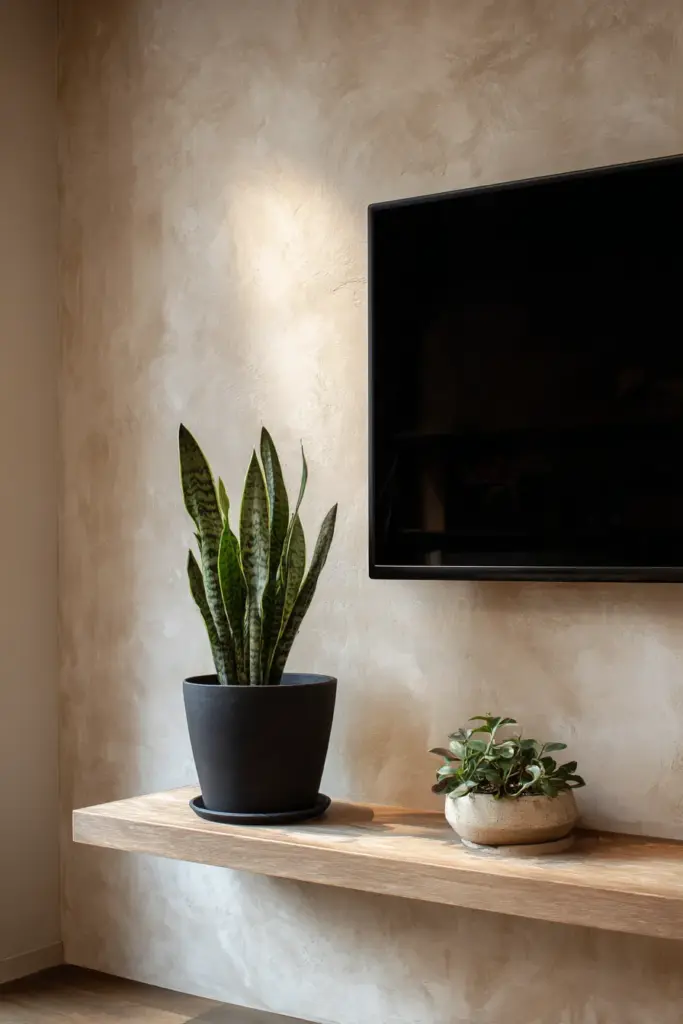
The wall around your TV should feel like a gallery, not a cluttered mantle. In Japandi design, what you don’t add is as important as what you do.
Leave generous space above and around the screen. If your TV is 50 inches wide, the wall itself should be at least 72 inches across—that extra breathing room prevents visual crowding.
A single piece of art to one side, hung at a slightly different height, creates asymmetrical balance. Choose something textural: a simple line drawing in black ink, a small woven wall hanging, or a floating shelf with one sculptural ceramic piece.
Natural Elements as Anchors
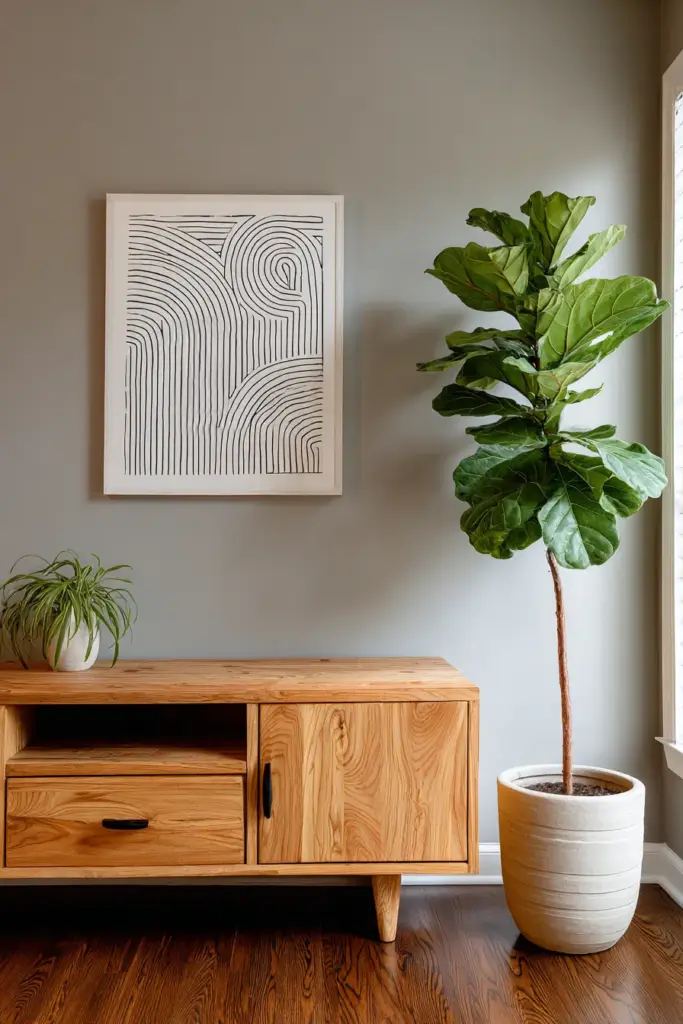
Plants bring life without competing for attention. A tall snake plant or fiddle leaf fig in a ceramic pot to one side of the TV unit grounds the space organically. The green introduces color while staying neutral and calming.
Wood accents echo the TV console. A small sculptural bowl made from reclaimed teak, a single branch in a glass vase, or a stack of two linen-bound books adds layers without busyness.
Lighting matters enormously here. A simple paper pendant lamp above or a minimalist floor lamp beside the TV provides ambient glow for movie nights. Warm-toned LED strips behind the TV (yes, even this can be Japandi) reduce eye strain and create a soft halo effect.
The TV-Off Aesthetic
When the screen is dark, it becomes a black rectangle. Make peace with this by treating it as intentional negative space—a pause in the visual rhythm. Some designers place a single framed print that leans casually against the wall on the console, partially overlapping the TV when it’s off.
Another approach: embrace the black. In a room of warm beiges and soft grays, that dark rectangle becomes a grounding element, an anchor that makes everything else feel lighter.
How to Hide TV Cables in a Japandi Living Room
Cables are the enemy of minimalist beauty. But in rental spaces or where you can’t drill into walls, solutions exist.
Cable raceways in white or wood finish can be painted to match your wall. They run vertically from your mounted TV down to an outlet, concealing cords in a clean line that’s barely noticeable.
For console setups, choose units with rear cutouts and built-in channels. Run all cables through the back, securing them with adhesive clips or velcro ties. Bundling cables together creates one slim line instead of visual chaos.
A textile solution: a piece of neutral fabric—linen or cotton in beige—can be draped strategically to conceal cables running along a baseboard. It looks intentional, like a soft design choice, while solving a practical problem.
Wireless is your friend. Invest in quality Bluetooth speakers rather than a soundbar with visible wiring. Streaming devices eliminate cable box clutter. The fewer cords you need, the cleaner your space remains.
Combining TV and Storage in a Small Japandi Living Room
Storage doesn’t have to look like storage. In Japandi design, it becomes part of the architecture.
Built-In Solutions
If you own your space, consider a custom built-in unit that spans the TV wall. Open cubbies alternate with closed cabinets—some for display (a ceramics collection, linen-bound books), others hiding electronics and practical items.
Use the same wood throughout for continuity. The TV recesses into this landscape of texture and function, becoming one element among many rather than the singular focus.
Modular Furniture Systems
For renters, modular systems offer flexibility. Stackable cube units in light oak or ash can be arranged around the TV—three cubes to the left, two to the right, creating asymmetry that feels organic.
Each cube holds something beautiful or functional: a woven basket for remotes, a small potted succulent, folded throws in neutral tones. The TV sits among these vignettes, integrated rather than isolated.
Vertical Storage for Tiny Rooms
When floor space is scarce, build up. Floating shelves above the TV—not too many, perhaps just two—can hold a few select items. Keep each shelf minimally styled: one shelf with two small ceramic vessels, another with three hardcover books stacked horizontally.
The key is restraint. In a 120-square-foot living room, three floating shelves is plenty. More becomes visual noise.
Making Your Small Living Room Look Bigger with Japandi Style
Color Psychology for Spaciousness
Neutral colors genuinely expand perceived space. Soft beige walls reflect natural light, making rooms feel airier. Warm grays prevent the coldness that pure white can bring while maintaining brightness.
Your TV wall can be painted one shade deeper than surrounding walls—a technique called color blocking. A warm taupe behind the TV, with pale sand on other walls, creates subtle depth that makes the room feel layered and larger.
Avoid dark woods if your space is truly tiny. Choose lighter varieties—ash, white oak, light walnut—that don’t absorb light. The TV console in pale wood keeps the room from feeling bottom-heavy.
Furniture Placement Tricks
Pull furniture slightly away from walls. Counterintuitively, this creates the illusion of more space by allowing visual flow around each piece. Your sofa sits 8 inches from the wall, the TV unit floats 4 inches out—suddenly the room breathes.
Choose furniture with exposed legs rather than pieces that sit flush to the floor. Those glimpses of floor beneath a sofa or TV stand make everything feel less dense, less crowded.
A large mirror on the wall perpendicular to your TV reflects light and expands the room visually. Keep it frameless or in a simple light wood frame to maintain the Japandi aesthetic.
Lighting for Perceived Space
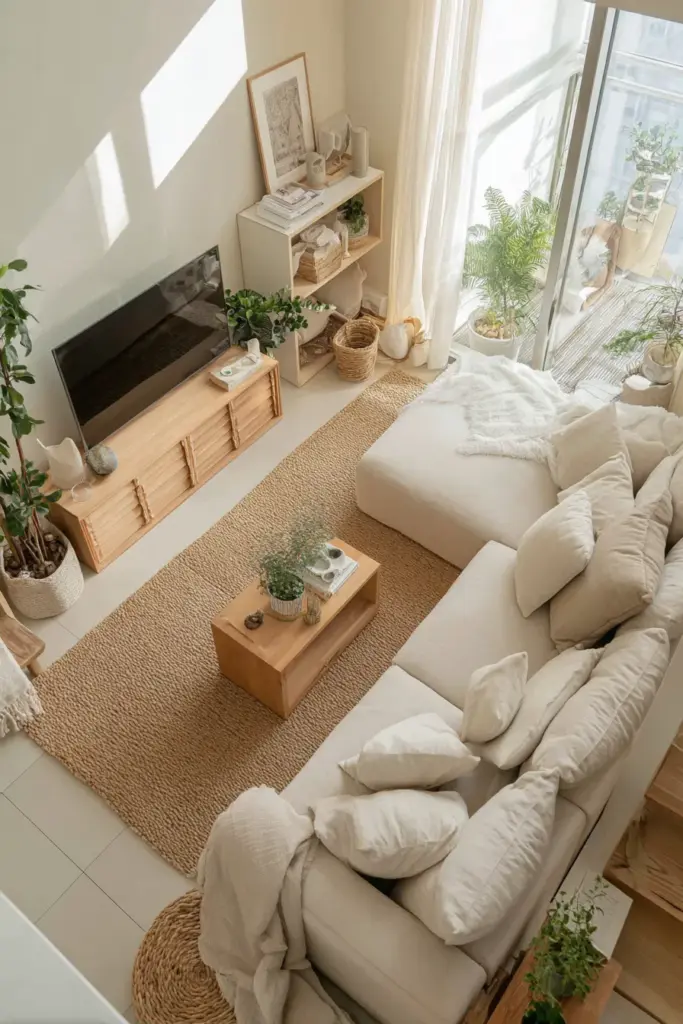
Layer your lighting. Overhead ambient light, a floor lamp for reading, and the soft glow from behind your TV create multiple light sources that make rooms feel more dimensional and larger.
Natural light is your greatest asset. Keep window treatments minimal—sheer linen panels or bamboo shades that roll up completely during the day. The more natural light floods in, the less your 150 square feet feels constrained.
Candles on the TV console during evening hours (when the TV is off) bring a flickering warmth that’s inherently Japandi. The soft, moving light adds depth and a meditative quality to small spaces.
How to Add Warmth to a Minimalist Japandi TV Area
Minimalism can feel cold if not balanced correctly. Japandi’s genius is marrying restraint with coziness.
Textiles as Warmth
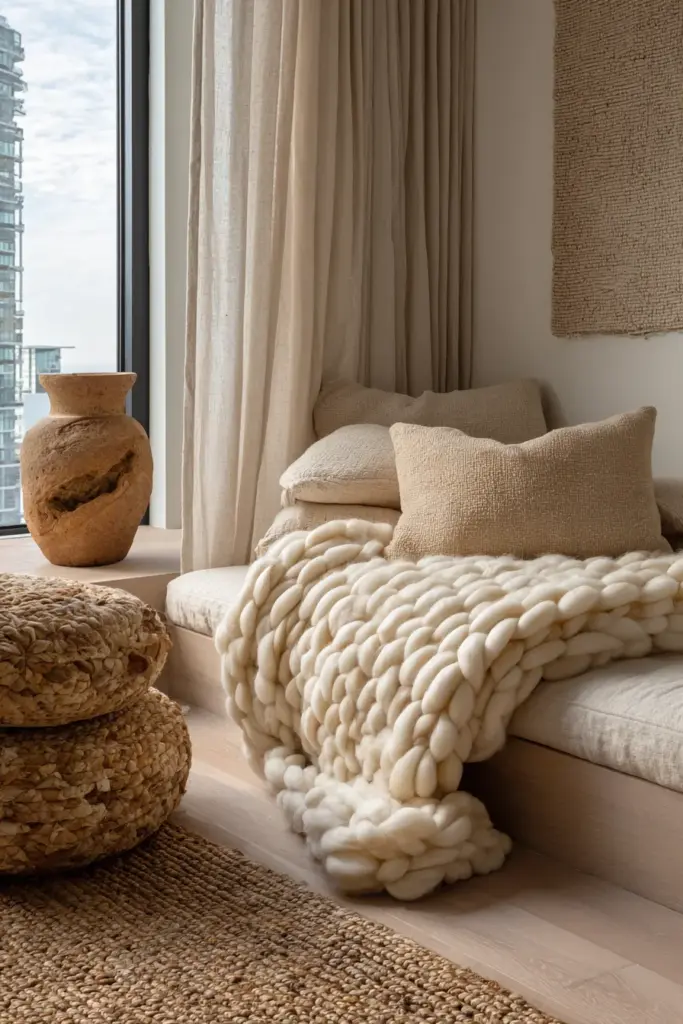
A chunky knit throw draped over your sofa arm, a sheepskin rug beneath the coffee table—these textures invite touch and add warmth without clutter. Choose natural fibers in cream, oatmeal, or soft gray.
Linen curtains soften the window line. Jute or sisal rugs ground the TV area with organic texture. Even your sofa cushions—opt for natural cotton or linen covers in warm neutrals—contribute to that lived-in, hygge feeling.
Wood Tones and Patina
Don’t match woods too perfectly. A TV console in warm walnut paired with a coffee table in lighter ash creates visual interest through tonal variation. Both are natural, both are wood, but the difference keeps the eye engaged.
Patina and wear add soul. A vintage wood piece with slight marks and aging tells a story. In Japandi design, wabi-sabi celebrates imperfection as beauty. That slight scratch on your TV bench isn’t a flaw—it’s character.
Living Elements
Plants are warmth incarnate. A pothos trailing from a shelf above the TV, a small terrarium on the console, or a sculptural branch in a ceramic vase brings organic life into the space.
Even dried elements work—pampas grass in a simple vase, eucalyptus hanging nearby. These nods to nature warm minimalist spaces without requiring the saturated colors that would break Japandi’s neutral palette.
Smart Home Integration for Japandi Living Rooms
Technology and natural aesthetics can coexist. The key is making tech invisible.
Hidden Speakers for Clean Lines
Soundbars interrupt the low-profile aesthetic. Instead, consider in-wall speakers if you own, or sleek Bluetooth speakers in neutral finishes that sit on shelves, disguised among books and objects.
Brands like Sonos offer speakers in matte white or black that can blend into shelving systems. The sound quality elevates your TV experience while the design remains understated.
Voice Control and Invisible Tech
Smart lighting controlled via voice eliminates clunky switches and remotes. Phillips Hue bulbs in warm tones can be dimmed for movie nights without leaving your floor cushion.
Streaming sticks (Roku, Apple TV, Chromecast) eliminate the need for cable boxes and DVD players. One small device hidden behind your TV replaces an entire entertainment center’s worth of equipment.
Choose TV models with minimal bezels—the thinner the frame, the more the screen disappears when off. OLED screens with true black displays integrate better into minimalist spaces than backlit LED models.
DIY Japandi TV Wall Ideas for Small Spaces
The Floating Shelf Approach
Create a simple TV platform using a 48-inch floating shelf in light oak. Mount it 42 inches from the floor. Place your TV on it, and use two woven baskets underneath (on a second lower shelf or floor) for remotes and accessories.
Cost: Under $80 for shelf, brackets, and baskets. Time: 2 hours installation. Impact: Dramatic space-saving and authentic Japandi aesthetic.
The Pegboard Accent Wall
Paint a section of wall behind your TV in warm beige. Install a wooden pegboard in the same tone for the upper portion. Use wooden pegs to hang small plants, a minimalist clock, or lightweight art, creating a flexible, changeable display around your TV.
This works brilliantly for renters—pegboards can be removed without major wall damage. It adds texture and function while maintaining the natural, organic Japandi feel.
The Bamboo Panel Screen
Source bamboo panels (readily available in the Philippines) and create a backdrop wall treatment. The vertical lines add height to small rooms. Cut panels to frame the TV space, leaving the screen area open, with bamboo texture on either side.
Finish with low-VOC natural oil to protect the bamboo and bring out its warm honey tones. This DIY costs $100-150 in materials and provides stunning, sustainable texture.
Key Takeaways for Your Small Japandi Living Room TV Setup
- Choose low-profile TV units (16-24 inches high) in natural wood with tapered legs
- Position the TV on the shortest wall, perpendicular to windows to avoid glare
- Mount at eye level (42-53 inches from floor when seated) for comfort and aesthetics
- Hide cables using raceways, built-in channels, or wireless solutions
- Create negative space around the TV—don’t overcrowd the wall
- Use neutral colors (beige, warm gray, cream) to expand perceived space
- Add texture through textiles—linen, wool, jute—for warmth without clutter
- Incorporate plants to bring organic life and natural color
- Layer lighting—ambient, task, and accent—to create depth
- Choose multi-purpose storage that serves both function and beauty
- Embrace imperfection through wabi-sabi—patina and wear add character
- Go wireless where possible to reduce visual noise
- Consider DIY solutions using local materials like bamboo for sustainability
Conclusion: The Living Room That Holds You
A small Japandi living room with a thoughtfully placed TV becomes more than a space to watch shows. It becomes a refuge—a room that holds you gently at the end of long days, where every element serves both eye and soul.
The television, once a source of design anxiety, settles into its role. Low and natural, surrounded by wood and linen and the quiet green of plants, it’s simply part of the whole. The room breathes around it. Light moves through it. You sink into your sofa, warm tea in hand, and feel the particular peace that comes from living in a space you’ve crafted with intention.
This is the gift of Japandi in small spaces—not just beauty, but belonging. Not just minimalism, but meaning. Your living room, compact as it may be, becomes precisely enough.
Frequently Asked Questions
What is the best TV size for a small Japandi living room?
For rooms under 150 square feet, a 43 to 50-inch TV maintains proportion without overwhelming the space. The key is ensuring your viewing distance is at least 1.5 times the screen width—so a 50-inch TV needs about 6 feet of distance. In truly compact spaces, a 32 to 43-inch screen preserves the Japandi principle of restraint while remaining functional.
How do you style a TV wall in Japandi decor without clutter?
Follow the rule of three: choose no more than three additional elements around your TV. This might be one plant, one piece of art, and one sculptural object. Leave generous negative space—at least 6-8 inches between each item and the TV itself. Use natural materials exclusively: wood, ceramic, linen, greenery. The goal is breathing room, not gallery density.
Can I use dark wood for my TV unit in a small Japandi living room?
Yes, but balance it carefully. Dark walnut or teak can ground a small room beautifully if surrounded by lighter elements—pale walls, cream textiles, ample natural light. Choose a unit with open shelving or tapered legs to prevent visual heaviness. Pair dark wood with warm whites and soft grays rather than cooler tones to maintain the cozy Japandi atmosphere.
How do I hide TV cables in a rental without damaging walls?
Use adhesive cable raceways that peel off cleanly, available in neutral colors. Alternatively, position furniture strategically—a narrow console table or tall plant—to conceal vertical cable runs. Fabric cord covers in linen or cotton blend with Japandi aesthetics while hiding wires. For truly minimal intervention, bundle all cables with velcro ties and tuck them behind the TV unit where the wall meets the furniture.
What colors work best for a small Japandi living room with a TV?
Warm neutrals expand space and create calm: soft beige (greige), warm gray (taupe-gray), cream, and off-white form your foundation. Introduce depth through natural wood tones—light oak, ash, or warm walnut—and bring subtle life with muted greens from plants. Black (from the TV screen) acts as an intentional anchor. Avoid bright or saturated colors; even accent pieces should stay within earth tones—terracotta, sage, warm charcoal.
Is it better to wall-mount or use a TV stand in small Japandi spaces?
Wall-mounting saves floor space and creates the floating, minimal aesthetic Japandi loves—ideal for rooms under 120 square feet. However, a low-profile TV stand (under 20 inches high) adds valuable storage in slightly larger spaces and can be moved, making it renter-friendly. The best choice depends on your storage needs and whether you can drill into walls. Both can look beautiful when executed with intention and quality materials.