
Table of Contents
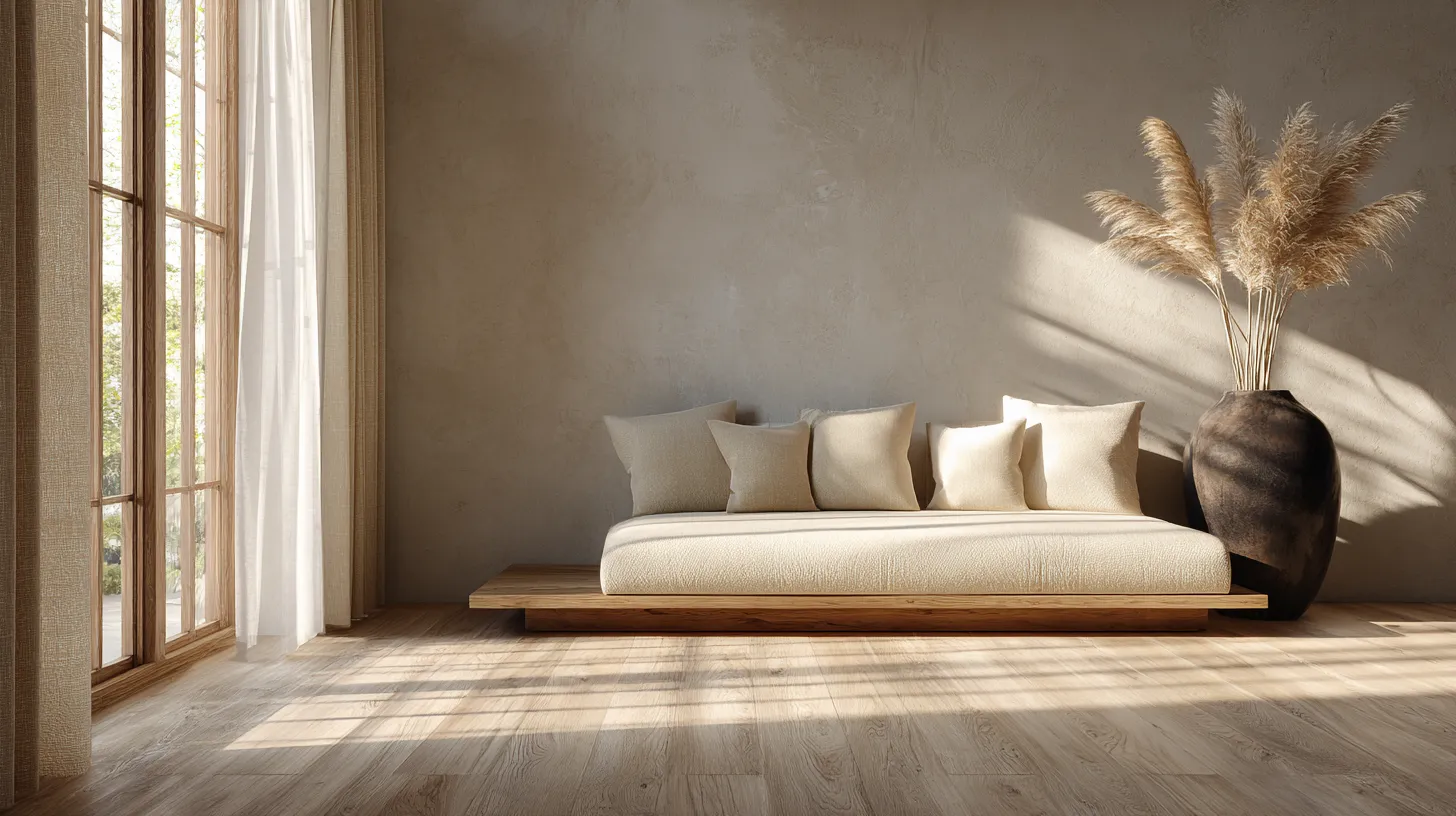
Imagine stepping into your living room barefoot — the floor warm beneath you, the world outside hushed and far away. No hollow echoes. No vibrations creeping up from downstairs. Just stillness, layered beautifully beneath a space that feels like it was designed to breathe.
That is the promise of Japandi design. And when you pair its philosophy with intentional soundproofing, your floor becomes more than a surface — it becomes the foundation of an entire sensory experience.
Japandi living room flooring soundproofing sits at the intersection of two disciplines: the artful minimalism of Japanese-Scandinavian design and the practical science of acoustic comfort. This guide walks you through the best materials, underlays, and layering strategies to help you create a living room that looks effortlessly curated and sounds beautifully quiet.
Whether you live in a high-rise apartment in Silang or a compact open-plan home, this is your thoughtful, room-by-room guide to getting it right.
Why Soundproofing Matters in a Japandi Living Room
The Sensory Foundation of Japandi Style
Japandi design is rooted in wabi-sabi and hygge — two philosophies that celebrate imperfect beauty and cozy sanctuary. But visual calm alone isn’t enough. Sound shapes how a room feels just as much as color or texture does.
Hard floors, open layouts, and high ceilings — all hallmarks of Japandi interiors — can amplify sound in ways that undermine the very serenity you’re trying to create. Footsteps clatter. Voices bounce. Bass from the floor below travels right through the joists.
Addressing sound at the floor level is one of the highest-impact changes you can make. And done with the right materials, it doesn’t compromise the aesthetic — it deepens it.
Understanding the Two Types of Floor Noise
Before choosing materials, it helps to know what you’re actually blocking.
Impact sound is the noise created by physical contact — footsteps, a dropped book, a child running. It travels through solid structures and can be felt as much as heard. Airborne sound is transmitted through the air — voices, music, television — and enters through gaps and thin surfaces.
For most Japandi living rooms, impact sound is the primary concern. The good news: several naturally beautiful flooring materials are exceptionally good at absorbing it.
The Best Japandi-Compatible Flooring Options for Soundproofing
Cork Flooring: The Quiet Champion
Cork is, without question, the most acoustically effective flooring material that also fits perfectly within a Japandi palette. Its cellular structure — millions of tiny air pockets compressed into every square centimeter — absorbs both vibration and sound with remarkable efficiency.
In acoustic terms, cork achieves a Noise Reduction Coefficient (NRC) of up to 0.70 and an Impact Insulation Class (IIC) rating that can reduce impact noise by 20–30 dB when properly installed. That’s a meaningful, perceptible difference in a busy household.
Visually, cork brings warmth. Its soft matte tone in sandy beige or warm gray reads as natural and grounded — a perfect complement to Japandi’s linen textiles, washi paper accents, and low-profile furniture. Seal it annually, especially in humid climates like Calabarzon, to protect against moisture and extend its life well beyond 20 years.
Cork at a Glance
| Feature | Detail |
|---|---|
| NRC Rating | Up to 0.70 |
| Impact Noise Reduction | 20–30 dB |
| Japandi Aesthetic Fit | Excellent |
| Humidity Resistance | Moderate (seal regularly) |
| Estimated Cost (PH) | ₱2,000–₱4,000/sqm |
| Longevity | 20+ years with proper care |

Bamboo Flooring with Acoustic Underlay
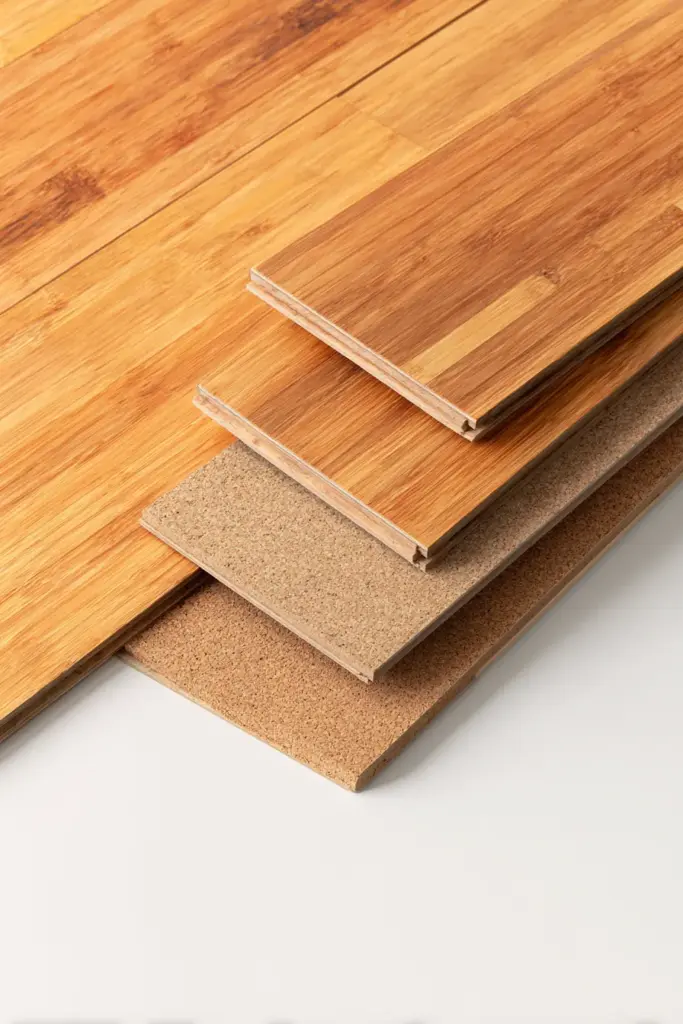
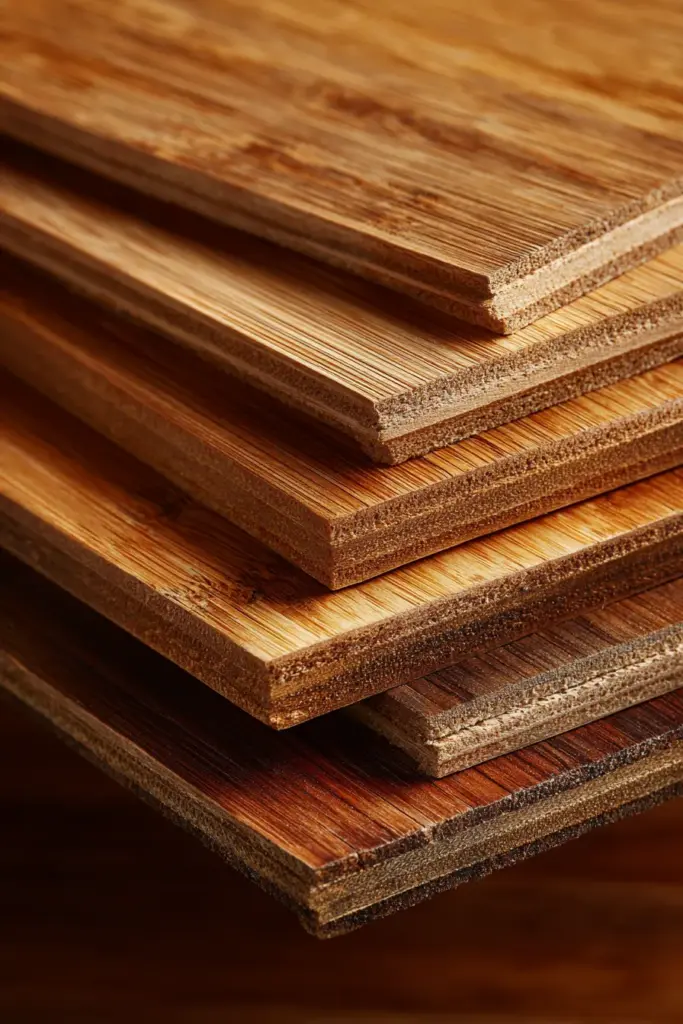
Bamboo sits beautifully at the heart of Japandi design — it is fast-growing, FSC-certifiable, and carries the organic warmth that both Japanese and Scandinavian aesthetics celebrate. On its own, however, bamboo offers limited sound absorption. The solution lies beneath.
Pairing bamboo with a quality acoustic underlay transforms it. A mass-loaded vinyl (MLV) underlay or a cork acoustic underlay (6–12mm thick) installed beneath bamboo planks can raise the IIC rating significantly, making the combination suitable for apartments and open-plan homes where footfall noise travels between floors.
Choose strand-woven bamboo for durability and a tighter grain that reads more refined in a Japandi setting. Its natural honey or ash tones complement neutral walls, handmade ceramics, and the kind of cozy furniture that anchors a room without overwhelming it.
Bamboo + Underlay IIC Comparison
| Underlay Type | IIC Improvement | Best For |
|---|---|---|
| No underlay | Low | Single-story homes |
| Foam underlay (3mm) | Moderate (+5–8 IIC) | Light traffic areas |
| Cork underlay (8mm) | Good (+10–15 IIC) | Apartments, open plans |
| Mass-loaded vinyl (MLV) | Excellent (+15–20 IIC) | High-traffic, upstairs units |
Engineered Hardwood: Warmth with a Floating Floor Advantage
Engineered hardwood offers the visual richness of solid wood — the deep grain, the warmth underfoot, the quiet luxury — with a construction that makes it ideal for floating floor installations. And floating floors are one of the most effective strategies for reducing both impact and airborne sound transmission.
Because a floating floor is not glued or nailed to the subfloor, it creates a decoupled layer that interrupts the path of sound. Combined with an acoustic underlay, engineered hardwood can perform surprisingly well in urban living rooms.
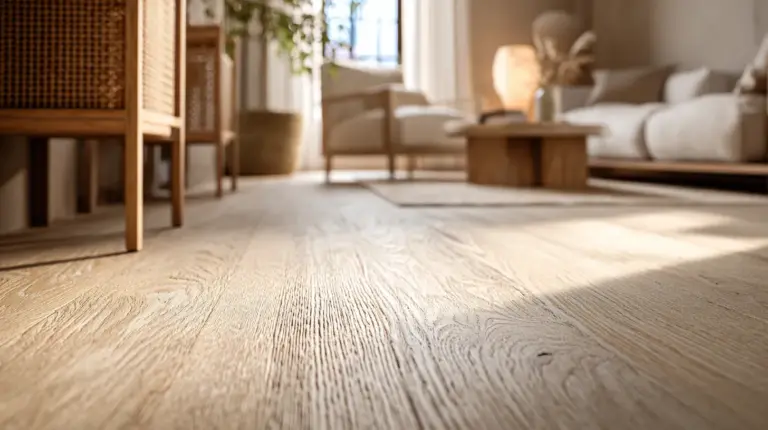
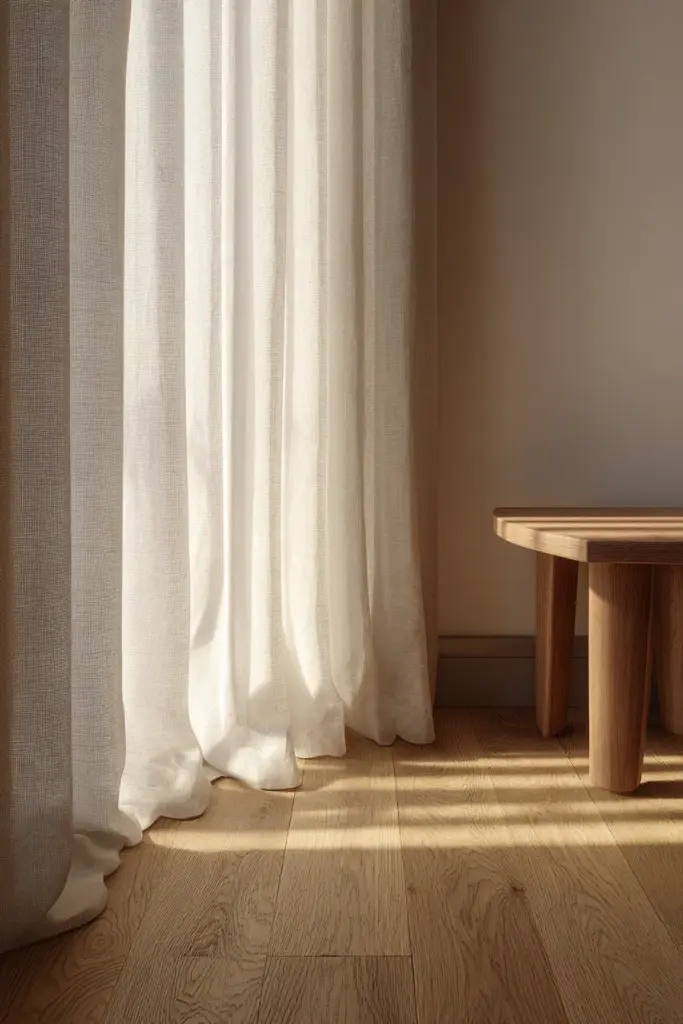
Opt for wire-brushed or hand-scraped finishes in muted warm oak, smoked walnut, or pale ash. These textures absorb light rather than reflecting it, contributing to the soft, grounded quality that defines Japandi lighting ideas and room composition.
Natural Stone and Concrete: Handle with Care
Polished concrete and natural stone are beloved in Japandi interiors for their rawness and cool mineral beauty. But they are acoustically demanding — hard, dense, and highly reflective of both sound and light.
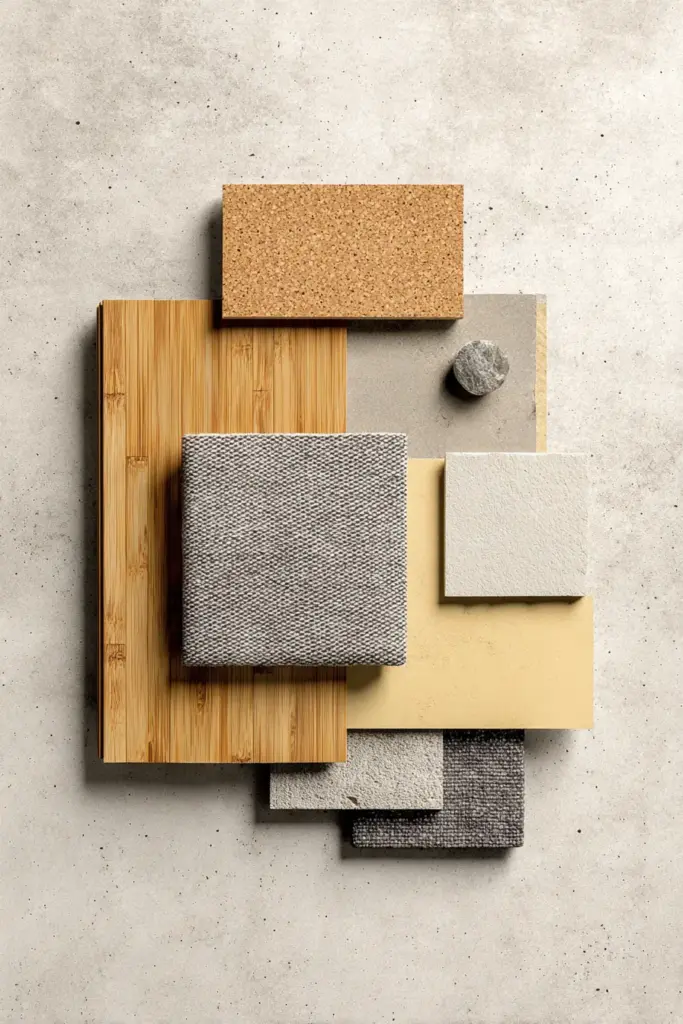
If you love the look of concrete, consider concrete-effect vinyl planks or tiles laid over a thick foam or cork underlay. You get the aesthetic without the acoustic penalty. Alternatively, lean heavily on Japandi rugs (see below) to compensate.
Natural stone used sparingly — as an accent in an entryway or around a fireplace — can work beautifully without dominating the acoustic environment of the room.
DIY Soundproofing Layers: A Japandi-Compatible Approach
How to Build a Quiet Floor from Scratch
You don’t need to gut your floor to improve its acoustics. A layered approach — accessible even for renters using floating installations — can dramatically reduce noise transmission.
Here is a practical sequence for a Japandi living room floor upgrade:
- Layer 1 — Subfloor prep: Ensure the existing subfloor is clean, level, and dry. Any gaps or unevenness amplify impact noise.
- Layer 2 — Acoustic underlay: Choose cork (natural, Japandi-friendly) or MLV (denser, higher IIC). For renters, self-adhesive cork tiles over existing flooring are a non-destructive option.
- Layer 3 — Flooring surface: Bamboo, engineered hardwood, or cork planks installed as a floating floor.
- Layer 4 — Japandi rugs: Layered wool or jute rugs over the finished floor add a final 20–30% reduction in surface-level sound absorption.
Soundproofing for Renters in Small Spaces
If you’re renting and can’t modify the floor structurally, your most powerful tool is area rugs. A thick wool Japandi rug — in oatmeal, charcoal, or undyed natural — can reduce the perception of impact noise substantially. Add a dense rug pad beneath it for even greater effect.
Acoustic cork tiles placed beneath furniture groupings (particularly under the sofa and coffee table area) work without permanent installation. They’re available in natural finishes that blend seamlessly into a Japandi palette.
Japandi Rugs as Acoustic Companions
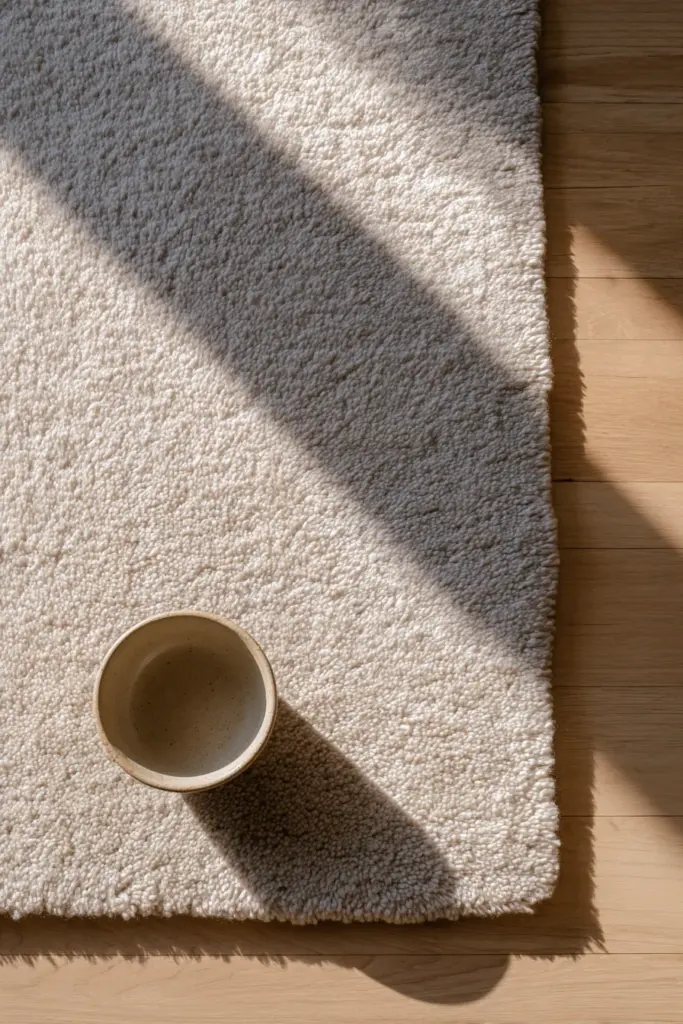
A floor without a rug in a Japandi living room isn’t quite complete — aesthetically or acoustically. The right rug does double duty: it softens the visual composition and absorbs the sound that hard flooring reflects.
Wool is the gold standard. Dense, naturally fire-resistant, and beautifully textured, wool rugs have excellent NRC properties. A thick-pile wool rug (15mm+) can absorb mid-to-high frequency sounds that contribute to room resonance. Jute and sisal are slightly less absorbent but bring a beautiful, organic rawness to a Japandi interior — ideal layered beneath a softer wool piece.
Choose rugs in natural, undyed tones: ecru, warm sand, slate, charcoal, or the softest blush. Avoid synthetic pile — it looks thin and performs poorly acoustically compared to natural fibers.
Quick-Reference Checklist: Japandi Floor Soundproofing Essentials
- Choose cork, bamboo with underlay, or engineered hardwood as your primary surface
- Always install a quality acoustic underlay — cork or MLV are the most Japandi-compatible
- Use floating floor installation to decouple the floor from the subfloor
- Layer natural fiber rugs (wool, jute) over finished floors for additional absorption
- Seal cork floors annually if you’re in a humid climate to maintain performance and longevity
- Look for FSC-certified wood or bamboo — sustainable sourcing aligns with Japandi values
- In apartments, prioritize IIC rating over NRC — impact sound is your primary concern
- For renters: use acoustic cork tiles beneath furniture and thick rugs as non-invasive solutions
- Budget-conscious options in the Philippines: bamboo from local suppliers (₱1,500–₱2,500/sqm) with imported cork underlay
Sustainable and Budget-Friendly Options in the Philippines
Japandi’s commitment to natural materials aligns beautifully with locally sourced and eco-certified options available in the Philippines. Bamboo, widely cultivated across the archipelago, is among the most cost-effective and environmentally responsible choices — FSC-certified bamboo products are increasingly available through import suppliers in Metro Manila and regional distributors.
Recycled cork underlays, sourced from wine cork industry by-products, are available through European import channels and represent a circular-economy option that resonates with Japandi’s ethos of mindful material use.
For homeowners in Calabarzon — where humidity is a consistent factor — engineered hardwood with a sealant or cork with annual resealing are particularly well-suited. Both handle moisture better than solid hardwood and maintain their acoustic properties over time.
Conclusion: The Quiet Room You’ve Always Wanted
The most beautiful rooms are the ones you feel before you see them.
A Japandi living room done right doesn’t just look calm — it sounds calm. The gentle creak of bamboo underfoot. The soft give of cork as you cross the room. The way a wool rug seems to draw sound downward, keeping everything intimate and still.
Flooring is the first layer of that experience. And when chosen thoughtfully — with both aesthetics and acoustics in mind — it becomes the foundation on which every moment in your home is built.
At ERYLIN, we believe that beautiful design and practical living are never in conflict. They simply require intention. May your floor be the quietest, most beautiful thing in the room.
Frequently Asked Questions
What is the best flooring for soundproofing a living room?
Cork flooring is the top-performing option for living room soundproofing, offering an NRC of up to 0.70 and impact noise reduction of 20–30 dB. For a Japandi aesthetic, bamboo with an acoustic cork or MLV underlay is an excellent alternative — combining natural beauty with strong acoustic performance.
Is cork flooring good for Japandi style and noise reduction?
Yes — cork is one of the best materials for both. Its matte, organic texture fits naturally within a Japandi palette of neutral tones and natural materials, while its cellular structure makes it among the most acoustically effective flooring options available. Properly sealed, it is also durable and hypoallergenic.
How do I soundproof floors in a Japandi interior without losing the aesthetic?
The key is layering: install a quality acoustic underlay (cork or MLV) beneath your primary flooring, use a floating floor installation to decouple the surface from the subfloor, and finish with a natural fiber rug. All these additions work beneath or alongside Japandi-appropriate materials without disrupting the visual calm of the space.
Does bamboo or wood flooring provide soundproofing in living rooms?
On their own, neither bamboo nor solid wood offers significant soundproofing. However, engineered hardwood installed as a floating floor and bamboo paired with an acoustic underlay can achieve meaningful IIC improvements — especially when combined with area rugs. The underlay does the heavy lifting; the flooring provides the beauty.
What Japandi flooring options absorb sound best?
Ranked by acoustic performance: cork flooring (best), bamboo with acoustic underlay (very good), engineered hardwood floating floor (good), natural stone or concrete with thick rugs (compensated). All can be styled beautifully within a Japandi interior when chosen with intention and care.