
Table of Contents
There is something quietly magical about the way morning light moves through a linen curtain. It softens. It pools. It turns an ordinary room into something that feels intentional — like the space was designed with your nervous system in mind.
That is exactly what Japandi window treatments do. They borrow the warmth of Scandinavian hygge and the restraint of Japanese wabi-sabi, and they turn your windows into a daily ritual rather than just a functional covering.
At ERYLIN, we believe that beautiful interiors should not require a contractor, a big budget, or a permanent installation. This guide is for anyone living in a small apartment or condo who wants that calm, textured, light-drenched Japandi look — without a single drill hole in the wall.
Whether you are in a Manila high-rise or a rented studio with aluminum window frames, these DIY Japandi window treatment ideas will meet you where you are.
What Makes a Window Treatment “Japandi”?
Japandi design is not a product — it is a philosophy. It values natural materials, honest imperfection, and the quiet beauty of negative space.
A Japandi window treatment feels like it belongs to the room organically. It does not shout for attention. It filters light the way rice paper does — gently, warmly, with just enough privacy.
The Core Elements
- Natural materials: bamboo, linen, jute, woven grasscloth, rattan, cotton duck
- Warm neutrals: warm white, greige, taupe, soft sage, muted charcoal
- Clean lines: no ruffles, no heavy pelmet boxes, no loud hardware
- Layered function: light-filtering, heat control, and blackout — all working together
- Negative space: leaving parts of the window bare is not laziness — it is design
The best Japandi window treatments let nature do the decorating. Your job is simply to choose the right frame.
Choosing the Right Japandi Window Treatment for Your Space
Before reaching for bamboo or linen, it helps to know what each room actually needs. Light, privacy, and heat control play differently depending on where you are in the day — and where you are in the home.
Room-by-Room Guide
| Room | Best DIY Japandi Treatment | Mounting Option (No Drill) | Key Benefit |
|---|---|---|---|
| Small bedroom | Bamboo slat + sheer linen clip-on | Tension rod + curtain clips | Diffused morning light, blackout option |
| Living room | Woven rattan panel + floor-length linen | Command hook rod system | Warmth, texture, natural privacy |
| WFH / study area | Linen sheer + bamboo slat angled | Tension rod, inside frame | Glare control without full darkness |
| Bathroom | Woven jute Roman shade | Adhesive bracket + rod | Privacy with airflow |
| Rental condo | PVC-free blackout + linen over-sheer | Command hook + clip rings | No damage, easy removal |
This table is your starting point. Every room has a different relationship with sunlight — and your window treatments should honour that relationship.
The Three-Layer Japandi Window System
Think of Japandi window treatments less like window coverings and more like a layering system — the way you layer clothing on a cool morning.
Each layer has a job, and together they create the full range of light, privacy, and warmth you need throughout the day.
Layer One: The Light-Filtering Sheer
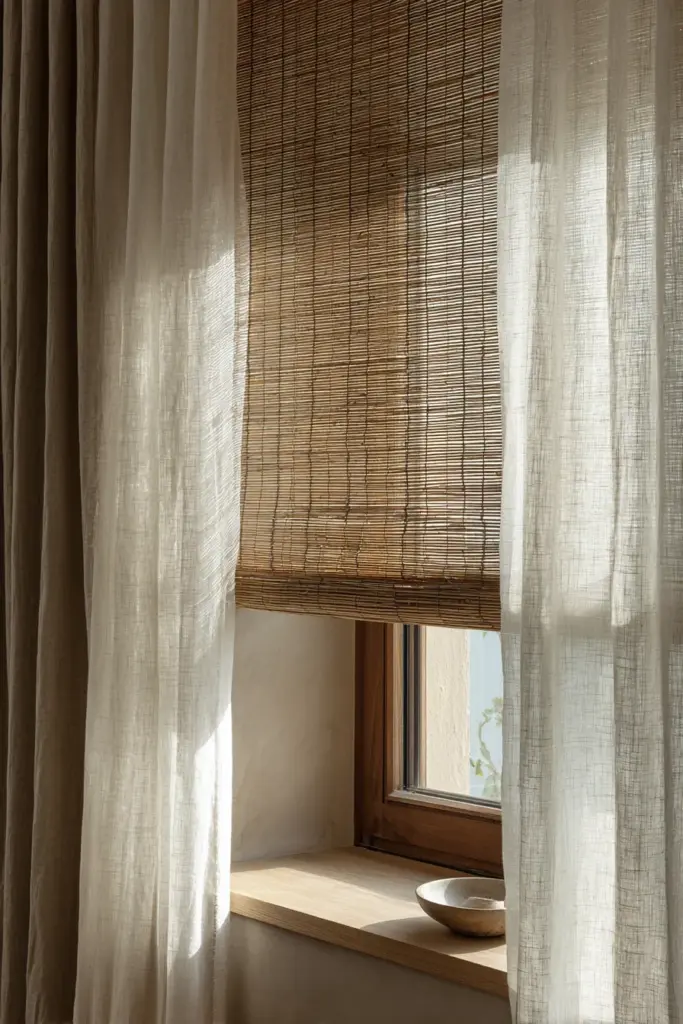
This is your innermost layer. Choose a loosely woven linen or a cotton voile in warm white or natural greige. It lets soft, diffused light enter the room while providing daytime privacy.
For a no-drill option, hang it on a tension rod fitted inside the window frame. Use curtain clips instead of sewn headers — the exposed clip is clean and modern in Japandi spaces.
Layer Two: The Natural Texture Panel
This is your mid-layer — and the most distinctly Japandi of the three. Think bamboo slats, woven grass shades, or a rattan panel. This layer gives the window its organic texture and controls the angle of incoming light.
You can DIY this layer with bamboo strips from your local market (more on this below). Hang it just above the window frame using a low-profile tension rod or adhesive hook system.
Layer Three: The Blackout Insert
This is your practical layer. For bedrooms and WFH spaces, a clip-on blackout liner behind the sheer gives you full light control without sacrificing the Japandi aesthetic.
Look for a PVC-free blackout fabric in a matte finish. Clip it discreetly to the same curtain ring system as your sheer so the two move together.
DIY Japandi Window Treatment Projects
Now for the hands-on part. These projects are designed for renters, small-space dwellers, and anyone who wants a high-design result without a big investment.
Project 1: The Bamboo Slat Panel (No-Drill)
This is the most quintessentially Japandi treatment you can build at home. It evokes the shoji screen without replicating it literally — all you need is bamboo, a tension rod, and an hour of your time.
Materials:
- Bamboo strips or bamboo skewers (from local markets or hardware stores)
- Strong twine or jute cord
- One aluminum tension rod (sized to your window width)
- Matte black curtain clips (6–8 per panel)
Steps:
- Measure your window width and desired drop. For Japandi proportions, aim for a drop that ends at the window sill or just 5–10 cm below the frame — not floor length.
- Cut bamboo strips to the same width as your window minus 2 cm on each side.
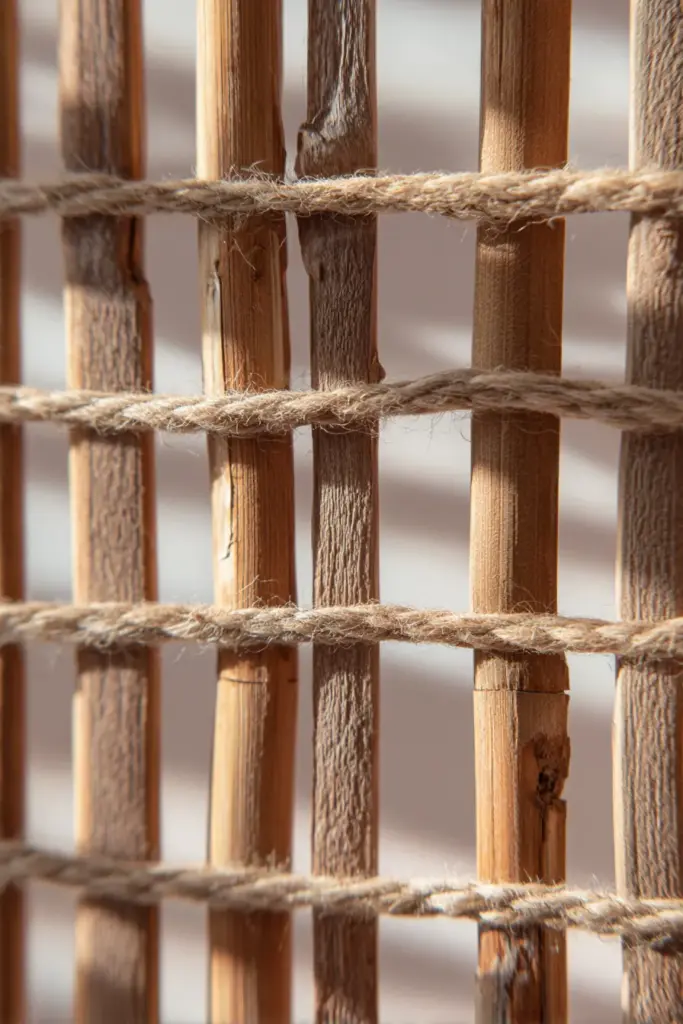
- Lay the strips horizontally and lace jute cord vertically through them at even intervals, spacing strips 2–3 cm apart. Tie off at the top and bottom.
- Attach curtain clips along the top of the panel at even intervals.
- Clip onto your tension rod and install inside the window frame.
The result is a light-filtering screen that shifts beautifully with any breeze. In warm climates, it also creates soft ventilation while maintaining privacy.
Project 2: The Linen Sheer from a Flat Sheet (No-Drill)
You do not need to buy curtain fabric. A plain linen flat sheet — or even a loosely woven cotton one — makes an effortless Japandi sheer with zero sewing required.
Materials:
- One linen or cotton flat sheet (warm white, greige, or natural)
- Tension rod
- 8–10 curtain clips with rings
Steps:
- Fold the sheet in half lengthwise if your window is narrow. Leave it full-width for larger windows.
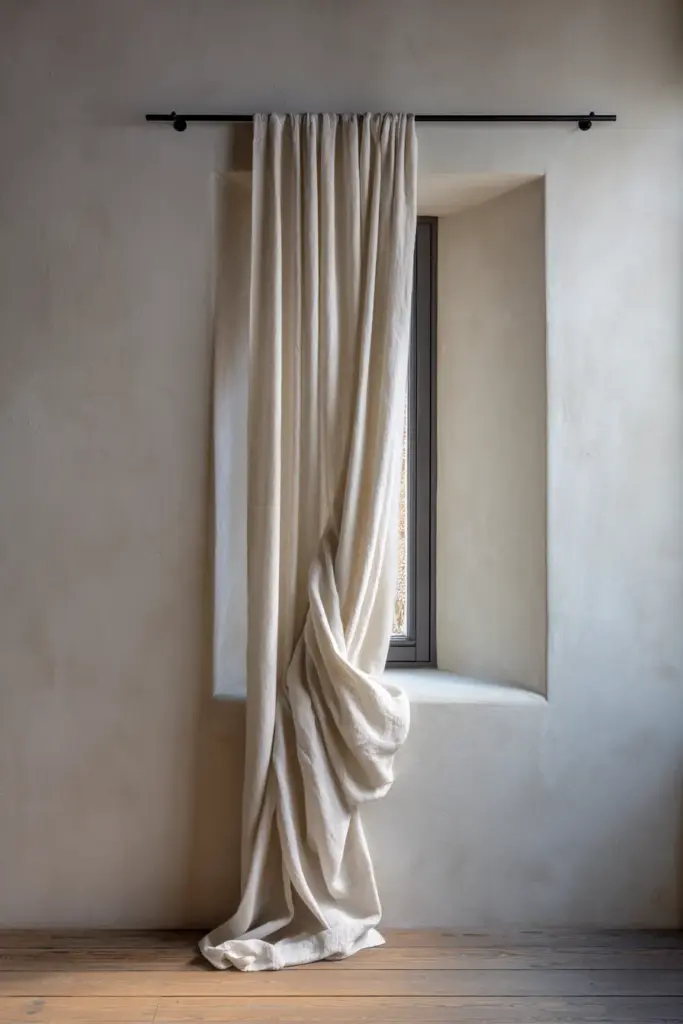
- Allow the drop to pool very slightly on the floor (5–8 cm) for a relaxed, lived-in Japandi feel — or keep it 1 cm above the floor for a cleaner look.
- Clip the curtain rings evenly along the top fold of the sheet.
- Hang on a tension rod placed just inside the window frame or on a Command hook rod above the window.
No hemming. No sewing. Just soft, draped linen that makes light feel like something you can touch.
Project 3: Upcycled Curtain Panel Japandi Makeover
If you already have old curtains — even the heavy, dated kind — you can strip them back into something clean and Japandi.
Steps:
- Remove any existing heading tape, pleats, or stiffening.
- If the fabric is too heavy, cut away the lining and keep only the outer panel.
- Wash and air-dry without ironing — the relaxed, slightly wrinkled texture is part of the Japandi aesthetic.
- Re-hang using curtain clips on a simple tension rod. Avoid ornate finials; choose brushed aluminum or matte black.
This approach transforms fast-fashion blinds into slow-living panels — and it costs almost nothing.
Hot-Climate Japandi: Blocking Heat Without Blocking Light
This is where most design guides fall short. Japandi originated in cooler climates, but its principles translate beautifully to tropical settings — with one important adjustment.
In a Mandaluyong condo or any sun-facing apartment, the midday sun does not just brighten a room. It heats it. The layering system must work harder here.
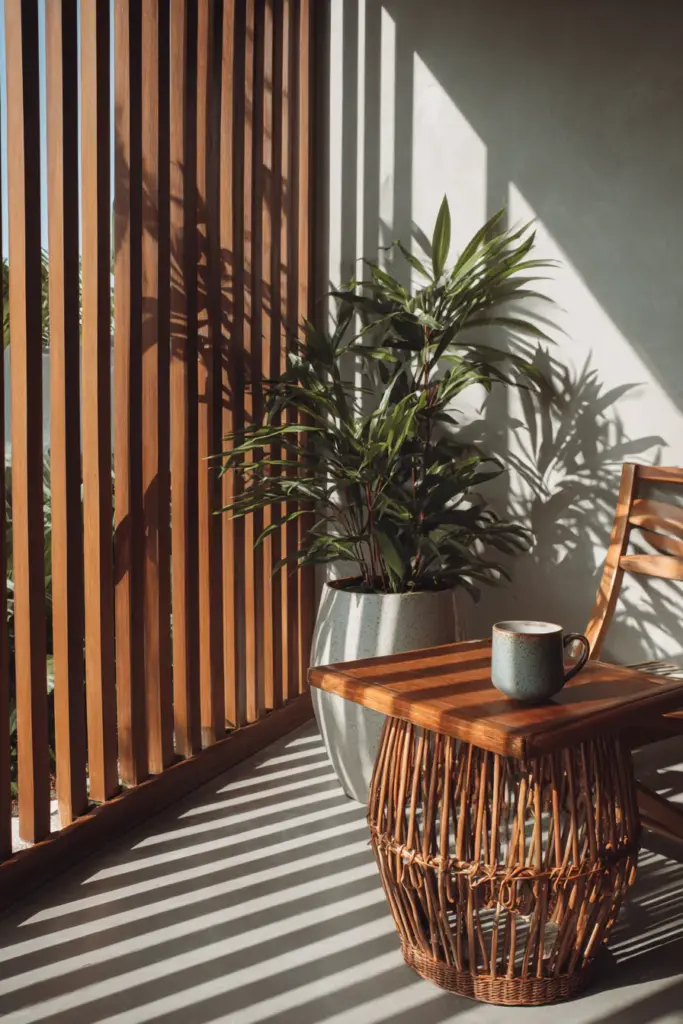
The Philippine Japandi Window Stack
- First layer (innermost): UV-filtering sheer — blocks heat radiation while maintaining a soft, rice-paper quality of light
- Second layer: Bamboo slats angled slightly downward — deflects direct midday glare while allowing air circulation
- Third layer (outermost or clip-behind): Matte blackout panel for siesta time or deep WFH focus
This stack lets you control the room’s temperature and mood without ever compromising the Japandi aesthetic. The bamboo slats do the heavy lifting, and the linen does the softening.
The Japandi Light Ritual: Using Your Window Treatments Throughout the Day
Japandi is not just a look — it is a way of living with your space intentionally. Your window treatments can support a daily rhythm that feels grounding rather than reactive.
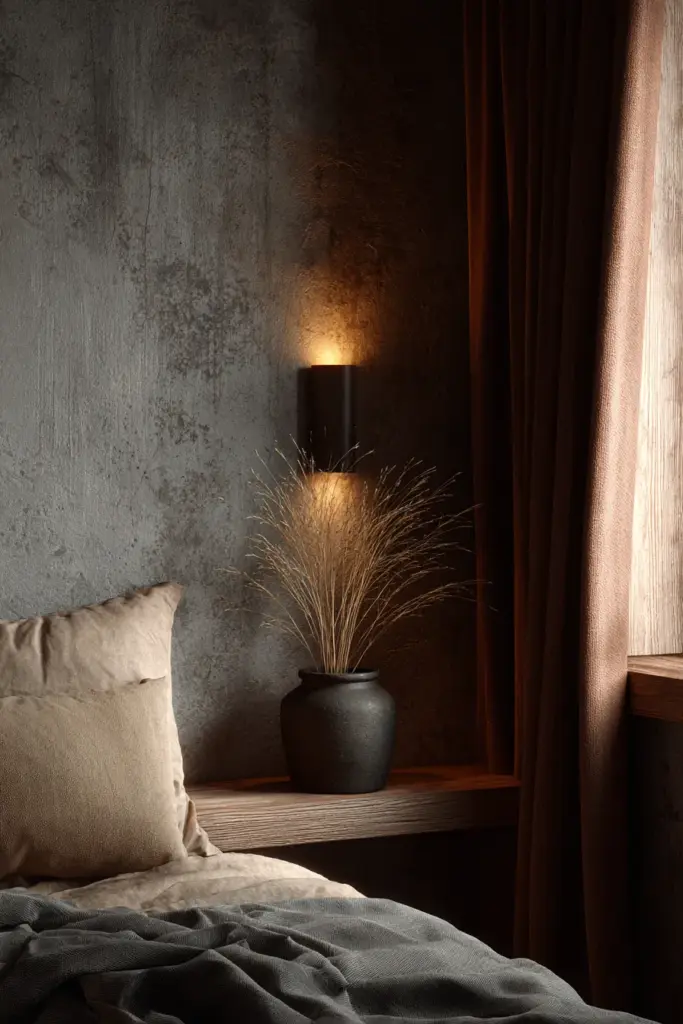
A Daily Light Framework
| Time of Day | Treatment Position | Effect |
|---|---|---|
| 6–8 AM | Sheer open, slats angled upward | Soft diffused morning light fills the room |
| 9 AM–12 PM | Sheer open, slats neutral | Balanced light for work or reading |
| 12–4 PM | Slats angled downward + blackout clipped behind sheer | Heat deflected, soft ambient light maintained |
| 5–7 PM | All layers open | Golden hour light, maximum warmth and mood |
| 8–10 PM | Full blackout + warm-white LEDs | Hygge mode: enclosed, warm, restorative |
This ritual transforms your window from a passive architectural element into an active part of your daily wellbeing. That is deeply, authentically Japandi.
Sourcing Materials Locally and Sustainably
One of the quiet joys of DIY Japandi is that it rewards slow, intentional sourcing. You do not need imported fabrics or designer hardware.
Where to Find Japandi Materials in the Philippines
- Bamboo strips and woven panels: Divisoria, Quiapo market stalls, or local hardware stores with garden sections
- Linen-like cotton duck or unbleached cotton: Fabric stores in Escolta, Cartimar, or SM fabric sections
- Aluminum tension rods and curtain clips: Ace Hardware, True Value, or Shopee Philippines
- Jute and rattan accents: Sia’s, Rustans home section, or local weekend markets
Sustainable Sourcing Checklist
- Choose bamboo sourced locally over imported plastic mini-blinds
- Opt for unbleached natural fabrics over synthetic sheers
- Repurpose existing fabric before buying new
- Choose matte powder-coated metal hardware over chrome
- Avoid PVC-coated blackout fabrics — look for polyester-cotton blackout weaves instead
The most sustainable Japandi treatment is often the one already in your home, waiting to be reimagined.
No-Drill Mounting Systems: A Renter’s Complete Guide
You should never have to choose between beautiful windows and your security deposit.
Mounting Options by Window Type
| Window Type | Best No-Drill System | Weight Limit | Notes |
|---|---|---|---|
| Standard aluminum frame | Tension rod (inside mount) | Up to 3 kg | Most rental-friendly option |
| Wide window (1.5 m+) | Command hook rod + two rods | Up to 2 kg each | Use two shorter rods side by side |
| Floor-to-ceiling window | Adhesive ceiling hooks + hanging panel | Up to 5 kg | Test adhesive on a hidden spot first |
| Casement or louvre window | Clip-on panel with magnetic closures | Up to 1 kg | Lightweight bamboo only |
Hardware You Actually Need
- Tension rods in brushed aluminum (not chrome — it reads too cold for Japandi)
- Matte black curtain clips with smooth rings
- Large Command adhesive hooks rated for the weight of your panel
- Optional: a slim wooden dowel to replace decorative finials
Keep hardware minimal and tonal. In Japandi design, the hardware should disappear — not decorate.
Japandi Window Treatment Measurements: A Practical Guide
Most design blogs skip the numbers. We will not.
Drop and Width Calculations
- Inside mount (tension rod in frame): Measure exact frame width; subtract 2 cm per side for tension rod clearance
- Outside mount (above window): Add 15–20 cm above the frame for visual height and 10 cm beyond each side for light coverage
- Floor-length drop: Measure from rod to floor, then add 2–5 cm for a gentle pool — or subtract 1 cm for a clean hover
- Sill-length drop (Japandi minimalist): Measure from rod to sill; subtract 1 cm
Standard Philippine Condo Window Sizes
| Window Type | Typical Width | Typical Height | Recommended Treatment |
|---|---|---|---|
| Bedroom sliding window | 1.2–1.5 m | 1.0–1.2 m | Single bamboo panel + sheer |
| Living room picture window | 1.8–2.4 m | 1.5–2.0 m | Two-panel linen + bamboo layer |
| Bathroom louvre window | 0.6–0.9 m | 0.5–0.8 m | Small Roman shade or clip-on panel |
| Balcony sliding door | 2.0–2.4 m wide | 2.0–2.4 m | Floor-length linen sheers, two panels |
These numbers give you a real starting point — not a vague “measure your window” instruction that leaves you doing the maths alone.
Quick-Start Checklist: DIY Japandi Window Treatment Essentials
Before you begin, gather everything that matters.
Materials:
- Natural linen, cotton voile, or cotton duck in warm neutrals
- Bamboo strips, rattan, or woven grass panels
- Jute or cotton twine for slat lacing
- PVC-free blackout fabric (optional, for bedrooms)
Hardware:
- Aluminum tension rods (sized to your window)
- Matte black curtain clips with smooth rings
- Command adhesive hooks (large, rated for appropriate weight)
- Optional: slim wooden or bamboo dowel
Design principles to keep:
- Keep colours in warm neutrals — no stark whites, no cool greys
- Choose texture over pattern — the material tells the story
- Leave negative space — not every window needs full coverage
- Let imperfection be beautiful — wrinkles in linen are a feature, not a flaw
- Layer for function, not decoration
Conclusion
A Japandi window is not just dressed — it is considered. It asks: how does light move through this space? What does the room need at eight in the morning versus eight at night?
When you choose bamboo over plastic, linen over polyester, and intentional simplicity over visual noise, you are not just decorating a window. You are choosing a slower, quieter, more grounded way of living at home.
At ERYLIN, that is the kind of beauty we believe in — the kind that makes your home feel like a breath.
Start with one window. One layer. One morning ritual. The rest will follow naturally.
Frequently Asked Questions
What window treatments work best for Japandi style?
Bamboo slat panels, light-filtering linen sheers, woven grass Roman shades, and natural jute roller blinds are the most authentic Japandi choices. The key is natural materials, warm neutrals, and clean, unfussy lines. Avoid synthetic fabrics, glossy finishes, and ornate hardware.
How do I make Japandi-style window treatments at home?
The simplest DIY starts with a tension rod, curtain clips, and a linen flat sheet. For a more textured look, lace bamboo strips with jute cord to create a custom slat panel. Both projects require no sewing and no drilling — just measuring, clipping, and hanging.
What colors and fabrics suit Japandi window treatments?
Stick to warm neutrals: warm white, natural greige, taupe, soft sage, and muted charcoal. For fabrics, choose linen, unbleached cotton, bamboo weave, woven jute, or grasscloth. Avoid stark white, cool grey, or any synthetic sheen.
Can I get Japandi window treatments without drilling (for rentals)?
Yes. Tension rods fitted inside the window frame are the most renter-friendly option. For heavier panels, use large Command adhesive hooks to mount a lightweight curtain rod above the window. Curtain clips with smooth rings make any fabric panel completely removable and damage-free.
How do I layer Japandi window treatments for light and privacy?
Use three layers: a UV-filtering linen sheer as your inner layer, a bamboo or woven grass panel as your mid-layer for texture and glare control, and a clip-on blackout liner behind the sheer for full privacy or sleep. Adjust the layers throughout the day to follow the natural light and your daily rhythm.