
Table of Contents
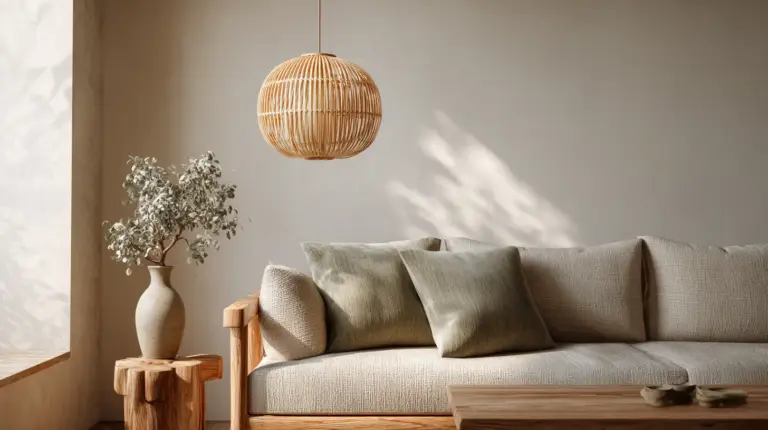
There’s a particular kind of stillness that settles into a room when everything is just right. The light falls softly across a linen sofa. A single print on the wall holds your gaze without demanding it. The air feels unhurried.
That’s the quiet magic of Japandi — and art is where it truly comes alive.
Japandi living rooms are built on the marriage of Japanese wabi-sabi and Scandinavian hygge. Both philosophies celebrate imperfection, simplicity, and the beauty found in what’s left unsaid. When you choose art through this lens, you’re not decorating a wall. You’re composing a feeling.
At ERYLIN, we believe the right piece of art doesn’t shout — it whispers. This guide will help you listen for it.
What Is Japandi Wall Art?
Japandi wall art draws from two design traditions that, on the surface, seem worlds apart — but share a deep reverence for restraint.
Japanese aesthetics bring us ma (the beauty of negative space), ink wash landscapes, and organic motifs like bamboo, cherry blossoms, and weathered stone. Scandinavian sensibility adds clean lines, muted warmth, and a quiet functionality. Together, they produce art that feels ancient and modern at once.
Think: a single brushstroke crane on unbleached paper. A minimalist landscape in soft charcoal and sage. A botanical line drawing framed in FSC-certified oak. These pieces don’t fill a room — they complete it.
How to Choose Art for a Japandi Living Room
Choosing Japandi art isn’t about finding the “right” trend. It’s about finding the right resonance — pieces that echo the textures, tones, and mood already present in your space.
Start With Your Room’s Existing Palette
Before you fall in love with a print, look at your walls, your sofa, your floor. What colors are already speaking?
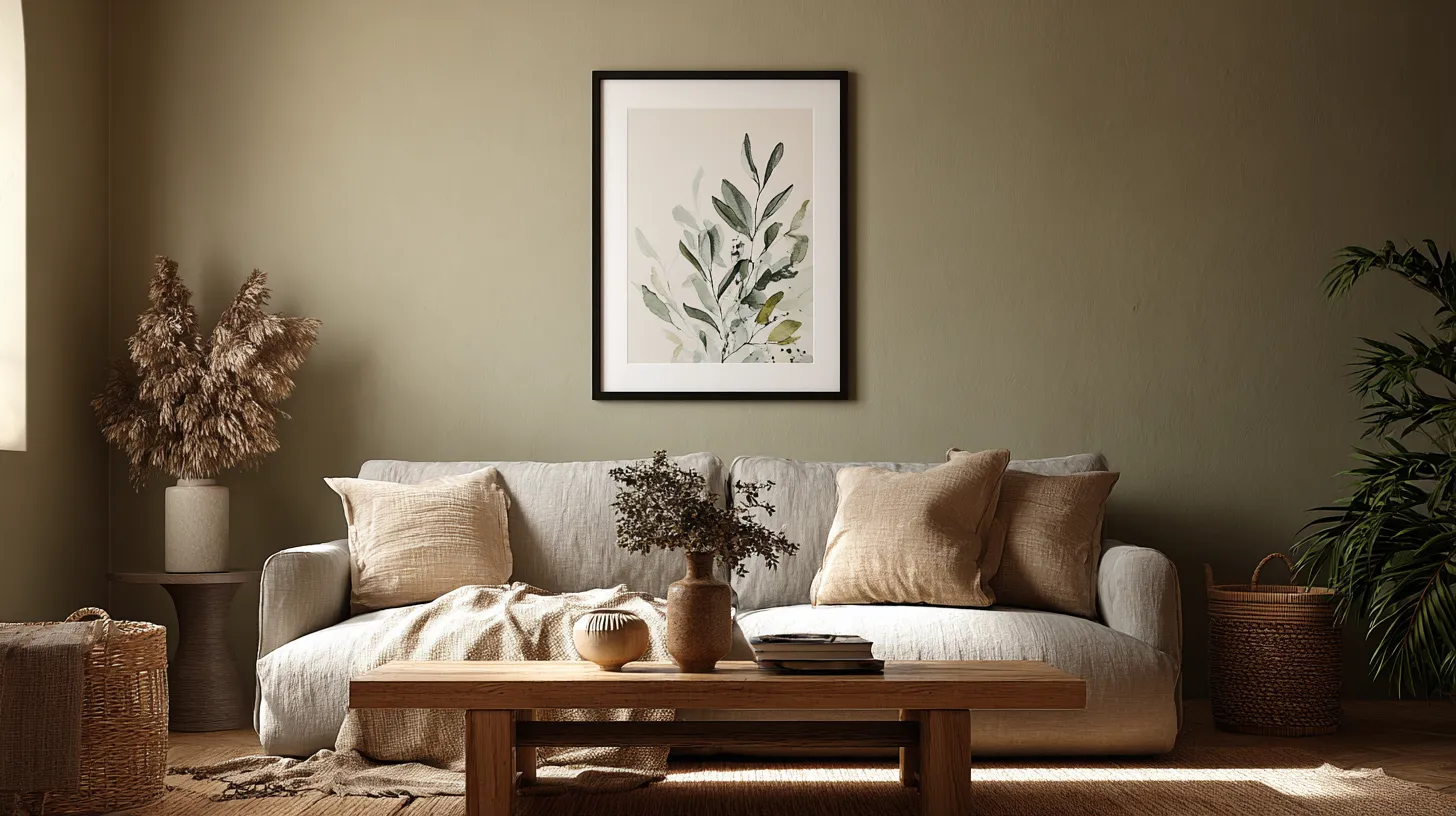
Japandi living rooms typically wear a wardrobe of earthy beiges, warm whites, soft grays, dusty sage, and deep charcoal. Your art should feel pulled from the same earth, not dropped in from somewhere brighter.
A muted green botanical print will feel native. A saturated teal abstract will feel like a guest that arrived at the wrong party.
Match Scale to Your Space
Art that’s too small floats timidly on a wall. Art that’s too large overwhelms. The rule of thumb: your art or gallery arrangement should cover roughly two-thirds the width of the furniture beneath it.
For a standard 84-inch sofa, aim for a piece or grouping spanning 50–60 inches wide. In smaller Quezon City apartments where walls are precious real estate, consider vertical prints — they draw the eye upward and create the illusion of height without crowding the room.
Always hang art so the center sits at eye level — approximately 57 inches from the floor. This feels instinctive once you try it. The art becomes part of the room, not a thing affixed above it.
Embrace Negative Space
One of the most misunderstood principles of Japandi design is ma — the conscious, intentional use of emptiness. Negative space in a print isn’t absence. It’s breath.
Choose art where the composition doesn’t fill every corner of the canvas. A lone branch. A horizon line with vast sky. A single figure in open white space. These pieces allow your eyes — and your mind — to rest.
Resist the urge to fill. In Japandi, the space around the art is as important as the art itself.
What Colors Work Best for Japandi Art?
The Japandi color palette for art stays warm, natural, and never loud.
| Color Family | Examples | Why It Works |
|---|---|---|
| Earthy Neutrals | Warm beige, raw linen, sand | Grounds the space, feels organic |
| Soft Greens | Sage, moss, dusty eucalyptus | Brings the outdoors in subtly |
| Charcoal & Ink | Deep gray, sumi ink black | Adds depth without harshness |
| Muted Clay | Terracotta, dusty rose, warm rust | Adds warmth without brightness |
| Cool Whites | Off-white, cream, stone | Enhances negative space |
Avoid: Saturated primary colors, high-contrast neons, or bold graphic palettes. These disrupt the meditative calm that Japandi spaces are built around.
If you want to introduce a hint of color, do it the way a Japanese ink master would — with one deliberate stroke, not a full bouquet.
Art Styles That Belong in a Japandi Living Room
Botanical Line Drawings
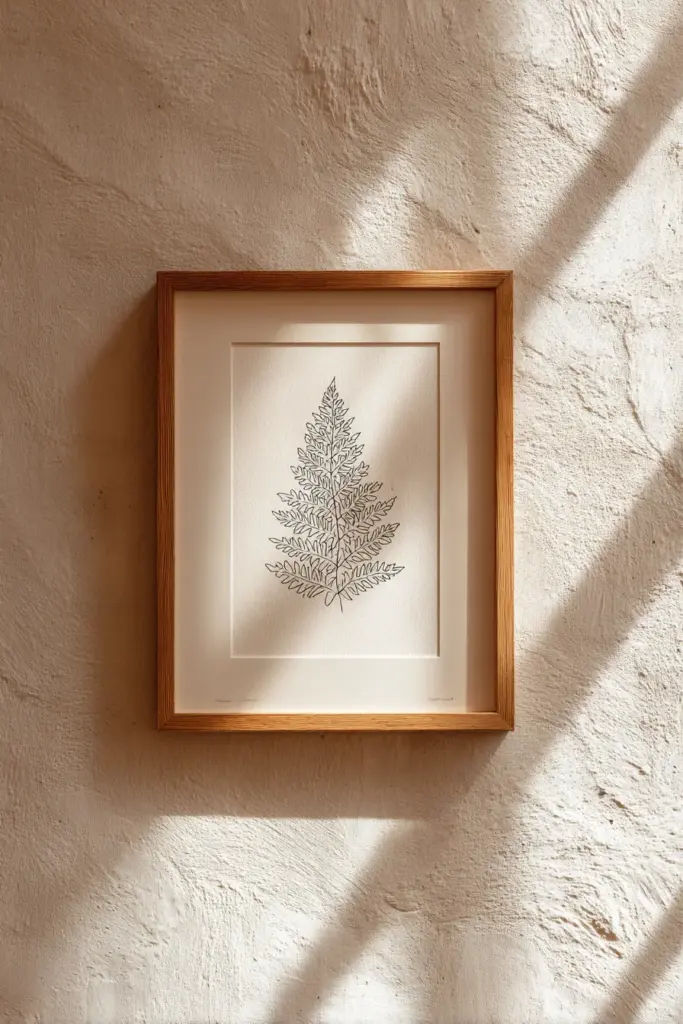
Fine-line botanical illustrations — delicate ferns, bamboo stems, single wildflowers — are among the most beloved choices for Japandi spaces. They carry organic energy without visual noise.
Look for prints with generous white space around the botanical subject. The simplicity of the line against unprinted paper is itself a design statement.
Ink Wash Landscapes
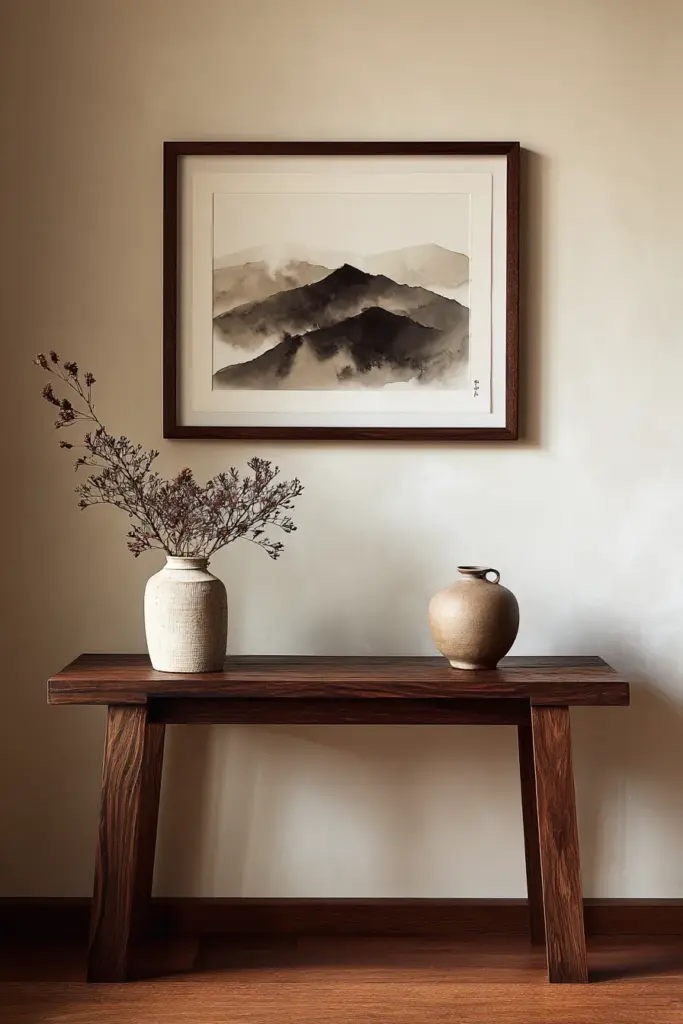
Sumi-e, the Japanese art of ink wash painting, translates beautifully into a modern Japandi home. Misty mountains, calm water, bare winter trees — these landscapes evoke a sense of depth and contemplation.
They pair beautifully with natural wood furniture, woven textures, and the soft glow of warm-toned lighting.
Abstract Organic Forms
Not all Japandi art needs to be representational. Abstract pieces that echo natural forms — irregular curves, soft stone-like shapes, layered washes of earthy tone — work powerfully in this aesthetic.
The key is that they feel found, not forced. As though the artist lifted a shape from a riverbed or a sand dune and simply translated it to canvas.
Minimalist Typography & Haiku
A single word, a short phrase, or a haiku rendered in elegant brushwork can carry enormous presence in a Japandi room. Keep the typography spare and the paper textured.
Choose meaning over decoration. A word you return to daily becomes part of the room’s quiet ritual.
Wabi-Sabi Textures
Pieces that celebrate imperfection — uneven brush marks, visible grain, organic irregularity — embody wabi-sabi at its most honest. Handmade prints, woodblock transfers, and plaster-textured canvases all carry this quality beautifully.
Sustainable Japandi Art: Choosing with Intention
Japandi philosophy is inseparable from respect for the natural world. It only makes sense that the art you choose honors that principle.
When sourcing prints and frames, look for:
- FSC-certified wood frames — sustainably harvested, traceable
- Recycled canvas or archival cotton rag paper — lower environmental footprint
- Low-VOC or water-based inks — better for indoor air quality, especially in smaller apartments
- Local artists and print makers — reduces shipping carbon footprint and supports creative communities
In the Philippines, a growing number of independent artists and print studios offer Japandi-inspired work with intentional sourcing. Exploring local markets and platforms like Etsy PH can surface beautiful pieces while keeping your choices grounded.
When you know a piece was made with care, you feel it every time you look at it.
DIY Japandi Art: Creating Beauty on a Budget
You don’t need to spend thousands to hang something meaningful. Some of the most beautiful Japandi art is made by hand — yours.
Simple DIY ideas under ₱1,000:
- Ink wash on watercolor paper — Use a wide brush and diluted black ink. Let it bleed imperfectly. That is the art.
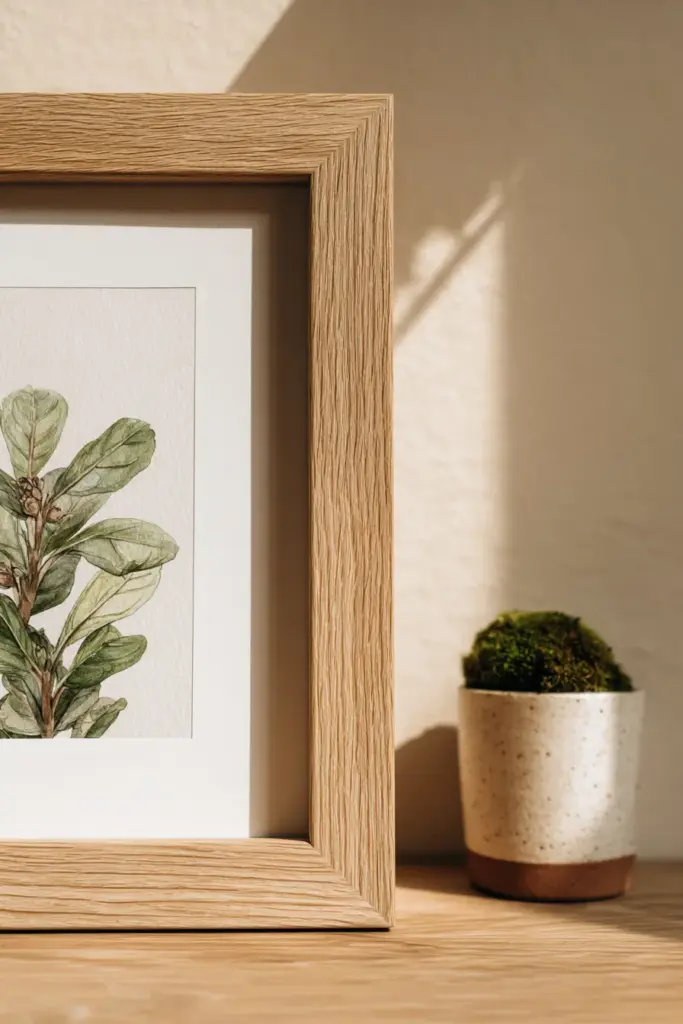
- Pressed botanicals — Press local leaves or ferns, mount on textured handmade paper, frame in raw wood.
- Plaster texture canvas — Apply joint compound to canvas in organic strokes, let dry, paint in warm white or stone. The texture catches light beautifully.
- Upcycled wood prints — Transfer a botanical illustration onto a piece of sanded driftwood or reclaimed board using transfer medium.
Frame these in simple natural wood, and they will sit comfortably alongside more considered pieces.
Art Placement in Japandi Living Rooms
The Single Statement Piece
One large-format print above a sofa or console creates a strong, meditative anchor. Keep everything else around it understated. Let the art hold the space alone.
The Japandi Gallery Wall
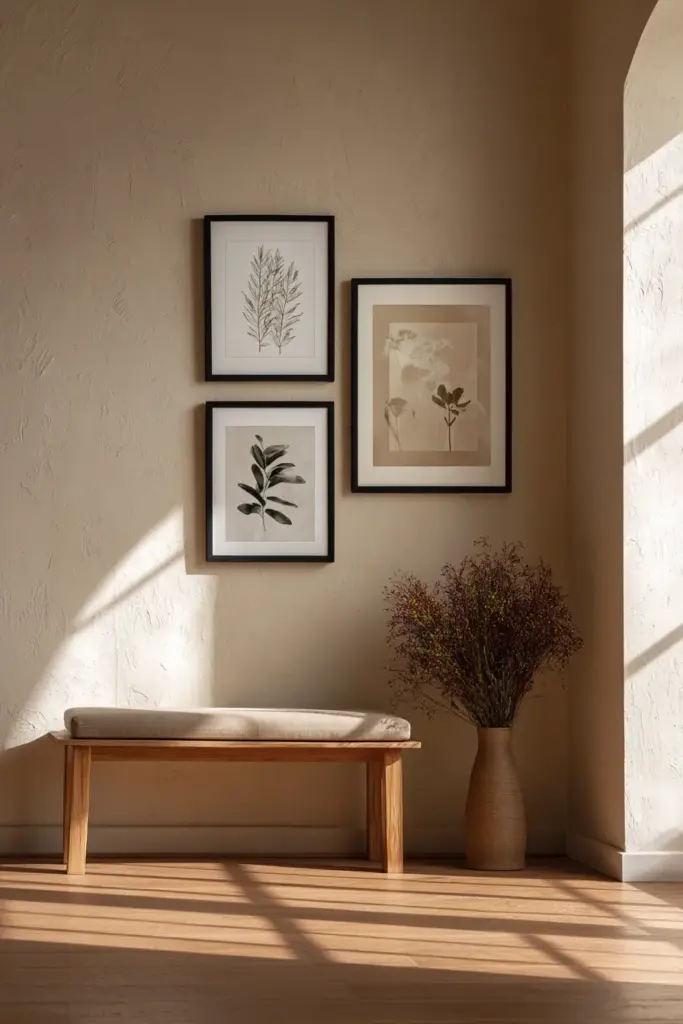
A Japandi gallery wall isn’t a grid of matching frames. It’s a quiet conversation between pieces — asymmetrical, breathing, unhurried.
Tips for a Japandi gallery wall:
- Mix frame sizes but keep all frames in the same material family (natural wood, black, or raw metal)
- Leave generous space between pieces — let each one breathe
- Vary orientations between portrait and landscape
- Include one tactile element — a woven textile or small shelf with a single object
Art for Small Apartments
In compact Quezon City apartments, the instinct is to go small — but vertical, mid-sized pieces actually work better. A tall narrow print elongates the wall. A trio of small botanical frames grouped tightly reads as one cohesive piece.
Use wall space above furniture thoughtfully. Art placed above a low sideboard or beside a floor lamp creates layered visual interest without overwhelming a small room.
Integrating Art with Plants and Light
Japandi spaces celebrate biophilic connection — the deep human need to be near living things. Your art and your plants can speak to each other beautifully.
Consider framing botanical art near a shelf of actual plants. The echo between the illustrated leaf and the living one creates a quiet, layered poetry.
For frames near plants, choose UV-protective glass to guard against leaf spray and humidity damage. This is especially relevant in the Philippines, where humidity is part of everyday life.
Pair art with warm-toned lighting — Edison bulbs, paper lanterns, or warm LED strips — to bring out the earthy tones of your prints and cast the kind of golden-hour light that makes everything feel like it belongs.
Japandi Art Selection Checklist
Before you hang anything, run through these:
- Does the art use a muted, earthy palette aligned with the room’s tones?
- Does the composition embrace negative space — is there room to breathe?
- Is the scale appropriate — roughly two-thirds the width of the furniture below?
- Is the center of the piece hanging at approximately 57 inches from the floor?
- Does the frame material feel natural — wood, metal, or raw linen?
- Does the art evoke a feeling of calm, nature, or quiet contemplation?
- Was the piece sourced sustainably or made with low-impact materials?
- Does it belong here, or does it feel like it arrived from somewhere else?
If you answered yes to most of these — trust it. Hang it. Live with it.
Conclusion
Art in a Japandi living room is never decoration for decoration’s sake. It’s a choice made with presence — a small act of intention that changes how a room feels to everyone who enters it.
The best piece isn’t the most expensive or the most technically impressive. It’s the one that makes you pause, just for a moment, and breathe a little deeper.
Start there. Let the walls become quiet companions. And let your home feel, finally, like the sanctuary it was always meant to be.
— With warmth, ERYLIN
Frequently Asked Questions
What is Japandi wall art?
Japandi wall art blends Japanese minimalism — characterized by negative space, ink wash techniques, and organic motifs — with Scandinavian calm and clean lines. The result is art that feels deeply natural, restrained, and emotionally resonant. Common styles include botanical line drawings, misty landscapes, wabi-sabi textures, and abstract organic forms in muted, earthy palettes.
How do I choose art for a Japandi living room?
Begin with your room’s existing color palette and textures, then select art that feels drawn from the same natural world. Prioritize pieces with generous negative space, muted tones, and organic subject matter. Match scale to your furniture — aim for two-thirds the width of the piece below — and hang the center at 57 inches from the floor.
What colors work best for Japandi art?
Earthy beiges, warm whites, soft grays, dusty sage, charcoal, muted clay, and moss greens all work beautifully. Avoid saturated or high-contrast colors. The palette should feel as though it was lifted from a forest floor, a stone riverbed, or a morning sky just before full light.
How do I hang Japandi art in a small living room?
In smaller spaces, choose vertical prints to create a sense of height, or group small pieces tightly so they read as a single cohesive work. Avoid going too small — a single mid-sized piece above a low console often works better than several tiny frames scattered across a wall.
Where can I find affordable Japandi art in the Philippines?
Local independent artists, Etsy PH, weekend design markets, and community print shops are excellent starting points. For DIY options, ink wash on watercolor paper or pressed local botanicals in raw wood frames can achieve a beautiful Japandi aesthetic for under ₱1,000. Prioritize pieces made with natural, low-impact materials whenever possible.