
Table of Contents
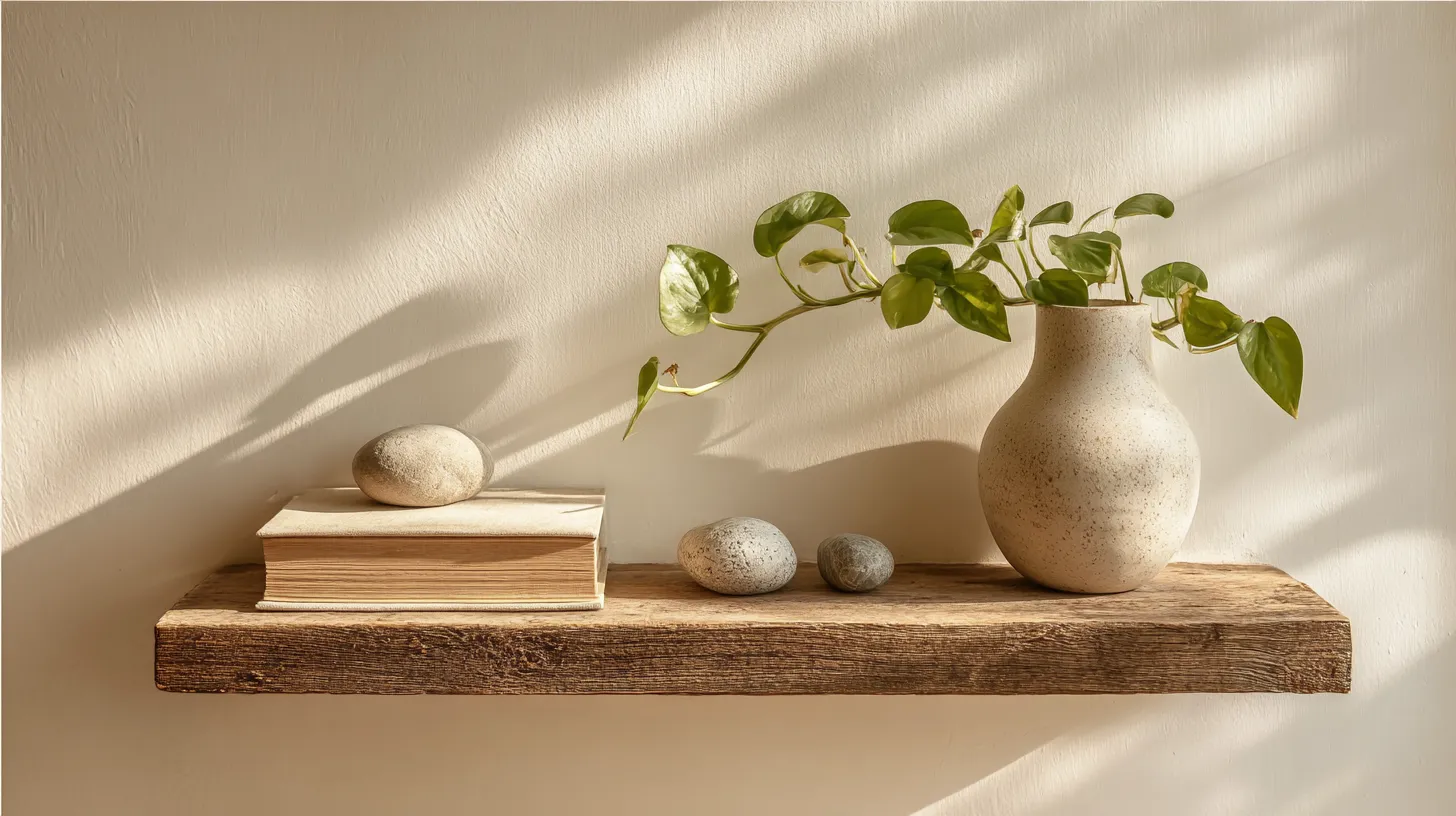
There is something quietly magnetic about a well-styled shelf. It holds your most beloved things — a ceramic bowl, a trailing plant, a single worn book — and somehow makes the whole room feel more you.
Japandi shelving captures exactly that feeling. It blends the warmth of Scandinavian hygge with the restraint of Japanese wabi-sabi, creating spaces that are both purposeful and deeply serene. Natural wood, honest materials, empty space treated as a design element — this is the philosophy behind every Japandi shelf built with intention.
The good news? You do not need a carpenter’s workshop or an unlimited budget to bring this aesthetic into your home. Whether you are working with a small apartment in Quezon City or a rented flat where drilling is forbidden, there is a Japandi shelving approach for you.
In this guide, we walk through everything: materials, methods, styling, and a few beginner-friendly builds that will transform your walls from blank to beautiful.
What Is Japandi Shelving Style?
Japandi is a fusion of Scandinavian and Japanese design principles. Think clean lines, neutral tones, natural textures, and deliberate simplicity. Nothing performative. Nothing excess.
For shelving specifically, Japandi means:
- Raw or lightly finished wood in warm, muted tones
- Low visual clutter — fewer objects, more breathing room
- Natural materials like bamboo, linen, stone, and rattan as accents
- Floating or wall-mounted forms that feel light and unobtrusive
The result is a shelf that does not demand attention but quietly earns it.
Choosing Your Materials: Wood, Stone, and Everything in Between
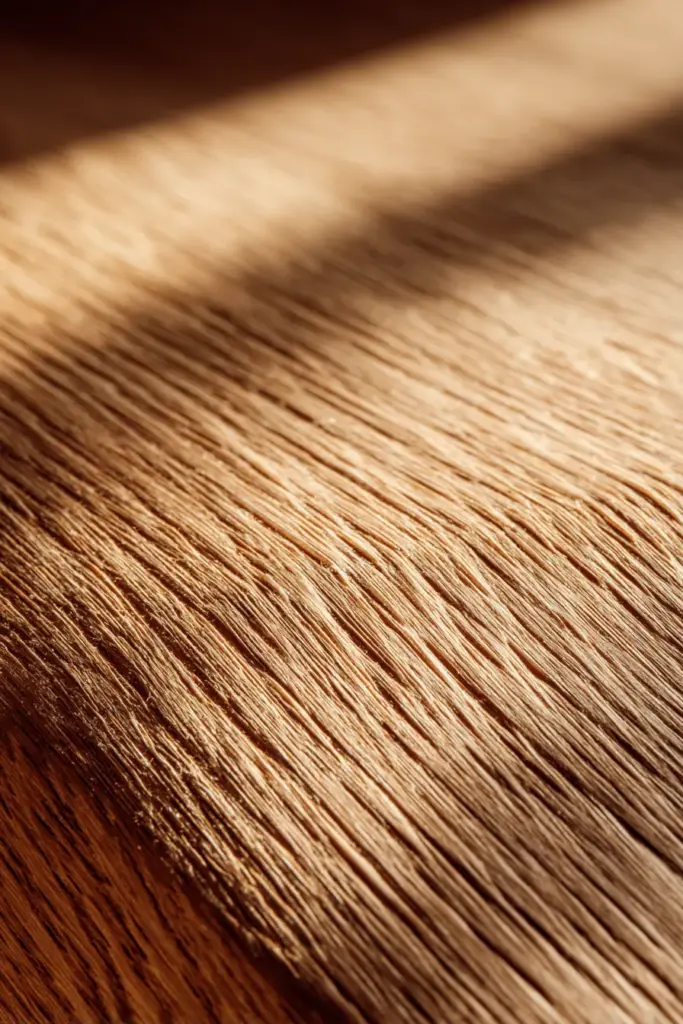
The material you choose sets the entire mood. Japandi shelving favors honest, natural materials that show their grain, their weight, their story.
Best Woods for DIY Japandi Shelves
| Wood Type | Appearance | Humidity Resistance | Avg. Cost (PHP) | Best For |
|---|---|---|---|---|
| Bamboo | Light, linear grain | Excellent | ₱300–₱600/board | Humid climates, lightweight builds |
| Solid Oak | Rich, warm grain | Good (sealed) | ₱800–₱1,500/board | Statement shelves, longevity |
| Spruce/Pine | Pale, soft grain | Moderate | ₱200–₱450/board | Budget builds, beginner DIY |
| Reclaimed Pallet Wood | Rustic, varied | Variable | Free–₱150 | Wabi-sabi aesthetic, upcycled look |
| Plywood (sanded) | Smooth, minimal grain | Good (sealed) | ₱250–₱500/sheet | Modular builds, clean lines |
For Philippine homes, bamboo and sealed oak perform best in humid conditions. Both resist warping and are widely available at hardware stores like Wilcon and AllHome.
If you are upcycling, pallet wood carries a beautiful wabi-sabi quality — imperfect, lived-in, layered with time. Sand it smooth, seal it with a matte wood oil, and it will look intentional rather than makeshift.
The Wabi-Sabi Stone Stack: No Tools Required
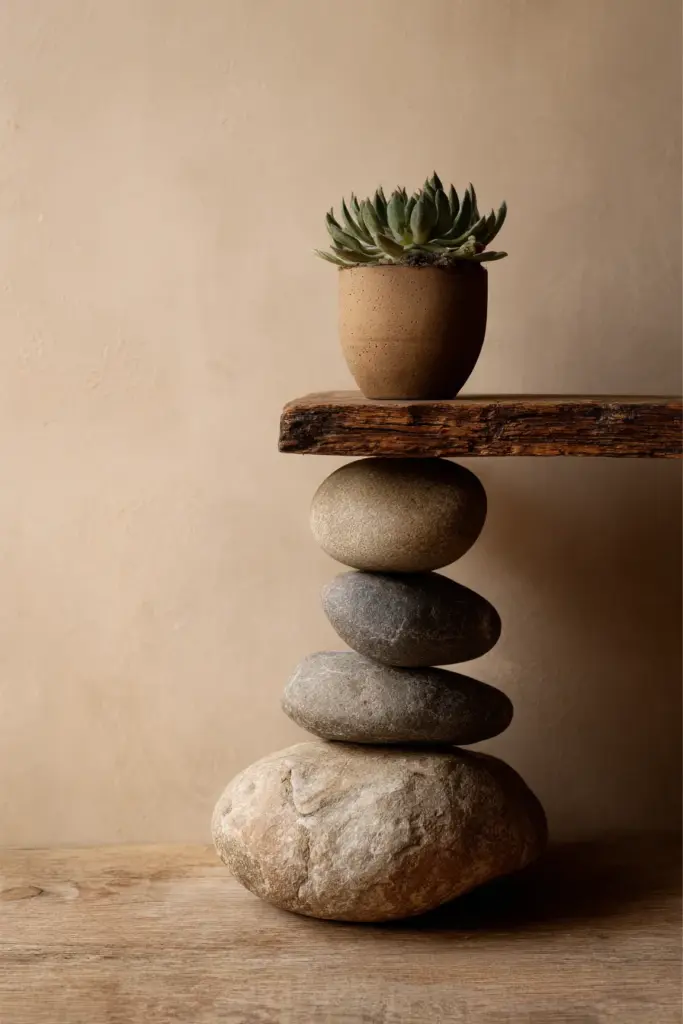
For renters or anyone who wants to avoid drilling entirely, the stacked stone shelf is a revelation. Source flat river stones or garden stones from a local landscaping supplier. Stack them in an organic column and rest a reclaimed wood plank across the top.
This method feels elemental — like something you would find in a forest-adjacent café. Add a small succulent or a trailing pothos beside it, and the whole vignette breathes.
Stability note: Stone-stacked shelves are medium stability and work best for lightweight décor, not heavy books. Keep them away from high-traffic areas if small children are present.
DIY Japandi Shelf Builds: Three Approaches for Every Skill Level
Build 1: The Floating Wall Shelf (Beginner-Friendly)
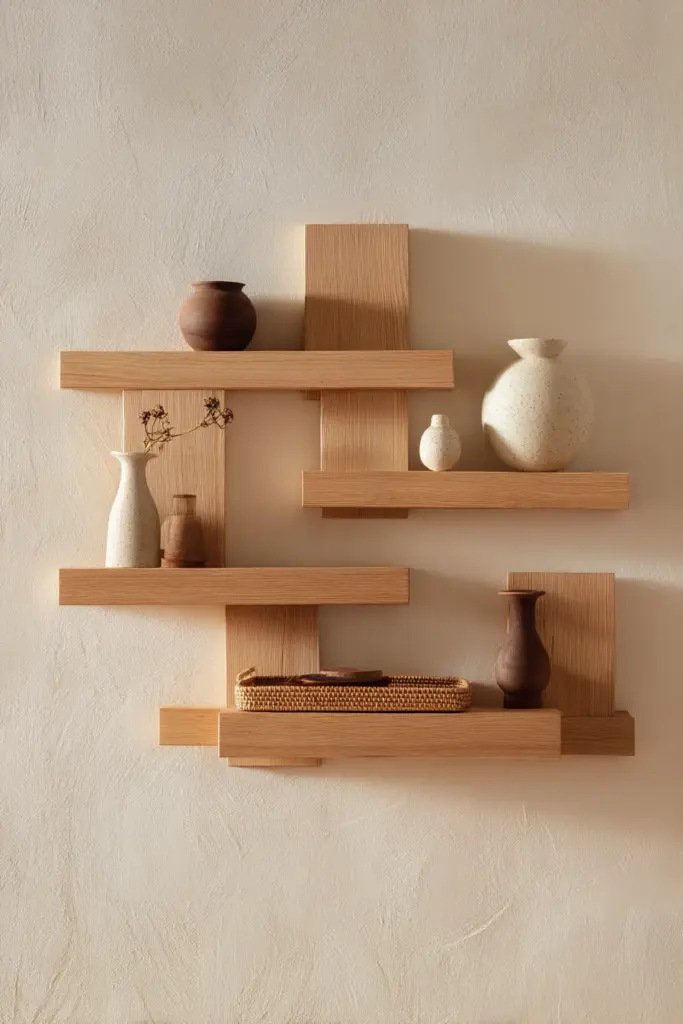
Floating shelves are the most versatile entry point into Japandi shelving. They hover cleanly against the wall, leaving the floor open and the eye free to travel.
What you need:
- 1 solid wood plank (oak or bamboo), 80–120 cm long, 20 cm deep
- Invisible bracket set (2–3 per shelf)
- Wall anchors and screws (appropriate for your wall type)
- Drill
- Level
- Matte wood oil or beeswax finish
Steps:
- Sand the plank with 120-grit sandpaper, then 220-grit for a silky finish.
- Apply two thin coats of matte wood oil. Let each coat dry fully.
- Mark your bracket positions on the wall using a level.
- Drill anchor holes and secure the brackets.
- Slide the shelf onto the brackets and check the level again.
- Style with intention — three to five objects maximum per shelf.
Estimated cost: ₱1,200–₱2,800 depending on wood choice and bracket quality.
Build 2: The Cleat Wall System (Intermediate)
The cleat shelf system is a Japandi-meets-workshop favorite. A French cleat — two beveled boards that interlock — mounts to the wall and allows you to rearrange shelves and hooks freely without re-drilling.
This system is ideal for home offices, entryways, and kitchens where storage needs shift. It is also deeply satisfying to build.
What you need:
- Solid spruce or plywood boards for cleats and shelves
- Table saw or router with a 45-degree bevel bit
- Drill and wall anchors
- Sandpaper and wood stain or oil
Steps:
- Cut your cleat boards at a 45-degree bevel along one long edge.
- Mount the wall-side cleat securely into studs.
- Attach the matching cleat to the back of each shelf.
- Hook the shelf cleats onto the wall cleat — they interlock and hold firmly.
- Adjust, rearrange, and add peg hooks or small bins as needed.
The beauty of this system is its adaptability. You build it once and style it endlessly.
Estimated cost: ₱2,500–₱5,000 depending on tools available and wood type.
Build 3: The Wabi-Sabi Stone Stack (No Tools)
As described above, this is the most meditative of the three builds. There is something ritualistic about choosing your stones, testing their balance, and finding the configuration that feels right.
What you need:
- 4–6 flat river stones or slate pieces
- 1 reclaimed wood plank or thick bamboo board
- Non-slip pads (optional, for stability)
Steps:
- Arrange stones in a stable column, widest at the base.
- Place non-slip pads between layers if desired.
- Rest the wood plank across the top stone column — or two parallel columns for a wider shelf.
- Style with a single plant, a candle, or a small ceramic.
This build costs under ₱1,000 and requires nothing but patience and a good eye.
Styling Your Japandi Shelf: The Art of the Considered Edit
Building the shelf is only half the practice. Styling it is where the Japandi philosophy truly lives.
The Rule of Odd Numbers and Empty Space
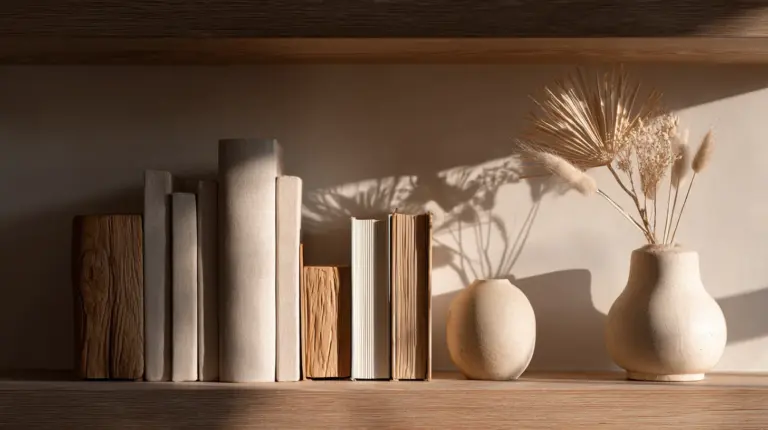
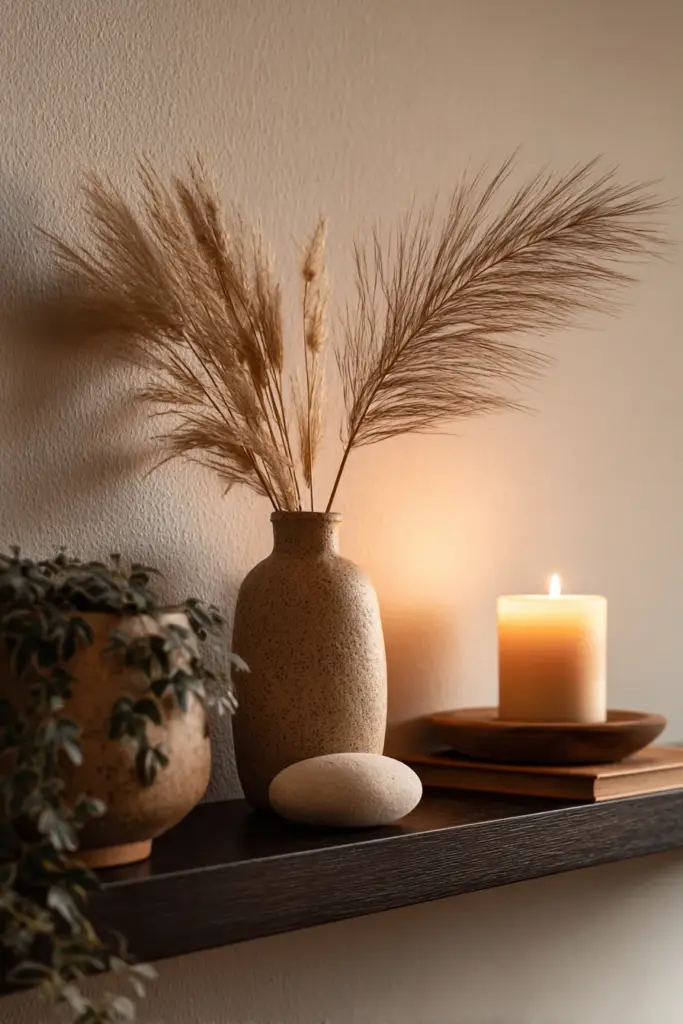
Style in groupings of three or five. Mix heights — a tall bud vase, a low ceramic bowl, a small trailing plant. Then step back and remove one item. Empty space is not absence; it is presence. It lets each object be seen.
Textures That Speak
Japandi shelving comes alive through texture contrast. A rough stone beside a smooth ceramic. A woven basket beside a polished wood object. A linen-bound book beside a delicate dried grass stem.
Consider these natural pairings:
- Matte clay vessel + trailing pothos
- Woven rattan tray + smooth river stone
- Raw linen book cloth + dried pampas grass
- Bamboo canister + small succulent
Lighting as a Styling Tool
Warm, directional light transforms a shelf from storage to sanctuary. A small LED strip tucked beneath a shelf casts a gentle glow across the objects below. A directional picture light above highlights texture and grain.
For daytime styling, position shelves near natural light sources when possible. Morning light through sheer curtains creates the golden, wabi-sabi warmth that Japandi spaces are known for.
Biophilic Touches: Integrating Plants Into Your Shelf Build
One of the most underexplored aspects of Japandi shelving is the integration of living things. A purpose-built plant ledge — slightly deeper, with a waterproof liner or ceramic tray — allows you to incorporate low-maintenance plants directly into your shelf system.
Best plants for Japandi shelves:
- Pothos (trailing, forgiving, lush)
- Succulents (structural, minimal care)
- Snake plant (architectural, upright)
- Moss in a shallow ceramic dish (meditative, textural)
For a shelf with hidden drainage, line a recessed section with a thin rubber mat and use a ceramic saucer beneath each pot. This keeps your wood dry and your plants happy.
Renter-Friendly Japandi Shelving: No Damage, Full Style
If your lease says no drilling, your options are more creative than you might think.
Removable adhesive brackets (like Command strips rated for 2–5 kg) work beautifully for lightweight Japandi shelves. Pair them with thin bamboo or pine planks and style with only the lightest objects — ceramics, dried botanicals, small frames.
Leaning ladders in natural wood or bamboo are another renter’s best friend. A simple ladder leaned against the wall and styled with draped linen, a few plants, and a couple of ceramic pieces becomes a Japandi moment without a single hole in the wall.
The stone stack build (above) is inherently renter-safe. It requires nothing from your walls and moves with you.
DIY Japandi Shelving: Quick-Reference Comparison
| Shelf Type | Tools Needed | Estimated Cost (PHP) | Stability | Best For |
|---|---|---|---|---|
| Stone Stack | None | Under ₱1,000 | Medium | Organic look, renters |
| Floating Wall Shelf | Drill | ₱1,200–₱2,800 | High | Small spaces, minimalist style |
| Wood Cleat System | Router/Jig | ₱2,500–₱5,000 | Very High | Custom fit, adaptable storage |
| Leaning Ladder | None | ₱800–₱2,000 | Medium | Renters, decorative display |
| Pallet Wood Shelf | Saw, Sandpaper | ₱500–₱1,500 | High | Wabi-sabi, upcycled aesthetic |
Key Takeaways
- Japandi shelving blends Scandinavian warmth with Japanese restraint — natural materials, clean lines, intentional negative space.
- Best woods for humid Philippine climates: bamboo (top choice), sealed oak, or reclaimed pallet wood with a quality matte sealant.
- Three builds for every skill level: floating wall shelf (beginner), cleat wall system (intermediate), stone stack (no tools needed).
- Style with texture contrast: raw beside smooth, organic beside geometric.
- Integrate plants with waterproof liners and low-maintenance species like pothos, succulents, and snake plants.
- Renters: use adhesive brackets, leaning ladders, or stone stacks — all wall-safe and fully Japandi.
- Total budget builds are possible: a complete Japandi shelf setup under ₱3,000 is achievable with bamboo boards and smart sourcing.
Conclusion
A shelf is never just a shelf. It is a small act of curation — a window into how you see beauty, how you choose to live, what you decide deserves space in your home.
Japandi shelving asks you to slow down and choose well. To let a single ceramic rest where three would crowd. To let the wood show its grain, the stone show its weight, the plant trail freely without apology.
Whatever your budget, your wall type, or your skill level, there is a version of this waiting for you. Start with one shelf. Style it with three things you love. Then step back and breathe in what you built.
That quiet satisfaction — that is ERYLIN.
Frequently Asked Questions
What materials are best for DIY Japandi shelves?
Natural wood is the foundation of most Japandi shelving. Bamboo is ideal for humid climates and offers a clean, linear grain. Solid oak brings warmth and longevity. For a no-tool, wabi-sabi approach, flat river stones stacked beneath a reclaimed wood plank create an organic, beautiful shelf with zero drilling required.
How do I make floating Japandi shelves without tools?
The stone-stack method requires no tools at all. Layer flat garden or river stones into a stable column, then rest a smooth wood or bamboo board across the top. For wall-mounted options without drilling, high-rated removable adhesive brackets can support lightweight bamboo or pine shelves — ideal for renters.
Are Japandi shelves easy for beginners?
Yes. A basic floating shelf requires only a drill, a level, invisible brackets, and a sanded wood plank. The wabi-sabi stone stack requires nothing more than found materials and a good eye. Many beginners also find success with IKEA shelf hacks — swapping standard brackets for matte black or natural wood alternatives to achieve a Japandi aesthetic affordably.
What is the Japandi shelving style?
Japandi shelving is a minimalist, warmly textured aesthetic born from the fusion of Scandinavian and Japanese design. It favors natural wood, neutral tones, and deliberate negative space. Objects are chosen carefully — a ceramic, a plant, a book — and each is given room to breathe. The result feels calm, considered, and quietly beautiful.
How can I style Japandi shelves with plants?
Choose low-maintenance plants with strong visual character: trailing pothos for softness, succulents for structure, or a snake plant for an architectural upright form. For integrated plant ledges, line a recessed shelf section with a rubber mat and use ceramic saucers to protect the wood. Mix your plant with one or two other objects — a stone, a candle, a linen-bound notebook — for a layered, living vignette.