
Table of Contents
There is something quietly magical about a plant that needs no soil, no pot, no fuss. It simply exists — suspended in air, drinking light and moisture from the room around it. That is the air plant. And in the world of Japandi design, it may be the most perfect living decoration you have never considered.
Japandi — the seamless blending of Japanese wabi-sabi philosophy and Scandinavian hygge warmth — is a design language built on restraint, nature, and honest beauty. It favors the unfinished edge, the raw texture, the quiet corner that makes you exhale. Air plants, or Tillandsia, speak that same language fluently.
This guide is for anyone who wants to bring more life into a calm, considered home without the clutter of pots, soil bags, and watering cans. Whether you live in a compact Manila apartment or a light-filled suburban space, Japandi air plants offer a low-maintenance, high-beauty path to the interior you have been imagining.
Let us walk through it together — varieties, displays, care rituals, and all the small, beautiful details that make a room feel truly alive.
Why Air Plants Belong in a Japandi Interior
Japandi design does not simply decorate — it edits. Every object earns its place. Tillandsia, which grow naturally without soil by clinging to trees and rocks, are among the most architecturally honest plants you can bring indoors.
Their silvery-green leaves carry a sculptural quality — some curl like sea creatures, others stand in quiet, upright symmetry. Placed against a backdrop of raw linen, matte ceramic, or pale hinoki wood, they add exactly the kind of organic imperfection that wabi-sabi celebrates.
They also remove the visual noise of traditional plant care. No drainage trays. No dark soil. No decorative pot competing for attention. Just the plant, its mount, and the space around it — breathing together.
Top Tillandsia Varieties for Japandi Styling
Not all air plants carry the same visual weight. Choosing the right variety is part of the design process.
| Variety | Shape | Best For | Japandi Mood |
|---|---|---|---|
| Tillandsia xerographica | Wide, curling rosette | Statement shelf or driftwood mount | Bold wabi-sabi anchor |
| Tillandsia ionantha | Small, upright cluster | Grouped displays, ceramic orbs | Quiet hygge warmth |
| Tillandsia caput-medusae | Twisted, octopus-like | Hanging wire or wood fork | Sculptural asymmetry |
| Tillandsia stricta | Slender, arching | Floating shelf or stone base | Clean Scandinavian line |
| Tillandsia bulbosa | Bulbous base, wild tips | Rattan cradle or glass vessel | Earthy, tactile drama |
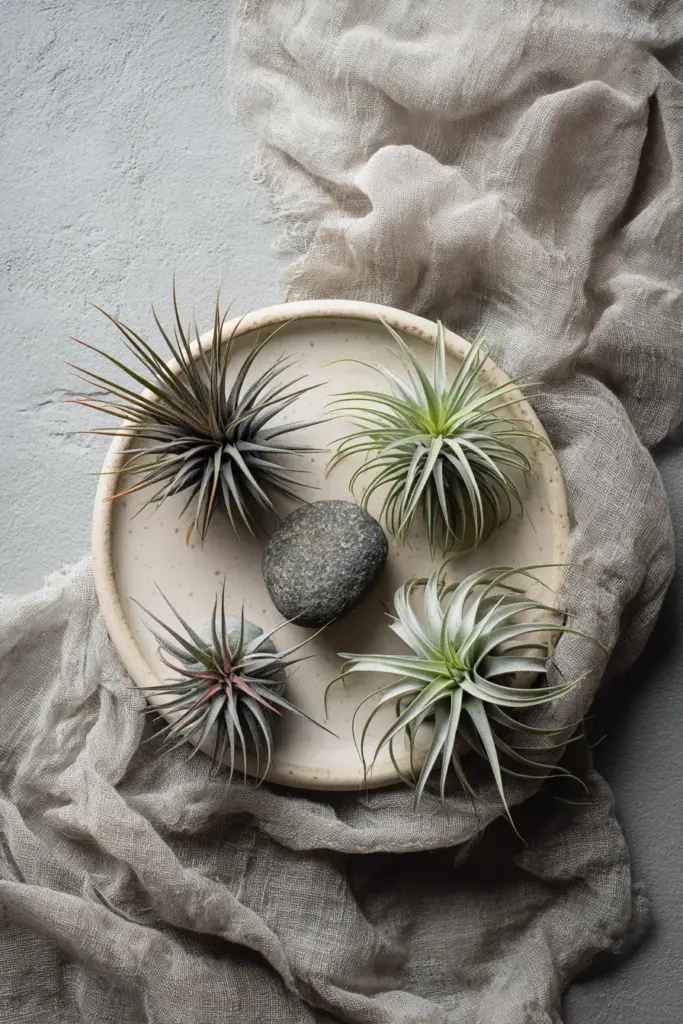
Tillandsia xerographica — The Japandi Statement Plant
If you place only one air plant in your home, let it be the xerographica. Its wide, silver-grey leaves curl inward like a slow exhale, forming a rosette that reads as almost architectural. Rest it directly on a slab of pale wood or a raw concrete shelf, and it becomes a centerpiece without trying.
Tillandsia ionantha — Small but Mighty
Ionantha clusters are ideal for layered displays. Group three to five on a small piece of driftwood or a ceramic tray, and the result feels like a miniature landscape — the kind of quiet, intentional vignette that Japandi interiors do so well.
How to Style Japandi Air Plants: Displays That Breathe
The most common mistake people make with air plants is treating them like ordinary houseplants. They reach for a pot. They look for soil. They miss the whole point.
In Japandi design, the mount is part of the artwork. The material you choose to hold or display your air plant carries as much meaning as the plant itself.
Driftwood and Reclaimed Wood Mounts
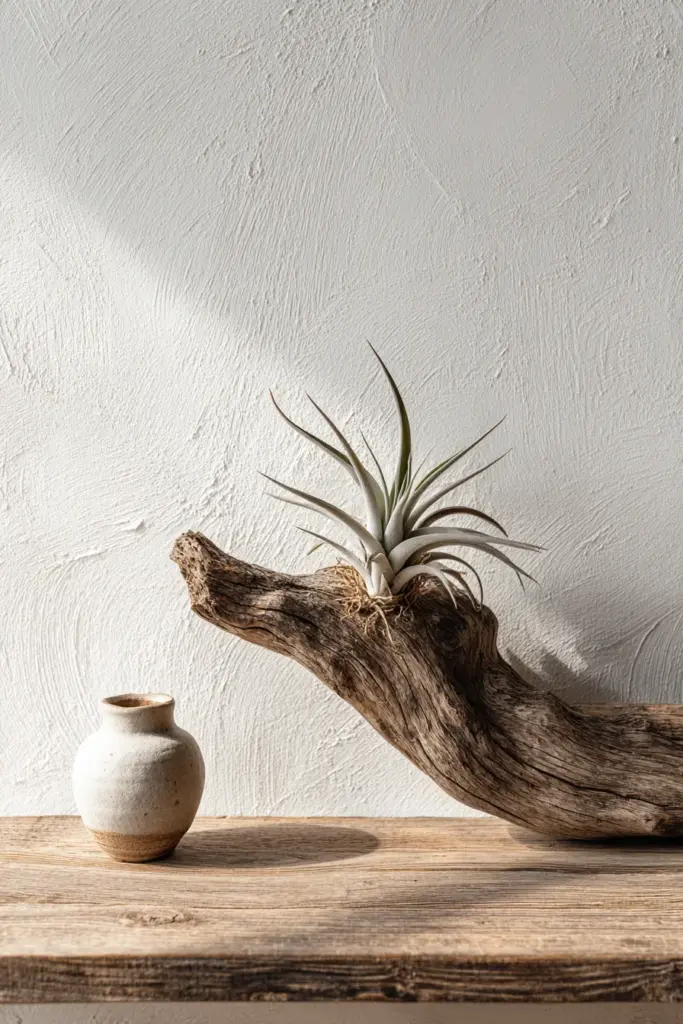
Driftwood is perhaps the most natural partner for Tillandsia. Its pale, weathered surface echoes the silver tones of many air plant varieties, and its irregular form celebrates the wabi-sabi principle of imperfection as beauty.
Secure a xerographica or caput-medusae to a piece of driftwood using a small drop of non-toxic adhesive or fine copper wire. Lean it against a wall or rest it on a floating shelf. The result is organic, effortless, and completely free of visual clutter.
Rattan and Bamboo Cradles
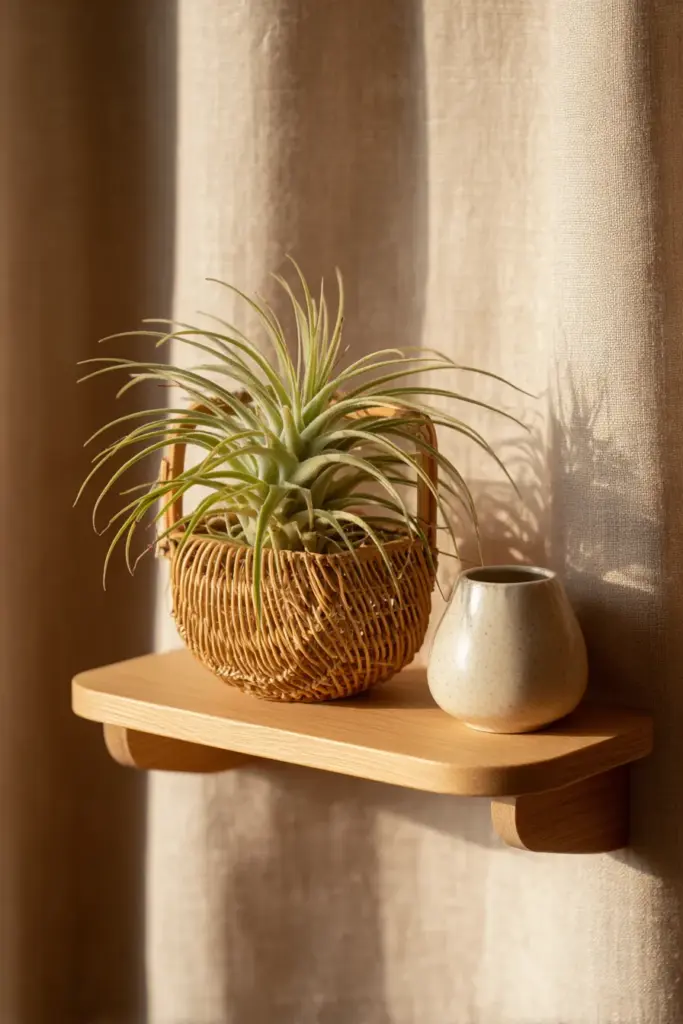
For a warmer, more hygge-leaning display, woven rattan holders bring softness and texture. Small rattan cradles — available locally in the Philippines for under ₱300 at Divisoria markets — cradle ionantha or stricta beautifully. Their warm, honey tones contrast gently against pale plaster walls or linen curtains.
Ceramic Orbs and Stone Vessels
Matte ceramic orbs with a single opening are designed for air plants. Choose glazes in warm white, smoke grey, or dusty sage — colors that echo the muted, natural palette of a Japandi interior. A single bulbosa nestled inside a stoneware bowl on a bedside table creates a moment of quiet beauty that greets you every morning.
Hanging Glass Terrariums
Geometric glass terrariums catch light in a way that feels almost meditative. Hang a small ionantha or stricta in a teardrop-shaped vessel near a window, and watch how morning light passes through the glass and falls softly across the plant. It is a living, changing installation that costs almost nothing.
DIY Budget Mounts — Japandi Style on a Philippine Budget
You do not need to spend a fortune to achieve a considered display.
- Upcycled wood offcuts from a local hardware store, sanded and oiled with coconut oil, make beautiful minimalist bases
- IKEA picture ledges styled with a mix of small air plants, pebbles, and a single dried stem create an effortless Japandi shelf moment
- River stones from garden centers, with small indentations, cradle tiny ionantha naturally
- Rattan baskets in small sizes from tiangge markets hold bulbosa plants with organic charm
The best Japandi displays are always personal, always a little imperfect, and always made with intention.
Caring for Air Plants in a Japandi Home
One of the reasons air plants align so well with Japandi philosophy is their care ritual. Simple, consistent, mindful — it mirrors the way Japandi design encourages you to interact with your home.
Watering — The Weekly Soak
The most effective way to water Tillandsia is to submerge them fully in room-temperature water for 20 to 30 minutes once a week. After soaking, shake them gently and place them upside down on a clean towel for an hour to allow water to drain from the base. Trapped moisture at the centre causes rot — the most common air plant failure.
In humid climates like Manila, you may find every ten days is sufficient. Your plant will tell you: grey, curling leaves mean thirst; soft, dark patches mean too much moisture.
Light — Bright but Gentle
Air plants thrive in bright, indirect light — the kind of soft, diffused glow that filters through sheer linen curtains. A spot within one to two metres of a window is ideal. Avoid harsh afternoon sun, which scorches their delicate leaves, and avoid dark corners, which slow their growth.
If your apartment lacks natural light, a small LED grow lamp styled discreetly on a shelf keeps your plants healthy without disrupting the room’s calm aesthetic.
Humidity and Air Circulation
Tillandsia are naturally adapted to humid, breezy environments. In Philippine homes, natural humidity is often an advantage — most varieties thrive without any misting. Ensure good air circulation, especially after soaking, and avoid placing plants directly next to air-conditioning units, which dry the air significantly.
Do Air Plants Purify the Air?
Air plants do contribute modestly to air quality. They absorb carbon dioxide and release oxygen, and like most plants, they help regulate indoor humidity levels. While they are not high-output air purifiers in the way that snake plants or peace lilies are often cited to be, the calming effect of living greenery on human wellbeing is well-documented — and in a Japandi home, that gentle, grounding presence matters enormously.
Japandi Air Plants for Small Spaces
One of the most practical gifts Tillandsia offers city dwellers is their complete flexibility of placement. No drainage, no soil, no fixed home — they go wherever you put them.
Vertical Walls
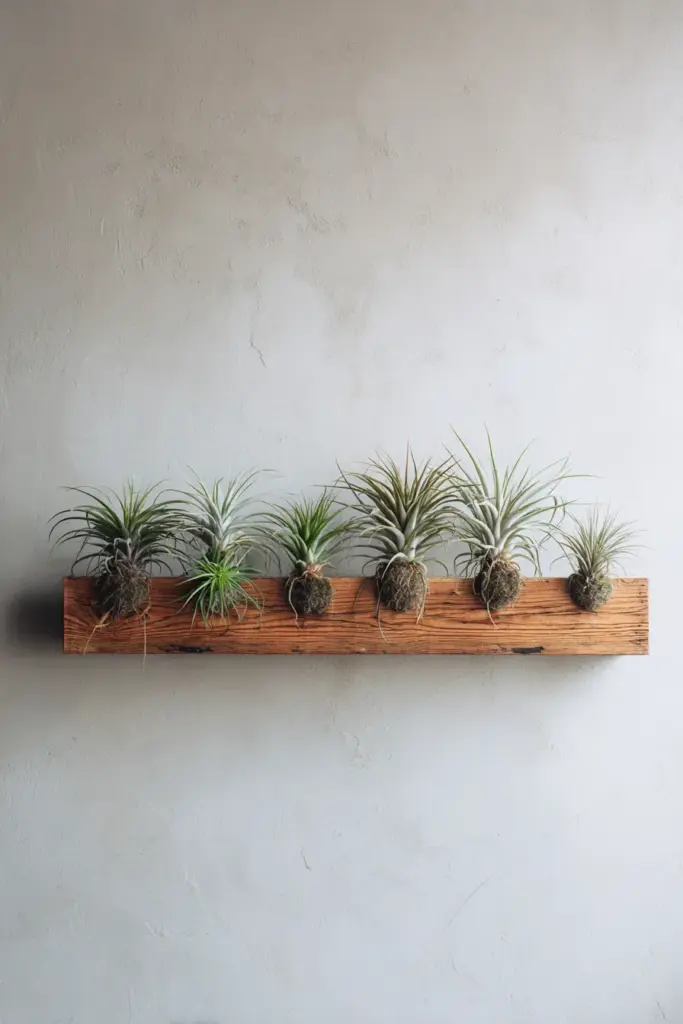
A driftwood board mounted horizontally on a wall, with five or six air plants of varying sizes attached at organic intervals, creates a living wall installation that takes up zero floor space. This is ideal for Manila apartments where every square metre counts.
Floating Shelves
A single narrow floating shelf styled with two or three air plants, a small ceramic vessel, and a smooth river stone captures the essence of Japandi in less than 30 centimetres of space. Layer with warm, ambient lighting ideas for an evening atmosphere that feels hotel-calm.
Bathroom and Kitchen Styling
Bathrooms offer the humidity air plants love. A xerographica resting on the edge of a stone basin or a small ionantha on a bathroom shelf adds life to a space that often feels sterile. In the kitchen, a cluster near a window brings nature into the most functional room in the home.
Quick Reference — Japandi Air Plant Styling Checklist
- Choose Tillandsia varieties with sculptural, asymmetric forms for authentic wabi-sabi character
- Mount on driftwood, rattan, ceramic, or stone — avoid plastic at all costs
- Display in bright, indirect light within two metres of a window
- Soak weekly for 20 to 30 minutes; always allow to dry fully before returning to display
- Group odd numbers of plants (three, five) for visual balance
- Keep colour palette muted — grey, white, warm wood, sage green
- Pair with cozy, natural-material furniture for a complete Japandi atmosphere
- Source locally in the Philippines — Divisoria, weekend markets, and garden centres offer beautiful, affordable varieties
- Avoid direct aircon airflow, which dries leaves and stresses plants
- Rotate displays seasonally to refresh the energy of a room
The Feeling You Are Really Designing For
When people discover Japandi design, they often describe a feeling before they can name a style. It is the feeling of walking into a room and immediately slowing down. Of noticing the way light falls across a wooden surface. Of breathing a little deeper without knowing why.
Air plants carry that feeling with them. They ask nothing dramatic of you — just a weekly soak, a bright corner, a little attention. In return, they bring life, texture, and a quiet sense of the natural world into the most intimate spaces of your home.
Place a Tillandsia xerographica on your desk. Hang a glass orb in a sun-touched window. Lay a small ionantha cluster on a stone tray beside your morning coffee. These are small acts, but they are the kind that shift how a home feels — from simply decorated to genuinely, softly alive.
That is what ERYLIN believes in. Not the grand gesture, but the considered one.
Frequently Asked Questions
Are air plants good for Japandi interiors?
Yes — air plants are exceptionally well-suited to Japandi design. Their no-soil growth habit removes visual clutter, and their sculptural, organic forms embody the wabi-sabi appreciation of natural imperfection. They are among the most minimalist living elements you can introduce to a calm, considered interior.
What are the best air plants for Japandi styling?
Tillandsia xerographica, ionantha, caput-medusae, stricta, and bulbosa are all excellent choices. Xerographica offers bold sculptural presence; ionantha clusters bring gentle warmth; caput-medusae adds dramatic, asymmetric texture.
How do I display air plants in a Japandi home?
Mount them on driftwood, rest them in matte ceramic orbs, cradle them in rattan holders, or hang them in geometric glass vessels. The goal is always simplicity — let the plant and its mount breathe within open space.
How often do air plants need watering?
Once a week is the standard — submerge fully in room-temperature water for 20 to 30 minutes, then allow to dry completely before replacing. In humid Philippine conditions, every 10 days may be sufficient.
Are air plants pet-safe?
Tillandsia are generally considered non-toxic to cats and dogs, making them a thoughtful choice for pet-friendly Japandi homes. Always confirm with your veterinarian if you have a pet with specific sensitivities.