
Table of Contents
There is something quietly transformative about walking into a room where a tall, leafy plant stands near a linen sofa, catching afternoon light. No clutter. No noise. Just green, wood, and stillness.
That is the soul of Japandi — a design philosophy born where Japanese wabi-sabi meets Scandinavian hygge. And tall plants are its most expressive living detail.
This guide is for anyone who wants their living room to breathe. Whether you are styling a compact city apartment or a wide open space, tall Japandi living room plants can anchor your room, soften its edges, and fill it with quiet life.
Let us walk through exactly which plants to choose, how to place them, and how to keep them thriving — especially if you are living in the warm, humid tropics.
What Makes a Plant “Japandi”?
Not every tall plant belongs in a Japandi room. The style calls for restraint — one dramatic statement rather than a dozen competing details.
A Japandi plant should feel earned. It earns its place through sculptural form, muted color, and a grounded kind of beauty that asks nothing of you but presence.
The Japandi Plant Checklist
- Vertical growth — height that draws the eye upward without crowding
- Clean lines — bold, simple leaf shapes over fussy or ornate foliage
- Low visual noise — not too many colors, patterns, or irregular forms
- Neutral-pot-friendly — looks best in matte ceramic, raw terracotta, or woven rattan
- Low to moderate maintenance — calm homes deserve calm plants
The Best Tall Plants for Japandi Living Rooms
1. Fiddle Leaf Fig (Ficus lyrata)
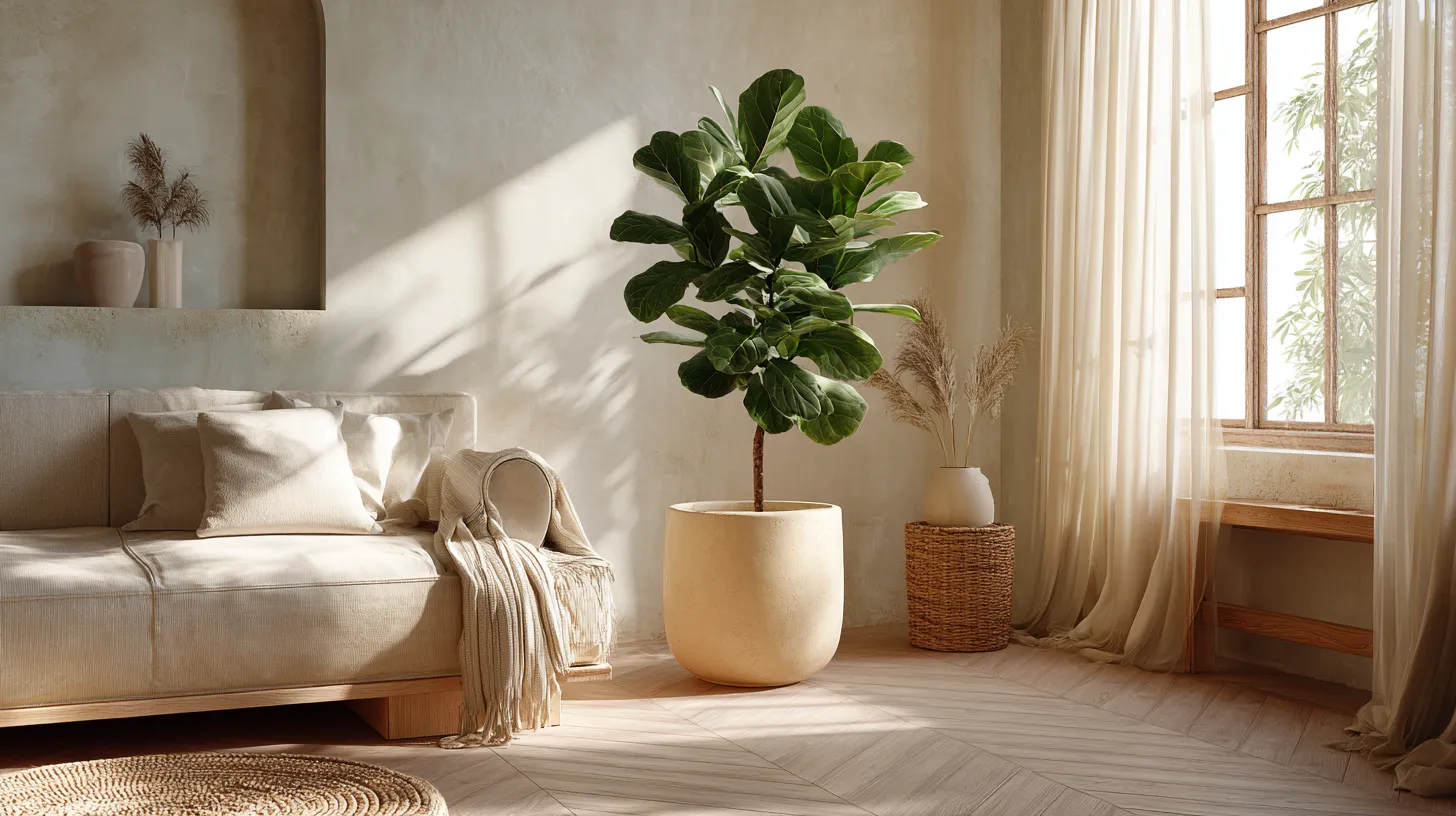
Few plants command a room the way a Fiddle Leaf Fig does. Its broad, violin-shaped leaves are bold and architectural — exactly the kind of statement Japandi lives for.
Place it beside a pale linen sofa or in a sun-warmed corner near a wood-framed window. The contrast of those dark, waxy leaves against a white-washed or clay-toned wall is simply stunning.
Care: Bright indirect light, watering every 1–2 weeks, hates cold drafts. Grows to 2m+ indoors with the right conditions.
⚠️ Pet note: Toxic to cats and dogs. Keep out of reach of curious paws.
2. Cornstalk Dracaena (Dracaena fragrans)
If the Fiddle Leaf Fig is the showpiece, the Cornstalk Dracaena is the quiet anchor. It grows tall and slender, with arching green and yellow-striped leaves that fan out like a slow exhale.
It is one of the most low-maintenance tall plants for Japandi interiors — forgiving of irregular watering and comfortable in lower light. Perfect for rooms that do not face a bright window.
Care: Low to medium indirect light, water every 2–3 weeks, mist occasionally in dry climates. Can reach 1.5–2m indoors.
✅ Low toxicity — generally safe for most households, but mildly toxic to pets.
3. Monstera Deliciosa (Split-leaf Philodendron)
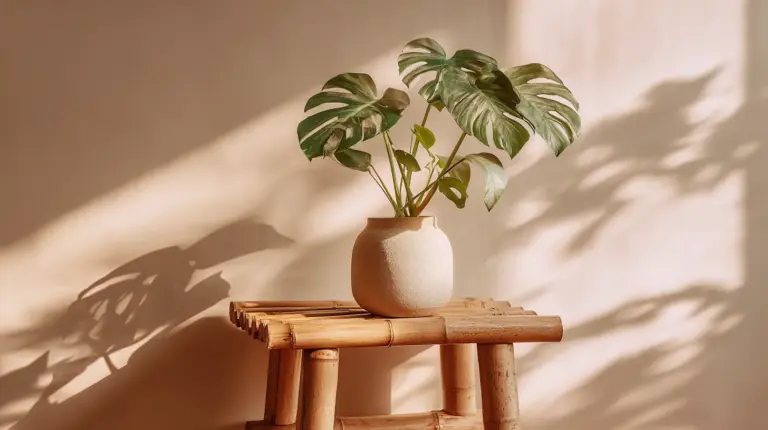
The Monstera is lush without being loud. Its fenestrated leaves — those iconic splits and holes — give it an almost meditative quality, like nature’s own pattern-making.
In a Japandi room, a mature Monstera in a stone-grey pot adds organic texture against smooth plaster walls. Pair it with a low wooden coffee table and a single handmade ceramic vase for a complete composition.
Care: Bright to medium indirect light, water every 1–2 weeks. Grows wide and tall — allow space for it to breathe. Can reach 1.5m+ with a moss pole.
⚠️ Toxic to pets. Choose a pet-safe alternative if needed.
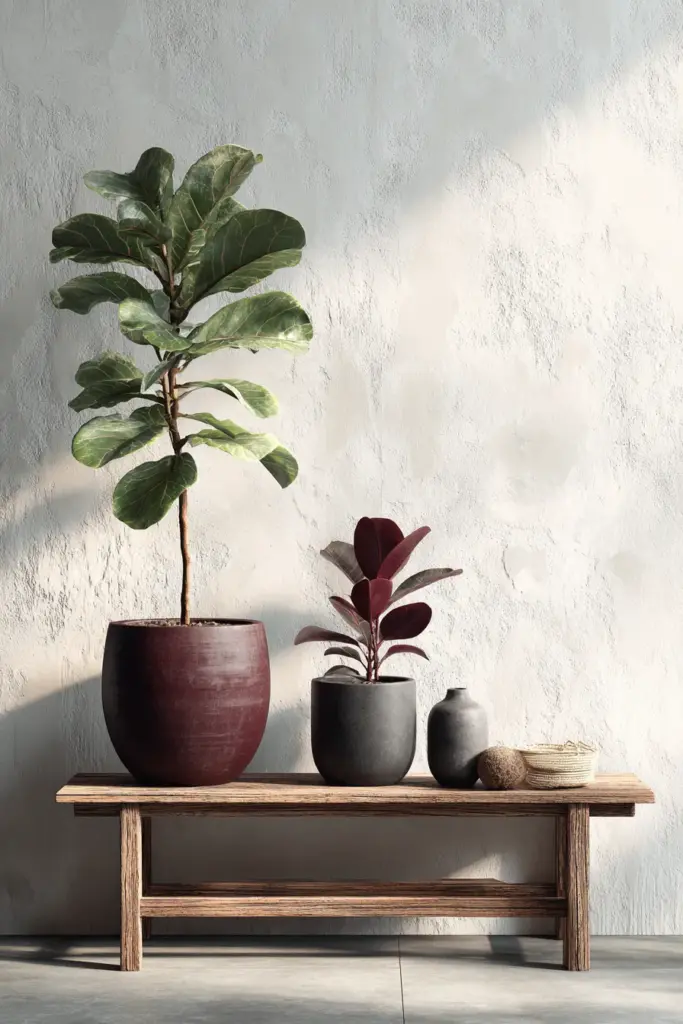
4. Rubber Plant (Ficus elastica)
The Rubber Plant is underrated in Japandi design, and it deserves far more attention. Its deep burgundy or dark green leaves are almost leather-like — rich, grounded, and quietly luxurious.
It fits beautifully in narrow living rooms where a wide Monstera might overwhelm. Trained upright, it can reach 1.8m and creates a striking vertical line next to a reading nook or beside a TV console.
Care: Bright indirect light preferred but adapts to medium light. Water every 1–2 weeks. Wipe leaves occasionally for that signature glossy look.
⚠️ Toxic to pets — sap can irritate skin.
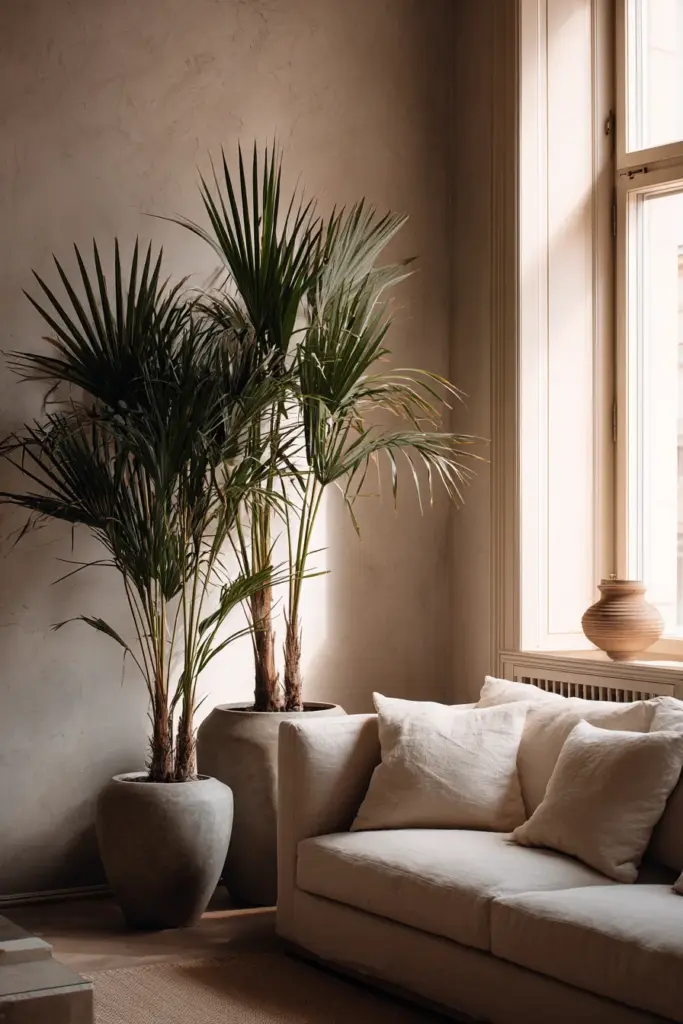
5. Kentia Palm (Howea forsteriana)
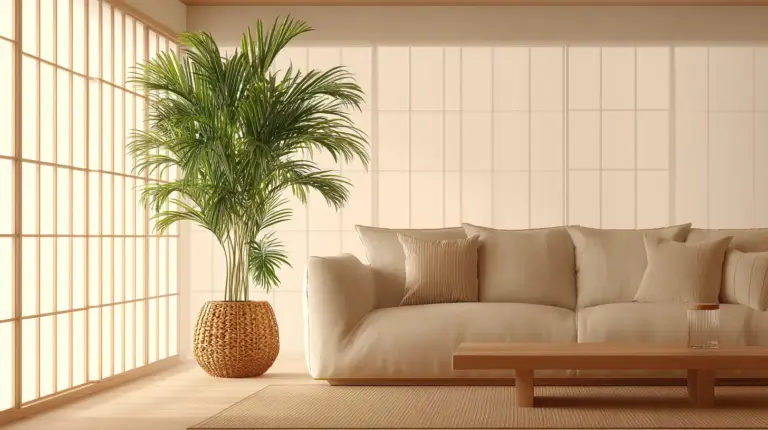
For those who love the softness of tropical living but want restraint, the Kentia Palm delivers both. Its feathery arching fronds create gentle movement — the room seems to breathe when a breeze passes through.
It is also one of the best tall plants for low-light Japandi living rooms. Unlike most palms, the Kentia thrives in shadier interiors, making it ideal for apartments with north-facing windows.
Care: Low to medium indirect light, water every 1–2 weeks, keep away from cold. Grows slowly to 2–3m — a long-term investment in beauty.
✅ Non-toxic to pets and children — an excellent family-safe choice.
6. Parlor Palm (Chamaedorea elegans)
The Parlor Palm is the Japandi plant for those who want elegance without risk. It is completely non-toxic, grows steadily, and tolerates low light with grace.
For compact living rooms, try a grouping of two Parlor Palms in matching matte black or sand-colored pots, flanking a low sofa. The effect is quietly magnificent.
Care: Low to medium indirect light, water every 1–2 weeks, keep humidity moderate. Grows to 1–1.5m, making it ideal for smaller spaces.
✅ Fully pet-safe and child-safe.
7. Olive Tree (Olea europaea)
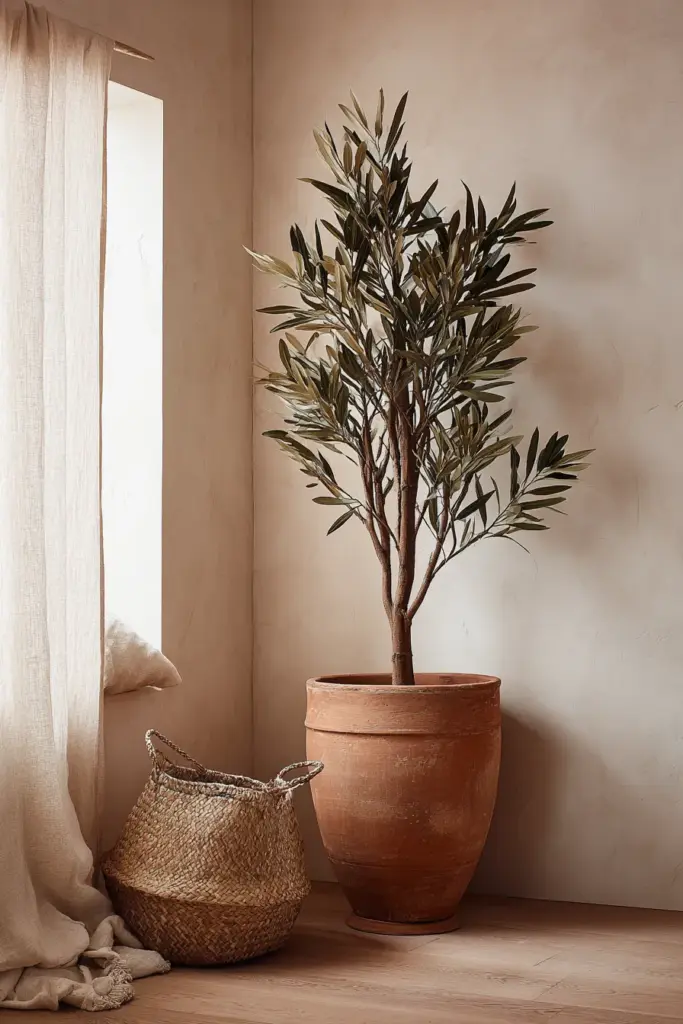
An Olive Tree indoors is an act of intention. It brings with it a sense of Mediterranean stillness — gnarled silver-grey branches, soft grey-green leaves, and a scent that is faint, clean, and ancient.
In a Japandi room, an Olive Tree in a large terracotta pot near a sun-drenched window becomes a living sculpture. Its wabi-sabi character — imperfect, aged, graceful — is the very essence of Japandi philosophy.
Care: Needs bright direct or indirect light (south-facing window ideal), water sparingly — let soil dry between waterings. Grows slowly to 1.5–2m indoors.
✅ Non-toxic to pets.
Tall Japandi Plant Comparison Table
| Plant | Height (Indoor) | Light Needs | Watering | Pet-Safe | Best For |
|---|---|---|---|---|---|
| Fiddle Leaf Fig | Up to 2m+ | Bright indirect | Every 1–2 weeks | ❌ No | Statement corner pieces |
| Cornstalk Dracaena | 1.5–2m | Low to medium | Every 2–3 weeks | ⚠️ Mild | Low-light rooms |
| Monstera Deliciosa | 1.5m+ | Medium to bright | Every 1–2 weeks | ❌ No | Wide open spaces |
| Rubber Plant | Up to 1.8m | Medium to bright | Every 1–2 weeks | ❌ No | Narrow rooms, TV walls |
| Kentia Palm | 2–3m | Low to medium | Every 1–2 weeks | ✅ Yes | Low-light, long-term |
| Parlor Palm | 1–1.5m | Low to medium | Every 1–2 weeks | ✅ Yes | Small spaces, pet homes |
| Olive Tree | 1.5–2m | Bright/direct | Sparingly | ✅ Yes | Sun-filled, sculptural rooms |
How to Style Tall Plants in a Japandi Living Room
Corner Placement: The Classic Anchor
Tall floor plants Japandi rooms do best when placed in corners, where they anchor the room without crowding it. A corner placement creates depth — the eye moves from the low coffee table upward to the plant canopy, then to the ceiling.
Choose one dominant corner — usually the one opposite your entry point — and place your tallest plant there. Let everything else be quieter.
Flanking the Sofa
Two matching tall plants flanking a sofa create a composed, gallery-like symmetry. Try a pair of Parlor Palms or Kentia Palms in matching stone pots on either side of a low linen sofa. The effect is enveloping, like sitting inside a grove.
Behind the TV Console
A tall plant placed behind or beside a TV console softens the hard edge of the screen. The Rubber Plant or Dracaena works beautifully here — vertical, tidy, architectural. It redirects the eye toward life rather than technology.
Pot Selection: The Japandi Way
The pot is not an afterthought — it is half the composition.
- Matte ceramic in sand, cream, or charcoal
- Raw terracotta for warmth and an earthy, wabi-sabi feel
- Woven rattan baskets over plain nursery pots for texture
- Concrete or stone-look planters for a more minimal, Nordic edge
Avoid patterned, glossy, or brightly colored pots — they compete with the plant’s natural form.
Caring for Tall Japandi Plants in Tropical Climates
For readers in the Philippines, Southeast Asia, and other tropical regions — this section is for you.
Tropical climates offer both gifts and challenges for indoor plants. The warmth and humidity are ideal for most of these species — but the intensity of the wet season (and pest pressure it brings) requires some seasonal awareness.
March to May: Pre-Monsoon Care
As humidity begins to climb in March, increase airflow around your plants. Open windows in the early morning, and rotate your plants a quarter turn weekly so all sides receive even light.
Check the underside of leaves for spider mites — they thrive in pre-monsoon heat. A diluted neem oil spray every two weeks is a gentle, effective preventative.
Wet Season: June to October
During heavy rains, resist the urge to increase watering — your indoor plants do not need more moisture when the air itself is saturated. Water only when the top two inches of soil feel dry.
Watch for fungal issues in densely leafed plants like Monstera. Improve air circulation and remove any yellowing or damaged leaves promptly.
Budget-Friendly Sourcing
You do not need to spend a fortune building a Japandi plant collection. In the Philippines, local nurseries — including those around Silang, Cavite — often carry Dracaena, Rubber Plants, and Parlor Palms at a fraction of specialty shop prices.
Consider propagating from cuttings: Rubber Plants and Dracaenas root readily in water. Use wooden crates, upcycled ceramic jars, or bamboo baskets as planters for a budget-conscious, eco-aligned aesthetic that is deeply in the spirit of Japandi.
Small Space Hacks for Tall Japandi Plants
Not everyone has a generous floor plan — and Japandi was never about size. It is about intention.
Dwarf and Compact Varieties
- Compact Kentia Palm — pruned to 1.5m, it gives full palm energy in a smaller footprint
- Dwarf Umbrella Tree (Schefflera arboricola) — bushy, sculptural, grows upright with gentle training
- Slim Dracaena marginata — extremely slender trunk, minimal leaf spread, ideal for very narrow corners
Vertical Tricks for 10sqm Rooms
Place a tall plant in the corner diagonally opposite your entry — this tricks the eye into perceiving more depth. Choose a single statement plant rather than a cluster; restraint creates the illusion of more space, not less.
Use a pot with legs or a tall plant stand to elevate shorter plants, creating vertical interest without a wide footprint.
Key Takeaways: Tall Japandi Living Room Plants
- Choose one or two statement plants rather than many — Japandi lives in restraint
- Prioritize vertical growth, sculptural form, and simple leaf shapes
- The best tall Japandi plants include Fiddle Leaf Fig, Cornstalk Dracaena, Kentia Palm, and Rubber Plant
- For low-light rooms, choose Dracaena, Kentia Palm, or Parlor Palm
- For pet-safe choices, Kentia Palm, Parlor Palm, and Olive Tree are excellent
- Use matte, neutral pots — terracotta, stone, or woven rattan
- Place plants in corners, beside sofas, or near TV consoles for maximum visual impact
- In tropical climates, rotate plants seasonally, watch for pests pre-monsoon, and reduce watering in the wet season
- Propagate from cuttings and use upcycled containers for budget-friendly styling
- In small rooms, use a single tall plant in a diagonal corner to create depth
Conclusion
A tall plant in a Japandi living room is not decoration. It is a presence.
It changes the quality of light in a room. It softens the sound of a busy day. It reminds you — quietly, persistently — that life is growing right there beside you.
Whether you choose the dramatic sweep of a Fiddle Leaf Fig or the gentle rustling of a Kentia Palm, the effect is the same: a room that feels alive. Grounded. A little more like home.
At ERYLIN, we believe that the most beautiful interiors are the ones that grow with you. Start with one plant. Find its perfect corner. And let the room tell you what it needs next.
The best design decisions are never rushed — they are grown.
Frequently Asked Questions
What are the best tall plants for Japandi living rooms?
The top choices are the Fiddle Leaf Fig for drama, Cornstalk Dracaena for low-maintenance height, Kentia Palm for soft texture, and Rubber Plant for narrow spaces. Each brings sculptural form and a calm, natural presence that aligns with Japandi aesthetics.
Which tall houseplants fit Japandi style?
Plants with clean, architectural forms work best — think large single leaves, upright trunks, and limited color variation. The Rubber Plant, Monstera Deliciosa, Dracaena, and Olive Tree all have the restrained elegance that Japandi calls for.
How do I style tall plants in a Japandi living room?
Place your tallest plant in a corner to anchor the room, or use two matching plants to flank a sofa symmetrically. Keep the pot neutral — matte ceramic, terracotta, or rattan — and let the plant stand alone as a focal point rather than grouping it with smaller plants.
What tall Japandi plants thrive in low light?
The Cornstalk Dracaena, Kentia Palm, and Parlor Palm are your best options for lower-light living rooms. All three grow to statement heights, require minimal watering, and maintain their graceful form even without a sunny window.
Are there low-maintenance tall plants for Japandi interiors?
Absolutely. The Cornstalk Dracaena and Parlor Palm are among the most forgiving tall plants available — they tolerate irregular watering, lower light, and even occasional neglect. The Snake Plant (Sansevieria) is another excellent vertical option, nearly indestructible and deeply architectural in form.