
Table of Contents
There is something deeply calming about a home where every element earns its place. The matte clay pot on the shelf. The linen throw draped just so. And in the corner, a single plant — sculptural, unfussy, quietly alive.
This is the soul of Japandi design: the Japanese love of ma (negative space) meeting the Scandinavian embrace of hygge. And plants, when chosen thoughtfully, become some of the most powerful objects in this aesthetic language.
But not every home is a greenhouse. Many of us live in apartments with north-facing windows, shaded balconies, or rooms that drink in more shadow than sun. The good news? The most beautiful Japandi plants actually prefer it that way.
In this guide, we’ll walk you through the best Japandi low light plants — how to choose them, style them, care for them in humid tropical climates, and even propagate them at home. Whether you’re in a condo in the Philippines or a flat in Scandinavia, this is your gentle guide to greening your space without the guesswork.
What Makes a Plant Feel Japandi?
Clean Lines, Quiet Presence
A Japandi plant isn’t just any houseplant. It has a certain architectural stillness — upright silhouettes, bold leaf shapes, or dark glossy surfaces that catch indirect light like a quiet painting.
Think of the ZZ Plant’s waxy, arching stems or the Snake Plant’s sharp vertical blades. These aren’t plants that beg for attention. They hold space.
The Wabi-Sabi Effect
Japandi design embraces wabi-sabi — the beauty of imperfection and impermanence. A gently asymmetrical plant in a handmade ceramic pot, placed on bare wooden floorboards, is more powerful than a perfect symmetrical arrangement.
Choose plants with natural texture: ribbed leaves, matte surfaces, irregular growth patterns. Let them be a little wild within their stillness.
Neutral Tones, Living Contrast
Japandi interiors lean toward warm whites, stone greys, aged wood, and dark charcoal. Plants add the single note of living green — and in low light, that green deepens beautifully into forest shades, blue-greens, and near-blacks.
The contrast between a deep green ZZ Plant and a white plaster wall is one of the most quietly dramatic moments you can create in a room.
The Best Japandi Low Light Plants
ZZ Plant (Zamioculcas zamiifolia)
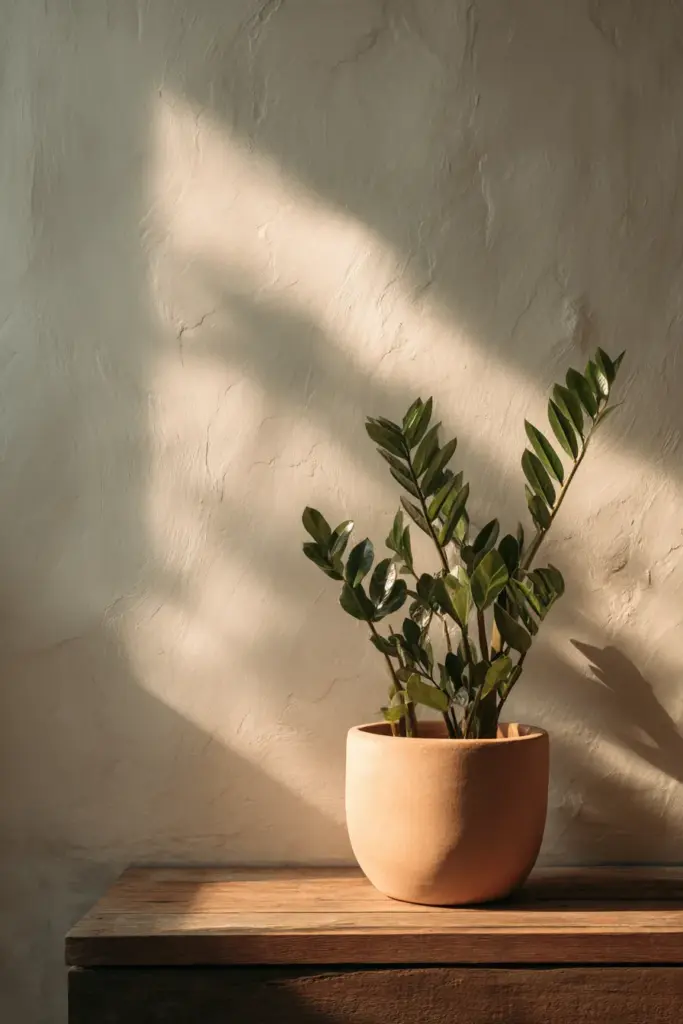
The ZZ Plant is perhaps the most perfectly Japandi plant in existence. Its glossy, oval leaves emerge in slow, arching sprays — sculptural, almost architectural. It thrives in indirect or low light, tolerates irregular watering, and asks for very little in return.
Place it in a matte black or terracotta pot on a low wooden platform. Let it stand alone. That’s all it needs.
Care at a glance:
- Light: Low to indirect
- Water: Every 2–3 weeks (less in humid climates)
- Humidity: Tolerates high humidity — great for Philippine homes
- Pet safety: ⚠️ Toxic to dogs and cats — keep elevated
Snake Plant (Sansevieria trifasciata)
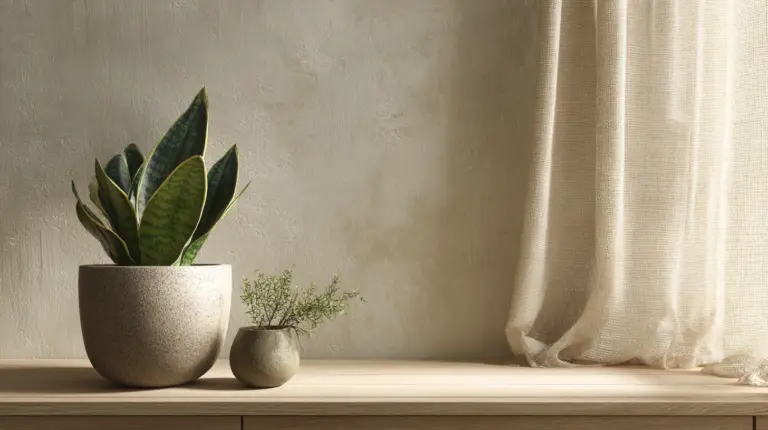
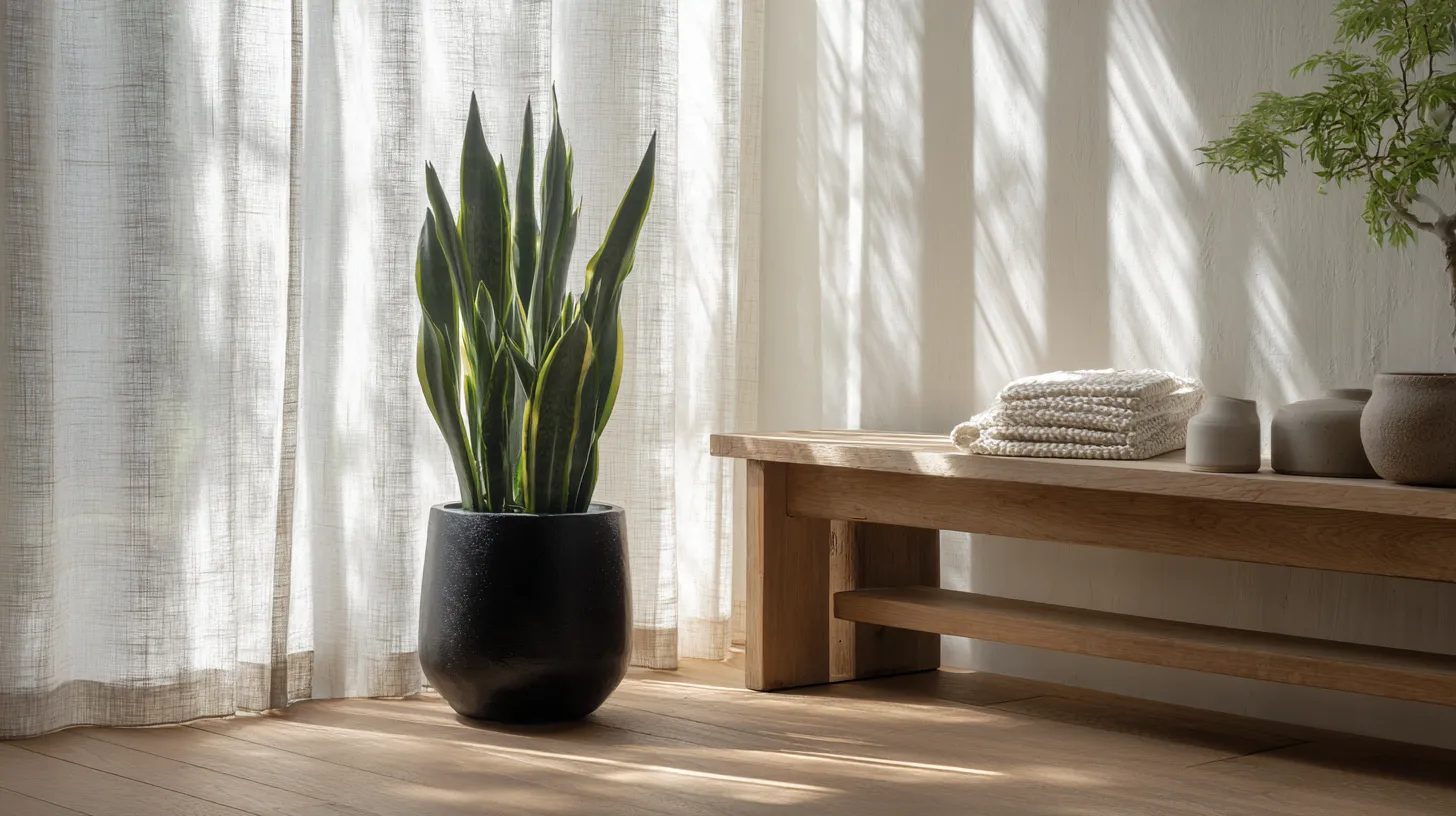
Are snake plants Japandi? Absolutely. The Snake Plant’s bold, upright form is one of the most iconic silhouettes in minimalist interiors — and it’s practically indestructible. Its sword-like leaves in dark green with pale gold edges bring both structure and elegance to any corner.
A NASA clean air study noted that Snake Plants can help filter indoor VOCs including formaldehyde and benzene — making them as functional as they are beautiful.
Care at a glance:
- Light: Low light to bright indirect — extremely adaptable
- Water: Every 3–4 weeks; allow to dry fully between waterings
- Humidity: Tolerates tropical humidity but needs good airflow to prevent root rot
- Pet safety: ⚠️ Mildly toxic to cats and dogs
Air Quality Table:
| Plant | VOCs Filtered | NASA Rating |
|---|---|---|
| Snake Plant | Formaldehyde, benzene, trichloroethylene | High |
| Peace Lily | Formaldehyde, ammonia, benzene | High |
| ZZ Plant | Xylene, toluene | Moderate |
| Pothos | Formaldehyde, carbon monoxide | Moderate |
Peace Lily (Spathiphyllum wallisii)
Where most low light plants offer form, the Peace Lily offers feeling. Its soft white blooms rise from deep green leaves like quiet gestures — serene, generous, a little poetic.
It’s one of the few flowering plants that genuinely thrives in shade, and it communicates its thirst by drooping gently before bouncing back with a drink. In Japandi spaces, it pairs beautifully with natural rattan shelving and linen-toned walls.
Care at a glance:
- Light: Low to moderate indirect light
- Water: When leaves begin to droop slightly — typically weekly
- Humidity: Loves humidity; mist occasionally or use a pebble tray
- Pet safety: ⚠️ Toxic to cats and dogs — position thoughtfully
Parlor Palm (Chamaedorea elegans)
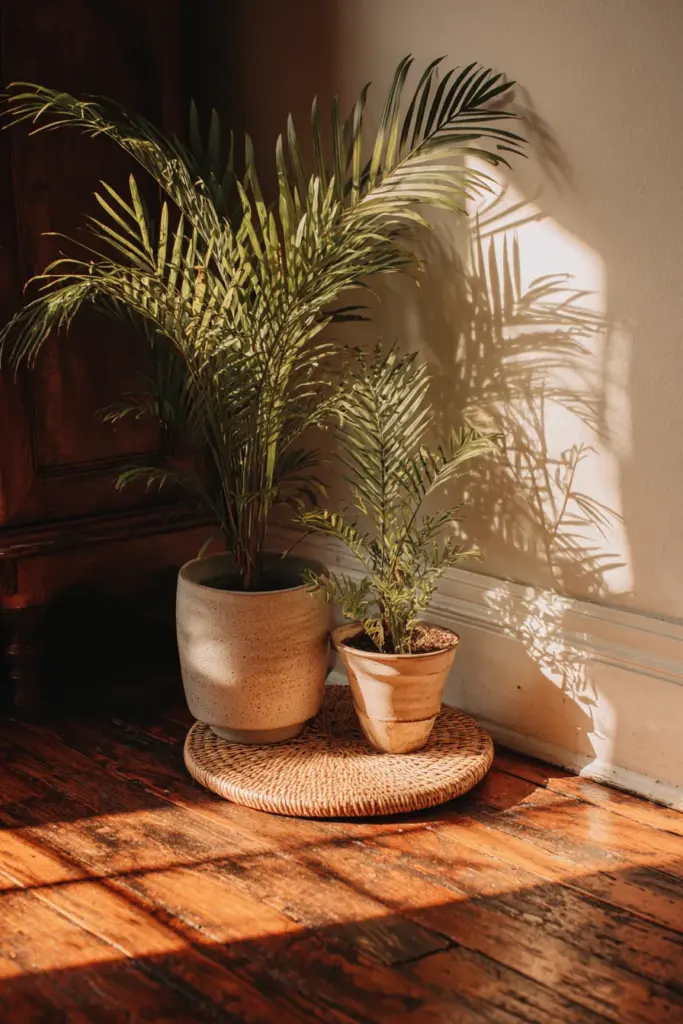
What plants do Japanese homes have? Often, they lean toward plants with delicate, refined structure — and the Parlor Palm fits beautifully. Its feathery fronds bring a softness to hard surfaces, especially concrete, stone tile, and dark-stained wood.
It’s one of the most low-light-tolerant palms you can find, making it ideal for bedrooms or reading nooks without direct sun. In the Philippines, it adapts beautifully to indoor humidity.
Care at a glance:
- Light: Low to medium indirect
- Water: Keep slightly moist; avoid soggy roots
- Humidity: Loves the tropical air — let your home’s natural humidity do the work
- Pet safety: ✅ Non-toxic to cats and dogs
Cast Iron Plant (Aspidistra elatior)
The Cast Iron Plant lives up to its name. Dark, broad, strap-like leaves that almost look lacquered — and a tolerance for neglect that borders on legendary. In traditional Japanese interiors, this plant has been used for centuries as a symbol of resilience and endurance.
Its deep green presence against a paper-white wall or pale wooden floor is something you’ll photograph over and over.
Care at a glance:
- Light: Very low light — one of the most shade-tolerant plants available
- Water: Every 2–3 weeks; highly drought tolerant
- Humidity: Adaptable; handles both dry and humid environments
- Pet safety: ✅ Non-toxic to cats and dogs
Pothos (Epipremnum aureum)
Can pothos grow in low light? Yes — and beautifully. While it grows faster in brighter conditions, Pothos is one of the most adaptable trailing plants for darker corners. In Japandi spaces, it works best when styled with intention: trailing from a hanging woven basket, or draping from a high shelf over raw wood.
Its heart-shaped leaves come in many varieties — golden, marble queen, and neon — but for Japandi aesthetics, stick with the deeper N’Joy or Global Green varieties for a quieter palette.
Care at a glance:
- Light: Low to moderate; will slow growth in deep shade
- Water: Every 1–2 weeks; let top inch of soil dry out
- Humidity: Thrives in high humidity — no extra effort needed in PH homes
- Pet safety: ⚠️ Toxic to cats and dogs
Philodendron (Philodendron hederaceum)
Philodendrons share the trailing grace of Pothos but with deeper, more velvety leaves — almost like soft leather in texture. The Heartleaf Philodendron is particularly stunning in low light, its foliage turning a rich, deep green in shade.
In Japandi interiors, let a Philodendron cascade from a suspended bamboo or ceramic wall planter. The organic drape softens architectural edges perfectly.
Care at a glance:
- Light: Low to moderate indirect
- Water: Every 1–2 weeks
- Humidity: High humidity lover — ideal for tropical apartments
- Pet safety: ⚠️ Toxic to cats and dogs
Plant Comparison at a Glance
| Plant | Light Need | Water Frequency | Pet Safe | Best For |
|---|---|---|---|---|
| ZZ Plant | Low | Every 2–3 weeks | ❌ No | Sculptural corners |
| Snake Plant | Low–Medium | Every 3–4 weeks | ❌ No | Upright accent |
| Peace Lily | Low–Medium | Weekly | ❌ No | Soft blooms, shelves |
| Parlor Palm | Low–Medium | Moderate | ✅ Yes | Bedrooms, nooks |
| Cast Iron Plant | Very Low | Every 2–3 weeks | ✅ Yes | Dark rooms |
| Pothos | Low | Every 1–2 weeks | ❌ No | Trailing, shelves |
| Philodendron | Low–Medium | Every 1–2 weeks | ❌ No | Wall planters |
Styling Japandi Low Light Plants: Room by Room
Living Room: The Statement Corner
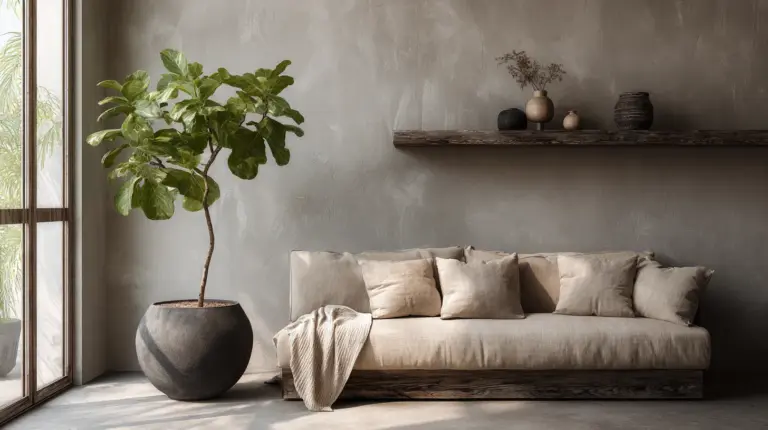
What are the best plants for Japandi style? In a living room, you want one statement plant — not a collection. A tall Snake Plant or a lush ZZ Plant placed in an oversized matte ceramic pot creates an immediate focal point.
Pair with a low teak sideboard, a single framed print, and a woven jute rug. Let the plant be the punctuation at the end of a quiet sentence.
Bedroom: The Breathing Space
Bedrooms in Japandi design are meant for rest, not stimulation. Choose a Peace Lily or Parlor Palm — both gentle in form, air-purifying in function.
Place near (but not in direct) a north-facing window, on a low bamboo stool or a stack of raw linen books. The soft palette of these plants harmonizes with warm bedding and aged wood tones.
Home Office or Study: The Focused Green
A trailing Pothos or Philodendron on a high shelf above your desk brings life without distraction. The trailing form draws the eye upward, making small spaces feel taller.
In a home office styled with cozy Japandi furniture, that single trailing plant becomes the room’s quiet exhale.
Caring for Japandi Plants in Tropical Climates
Humidity: Friend and Enemy
In the Philippines and other tropical climates, high humidity is a blessing for most of these plants. Pothos, Peace Lilies, and Philodendrons will thrive without extra misting.
However, too much humidity around the soil can cause root rot — especially for ZZ Plants and Snake Plants. Always use well-draining soil, terracotta pots (which breathe), and pots with drainage holes.
DIY Pebble Tray for Humidity Control
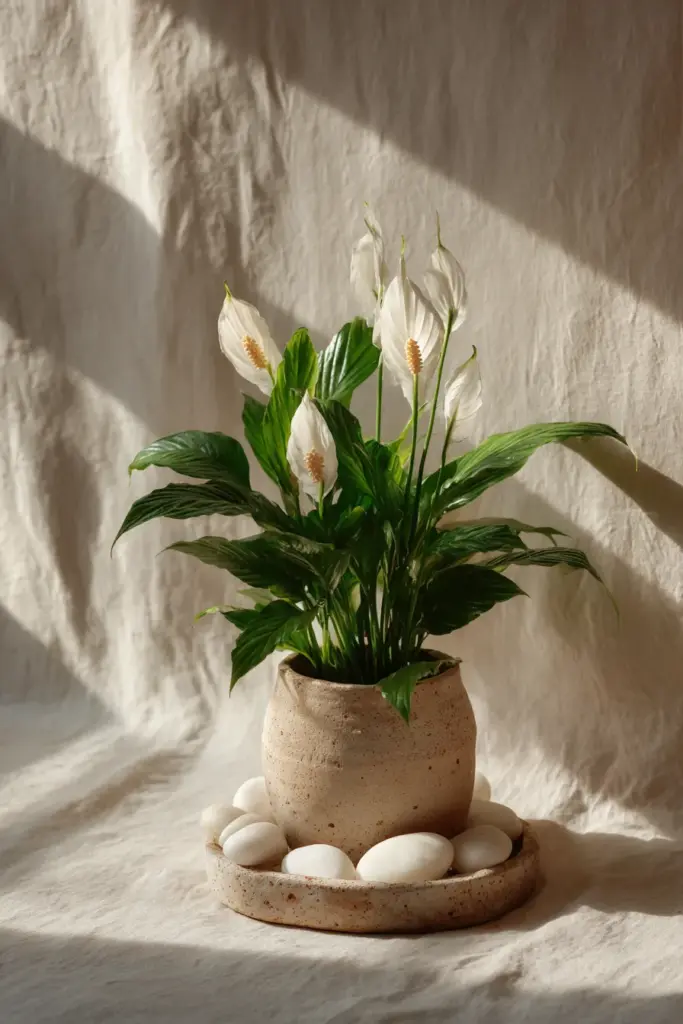
For plants like the Peace Lily that love moisture but hate soggy roots, a pebble tray is a simple, beautiful solution.
How to make one:
- Fill a shallow tray with small pebbles or river stones
- Add water until it sits just below the pebble surface
- Set your pot on top — the evaporation creates a humid microclimate without waterlogging roots
This also doubles as a design element — choose smooth white or black pebbles to stay on-aesthetic.
Ventilation Matters
In humid climates, air circulation is as important as watering. Avoid placing plants in completely sealed corners. A small, quiet fan on low, or simply opening windows for cross-ventilation, prevents fungal issues and keeps foliage healthy.
How to Propagate Japandi Plants at Home
Pothos and Philodendron: Water Propagation
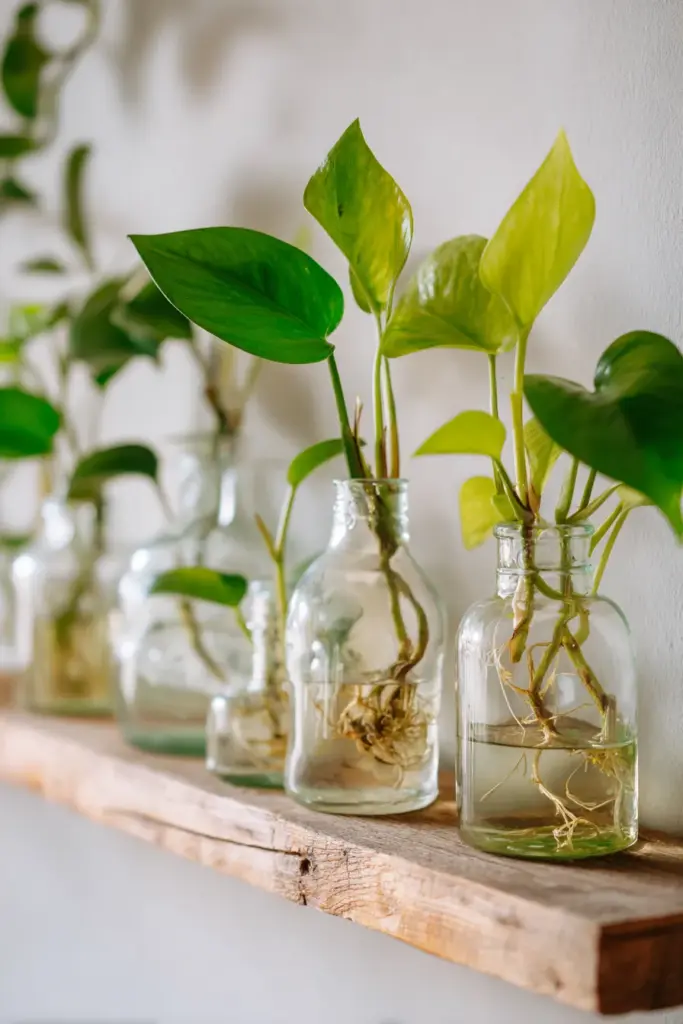
Both Pothos and Philodendron propagate beautifully in water — and the clear glass vessels make for lovely decor in themselves.
Step-by-step:
- Cut a healthy stem just below a leaf node (the small bump where a leaf meets the stem)
- Remove lower leaves so no foliage sits in the water
- Place in a glass jar or propagation vessel filled with clean water
- Set in bright indirect light — a windowsill works well
- Change water every 5–7 days
- Once roots reach 3–5 cm, transfer to a pot with well-draining soil
This is an especially lovely weekend project — and a beautiful way to gift plants to friends without spending a peso.
Budget-Friendly Sourcing in the Philippines
You don’t need to spend thousands to build a Japandi plant corner. Many of these plants are widely available at local markets, garden centers, and online.
Approximate local prices (as of 2025):
| Plant | Shopee/Lazada Estimate | Local Talipapa/Market |
|---|---|---|
| Snake Plant (small) | ₱150–₱300 | ₱80–₱150 |
| ZZ Plant | ₱250–₱500 | ₱200–₱400 |
| Pothos | ₱80–₱200 | ₱50–₱100 |
| Peace Lily | ₱200–₱400 | ₱150–₱300 |
| Parlor Palm | ₱300–₱600 | ₱200–₱450 |
For pots, thrift stores and ukay-ukay finds in muted neutrals — cream, charcoal, terracotta — are treasure troves for Japandi styling on a budget. A simple sand or chalk paint can transform any plastic pot into something that looks handmade and intentional.
Japandi Low Light Plant Care Calendar
| Season / Period | Care Focus |
|---|---|
| Dry Season (Nov–Apr) | Increase watering slightly; watch for dry soil; mist Peace Lily and Philodendron |
| Rainy Season (May–Oct) | Reduce watering; improve drainage; check for root rot; ensure ventilation |
| Monthly (Year-Round) | Wipe leaves with damp cloth; inspect for pests; rotate pots for even growth |
| Every 6 Months | Repot if root-bound; refresh top inch of soil; fertilize lightly with slow-release pellets |
Checklist: Is Your Japandi Plant Corner Ready?
- Choose one statement plant for each space — avoid overcrowding
- Use matte, neutral pots in terracotta, stone, black, or white
- Ensure drainage holes in every container
- Group plants on a low wooden platform or tray for cohesion
- Add a pebble tray under moisture-loving plants in humid climates
- Keep trailing plants elevated — wall shelves, high stools, hanging baskets
- Wipe leaves monthly for light absorption and visual clarity
- Consider pet safety when placing plants in accessible spots
- Propagate cuttings in clear glass vessels for budget-friendly growth
- Let negative space exist — not every shelf needs a plant
A Final Note
There’s a Japanese concept called ichi-go ichi-e — “one moment, one encounter.” It speaks to the irreplaceable nature of a single experience, a single meeting.
Your home can hold that feeling. A low-light corner, a quiet plant, a pot that carries the memory of a thrift-store find or a friend’s cutting passed between hands. These are the details that turn a house into something that breathes.
At ERYLIN, we believe beautiful spaces are built slowly, intentionally, and with love for the imperfect and the living. Start with one plant. Let the room respond.
Frequently Asked Questions
What plants are good for Japandi style?
The best plants for Japandi style combine sculptural form with low-maintenance care. Top choices include the ZZ Plant, Snake Plant, Cast Iron Plant, Parlor Palm, and Peace Lily. Look for plants with clean silhouettes, dark or matte foliage, and a quiet architectural presence that complements neutral, minimalist interiors.
Are snake plants Japandi?
Yes — Snake Plants are one of the most naturally Japandi plants available. Their upright, blade-like leaves mirror the vertical lines common in Japanese-influenced design, while their low-maintenance nature aligns with the Scandinavian principle of simplicity. They’re a go-to choice for dark corners, entryways, and beside low furniture.
What plants do Japanese homes have?
Traditional Japanese homes often feature plants with deep cultural or symbolic meaning: bonsai (miniaturized trees representing harmony and patience), bamboo (strength and flexibility), Cast Iron Plants (endurance), and moss arrangements. In modern Japandi interiors, these translate to low-care, sculptural houseplants that hold quiet presence without demanding attention.
What is the best low light plant?
For Japandi interiors, the Cast Iron Plant is arguably the best low light option — it tolerates near-darkness and requires minimal watering. The ZZ Plant is a close second, with its glossy sculptural form perfect for Japandi aesthetics. For pet-safe households, the Parlor Palm is an excellent low-light choice with elegant feathery fronds.
Can pothos grow in low light?
Yes, Pothos can grow in low light, though it grows more slowly than in brighter conditions. In Japandi spaces, Pothos works beautifully as a trailing element from high shelves or hanging planters. Opt for deeper-toned varieties like N’Joy or Global Green for a more restrained, on-palette look.