
Table of Contents
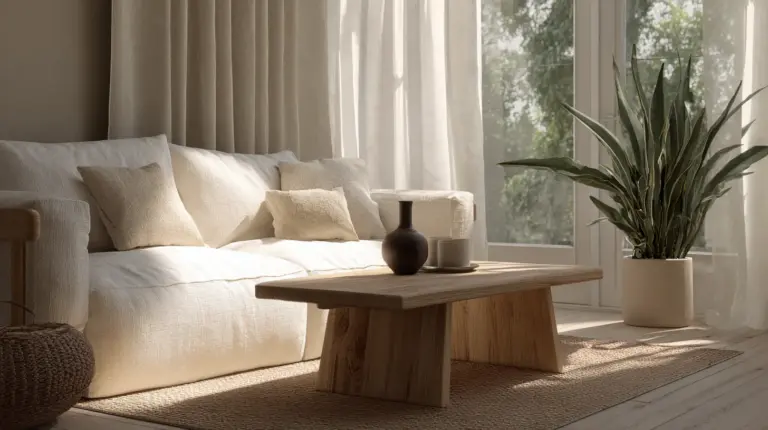
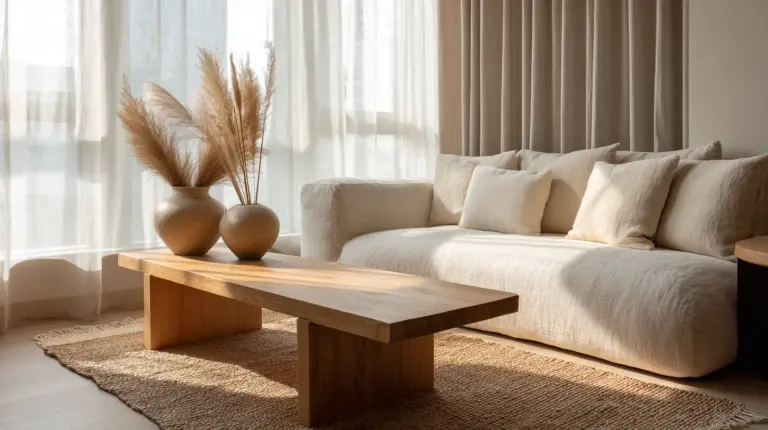
There is a particular kind of quiet that a well-designed living room holds. The light falls softly across pale oak. A linen sofa exhales. A ceramic cup sits on a low table with no apology for its simplicity. This is Japandi — and if you’ve been drawn to it, you already feel what it’s trying to say.
Japandi is the gentle union of Japanese wabi-sabi and Scandinavian hygge. One tradition finds beauty in imperfection and transience; the other wraps comfort around the bones of function. Together, they create living rooms that feel both intentional and deeply liveable — spaces that hold your family without cluttering your mind.
At ERYLIN, we believe your home should feel like an exhale. This guide walks you through every Japandi living room furniture decision — from sofa height to wood species, from layout to lighting — so you can build something that is genuinely yours.
Whether you’re starting from scratch or simply want to bring more calm into a space that already exists, pull up a chair (a low, solid-wood one, ideally) and let’s begin.
What Makes a Living Room Truly Japandi?
Before you shop a single piece, understand the philosophy behind the aesthetic. Japandi is not a checklist — it is a posture toward your belongings.
Less, but better. Every item earns its place. A Japandi living room is not sparse for the sake of minimalism; it is curated for the sake of peace.
Natural materials, always. Solid wood, linen, cotton, jute, rattan, unglazed ceramic — these are the textures of a Japandi home. They age gracefully. They breathe.
Neutral warmth, not sterility. The palette leans into beige, taupe, warm gray, soft white, and the deep richness of walnut or dark oak. It is warm, not cold. Grounded, not clinical.
Core Japandi Living Room Furniture Pieces
The Low-Profile Sofa: Your Room’s Heartbeat
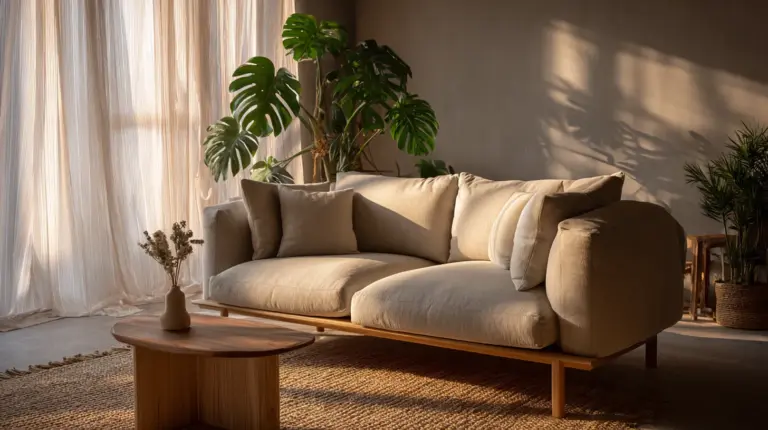
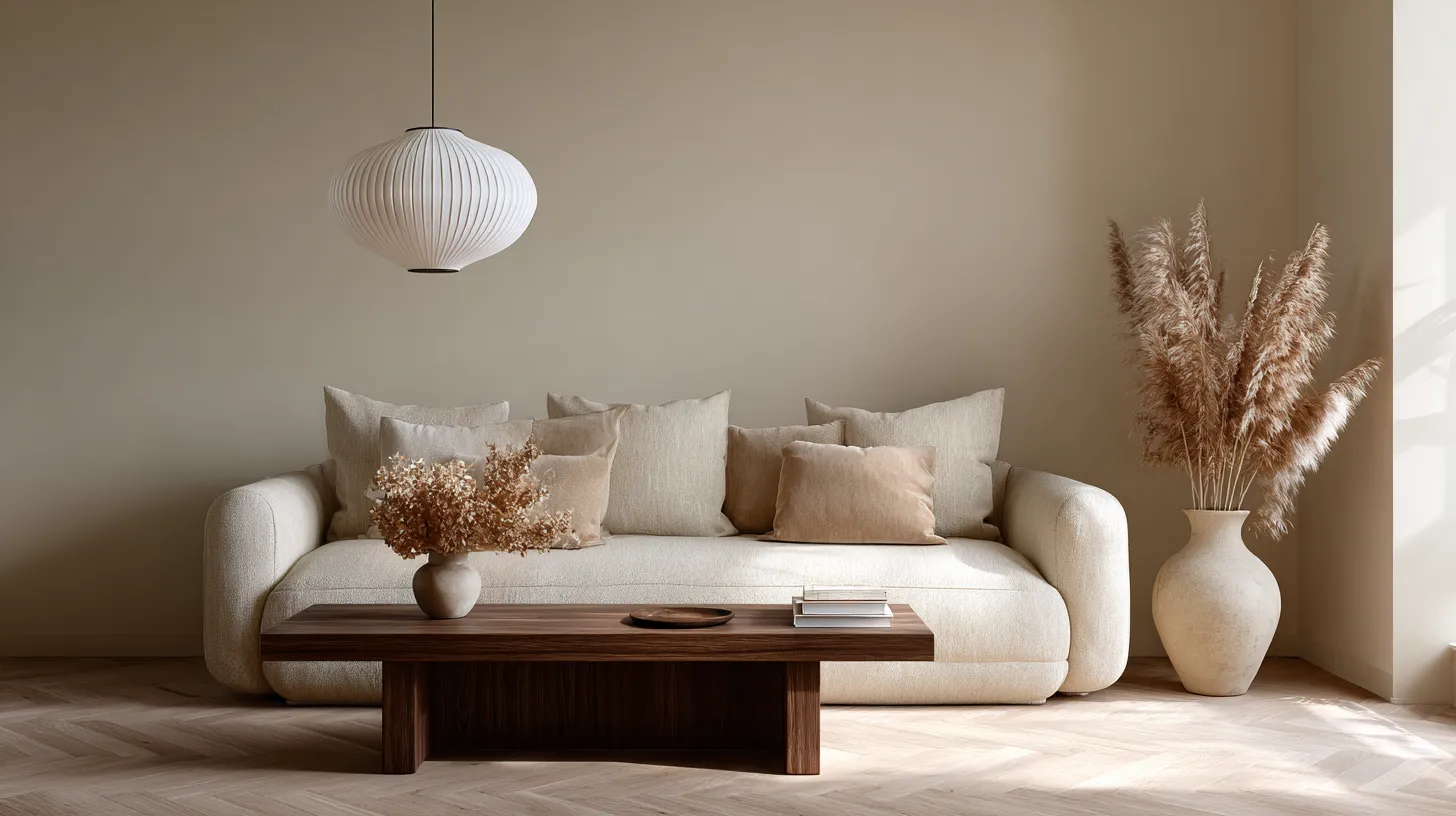
The sofa sets the tone for everything. In a Japandi living room, the right sofa sits lower to the ground — typically 35–45 cm seat height — which draws the eye downward, makes ceilings feel taller, and creates that signature sense of groundedness.
What to look for:
- Seat height: 35–45 cm
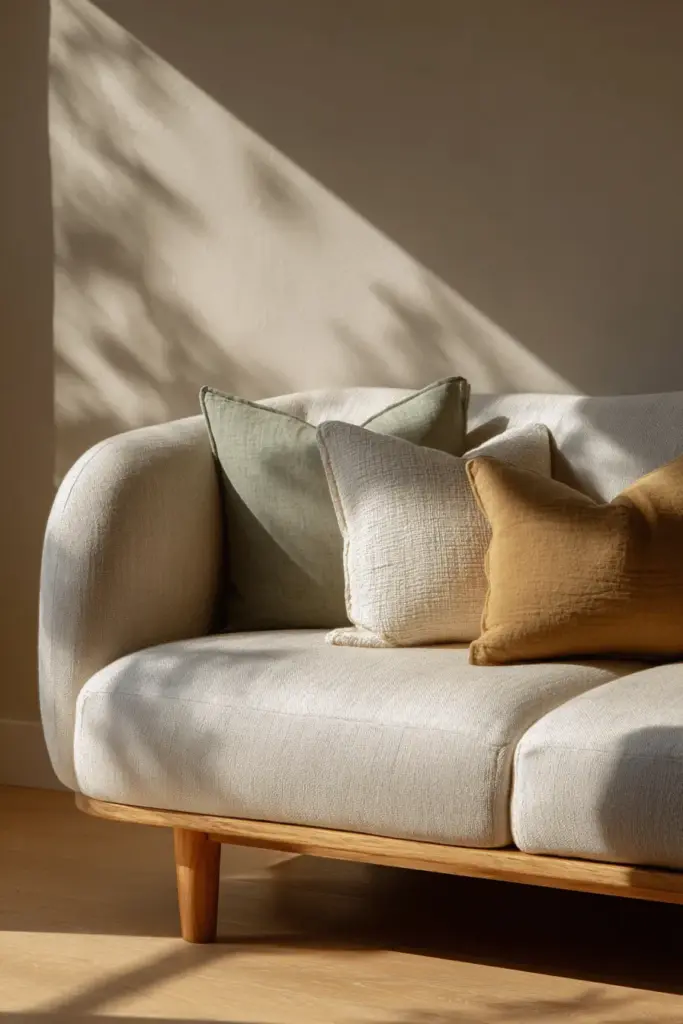
- Leg material: solid wood (oak, walnut, ash) — never chrome or plastic
- Upholstery: natural fabrics — linen, cotton, wool bouclé, or textured weaves
- Color: warm beige, oatmeal, light taupe, or soft charcoal
What to avoid:
- High backrests with ornate curves
- Velvet or synthetic microfiber in bright tones
- Legs that are too thin or too decorative
What Color Sofa Is Best for a Japandi Living Room?
Neutral is the answer — but not the boring kind. Warm neutrals are the soul of Japandi. Opt for a linen beige, a soft warm gray, or an earthy oatmeal. If you want something bolder, a deep charcoal or muted olive can anchor the room beautifully when balanced with pale wood and light walls. Avoid cool-toned grays, which can feel more Scandi-stark than Japandi-warm.
The Wooden Coffee Table: Grounded and Purposeful
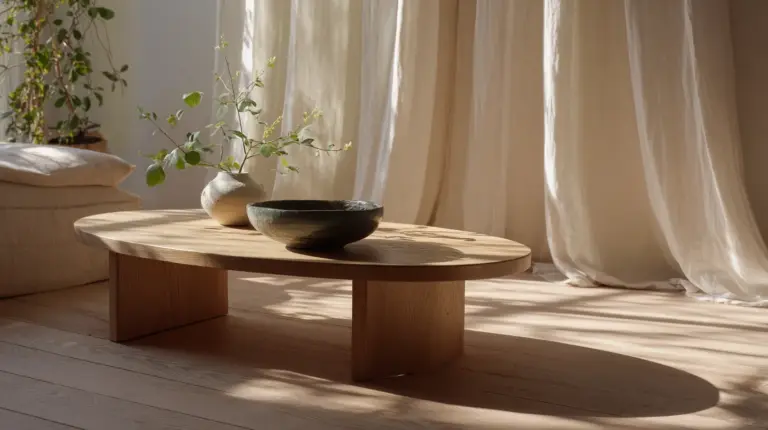
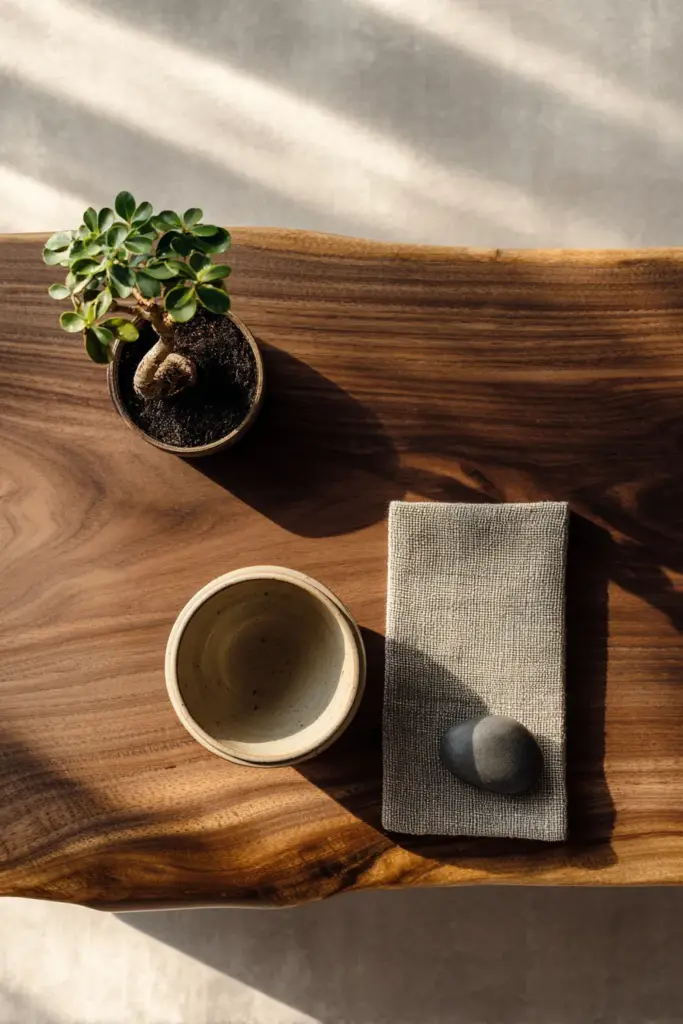
A solid wood coffee table in oak, walnut, or ash is one of the most important investments in a Japandi living room. Its grain tells a story. Its surface holds your morning tea, a ceramic bowl, a single branch of dried pampas.
Ideal proportions for a 15–25 m² living room:
- Height: 35–45 cm (aligned with sofa seat height or slightly lower)
- Length: roughly 2/3 the length of your sofa
- Finish: matte oil or natural wax — never high-gloss lacquer
Consider a coffee table with a lower shelf for hidden clutter storage: books, remote controls, a woven basket. Functionality is never invisible in Japandi — it is quietly elegant.
The Japandi TV Unit and Media Console
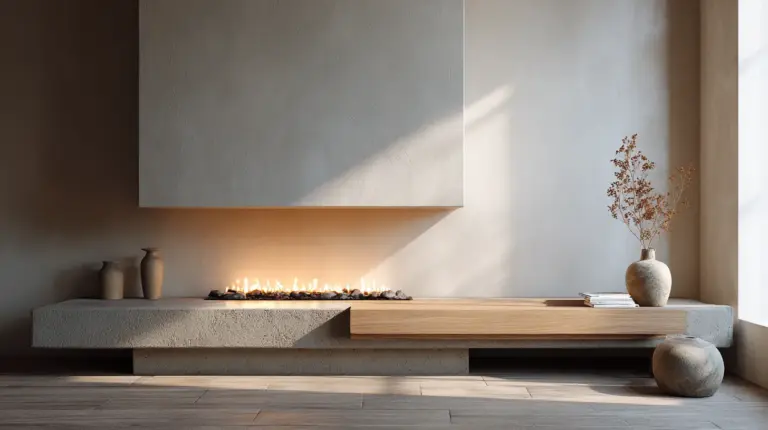
The media console is often the room’s hardest-working piece — and the easiest to get wrong. In a Japandi living room, the TV unit stays low and long, close to the floor, often wall-mounted or resting on short solid-wood legs.
Key specs:
- Height: 35–50 cm from floor
- Material: solid wood or wood veneer with a matte finish
- Storage: closed cabinets with minimal hardware (push-to-open or recessed pulls)
- Cable management: built-in channels or back cutouts to hide all wires
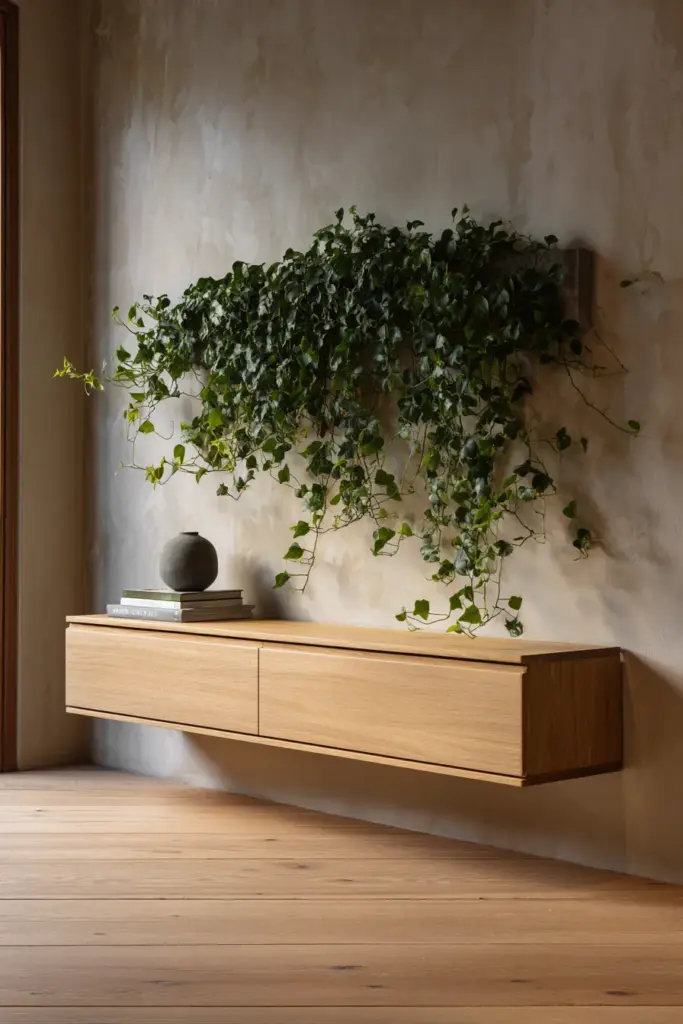
A floating media console in warm walnut or oak, paired with a slim wall-mounted TV, becomes a composition rather than a problem to solve. Style the surface with one ceramic object, a trailing plant, and negative space — nothing more.
Storage Units: The Art of Hiding in Plain Sight
Wabi-sabi teaches us that beauty lives in restraint. Japandi storage is not about hiding everything — it is about choosing what deserves to be seen.
Japandi-approved storage approaches:
- Low sideboards with solid wood doors and minimal hardware
- Modular wall shelving in natural wood with thoughtful negative space
- Woven rattan baskets tucked under coffee tables or in console niches
- Built-in cabinetry painted in warm white or muted greige for a seamless feel
The golden rule: if it doesn’t serve you daily or bring you quiet joy, it doesn’t live in your living room.
Accent Chairs: A Second Voice in the Room
A single accent chair — placed at an angle, in linen or boucle, on solid oak legs — adds rhythm without noise. Think of it as a conversation partner for your sofa, not a matching set.
Japandi-friendly accent chair styles:
- Low-back armchair with natural wood frame
- Simple wishbone or shell chair in neutral fabric
- A floor cushion or zabuton for a more Japanese-leaning moment
Avoid oversized recliners, busy patterns, or chairs that fight the room’s palette. One quiet piece says more than two loud ones.
Rugs: Texture Underfoot
A jute, wool, or cotton rug grounds the seating area and adds the tactile layer that makes a room feel finished. In Japandi interiors, the rug tends to be low-pile, natural-toned, and either plain-woven or with a subtle geometric or organic texture.
Sizing guide:
- For a standard sofa arrangement: at least 160 x 230 cm
- Front legs of the sofa and accent chair should rest on the rug
- Choose undyed natural fibers or a muted, earthy palette
Japandi Living Room Layouts by Room Size
Small Living Room: 12–18 m²
Space is not a limitation in Japandi — it is an invitation to be more intentional.
| Furniture Piece | Recommended Size | Placement |
|---|---|---|
| Low-profile sofa | 180–210 cm wide | Against main wall or angled |
| Coffee table | 90–110 cm long | Centered in front of sofa |
| TV unit | 120–150 cm long | Opposite sofa, wall-mounted |
| Accent chair | 65–70 cm wide | Corner or beside sofa |
| Floor lamp | Standard | Behind sofa, one side |
Key principles: leave at least 45 cm of walkway around furniture, avoid a second sofa, and use vertical shelving to draw the eye up.
Medium Living Room: 20–30 m²
More space means more opportunity for breathing room — not more furniture.
| Furniture Piece | Recommended Size | Placement |
|---|---|---|
| Modular sofa | 220–270 cm wide | Central or L-shaped layout |
| Coffee table | 120–140 cm long | Centered |
| TV unit / media wall | 160–200 cm long | Feature wall |
| Two accent chairs | 65–75 cm each | Flanking or angled |
| Rug | 200 x 300 cm | Anchoring seating zone |
| Storage sideboard | 140–180 cm | Along secondary wall |
Budget-Tier Japandi Furniture Strategy
Where to Splurge
Invest in pieces that take the most physical wear and carry the most visual weight: your sofa frame and your coffee table. A solid oak or walnut coffee table will outlast trends and synthetic alternatives by decades.
Where to Save
Accent tables, cushion covers, ceramic decor, and woven storage baskets can be sourced affordably — especially through local markets, rattan workshops, or regional online platforms. Look for natural materials even at lower price points; a simple unglazed pot from a local market beats a mass-produced “Japandi-style” synthetic one every time.
What to Avoid at Any Price
- Furniture with laminate or paper-thin veneer over MDF that will chip and swell
- Chrome or plastic hardware on wood furniture
- “Japandi-inspired” pieces in polyester upholstery with cool-toned gray tones
Quick buying checklist:
- Is it low-profile? (seat height under 45 cm)
- Is it solid wood or quality veneer with wood-grain authenticity?
- Does it have hidden or minimal storage?
- Is the upholstery a natural fabric or washable performance linen?
- Does it ship or arrive without assembly gaps or wobbly joints?
Tropical Japandi: Adapting the Aesthetic for Humid, Asian Homes
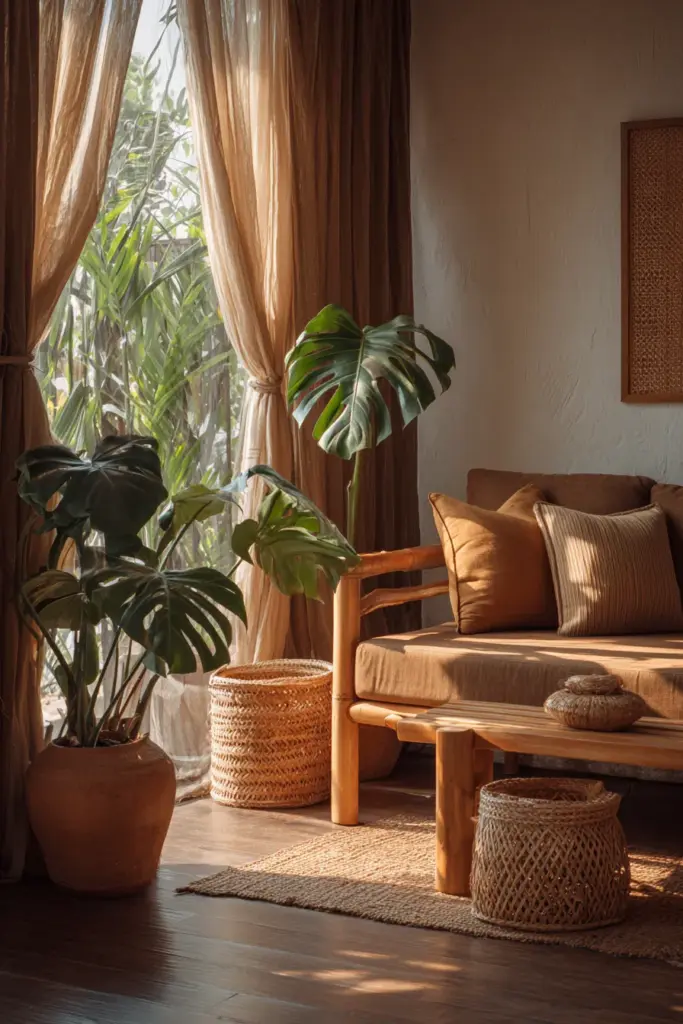
Most Japandi guides are written for temperate Western climates. But here in the Philippines — and across Southeast Asia — our homes breathe differently. Humidity is real. Family is central. Life is layered.
Choosing the Right Wood Finishes for Tropical Climates
In humid environments, raw wood needs protection. Look for oil-finished or wax-finished solid wood rather than bare or heavily lacquered pieces. Teak and acacia perform especially well in tropical conditions. Bamboo is another excellent, locally abundant Japandi-aligned material — it naturally resists moisture and holds up beautifully.
Avoid: untreated softwoods in high-humidity rooms, and furniture with MDF cores that can warp and swell in wet seasons.
Balancing Minimalism with Filipino Family Living
Japandi minimalism doesn’t mean cold or childless. It means intentional. A home with kids, multiple generations, and a TV-centric culture can still be Japandi at heart — it simply means choosing furniture that works harder.
- Opt for modular sofas with washable slipcovers
- Use deep, low sideboards for shoes, bags, and everyday items
- Keep a dedicated storage bench near the entryway
- Choose durable but beautiful materials: solid wood over glass, linen over velvet
Japandi Lighting: Warm, Layered, and Hidden in Plain Sight
The Right Bulb Temperature
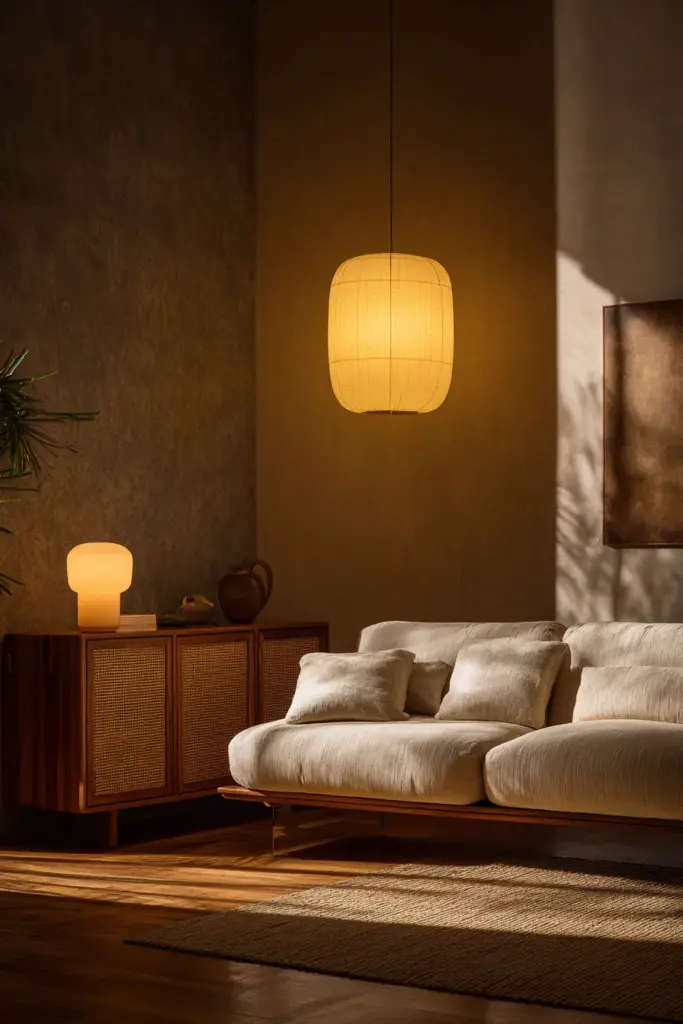
Lighting changes everything. For a Japandi living room, warm white bulbs at 2700–3000K are essential. This color temperature mimics candlelight — it makes skin glow, wood feel richer, and the whole room settle into evening.
Avoid cool-white or daylight bulbs in living spaces; they flatten textures and make neutral palettes feel washed out.
A Layered Lighting Plan
- Ambient: a simple paper pendant or rattan ceiling fixture centered in the room
- Task/accent: a floor lamp tucked behind the sofa on one side — warm, directional, cozy
- Mood: small ceramic table lamps on the sideboard or side table
- Negative space: leave some corners unlit; shadow is part of the composition
Hiding Technology Gracefully
In a Japandi living room, the TV exists — it simply doesn’t dominate. Style your media wall with a floating console in matte wood, route all cables through built-in channels, and tuck the router and streaming devices inside a closed cabinet. A single trailing plant on the console softens the technology without erasing it.
Japandi vs. Scandinavian Living Room: A Quick Comparison
| Element | Japandi | Scandinavian |
|---|---|---|
| Sofa height | Low (35–45 cm seat) | Mid (45–50 cm seat) |
| Color palette | Warm beige, taupe, earthy tones | Cool gray, crisp white, pops of color |
| Wood tones | Warm walnut, oak, bamboo | Light birch, pale ash |
| Decor density | Extremely minimal | Minimal but layered with textiles |
| Storage philosophy | Hidden, intentional | Functional and visible |
| Wabi-sabi influence | Strong | Absent |
| Hygge influence | Moderate | Strong |
Can I Mix Japandi and Scandinavian Living Room Furniture?
Yes — thoughtfully. Scandinavian pieces with clean lines and natural wood legs translate well into a Japandi space. The key is letting the Japandi philosophy lead: keep the palette warm, reduce decor density, and avoid introducing bright accent colors typical of pure Scandi style. A birchwood Scandi side chair pairs beautifully with a warm-beige Japandi sofa — especially if you tie them together with a natural jute rug.
Biophilic Japandi: Plants and Planters That Belong
“Add a plant” is the most repeated — and least useful — advice in design. Let’s be more specific.
Best Plants for a Japandi Living Room
| Plant | Light Requirement | Why It Works |
|---|---|---|
| Peace lily | Low to medium | Sculptural, dark green, air-purifying |
| Snake plant | Low | Vertical, architectural, easy care |
| Monstera | Bright indirect | Bold leaf shape, natural drama |
| Bonsai | Bright indirect | The most Japandi plant that exists |
| Pothos | Low to medium | Trailing softness for shelves and consoles |
Japandi-Friendly Planters
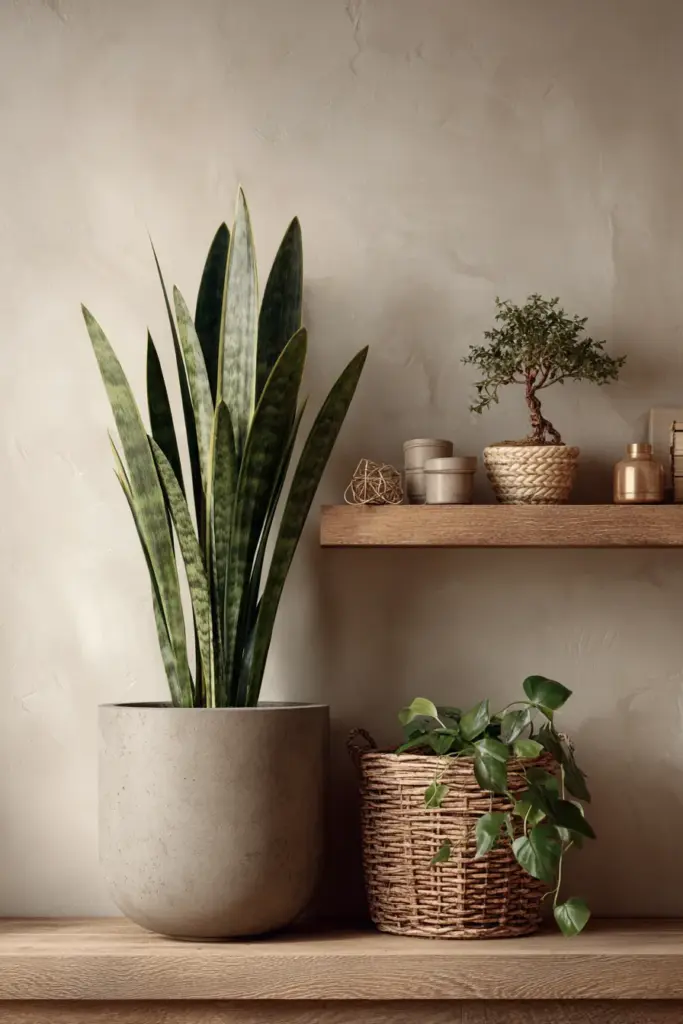
Choose unglazed ceramic, concrete, rattan, or raw wood planters. Avoid bright glazed ceramic, plastic, or anything with a pattern that competes with the room. A single large statement plant in an unglazed pot is always more powerful than five small ones scattered without intention.
Your Japandi Living Room: Before You Buy
Buyer Scenarios
| Scenario | Recommended First Step |
|---|---|
| Renting on a budget | Start with a linen sofa cover and a solid wood coffee table — change the room’s tone without commitment |
| Small apartment family | Invest in a modular sofa with storage + a low media console with closed cabinets |
| Starting from scratch | Begin with the sofa, rug, and coffee table — build the rest around this anchor |
| Already own a sofa | Reupholster or add a neutral slipcover; then add Japandi wood and ceramic accents |
| Love color but want Japandi | Keep walls and sofa neutral; introduce muted terracotta, ochre, or sage green through cushions and pottery |
Japandi Living Room Furniture: Key Takeaways
- Low-profile sofa in natural linen or boucle, solid wood legs, warm neutral color
- Solid wood coffee table in oak or walnut, matte finish, 2/3 the sofa’s length
- Low floating TV unit with closed storage, minimal hardware, built-in cable management
- Hidden storage through sideboards, woven baskets, and built-in cabinetry
- Layered warm lighting at 2700–3000K using paper pendants, floor lamps, and ceramic table lamps
- Natural rugs in jute, wool, or cotton — low-pile and generously sized
- One or two plants in unglazed ceramic or rattan — placed with intention, not habit
- Tropical adaptations: oil-finished solid wood, moisture-resistant finishes, washable upholstery
- Budget strategy: splurge on sofa and coffee table, save on accents and accessories
Conclusion
A Japandi living room is not built in a day — and it is not built by buying everything at once. It grows the way a well-tended home does: slowly, thoughtfully, one beautiful and useful thing at a time.
Start with what grounds you most. A sofa that holds you. A table that holds your morning. A lamp that makes the room feel like evening even in the middle of the day. The rest will follow — naturally, quietly, the way all good things do.
At ERYLIN, we are here for every step of that journey. May your home always feel like something you chose on purpose.
Frequently Asked Questions
What furniture is best for a Japandi living room?
A low-profile linen sofa, a solid wood coffee table in oak or walnut, a floating media console with closed storage, a natural-fiber rug, and one or two accent chairs with wood legs. Every piece should be low, natural, and functional.
What wood is used in Japandi furniture?
Solid oak, walnut, ash, and bamboo are the most common — and the most authentic. These woods are warm-toned, durable, and age beautifully. Always choose solid wood or quality veneer over MDF with paper-thin laminate.
Can I add color to a Japandi living room?
Yes, gently. Introduce muted, earthy tones — sage green, terracotta, ochre, or dusty rose — through cushions, ceramic vessels, and woven textiles. Keep walls, sofa, and large furniture pieces in neutral tones and let color whisper rather than shout.
Is dark wood okay in Japandi design?
Absolutely. Deep walnut, blackened oak, and dark-stained ash are all Japandi-appropriate — especially when balanced with light walls, natural linen, and plenty of open space. The key is contrast: dark wood with light surroundings creates depth without heaviness.
How do I decorate a small living room in Japandi style?
Choose a single low-profile sofa, a slim coffee table, and a wall-mounted or floating TV unit. Use vertical shelving to draw the eye upward, keep decor minimal, and let natural light do the heavy lifting. One large plant and a layered rug complete the picture without crowding the space.