

Table of Contents
There’s something profound about sitting in a room where every piece feels both ancient and new. Where a low-slung sofa invites you to sink into silence, and a handcrafted coffee table carries the weight of centuries in its joinery. This is the legacy of Japandi living room furniture—a design philosophy born from two islands separated by thousands of miles, yet united by a shared reverence for simplicity, craft, and the honest beauty of natural materials.
The story of Japandi furniture isn’t just about sofas and side tables. It’s about the quiet exchange of ideas across oceans, the patient hands of artisans, and the way light falls across a wooden surface worn smooth by time. It’s a history written in wabi-sabi imperfections and hygge warmth, in tatami mats and Danish joinery, in the slow evolution from isolationist Japan to the global embrace of minimalist comfort.
Today, when we arrange a Japandi living room, we’re not just decorating—we’re honoring a 150-year conversation between East and West. We’re bringing home the whisper of shoji screens and the glow of Scandinavian candles. We’re choosing furniture that speaks softly but says everything.
Let’s trace this beautiful lineage together.
The Roots: Pre-1850s Japanese Furniture Traditions
Before Japandi existed, there was simply Japanese living. And Japanese living meant sitting close to the earth.
Traditional Japanese homes centered around low-profile furniture born from centuries of tatami mat culture. The chabudai—a small, folding table that sat mere inches from the floor—defined the living space. Families gathered around it for meals, tea ceremonies, and quiet conversation. There were no towering armoires or overstuffed sofas. Just clean lines, natural wood, and a profound respect for negative space.
This wasn’t minimalism for aesthetics alone. It was practical spirituality. Every piece served a purpose. Every material came from the earth—hinoki cypress, bamboo, woven rush. The concept of wabi-sabi infused everything: finding beauty in imperfection, in the knot of wood grain, in the gentle patina of age.
Meanwhile, across the world, Scandinavian homes told a different story—one of warmth against harsh winters, of hygge coziness. But the bridge between these worlds had yet to be built.

The Opening: 1850s Cultural Exchange and First Encounters
Everything changed when Japan opened its borders in the mid-1850s, ending over two centuries of isolation.
Suddenly, Scandinavian artists and travelers could visit Japan. Danish designers, Swedish craftspeople, and Norwegian architects encountered a design language that felt both foreign and strangely familiar. They saw the Japanese reverence for natural materials—their own pine and oak mirrored in Japanese cypress and maple. They recognized the emphasis on craftsmanship, on joinery so precise it required no nails.
But there was something more. Japanese furniture possessed a restraint, a quietness that Scandinavian design admired but hadn’t fully articulated yet. The low silhouettes, the unadorned surfaces, the way a single flower arrangement could define an entire room—these ideas began their slow migration westward.
This wasn’t appropriation. It was recognition. Two cultures looking at each other and seeing shared values reflected back.
The Aesthetic Migration
Scandinavian travelers returned home with sketches and stories. They brought back ideas about floor-level living, about furniture that didn’t dominate space but rather honored it. The influence was subtle at first—a lowered chair here, a simpler table design there.
The exchange flowed both ways. Japanese craftspeople began adopting certain Scandinavian techniques, particularly in upholstery and the treatment of leather. But the foundation remained distinctly Japanese: low, lean, and intentional.
The Evolution: Early 20th Century Cross-Pollination
By the 1930s and 1940s, the conversation between Japanese and Scandinavian design had matured into something beautiful.
Danish furniture makers like Hans Wegner began incorporating Japanese joinery techniques into their iconic pieces. His chairs—with their organic curves and exposed wood joints—embodied this fusion. They sat higher than traditional Japanese furniture but retained that essential simplicity, that celebration of the material itself.
The low-profile coffee table emerged during this era as a direct descendant of the chabudai. Western living rooms wanted a surface for coffee cups and books, but influenced by Japanese aesthetics, designers kept them deliberately low. These tables became anchors for the modern living room—functional yet unobtrusive.
Scandinavian designers also adopted the Japanese concept of ma—negative space as an active design element. Living room furniture began to breathe. Sofas no longer dominated; they conversed with the space around them.
Materials and Craftsmanship
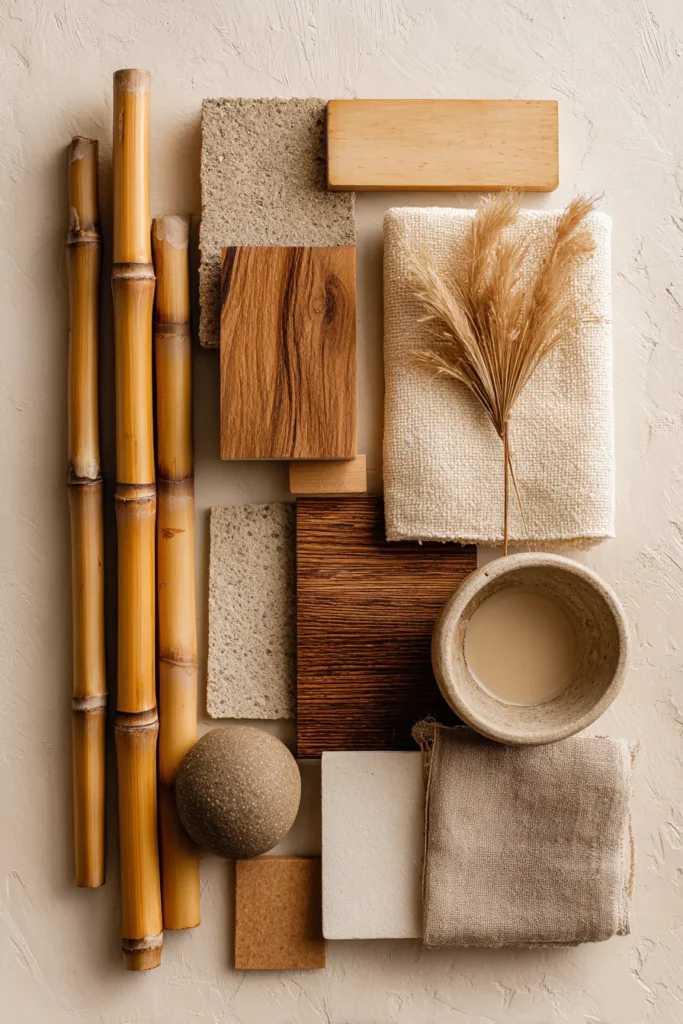
Both traditions shared an obsession with natural materials and honest construction. Teak, oak, and walnut became the woods of choice—warm, durable, aging gracefully. Upholstery remained simple: linen, cotton, leather in muted tones.
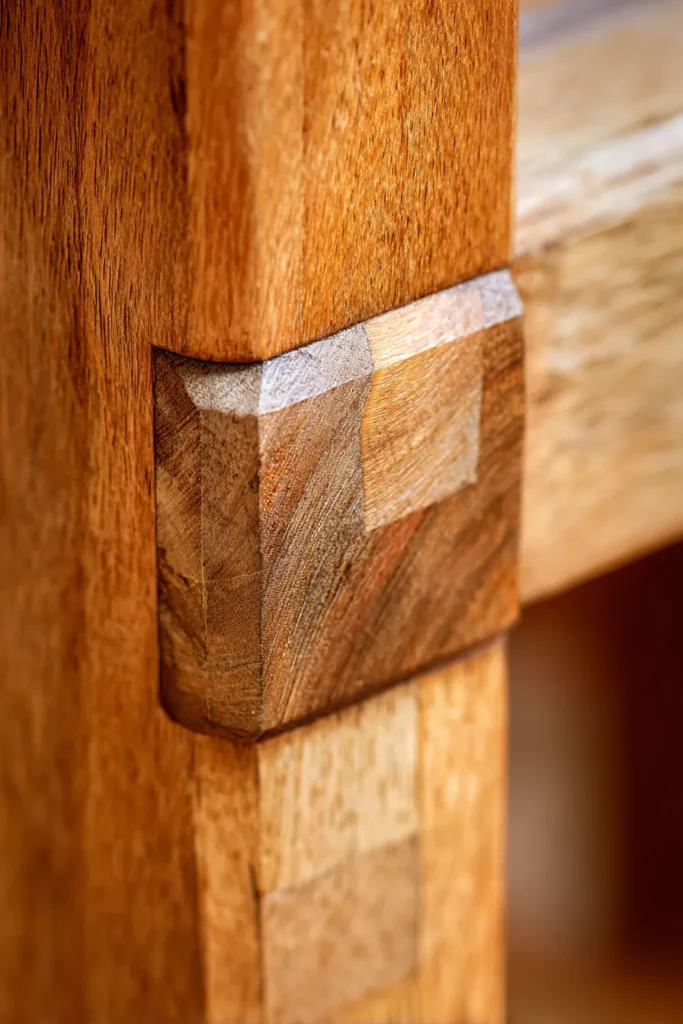
The joinery itself became art. Mortise-and-tenon joints, dovetails, finger joints—these techniques, perfected over centuries in both Japan and Scandinavia, meant furniture could last generations. No particle board, no shortcuts. Just wood meeting wood with precision.
The Modern Coining: 2010s and the Birth of “Japandi”
For decades, this fusion existed without a name. Designers knew it, collectors recognized it, but it lived in the quiet space between categories.
Then came the 2010s. Instagram. Pinterest. The global hunger for spaces that felt calm amid digital chaos. Suddenly, the design world needed a word for this aesthetic that blended Japanese minimalism with Scandinavian comfort.
Japandi was coined—a portmanteau that perfectly captured the fusion. And with that naming came an explosion of interest. People weren’t just looking for furniture anymore; they were seeking a lifestyle. They wanted living rooms that felt like sanctuaries.
The Japandi Living Room Takes Shape
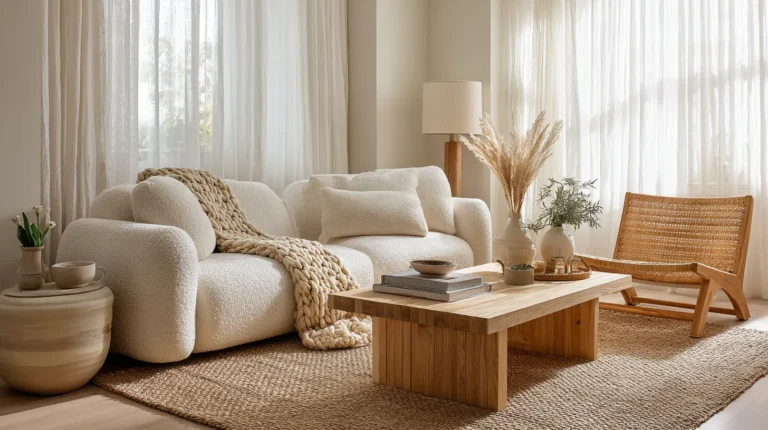
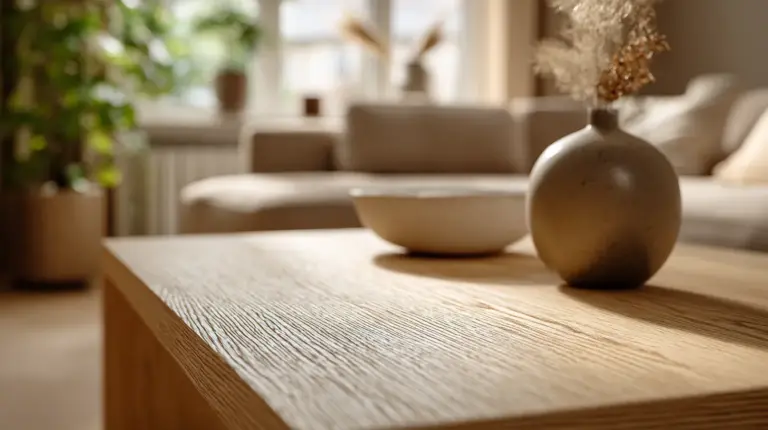
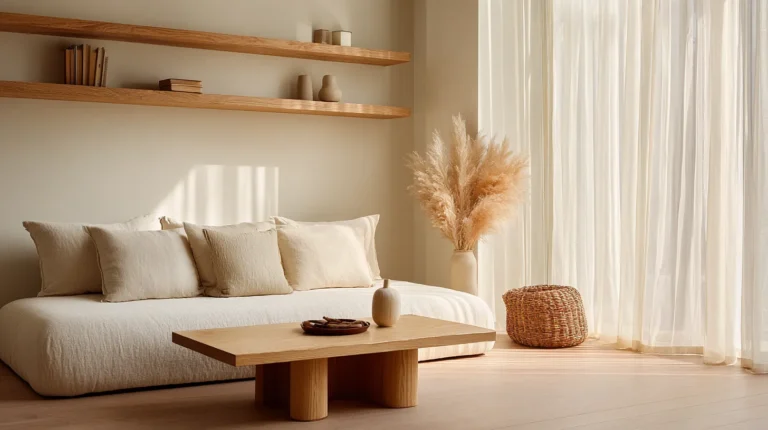
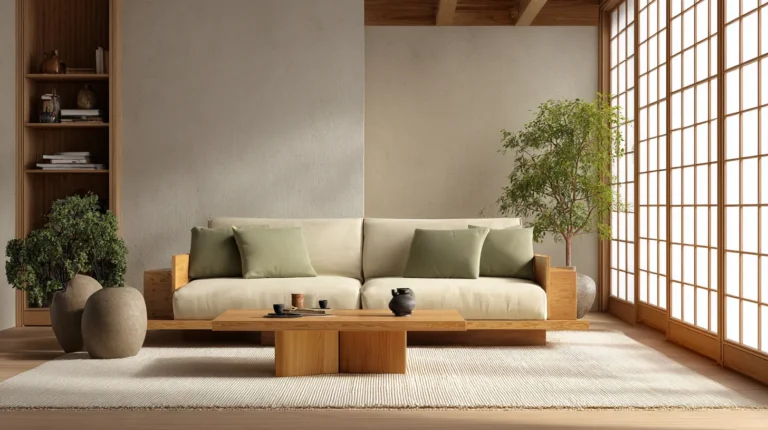
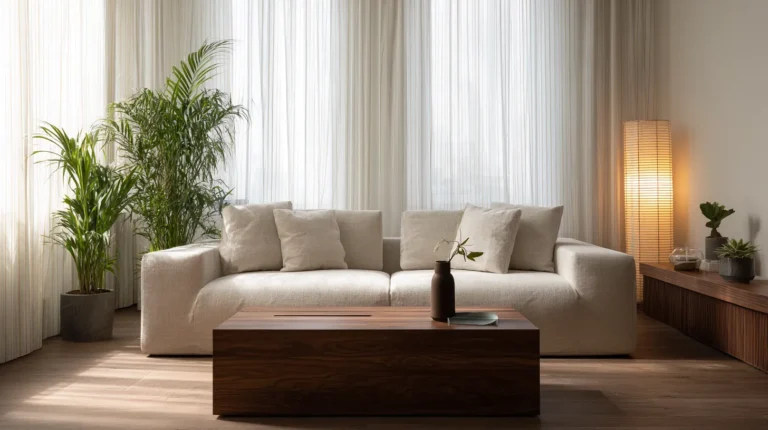
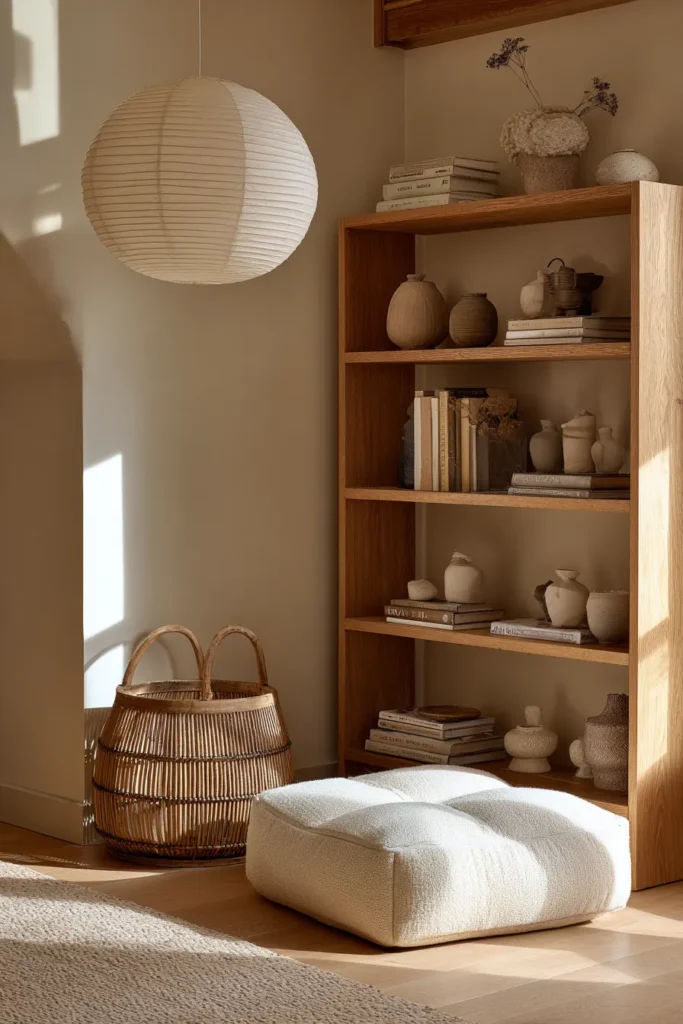
The modern Japandi living room crystallized around specific furniture pieces. A low-slung sofa in bouclé or linen, legs in light oak. A coffee table with clean lines and visible wood grain. Floor cushions that nodded to tatami culture. Open shelving in place of heavy cabinets.
Every piece honored the dual philosophy: Japanese restraint met Scandinavian warmth. Colors stayed neutral—warm whites, soft grays, natural wood tones with occasional charcoal accents. Textures provided interest: rough linen against smooth wood, woven baskets, ceramic vessels.
Lighting became crucial. Instead of harsh overheads, Japandi living rooms embraced ambient glow—paper lanterns descended from Japanese tradition, paired with Nordic candles and sleek floor lamps.
The Contemporary Era: 2020s Innovations and Sustainability
Today’s Japandi furniture carries the weight of history while pushing toward the future.
Sustainability has become paramount. Makers source FSC-certified woods, use non-toxic finishes, design modular pieces that adapt as lives change. The Japandi philosophy of longevity—furniture meant to last decades, not years—aligns perfectly with environmental consciousness.
Innovative furniture makers now combine traditional techniques with modern needs. Sofas with hidden storage honor small-space living. Coffee tables with lift-tops accommodate work-from-home life. Sustainable teak and bamboo—materials used in both traditions for centuries—dominate new collections.

Smart Integration Without Sacrifice
The latest evolution involves technology. How do you integrate modern life into a 150-year-old aesthetic philosophy? The answer: thoughtfully. Built-in charging stations hide in side tables. Cable management gets designed into furniture DNA. Smart lighting dims to mimic candlelight.
But these innovations never compromise the core principles. The furniture still sits low, breathes easy, ages beautifully. It still invites you to slow down, to notice the grain of wood, to sink into comfort without excess.
Key Furniture Pieces: The Japandi Living Room Timeline
| Era | Iconic Piece | Key Features | Cultural Origin |
|---|---|---|---|
| Pre-1850s | Chabudai Table | Low profile, folding legs, natural wood | Japanese tatami culture |
| 1900s-1930s | Scandinavian-Influenced Low Chairs | Clean lines, visible joinery, comfortable height | Nordic-Japanese exchange |
| 1940s-1960s | Hans Wegner-Style Lounge Chairs | Organic curves, exposed joints, quality upholstery | Danish craftsmanship + Japanese technique |
| 1970s-1990s | Minimalist Low-Profile Sofas | Neutral fabrics, wooden frames, understated elegance | Fusion aesthetic solidifies |
| 2010s-Present | Modular Japandi Living Sets | Sustainable materials, adaptable design, tech integration | Modern Japandi movement |

Forgotten Furniture Stories Worth Remembering
The evolution of Japandi living room furniture includes pieces that deserve more recognition.
The zaisu chair—a backrest without legs—inspired countless modern floor seating designs. These chairs acknowledged that sometimes the best seat is close to the ground, where you can feel the warmth of heated floors or the coolness of natural stone.
The tansu chest, with its careful compartmentalization and hand-forged hardware, evolved into modern media consoles and storage solutions. Its logic—a place for everything, beauty in function—remains core to Japandi design.
Early 20th-century Danish artisans created hybrid pieces specifically for the Japanese market, then brought those innovations home. These “bridge pieces” helped establish the vocabulary both cultures would eventually share.
The Upcycling Tradition
Both Japanese and Scandinavian cultures have long traditions of furniture repair and renewal. In Japan, mottainai—a sense of regret concerning waste—meant furniture got repaired, refinished, passed down. In Scandinavia, quality meant longevity. These values converge beautifully in contemporary Japandi design.
Today’s vintage Japandi furniture—whether a 1960s Danish credenza or a century-old Japanese tansu—can be restored, upcycled, integrated into modern living rooms. The wabi-sabi aging process isn’t something to hide but to celebrate.
Designing Your Japandi Living Room: A Checklist
Creating an authentic Japandi living room means honoring this rich history while making it yours:
- Choose low-profile furniture that encourages relaxation and connection to space
- Prioritize natural materials like oak, teak, bamboo, linen, and cotton
- Embrace visible joinery and honest construction—let craftsmanship show
- Select neutral color palettes with warm wood tones as the foundation
- Layer textures through fabrics, ceramics, and natural fibers
- Incorporate negative space as an active design element—don’t overfill
- Mix vintage and new to create depth and honor the style’s evolution
- Add intentional lighting that mimics natural daylight and candleglow
- Include handcrafted pieces that show the maker’s hand
- Consider sustainability in every purchase—furniture should last generations
- Keep floor seating options like cushions or low stools for versatility
- Use modular pieces that adapt to changing needs and small spaces
The Japandi Philosophy: Beyond Furniture
Understanding Japandi living room furniture history means grasping the philosophies beneath the surface.
Wabi-sabi teaches us that the scratch on a coffee table, the fading of linen, the patina on wood—these aren’t flaws but stories. Your furniture should age with you, becoming more beautiful through use.
Hygge reminds us that comfort matters. A living room isn’t a museum. That perfectly crafted sofa should invite curling up with tea and a book. The aesthetic serves life, not the other way around.
Ma—the Japanese concept of meaningful space—insists that what you don’t place in your living room matters as much as what you do. The breathing room between furniture pieces, the empty wall, the single artwork—these choices create calm.
Together, these philosophies create living spaces that feel both timeless and immediate, both minimal and deeply warm.
Looking Forward: The Future of Japandi Living Room Furniture
Where does this 150-year evolution lead next?
The 2025 trends suggest Japandi furniture will continue emphasizing sustainability, with innovations in recycled materials and carbon-neutral production. We’re seeing experiments with smart integration that remains invisible—technology serving the aesthetic rather than dominating it.
Small-space adaptations are driving innovation. Floating furniture, wall-mounted pieces, and transformable designs allow apartment dwellers to embrace Japandi principles without requiring sprawling square footage. The style’s emphasis on essentialism makes it perfect for compact living.
Customization is growing. Makers offer modular systems where customers choose dimensions, fabrics, and finishes while maintaining design integrity. This honors the Japanese concept of iki—sophisticated simplicity tailored to individual needs.
But the core will remain unchanged. Natural materials. Honest craft. Low profiles. The marriage of Japanese restraint and Scandinavian warmth. Because some truths about how humans want to live in space are timeless.
Closing Thoughts: The Living Legacy
When you sit in a Japandi living room today, you’re experiencing 150 years of cultural exchange condensed into form and function.
That coffee table carries the memory of Japanese artisans in the 1850s and Danish designers in the 1940s. That sofa embodies the meeting of hygge and wabi-sabi, the conversation between comfort and restraint. Every piece is a small monument to the idea that different cultures, looking at each other with respect and curiosity, can create something more beautiful than either could alone.
This is furniture with history in its joints, philosophy in its lines, and future in its sustainability. It’s furniture that asks you to slow down, to notice, to live more intentionally.
And perhaps that’s the real legacy of Japandi living room furniture—not just the pieces themselves, but the way of being they encourage. A little quieter. A little more present. A little more aware of the beauty in simplicity, the grace in restraint, the profound comfort of honest materials honestly made.
Your living room awaits. Not to be filled, but to be honored with only what matters most.
Frequently Asked Questions
What are the origins of Japandi style?
Japandi originated from the cultural exchanges between Japan and Scandinavia beginning in the mid-1850s when Japan ended its isolationist policies. Scandinavian artists and designers traveled to Japan, discovering shared values in craftsmanship, natural materials, and design restraint. This 150-year conversation between hygge warmth and wabi-sabi simplicity eventually crystallized into the modern Japandi aesthetic we know today.
When did Japandi furniture style start becoming popular?
While the Japanese-Scandinavian design exchange began in the late 19th century, the term u0022Japandiu0022 wasn’t coined until the 2010s. The style gained mainstream popularity through social media and interior design platforms, as people sought calm, sustainable living spaces. Today it represents one of the most enduring design trends, rooted in over a century of cross-cultural influence.
How has Japandi living room furniture evolved over time?
Japandi furniture evolved from traditional Japanese low-profile pieces like the chabudai table and Scandinavian craftsmanship traditions. Early 20th-century designers like Hans Wegner incorporated Japanese joinery into Western furniture forms. By the 2010s, the style matured into complete living room systems featuring low sofas, minimalist coffee tables, and sustainable materials—all honoring both cultural traditions.
What makes furniture authentically Japandi?
Authentic Japandi furniture combines Japanese minimalism with Scandinavian warmth through natural materials (oak, teak, bamboo), honest joinery, low profiles, and neutral color palettes. It emphasizes craftsmanship over mass production, sustainability over trends, and negative space as an active design element. The furniture should age beautifully, showing the wabi-sabi principle that imperfection and patina add character.
Can vintage furniture be incorporated into Japandi design?
Absolutely. Vintage pieces from both Japanese and Scandinavian traditions fit perfectly in Japandi living rooms. Mid-century Danish furniture, antique Japanese tansu chests, and restored wooden pieces honor the style’s emphasis on longevity and quality. Upcycling vintage furniture aligns with both the Japanese concept of mottainai (avoiding waste) and Scandinavian values of durability—making vintage integration not just acceptable but ideal.