
Table of Contents
There is something quietly powerful about walking into a room and feeling your shoulders drop. No alarm, no announcement — just a slow, wordless exhale. Japandi design has always understood this. It is not simply an aesthetic. It is an atmosphere built from restraint, warmth, and a deep respect for the living world.
Plants are at the heart of that living world. But not just any plant, placed anywhere, for decoration alone. The emerging field of Japandi plant psychology invites us to go further — to understand how specific plant forms, textures, colors, and placements interact with our nervous systems, attention, and emotional state.
This is not about having a perfect home. It is about building a space that works with your mind, not against it. A home that reminds you, gently and daily, to breathe.
At ERYLIN, we believe beauty should do something for you. So let us walk through what the plants in your home are actually saying to your brain — and how to listen.
What Japandi Plant Psychology Actually Means
It Is More Than “Plants Are Good for You”
Most of us already know that greenery lifts our mood. But Japandi plant psychology is more precise than that. It is the study of how a plant’s form, color, texture, and position in your home interact with your specific mental state, daily patterns, and emotional needs.
Environmental psychology research — including attention restoration theory developed by Rachel and Stephen Kaplan — shows that natural environments replenish directed attention, the kind we exhaust on screens, decisions, and noise. Soft, complex natural forms give our cognitive system a place to rest without disengaging entirely.
A 2019 meta-analysis in the journal Environment and Behavior found that indoor plants measurably reduce cortisol levels and self-reported stress. But the type of plant, its placement relative to eye level, and the visual complexity it adds to a space all influence how much that stress reduction occurs.
Japandi plant psychology brings that science into your living room. It gives you a design language that translates leaf shape into emotional outcome, pot placement into mental state, and watering rituals into mindfulness anchors.
How Plant Shapes and Textures Speak to Your Nervous System
Vertical and Architectural Plants: Structure and Calm Focus
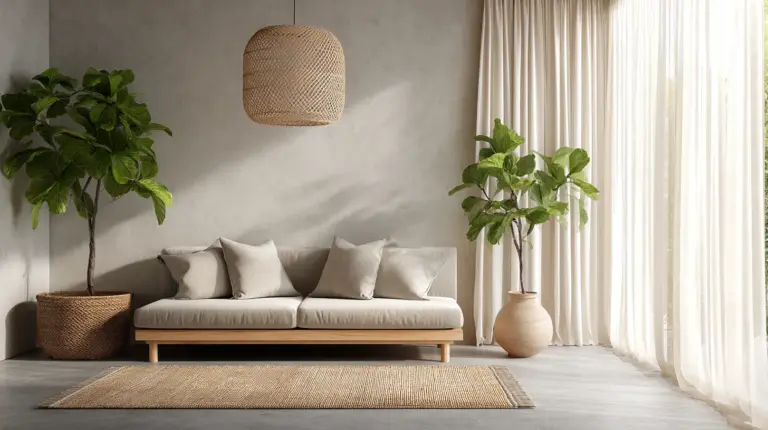
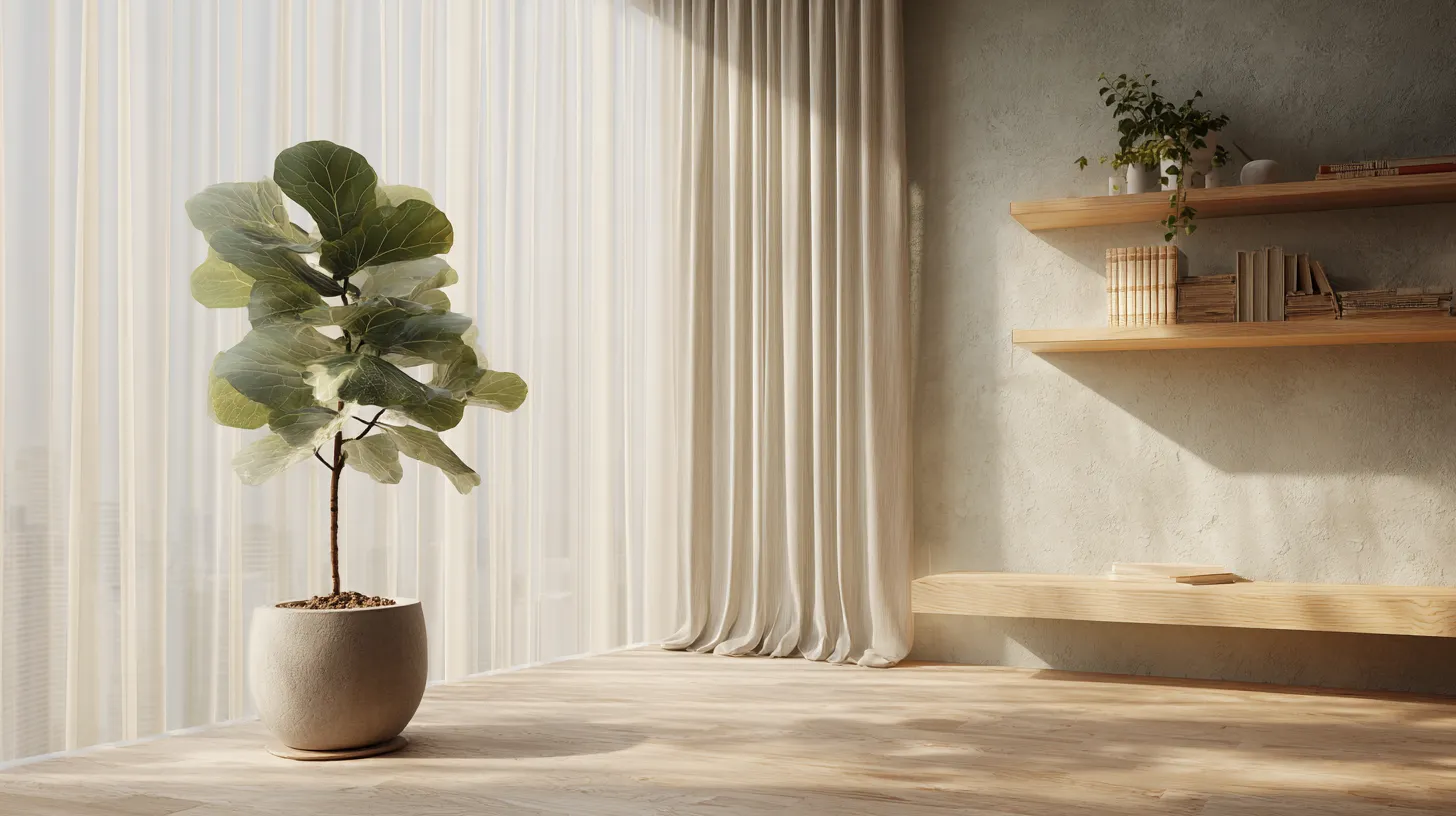
Tall, upright plants carry a quality of composure. Their vertical lines echo the architecture of the room, adding height without noise. When your eye travels up a fiddle leaf fig or a rubber plant, your body instinctively follows — a subtle shift in posture, a quiet sense of groundedness.
Place architectural plants near your entry, your desk, or in any area where you need clarity and intention. They signal: this is a space for presence.
Best Japandi choices: fiddle leaf fig, rubber plant, snake plant, bamboo palm.
Rounded and Cascading Plants: Softness and Decompression
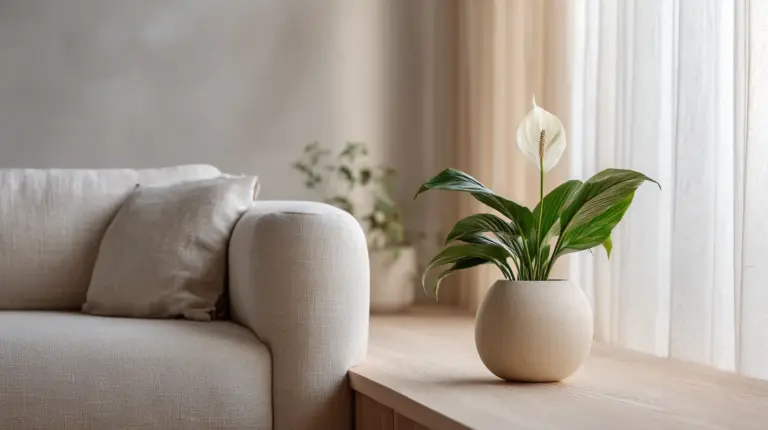
Soft, rounded foliage works differently. A peace lily with its gentle draping leaves, or a Bird’s Nest fern with its low, cup-like texture — these plants ask nothing of you. They do not demand your attention. They simply soften the corner they inhabit.
Research on biophilic texture suggests that irregular, organic forms reduce perceived visual complexity and signal safety to the nervous system. They are the design equivalent of an exhale.
Place soft, rounded plants near your sofa, your reading nook, or your bed. Anywhere the goal is decompression.
Best Japandi choices: peace lily, Bird’s Nest fern, ZZ plant, parlor palm.
Color Temperature and Emotional Tone
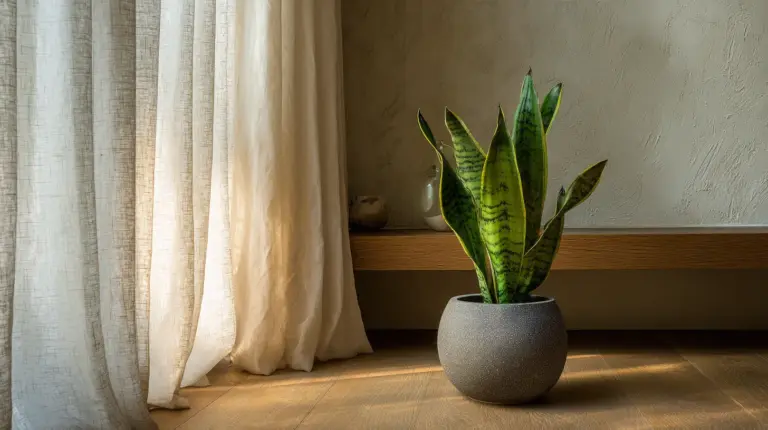
Not all green is the same. The psychological weight of a deep, muted forest green differs from the brightness of a lime-edged pothos or the cool blue-green of a snake plant.
| Green Tone | Emotional Effect | Best Placement |
|---|---|---|
| Deep forest green | Grounding, stabilizing | Living room, entryway |
| Blue-green | Cooling, clarifying | Office, bedroom |
| Bright, fresh green | Energizing, uplifting | Kitchen, creative studio |
| Variegated / pale green | Light, airy, expansive | Small rooms, north-facing spaces |
In a Japandi palette of warm stone, ash wood, and soft linen, greens anchor the organic without competing. Choose muted tones for calm zones and brighter varieties only where you need a gentle lift.
Plant Prescriptions by Emotional Profile
If You Are an Anxious Overthinker
You need softness, not stimulation. Too many plants create visual noise; too much variety creates decision fatigue. Your Japandi plant strategy is simple: fewer, rounder, more forgiving.
Choose two or three generous, low-maintenance plants with rounded foliage. Place them where your eyes land first — the entryway, the coffee table, the bedside. Let them be your visual anchor, not your responsibility.
Your plants: ZZ plant, peace lily, snake plant.
Your rule: One calm corner first. One plant that you cannot kill.
If You Are a Burnt-Out Creative
You need inspiration without pressure. Your space should feel alive but edited — a studio, not a jungle. One sculptural statement plant near your desk brings vertical energy and a sense of possibility. One soft plant nearby offers recovery.
The contrast between structure and softness mirrors the creative rhythm itself: focused effort, then release.
Your plants: Fiddle leaf fig or rubber plant (tall, structural) + Bird’s Nest fern (soft, low).
Your rule: One plant in your sightline when you look up from your screen.
If You Are a Minimalist Beginner
You are drawn to the aesthetic but afraid of the upkeep. That fear is real, and no one talks about it enough. Start with what we call training wheels plants — species so forgiving that neglect is almost part of their personality.
One to three hero plants in simple, neutral pots. Nothing fussy, nothing fragile. Let yourself build confidence before adding complexity.
Your plants: ZZ plant, snake plant, pothos.
Your rule: The 3–2–1 formula — one tall, one medium, one small. Nothing more until you feel ready.
Placement Psychology: Where You Put Your Plants Matters as Much as Which Ones You Choose
The Calm Entry Reset
Your entryway is a transition zone. After the noise of the outside world — commutes, errands, other people’s energy — this is where your nervous system begins the shift inward.
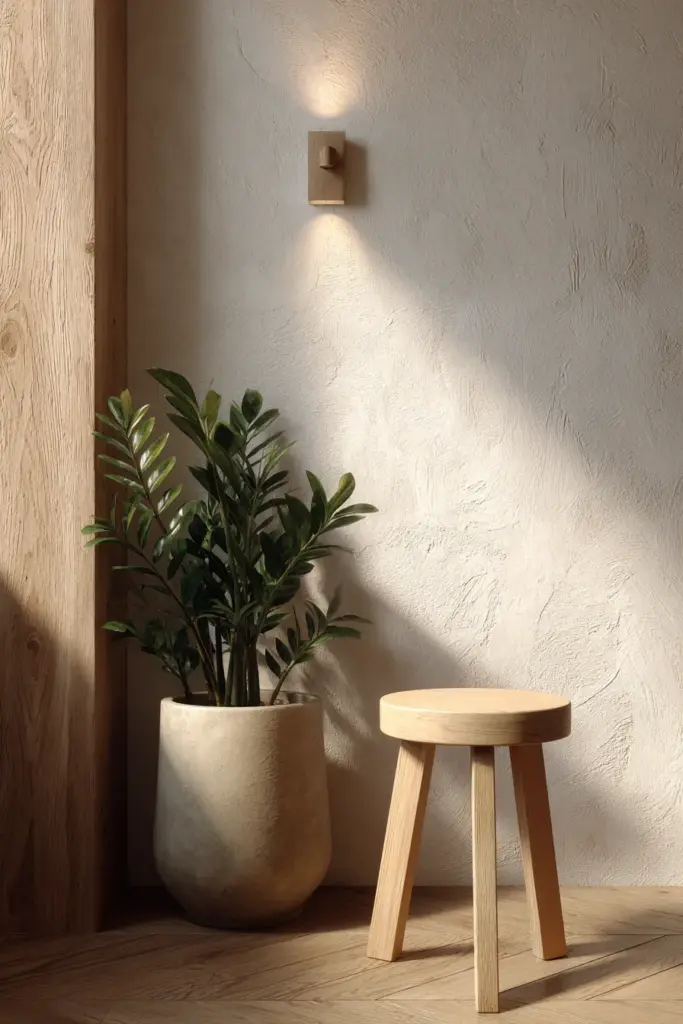
One simple plant here, paired with warm, layered lighting, creates what psychologists call a contextual cue: a sensory signal that tells your brain you are safe now, you can slow down. A low ZZ plant on a wooden stool. A single stem in a ceramic vessel. Restraint is the point.
The Focus Desk Triangle
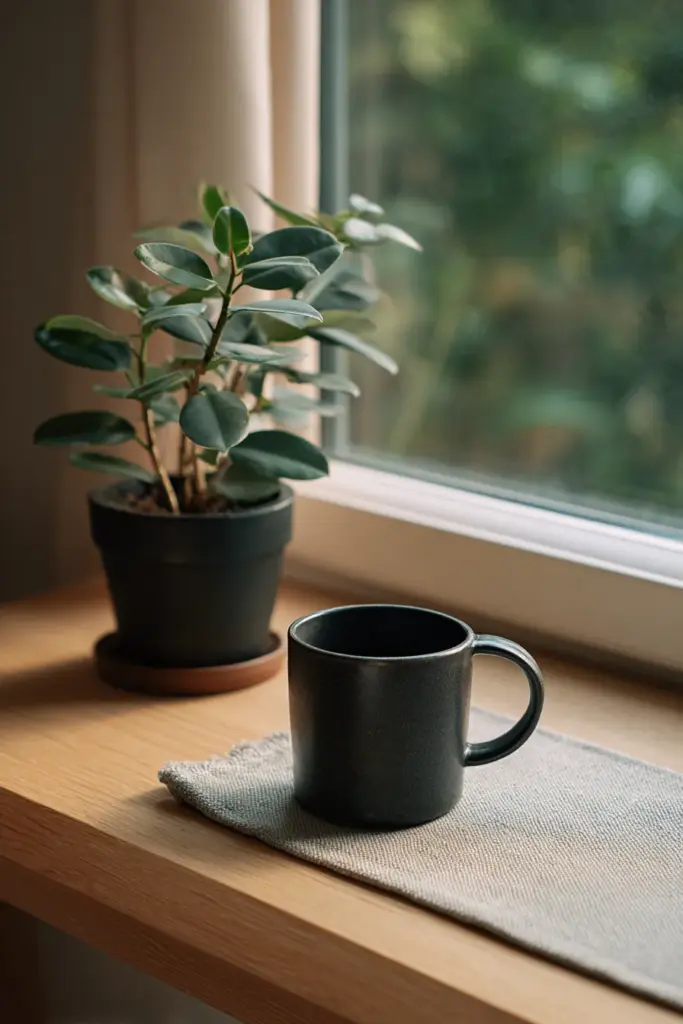
Position your desk so that a plant sits at the edge of your peripheral vision — not directly in front of you, but just to the side. This placement leverages attention restoration theory: the soft, irregular form of a living plant gives your visual cortex a gentle resting point between bouts of focused work.
A rubber plant to the left of your monitor. A small snake plant on the corner of your desk. You will not stare at them. But they will quietly restore you.
The Evening Wind-Down Corner
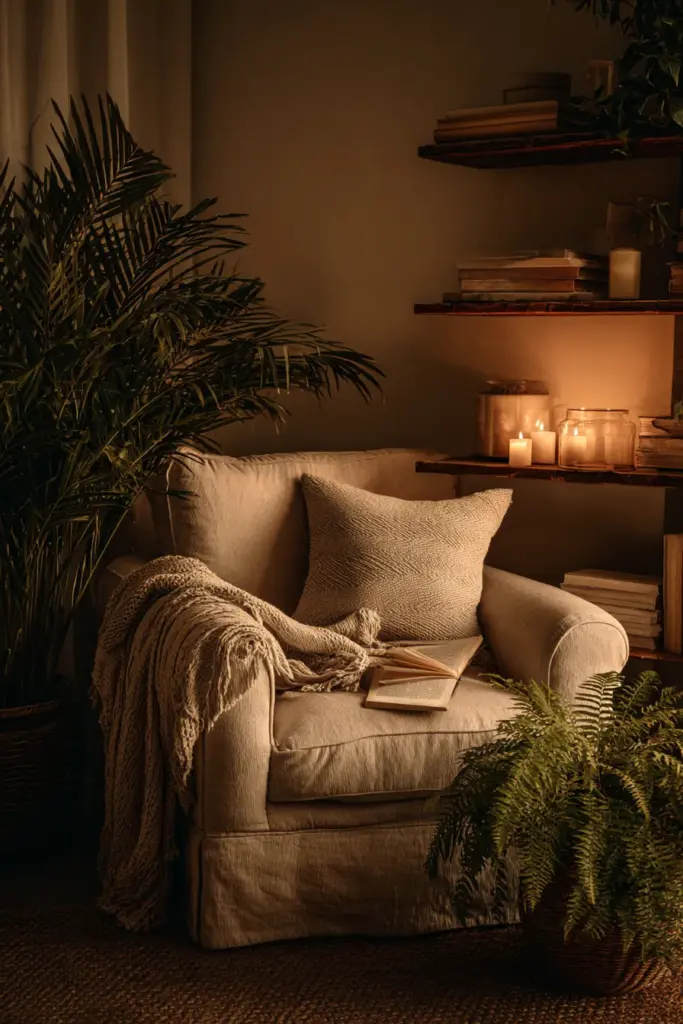
Lower plants, softer textures, dimmer light. This combination sends a coherent signal to your nervous system: the day is ending. A parlor palm at sofa height, a Bird’s Nest fern on a low shelf, a single candle nearby.
Pair this corner with cozy, low-slung furniture to complete the ritual of descent into rest. Your body reads the visual cues before your mind catches up.
Japandi Plant Rituals: Daily Anchors for a Calmer Mind
The Morning Leaf Check
Before you reach for your phone, reach for your watering can. Walk through your space and check each plant — a leaf, a stem, a new unfurling growth. It takes five minutes. It costs nothing. And it is, quietly, one of the most grounding ways to begin a day.
This is not performance. It is presence. And in a world designed to pull your attention outward, a morning ritual that keeps you here is radical.
Watering as Breathwork
Pair your watering days with three deep breaths before you begin. Feel the weight of the can, the coolness of the water, the smell of damp soil. Soil contains Mycobacterium vaccae, a naturally occurring microbe shown in studies to increase serotonin levels when inhaled. Your garden is, quite literally, medicine.
This micro-ritual takes two minutes. Over weeks, it becomes a signal: this is how I return to myself.
The Sunday Pruning and Reset
Once a week, tend to your plants the way you tend to yourself — removing what no longer serves, making space for new growth. Trim a yellowing leaf, wipe dust from a broad rubber plant leaf, rotate a pot toward the light.
This small act of care closes the week with intention. It is the plant equivalent of making your bed, tidying a surface, or writing a closing note in a journal.
When Plants Cause Stress Instead of Reducing It
The Plant Guilt Problem
No one talks about this, but it is real. Overbuying plants creates clutter. Forgetting to water creates guilt. Comparing your home to curated design feeds on social media creates inadequacy. These are not small feelings — they are design decisions that have gone wrong.
Japandi philosophy offers a correction, rooted in wabi-sabi: the acceptance of imperfection and impermanence. A yellowing leaf is not failure. It is life, doing what life does.
Practical resets:
- Start with one to three plants maximum.
- Choose species that genuinely forgive irregular watering.
- Accept the patina. A slightly imperfect plant in a beautiful pot is still beautiful.
- Resist the urge to fill every corner. Empty space is not emptiness — in Japandi, it is breath.
Key Takeaways: Your Japandi Plant Psychology Checklist
- Choose plant form intentionally — vertical for focus and structure, rounded for softness and recovery.
- Match green tones to emotional zones: deep greens ground, blue-greens cool, bright greens energize.
- Use the 3–2–1 formula for small spaces: one tall, one medium, one small plant.
- Place plants along your daily sightlines — entry, desk periphery, evening corner.
- Build micro-rituals around plant care: morning checks, mindful watering, Sunday pruning.
- Start small. Plant guilt is real. Three forgiving plants styled beautifully beat ten mediocre ones.
- Accept imperfection as part of the design. Wabi-sabi is not an aesthetic choice — it is a practice.
Closing: The Space That Breathes With You
Japandi has always known something that wellness culture is still learning: calm is not achieved — it is designed. It lives in the texture of a linen cushion, the grain of an ash shelf, the shadow of a leaf catching late afternoon light.
Your plants are not decoration. They are companions in the daily architecture of a quieter life. Choose them with care. Place them with intention. Tend to them as you would any small thing that brings you back to yourself.
And then, simply, let them grow.
At ERYLIN, we design for moments like this — the soft ones, the still ones, the ones that feel like coming home.
FAQs
What plants are best for Japandi style?
The best Japandi plants combine low-maintenance care with sculptural beauty. Top choices include the ZZ plant, snake plant, fiddle leaf fig, rubber plant, peace lily, Bird’s Nest fern, parlor palm, and bonsai. Rounded forms work best in relaxation zones; tall, architectural plants suit entry and desk areas.
How do plants improve mental health in Japandi design?
Plants reduce cortisol, support attention restoration, and introduce sensory richness — texture, scent, subtle movement — that grounds an overstimulated nervous system. Their effect deepens when paired with intentional placement and daily care rituals that build mindfulness habits.
What is Japandi biophilic design?
Biophilic design is the practice of bringing natural elements — light, materials, plants, water, texture — into built environments to support human wellbeing. Japandi biophilic design applies this through a Japanese-Scandinavian lens: organic materials, soft natural light, and carefully chosen plants that feel native to the space rather than decorative additions.
What are the best low-maintenance Japandi plants for busy people?
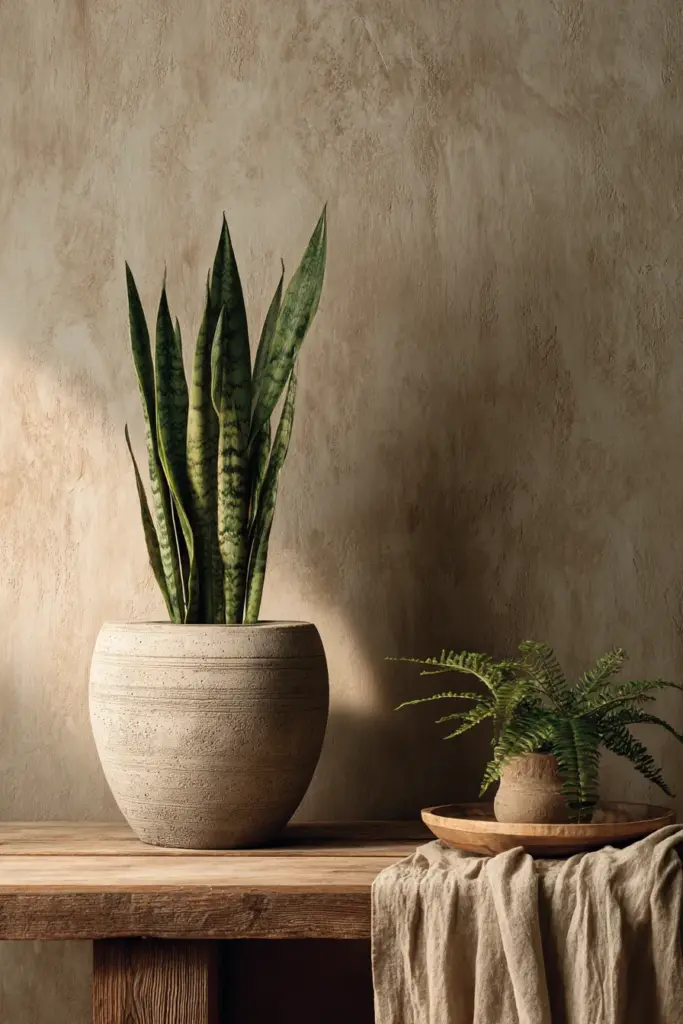
The ZZ plant, snake plant, and pothos are ideal. They tolerate irregular watering, low light, and neglect without visible distress. In a simple neutral pot against a warm plaster wall, any of these becomes a design statement — without the anxiety of a high-maintenance species.
How does plant placement affect mood in a Japandi home?
Placement matters as much as species selection. Entry plants create a neurological transition from outdoor chaos to indoor calm. A desk-periphery plant supports attention restoration during work. Low plants in evening zones, paired with dim lighting and soft textures, signal the body that it is time to rest. Think of placement not as interior styling, but as daily emotional choreography.