
Table of Contents
There is something quietly radical about choosing plants that ask little of you — and give so much in return.
Japandi style is more than an aesthetic. It is a philosophy of living: rooted in Japanese wabi-sabi, the beauty of imperfection, and Scandinavian hygge, the warmth of simple pleasures. When you bring plants into a Japandi home, you are not decorating. You are inviting nature to breathe alongside you.
The best Japandi plants are those that endure with grace — sculptural, calm, low-maintenance, and deeply alive. They don’t demand daily attention. They simply are, and in being, they make your space feel whole.
In this guide, ERYLIN walks you through the most beautiful low maintenance Japandi plants, how to style them, and how to care for them — even in small, humid tropical spaces like those in the Bicol region and across the Philippines.
What Makes a Plant Perfect for Japandi Style?
Not every plant belongs in a Japandi home. The ones that do share a few defining qualities.
They tend toward clean lines and sculptural forms — think upright leaves, arching fronds, or striking silhouettes that hold their shape without fuss. They complement neutral palettes: warm whites, sandy beiges, soft charcoals, and muted greens. And they thrive, beautifully, on a little benign neglect.
The Core Qualities to Look For
- Low light tolerance — Japandi interiors often feature indirect, diffused light through sheer curtains or north-facing windows
- Drought-tolerant or low-watering needs — ideally watered weekly or less
- Air-purifying qualities — contributing to that sense of clean, breathable calm
- Sculptural leaves or architectural forms — the plant itself becomes decor
- Wabi-sabi spirit — slight imperfections in leaf pattern or growth are welcomed, not corrected
The 10 Best Low Maintenance Japandi Plants
1. Snake Plant (Sansevieria trifasciata)
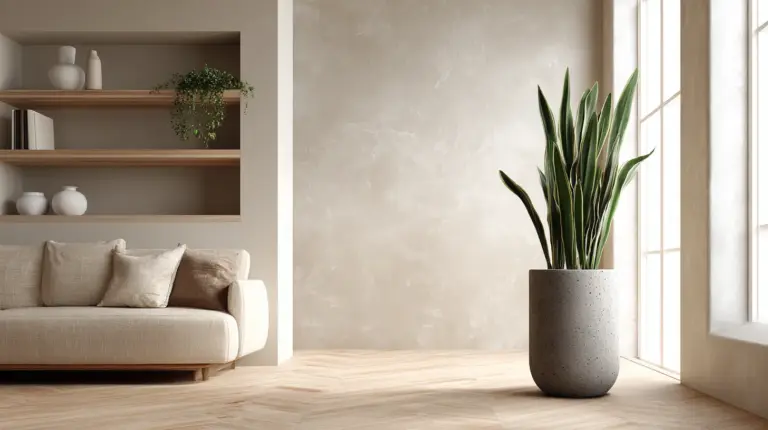
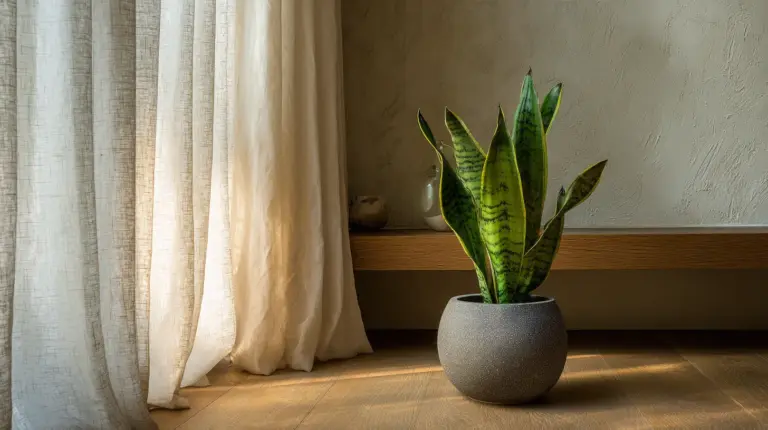
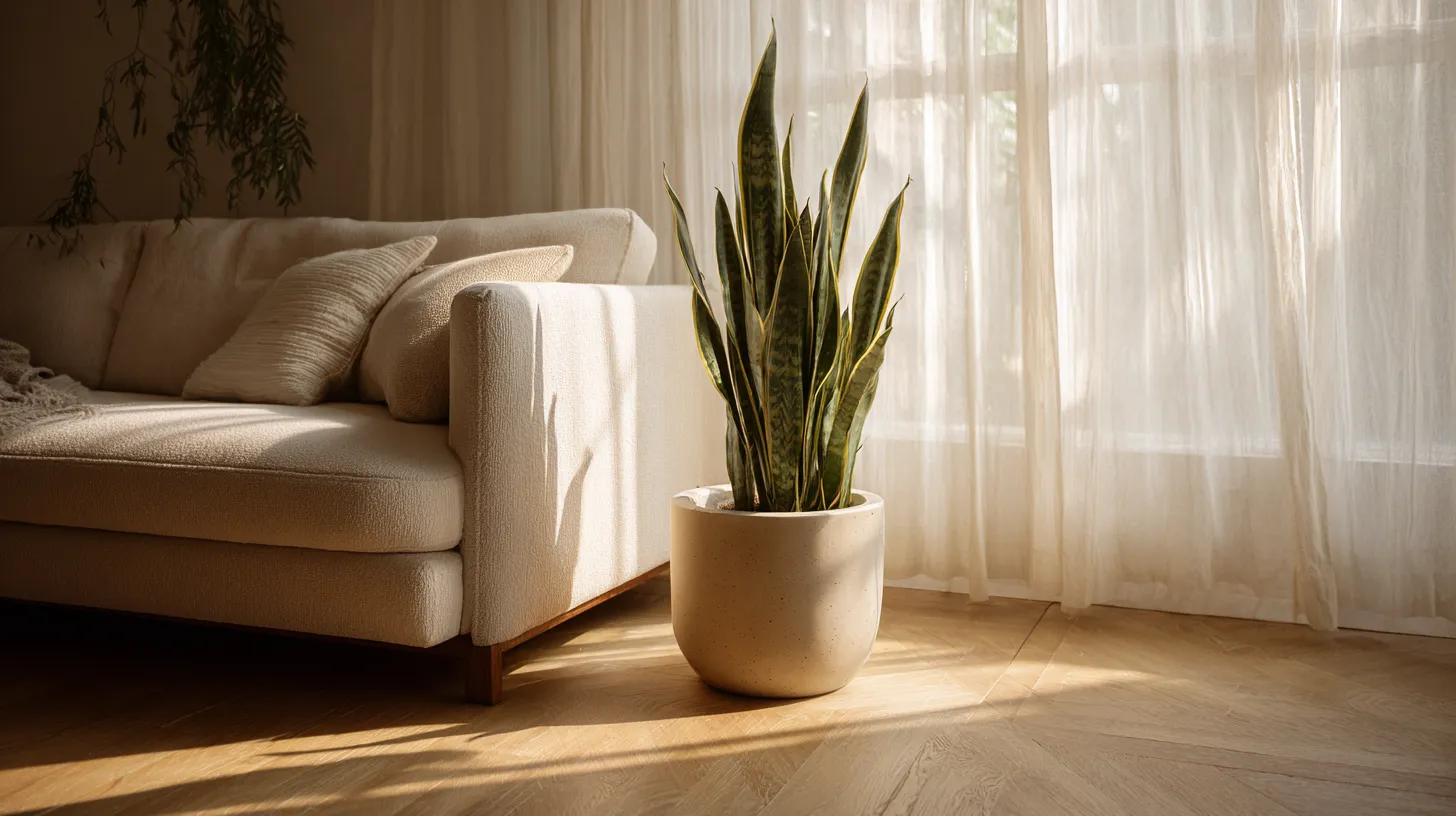
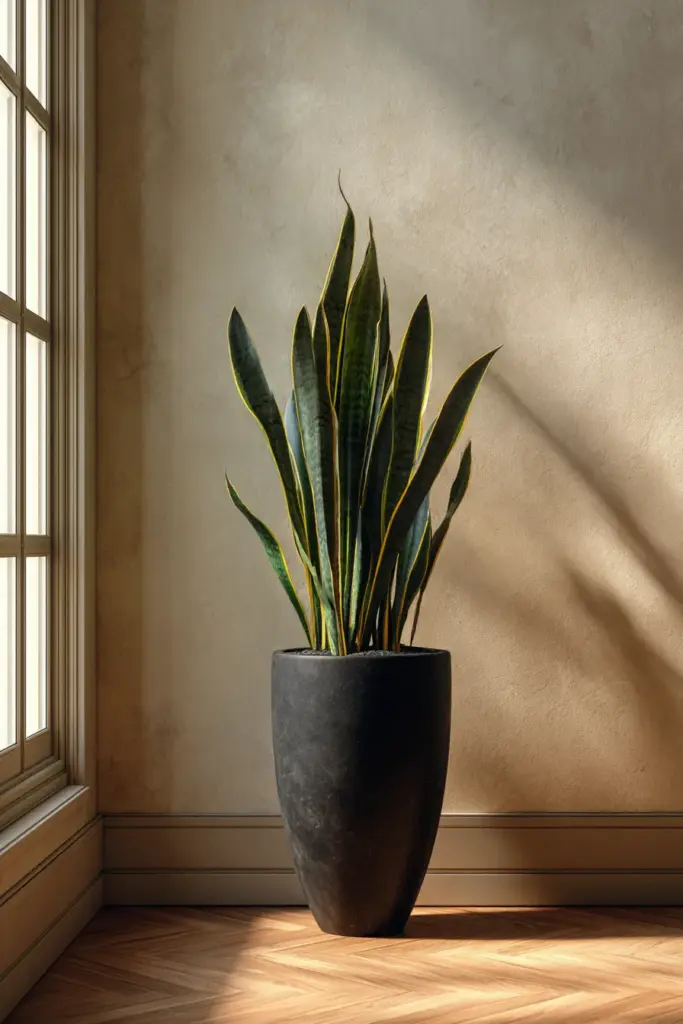
If there is one plant that was practically born for Japandi style, it is the Snake Plant. Its upright, sword-like leaves in deep green with pale yellow edges feel like living architecture. It tolerates low light, irregular watering, and neglect with remarkable composure.
Place it in a tall matte ceramic planter — sand-colored or slate — in a corner where natural light filters in softly. It will stay there for years, unmoved and magnificent.
Care: Water every 2–4 weeks. Indirect light. Well-draining soil.
2. ZZ Plant (Zamioculcas zamiifolia)
The ZZ Plant has a waxy, polished quality that looks almost architectural. Its deep green stems rise in graceful arcs, each leaflet catching the light in a way that feels intentional. It is one of the most low-light tolerant plants available.
In a Japandi space, pair it with a woven rattan basket or a simple concrete pot to contrast its glossy leaves with rough, natural texture.
Care: Water every 2–3 weeks. Thrives in low to bright indirect light. Extremely drought-tolerant.
3. Peace Lily (Spathiphyllum wallisii)
Are peace lilies good for Japandi? Absolutely — and they may be the most soulful choice on this list. Their white blooms rise above deep green foliage like paper lanterns, delicate and serene. They are also exceptional air purifiers, removing benzene and formaldehyde from indoor air.
Peace lilies love humidity, which makes them a natural fit for Philippine homes in Bicol and other tropical regions. They will tell you when they need water — leaves gently droop, then spring back with a drink.
Care: Water when the top inch of soil is dry. Keep in indirect light. Thrives in humidity.
4. Fiddle Leaf Fig (Ficus lyrata)
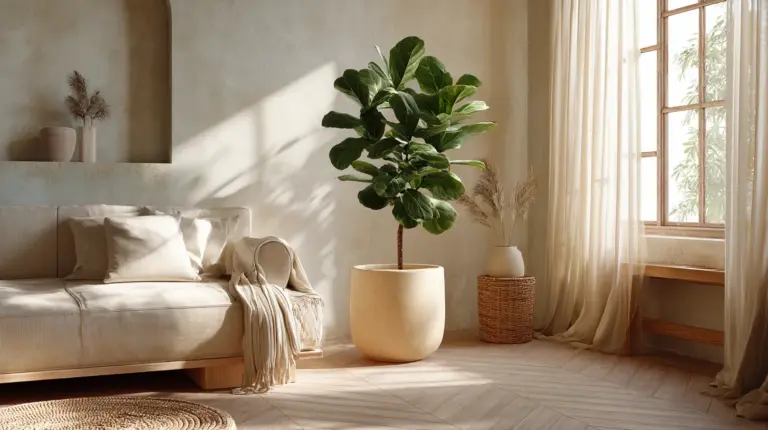
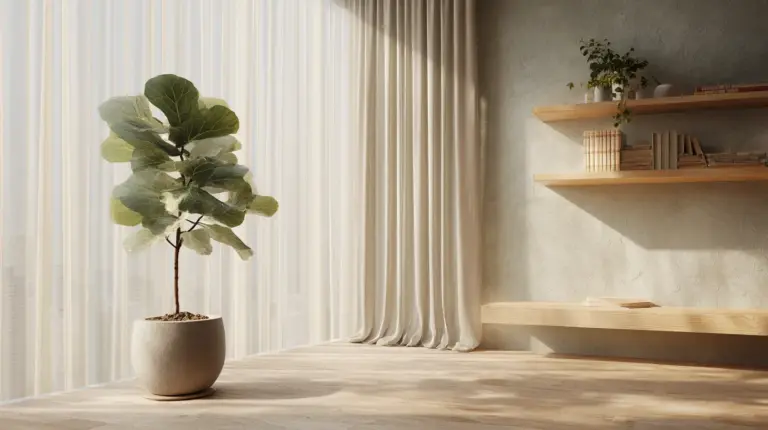
The Fiddle Leaf Fig is the statement piece of the Japandi world. Its large, violin-shaped leaves create a bold visual rhythm that draws the eye upward, making rooms feel taller and more alive. It is architectural in the truest sense.
Style it near a window with filtered light, in a tall cylindrical planter in terracotta or linen-toned ceramic. It does best when left alone — frequent moving stresses it. Choose its spot and let it settle.
Care: Water every 1–2 weeks when topsoil is dry. Bright indirect light. Well-draining soil.
5. Monstera Deliciosa
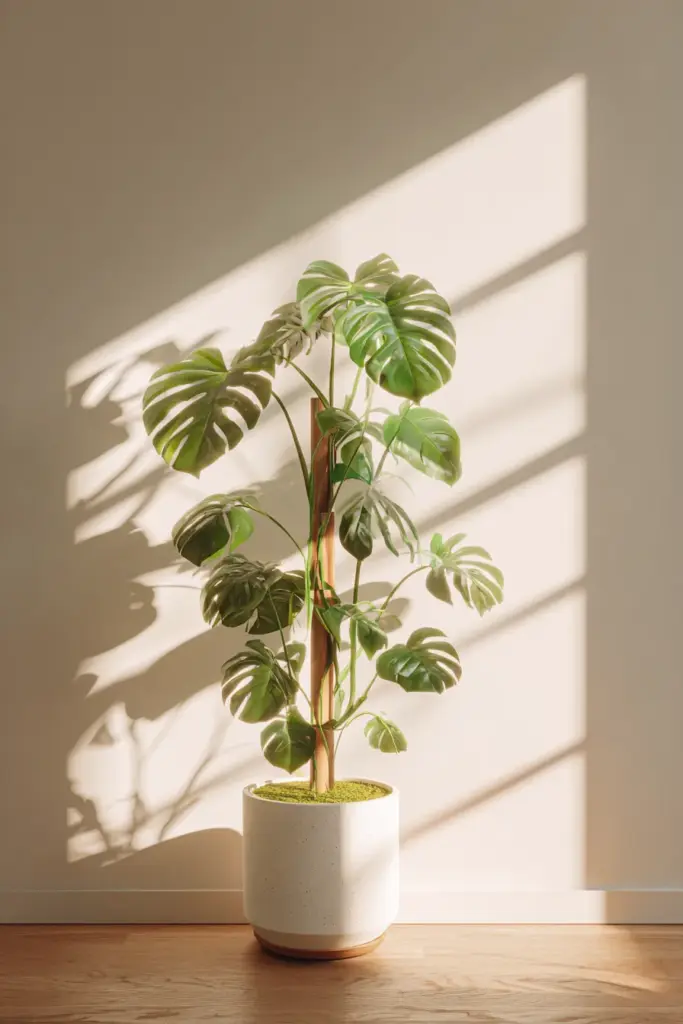
Few plants carry the organic, tropical serenity of Monstera Deliciosa. Its split, fenestrated leaves feel both wild and composed — a perfect expression of wabi-sabi beauty. In a Japandi space, it softens the lines of minimalist furniture with its lush, spreading presence.
Choose a matte black or warm white planter. Let it climb a simple wooden moss pole for a sculptural vertical element.
Care: Water every 1–2 weeks. Indirect or medium light. Easy to propagate — cut a node and place in water for a zero-waste new plant.
6. Cast Iron Plant (Aspidistra elatior)
True to its name, the Cast Iron Plant is nearly indestructible. Its dark, strappy leaves grow in a low, spreading mound that brings quiet texture to corners and shelves. It tolerates deep shade, temperature fluctuations, and irregular watering — ideal for busy households.
In Japandi design, its deep, glossy green creates a grounding contrast against light linen or oak wood tones.
Care: Water every 2–3 weeks. Thrives in low to medium indirect light. Very low-maintenance.
7. Chinese Evergreen (Aglaonema)
The Aglaonema is a hidden treasure for Japandi interiors — especially in the Philippines, where it grows freely and is widely available at local nurseries for as little as PHP 200–300. Its leaves come in muted greens, silvery tones, and blush-tinged varieties that complement Japandi’s neutral palette beautifully.
It is humidity-loving, low-light tolerant, and forgiving. For humid Bicol homes, it is one of the most naturally suited plants you can choose.
Care: Water every 1–2 weeks. Low to bright indirect light. Thrives in warm, humid conditions.
8. Parlor Palm (Chamaedorea elegans)
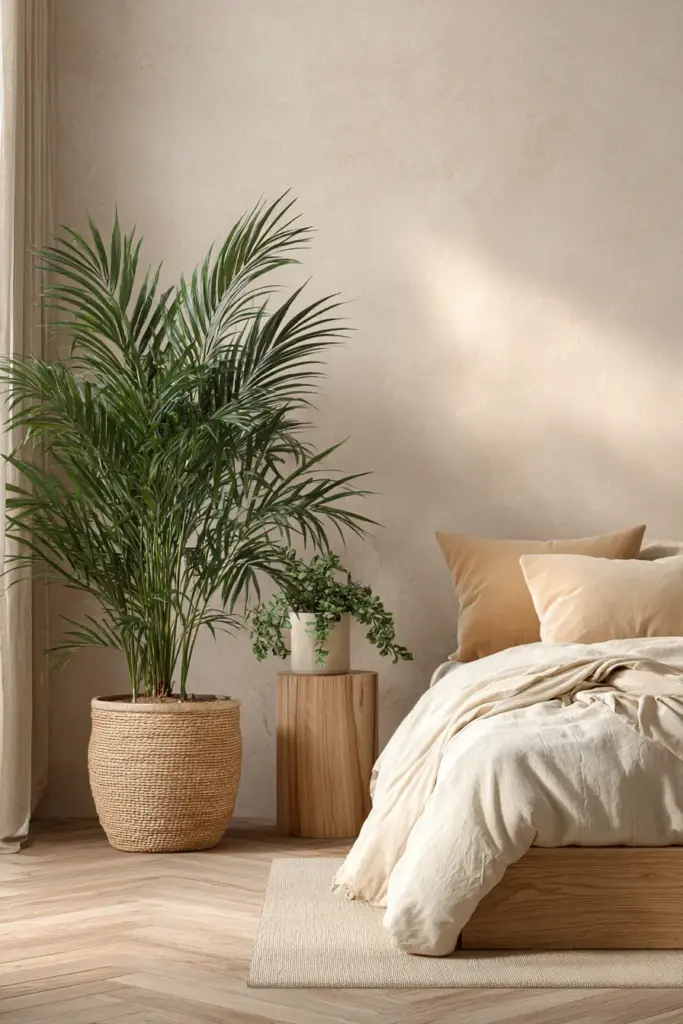
For a touch of natural softness — the kind that makes a room feel like a retreat — the Parlor Palm is unmatched. Its feathery fronds arc gracefully, creating a sense of gentle movement even on still days. It brings warmth to reading corners and meditation spaces.
Pair it with a jute-wrapped planter or a simple cylindrical clay pot. It is slow-growing, long-lived, and endlessly elegant.
Care: Water every 1–2 weeks. Tolerates low light well. Keep soil slightly moist.
9. Pilea Peperomioides (Chinese Money Plant)
Small, charming, and social — the Pilea is beloved for its round, coin-shaped leaves on slender stems. It has a playful quality that adds life to bookshelves, windowsills, and small-space Japandi setups. It is also one of the most propagation-friendly plants: it regularly produces small pups that can be separated and potted in recycled containers for a zero-waste approach to styling.
Care: Water every 1–2 weeks. Bright indirect light. Rotate occasionally for even growth.
10. False Aralia (Dizygotheca elegantissima)
For those who want drama without the maintenance, False Aralia delivers. Its dark, lacy leaflets on slender stems create an almost ethereal silhouette — delicate and strong at once. It has a Japanese woodland quality that feels deeply at home in a Japandi space.
Care: Water moderately every 1–2 weeks. Bright indirect light. Avoid cold drafts.
Japandi Plant Care at a Glance
| Plant | Light Needs | Watering Frequency | Best For |
|---|---|---|---|
| Snake Plant | Low to bright indirect | Every 2–4 weeks | Corners, floor placement |
| ZZ Plant | Low to bright indirect | Every 2–3 weeks | Shelves, desks |
| Peace Lily | Low to medium indirect | When topsoil dries | Air purifying, humid rooms |
| Fiddle Leaf Fig | Bright indirect | Every 1–2 weeks | Statement focal point |
| Monstera Deliciosa | Medium to bright indirect | Every 1–2 weeks | Living rooms, large spaces |
| Cast Iron Plant | Low to medium indirect | Every 2–3 weeks | Dark corners, low-light rooms |
| Chinese Evergreen | Low to bright indirect | Every 1–2 weeks | Humid tropical homes |
| Parlor Palm | Low to medium indirect | Every 1–2 weeks | Reading nooks, bedrooms |
| Pilea | Bright indirect | Every 1–2 weeks | Small spaces, shelves |
| False Aralia | Bright indirect | Every 1–2 weeks | Architectural accents |
How to Style Japandi Plants: A Room-by-Room Guide
Living Room: The Anchor Plant
Choose one large statement plant — a Fiddle Leaf Fig, Monstera, or Snake Plant — and let it command space. Place it beside your sofa or near your cozy furniture in a planter that speaks the same tonal language as your cushions and throws. The plant should feel like it belongs, not like an afterthought.
Bedroom: Quiet Greenery
The bedroom calls for softness. A Parlor Palm in the corner, or a Pilea on the nightstand, brings gentle vitality without visual noise. Consider plants with air-purifying qualities, like Peace Lily, for rooms where you rest and breathe deeply.
Small Spaces and Vertical Styling
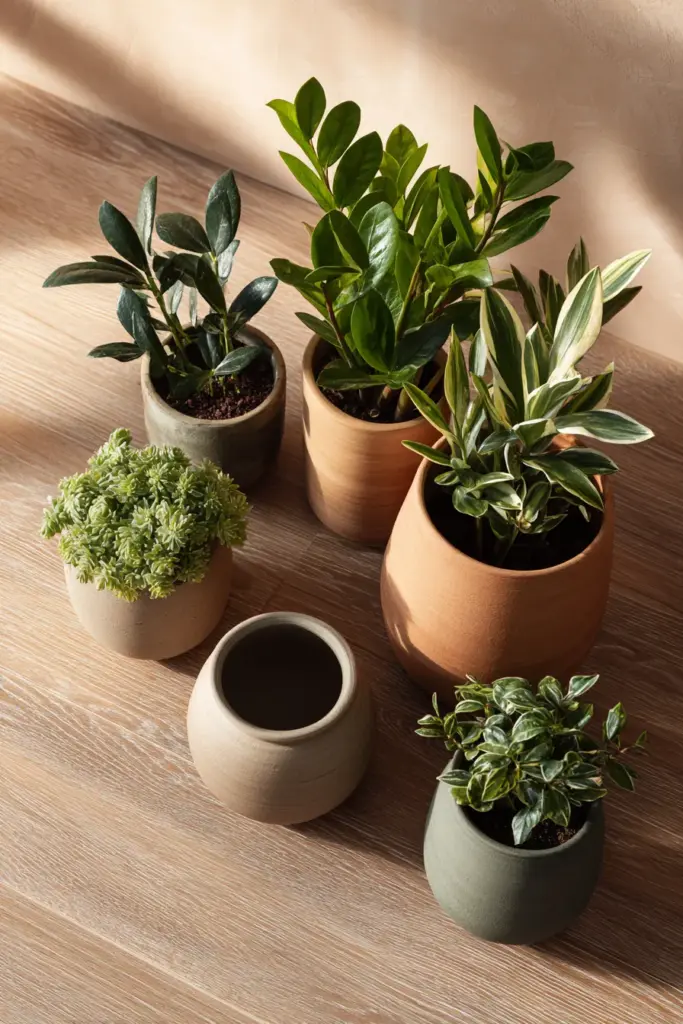
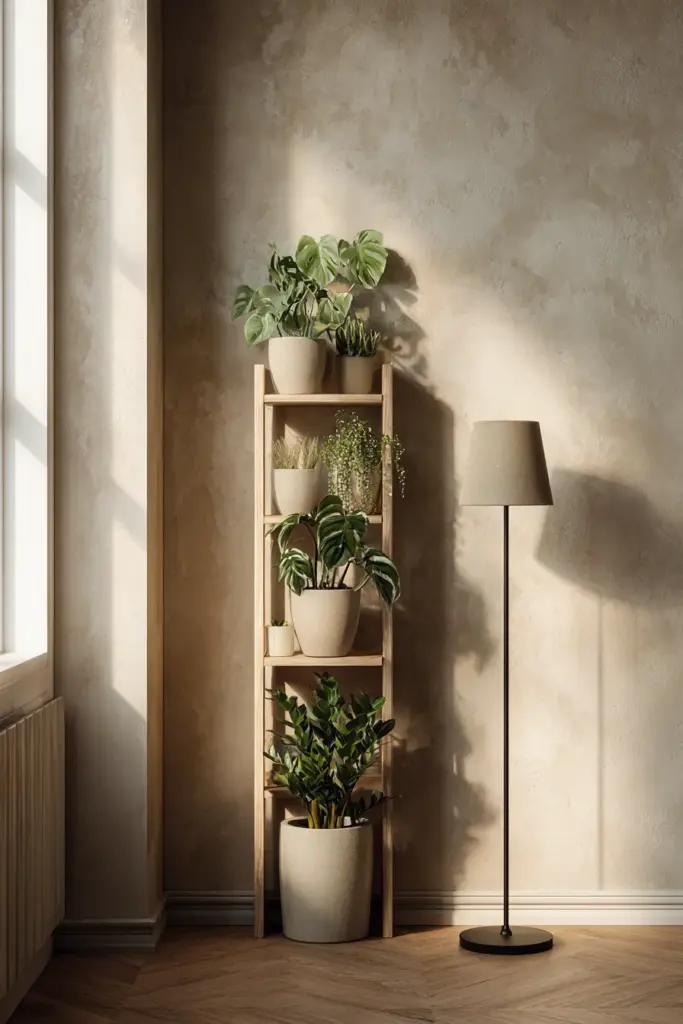
In compact rooms — even 10–15 sqm spaces typical in Philippine apartment living — go vertical. A simple wooden shelf styled with trailing Pilea pups, a compact ZZ Plant, and a small Aglaonema creates depth and life without consuming floor space. Use lighting ideas to bring warmth to your plant vignettes in the evenings.
Sustainable Japandi Plant Practices
Propagation: Zero-Waste Plant Care
Monstera, Pilea, and Aglaonema all propagate easily. Take cuttings, place in water, and watch roots form. Pot new plants in upcycled wooden crates, repurposed tins, or handmade clay pots from local Bicol artisans. Propagation turns one plant into many — and makes gifting beautiful.
Eco-Planters for a Japandi Aesthetic
The planter is as important as the plant. Choose:
- Unglazed terracotta — warm, breathable, naturally imperfect
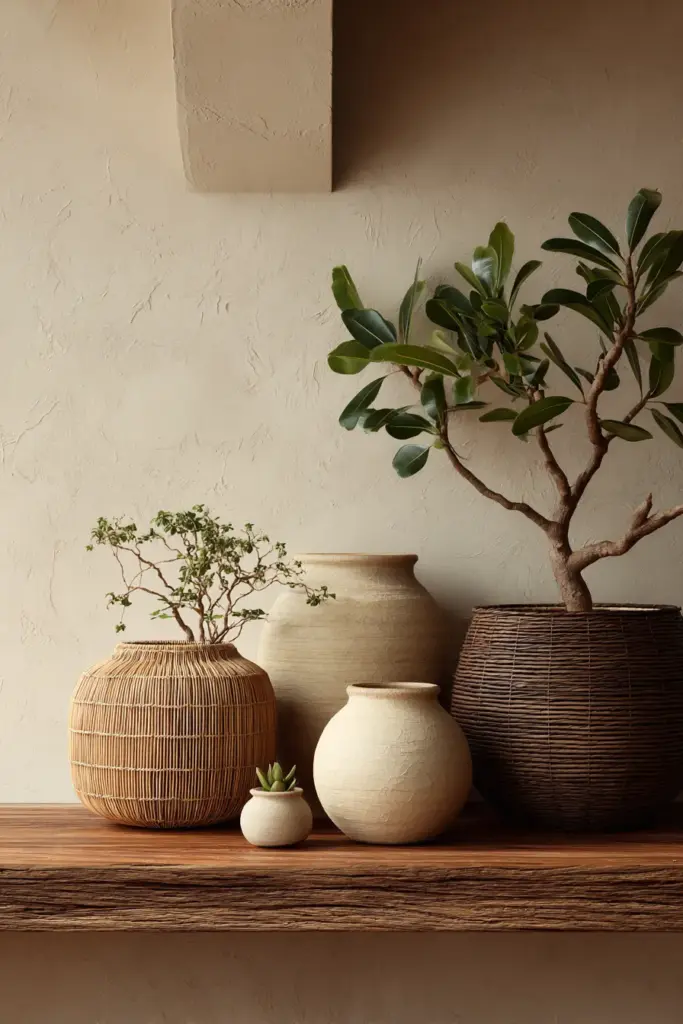
- Woven rattan or bamboo baskets — for a textured, earthy feel
- Matte ceramic in neutral tones — sand, slate, cream, or charcoal
- Upcycled wood containers — deeply wabi-sabi in spirit
Avoid planters with busy patterns or bright colors. Let the plant and its vessel speak quietly together.
Japandi Plant Care Calendar (Simplified)
- Weekly: Check soil moisture; wipe dust from large leaves (Monstera, Fiddle Leaf Fig)
- Bi-weekly: Water most plants; rotate pots for even light exposure
- Monthly: Check for pests; remove yellowed or dead leaves cleanly
- Seasonally: Propagate, repot if root-bound, refresh topsoil
Quick Summary: Key Takeaways
- Choose plants with sculptural, architectural forms that complement clean lines and neutral tones
- Prioritize low-light tolerance — most Japandi spaces use diffused, indirect natural light
- Embrace wabi-sabi imperfection — a slightly asymmetrical plant or an aged planter adds soul
- Layer textures with planters in terracotta, rattan, and matte ceramic
- Propagate for sustainability — Pilea pups, Monstera cuttings, and Aglaonema offshoots are all zero-waste opportunities
- In tropical Philippine climates, lean on humidity-loving plants like Peace Lily, Aglaonema, and Parlor Palm
- Local nurseries in Bicol and across the Philippines offer Sansevieria, Aglaonema, and Spathiphyllum varieties at PHP 200–500 — beautiful and accessible
- Small spaces can be lush — use vertical shelving and a curated selection of 2–3 plants rather than many
Conclusion
A Japandi home is not decorated. It is tended.
The plants you choose are not accessories. They are quiet companions — breathing, growing, changing with the seasons. When you bring a Snake Plant into a sun-warmed corner, or set a Peace Lily beside a window where morning light diffuses through linen, you are doing something ancient and deeply human: you are inviting the living world inside.
At ERYLIN, we believe beauty lives in restraint. In the space between things. In the imperfect leaf, the uneven grain of wood, the silence of a well-tended room. Your plants belong in that space — not as clutter, but as calm.
Choose one. Tend it gently. Let it grow.
Frequently Asked Questions
What plants are good for Japandi style?
The best Japandi plants have sculptural, architectural forms and are low-maintenance. Top choices include Snake Plant, ZZ Plant, Peace Lily, Monstera Deliciosa, Fiddle Leaf Fig, and Cast Iron Plant. For tropical climates like the Philippines, Chinese Evergreen (Aglaonema) and Parlor Palm are also excellent picks.
What plants go well with Japandi interiors?
Plants that complement Japandi interiors tend to be low-light tolerant, drought-resistant, and visually calm. Snake Plant, ZZ Plant, and Pilea thrive alongside the neutral tones, natural textures, and minimalist furniture typical of Japandi design.
Are peace lilies good for Japandi?
Yes — Peace Lilies are an ideal Japandi plant. Their white blooms and deep green foliage embody the simplicity and serenity central to the aesthetic. They also purify indoor air and thrive in humidity, making them especially well-suited to Philippine homes.
What is the best indoor plant for Japandi style?
If you could choose only one, the Snake Plant is the most versatile and forgiving Japandi plant. It tolerates low light, requires minimal watering, and has a naturally architectural form that suits Japandi interiors beautifully. For a more dramatic statement, the Fiddle Leaf Fig is equally beloved.
What are the best low maintenance Japandi plants for small spaces in the Philippines?
For small Philippine apartments or Bicol homes, consider Chinese Evergreen (Aglaonema), Pilea, ZZ Plant, or a compact Parlor Palm. These plants thrive in humid, warm conditions, require minimal care, and are widely available at local nurseries for PHP 200–500. Use vertical shelving to maximize greenery in compact rooms.