
Table of Contents
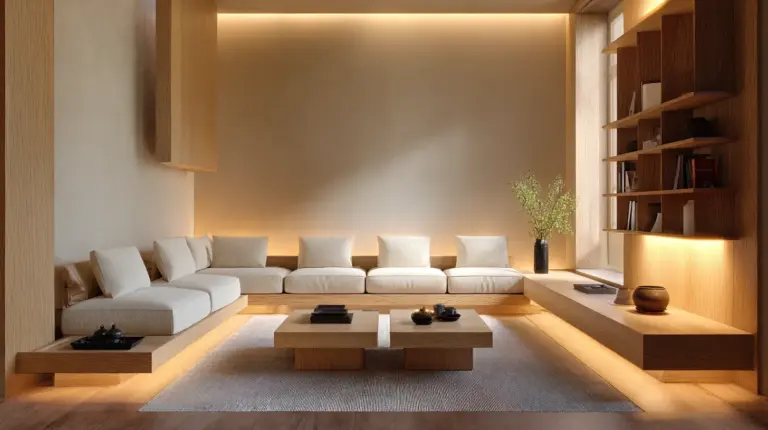
There is a particular kind of stillness that a well-designed room holds — the kind that slows your breathing the moment you walk in. That is the promise of Japandi: a design philosophy born from the quiet harmony between Japanese minimalism and Scandinavian warmth. And yes, even in the smallest of spaces, you can have it all.
If you live in a compact apartment, a cozy condo, or a studio where every square meter counts, this guide is written for you. We are not here to show you a fantasy home. We are here to help you build one — with real dimensions, practical furniture choices, and ideas that work in warm, tropical climates like the Philippines, not just the cool-toned interiors of a Stockholm magazine spread.
Think sun-bleached wood, breathable linen, the scent of woven bamboo, and a room that feels open even when it is small. That is the ERYLIN way of doing Japandi — soulful, sensory, and entirely liveable.
Let us begin.
Why Japandi Works So Well in Small Living Rooms
Japandi is not a trend. It is a logic — and small spaces respond to logic beautifully.
Both Japanese and Scandinavian design traditions were built around constraint. Japanese wabi-sabi celebrates imperfection and the beauty of what is essential. Scandinavian hygge wraps that simplicity in warmth and softness. Together, they create interiors that feel intentional rather than minimal — full of meaning, not full of things.
In a small Japandi living room, less truly becomes more. Negative space is treated as a design element. Low-profile furniture keeps the eye line open and the room feeling airy. Every object earns its place.
The result? A living room that breathes, even when it measures just 20–30 sqm.
Core Principles of a Small Japandi Living Room
Before you move a single piece of furniture, anchor yourself in these principles. They are the invisible architecture of every successful small Japandi living room.
Neutral Color Palette: Warm, Not Stark
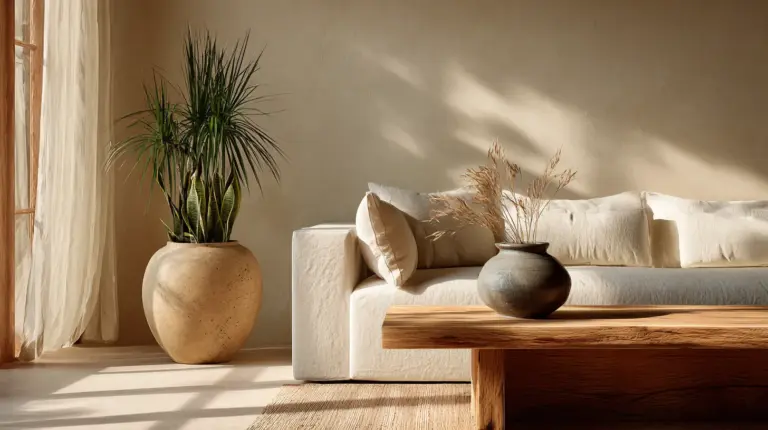
The palette of a Japandi small living room is never cold white. Think warm beige, soft greige, dusty taupe, and muted earth tones — colors that hold the warmth of late afternoon light. Pair these with the natural tones of wood, stone, and rattan.
Avoid: stark whites, cool grays, or overly saturated accent walls. These fight the Japandi spirit.
Natural Wood Elements: The Heart of the Room
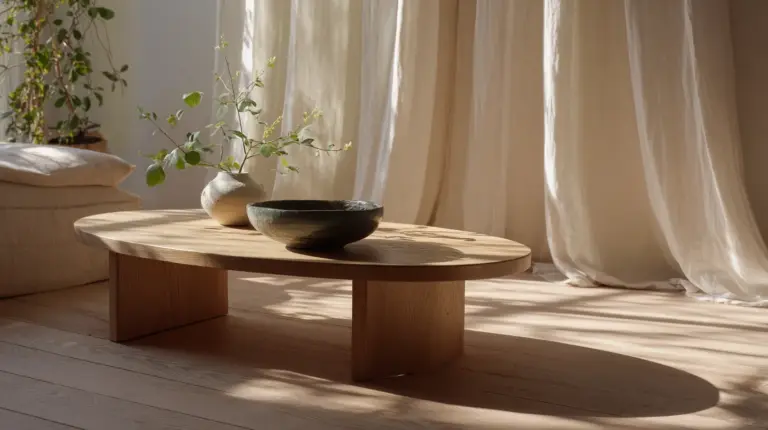
Wood is the soul of Japandi. In a small living room, light-toned woods — oak, ash, acacia, or locally sourced bamboo — add warmth without weight. Use it on coffee tables, shelving, TV consoles, and accent stools.
In tropical climates, wood naturally responds to humidity, so choose sealed or oiled finishes. Locally sourced hardwoods are also an affordable, sustainable option that feels authentically Japandi.
Negative Space: What You Leave Out Matters
One of the most powerful tools in a small Japandi living room is empty floor space. Resist the urge to fill every corner. Let the room breathe. A wide stretch of open floor between the sofa and TV console makes the room feel twice its size.
Natural Textiles: Soft, Breathable, Grounded
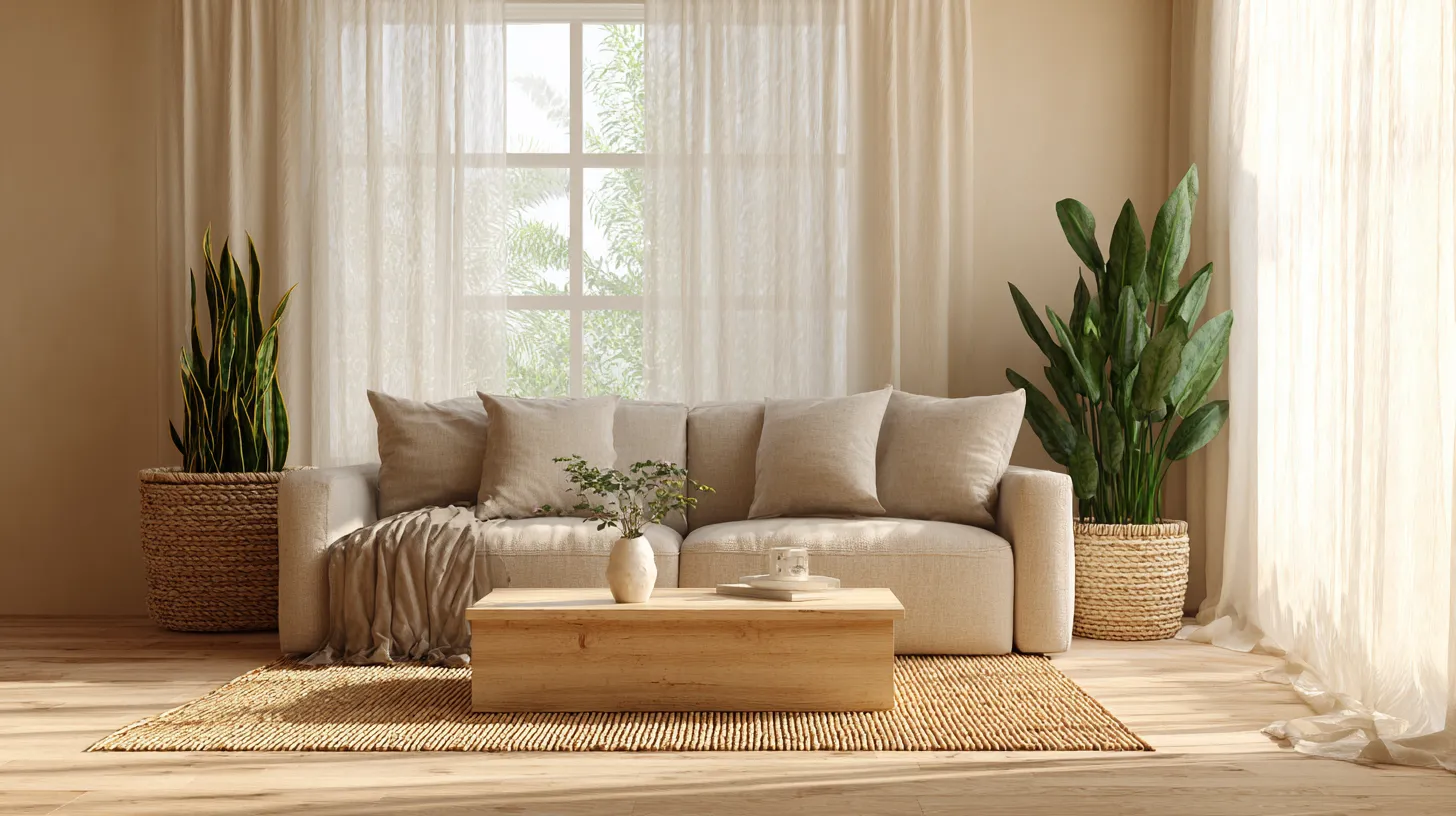
Layer your room in linen throw pillows, jute rugs, cotton blankets, and rattan accents. These textures speak the language of Japandi and — importantly for tropical homes — they breathe. Avoid heavy wool or thick pile rugs that trap heat and dust in humid climates.
Room Layouts for Small Japandi Living Rooms (20–30 sqm)
This is where most articles leave you stranded. Let us get specific.
Layout A: The Classic Open Floor (20–22 sqm)
Best for: studio apartments, single-room living spaces.
- Sofa placement: Against the longest wall, facing a low TV console on the opposite wall
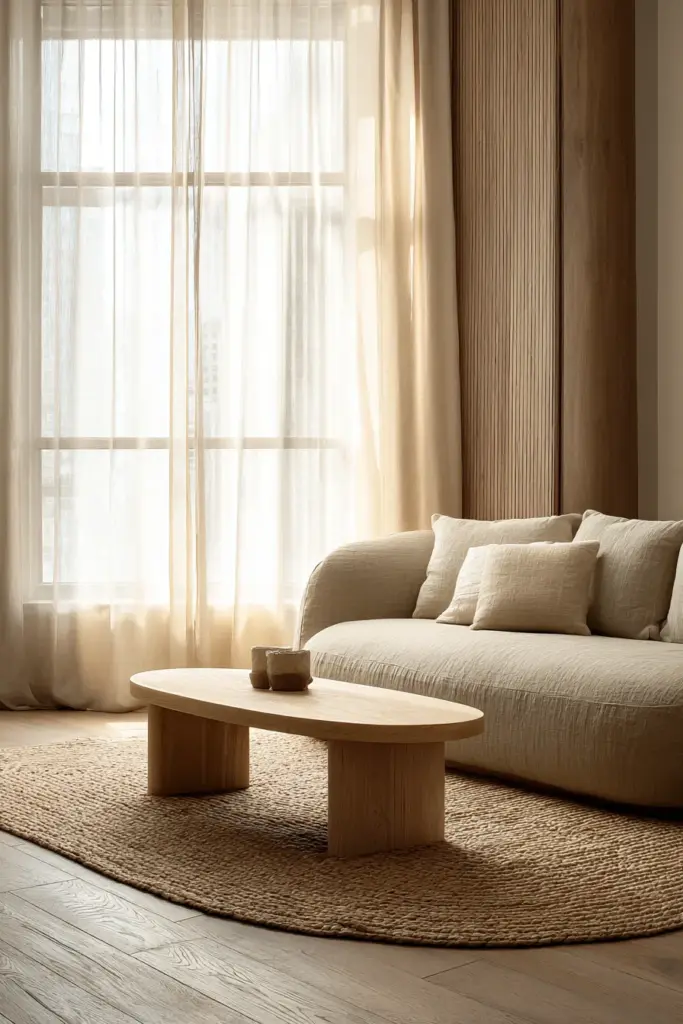
- Coffee table: Low rectangular table (max 90 cm × 50 cm), placed 45–60 cm from sofa
- Open floor: Keep at least 80 cm of clear walking space around all furniture
- Zoning tip: Use a jute or cotton rug (160 cm × 240 cm) to define the seating zone without adding visual weight
Text layout sketch:
Window wall → [Sofa: max 200 cm wide] → 50 cm gap → [Coffee table: 90×50 cm] → 80 cm → [TV console: 140 cm wide] → Wall
Layout B: The L-Shape Conversation Zone (25–28 sqm)
Best for: open-plan condos with a dining nook nearby.
- Sofa + chaise or 2-seater side sofa forming an L-shape in the corner
- No center table required — use a side table (40 cm diameter) beside each seat instead
- TV placement: Mounted on the wall at eye level (100–110 cm from floor to center screen)
- Separation from dining: A low open shelf unit (max 80 cm tall) acts as a visual divider without closing the space
Layout C: The Multi-Zone Studio (28–30 sqm)
Best for: work-from-home setups, studio living.
- Zone 1: Sofa facing window (natural light for daytime seating)
- Zone 2: Compact desk tucked perpendicular to sofa, behind a low shelf divider
- Zone 3: TV on a swivel console, viewable from both sofa and a floor cushion reading nook
- Tip: Use a single large rug (200 cm × 300 cm) to unify all zones visually
Furniture Sizes That Actually Fit a Small Japandi Living Room
Most interior articles show beautiful rooms without telling you the dimensions. Here is a practical guide.
| Furniture Piece | Recommended Size for 20–30 sqm | Notes |
|---|---|---|
| Sofa | 180–210 cm wide, max 85 cm deep | Low-profile legs (12–18 cm off floor) |
| Coffee table | 80–100 cm long, 45–55 cm wide | Round or oval if layout is tight |
| TV console | 120–150 cm wide, max 40 cm deep | Opt for floating wall-mount to free floor space |
| Armchair | 70–80 cm wide | Pair with a small side table (35–40 cm) |
| Open shelving | Max 30 cm deep, 80–100 cm tall | Keep shelves curated — max 3 objects per shelf |
| Area rug | 160×240 cm (minimum) | Needs to anchor sofa front legs at minimum |
Clearance rules to live by:
- Minimum 45 cm between coffee table and sofa
- Minimum 60 cm walking clearance around all sides of furniture
- Minimum 30 cm between TV screen and nearest wall edge
Japandi Small Living Room in Tropical Climates
This section is for the readers in the Philippines, Southeast Asia, and anywhere the sun presses warmly against your windows year-round. Most Japandi inspiration is written for cold climates. Here is how to adapt it for yours.
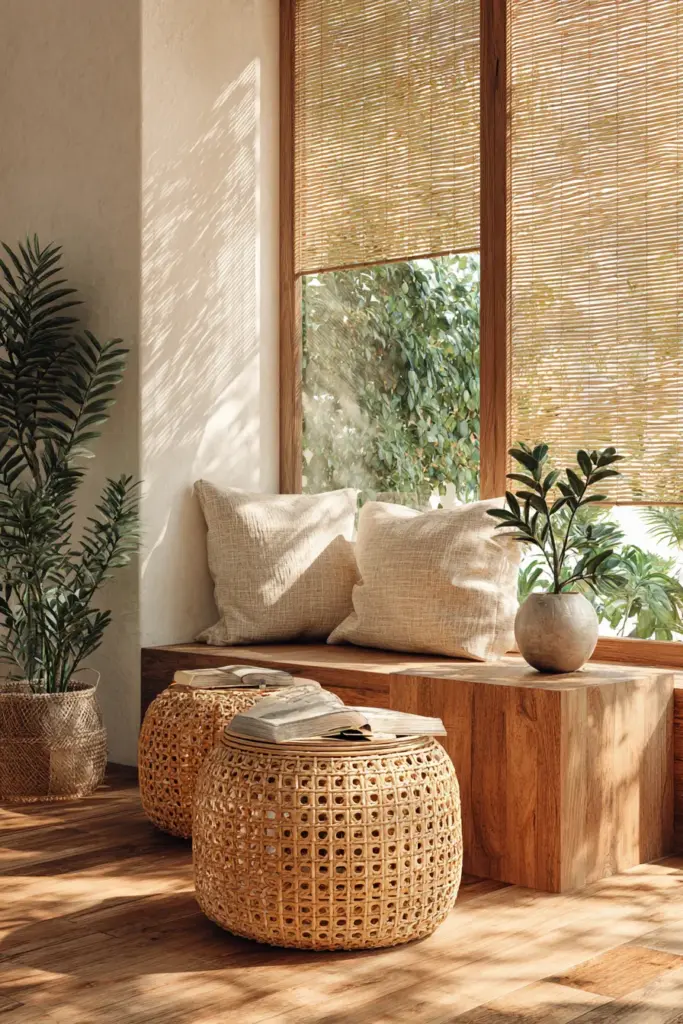
Choose Light, Breathable Rugs
Skip wool. In a tropical small Japandi living room, reach for jute, seagrass, cotton flatweave, or rattan mats. These materials regulate heat, resist mildew, and still carry the natural, grounded texture that Japandi demands.
Sun-Control Window Treatments
Shoji-style screens are iconic Japandi — and they double as sun diffusers in tropical rooms. Look for woven bamboo blinds, linen Roman shades, or light-filtering sheer curtains in warm ivory or sand tones. These soften the harshness of direct sun while letting in the gentle ambient light that makes a small room feel golden, not glaring.
Ceiling Fans That Feel Japandi
Yes, ceiling fans belong in a tropical Japandi room. Choose fans with natural wood-grain blades, matte black or brushed nickel finishes, and no ornate detailing. Pair with a simple pendant light on a separate switch for layered lighting. Avoid plastic-look blades or overly decorative light kits.
Manage Humidity with Material Choices
In humid climates, sealed wood, powder-coated metal, and treated rattan outlast untreated natural materials. Avoid upholstered pieces with non-breathable foam — opt for removable, washable linen slipcovers over firm cushions.
Lighting Strategy for a Small Japandi Living Room
Warm lighting is not a style choice — it is a structural decision in a small room. Done right, it makes the space feel larger, softer, and more intentional.
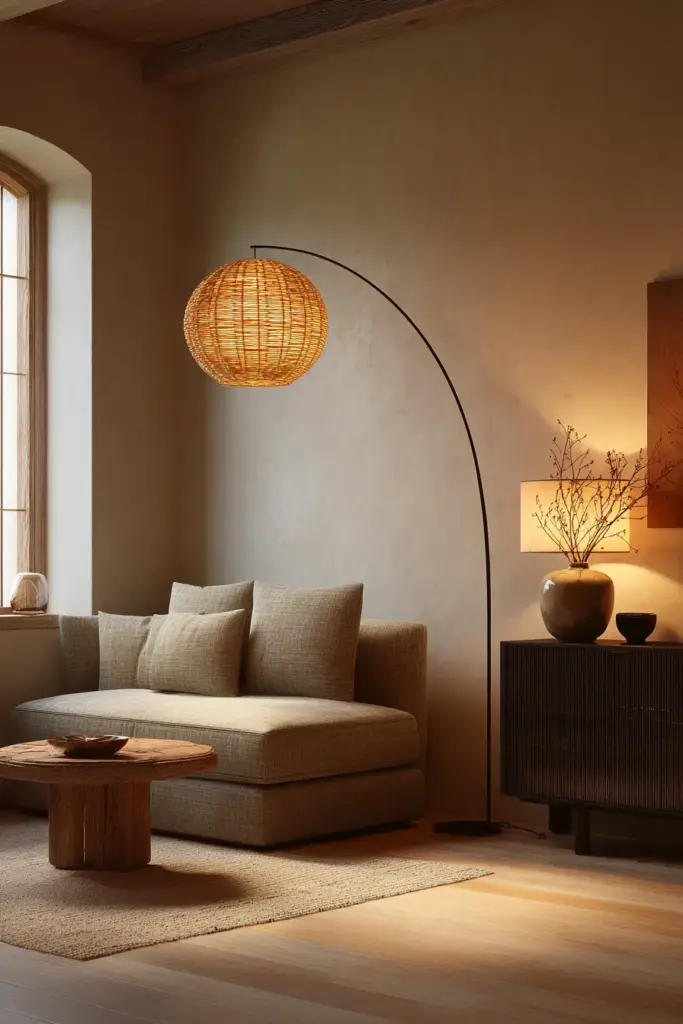
The Three-Layer Lighting Rule
A small Japandi living room needs at least three light sources at different heights:
- Ambient: A pendant light or ceiling fixture (warm white, 2700K–3000K) for overall fill light
- Task: A floor lamp beside the sofa or reading corner (adjustable arm, natural linen shade)
- Accent: A small table lamp or wall sconce to add depth and warmth to a dark corner
Placement Guide
| Light Source | Ideal Placement | Japandi Pick |
|---|---|---|
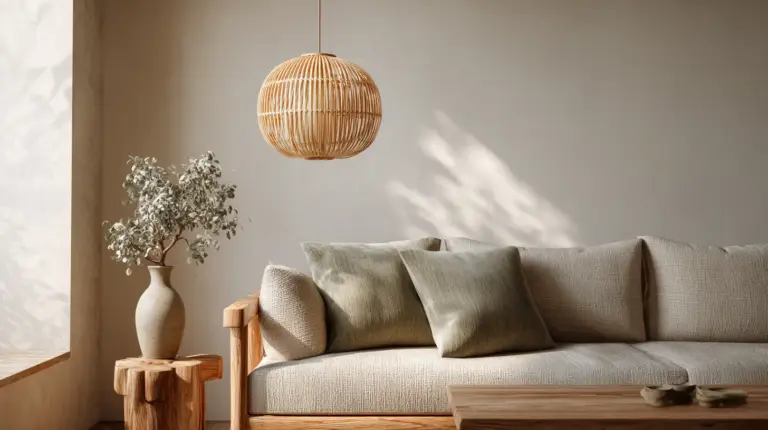
| Pendant light | Centered over seating zone | Woven rattan or paper globe |
| Floor lamp | Behind sofa arm or beside armchair | Slim arc lamp, linen shade |
| Table lamp | TV console or side table | Ceramic base, linen drum shade |
| Wall sconce | Flanking TV or above console | Minimalist brass or matte black |
Avoid: Overhead fluorescent lighting only. It flattens a room and erases the warmth Japandi depends on.
Avoid shadows behind shoji-style screens by placing a soft light source in front of them — never solely behind. Backlighting a screen creates dramatic shadows that make a small room feel cave-like.
Smart Storage in a Small Japandi Living Room
The Japandi approach to storage is simple: hide what is functional, display what is beautiful.
Multi-Functional Furniture
- Storage ottoman (55–60 cm square): Serves as coffee table, footrest, and hidden storage
- TV console with drawers: Choose a piece with at least two deep drawers for remotes, cables, and media
- Modular sofa with storage base: Available in local furniture stores, these are quietly Japandi when upholstered in linen or cotton in warm neutrals
Floating Shelves: Curated, Not Cluttered
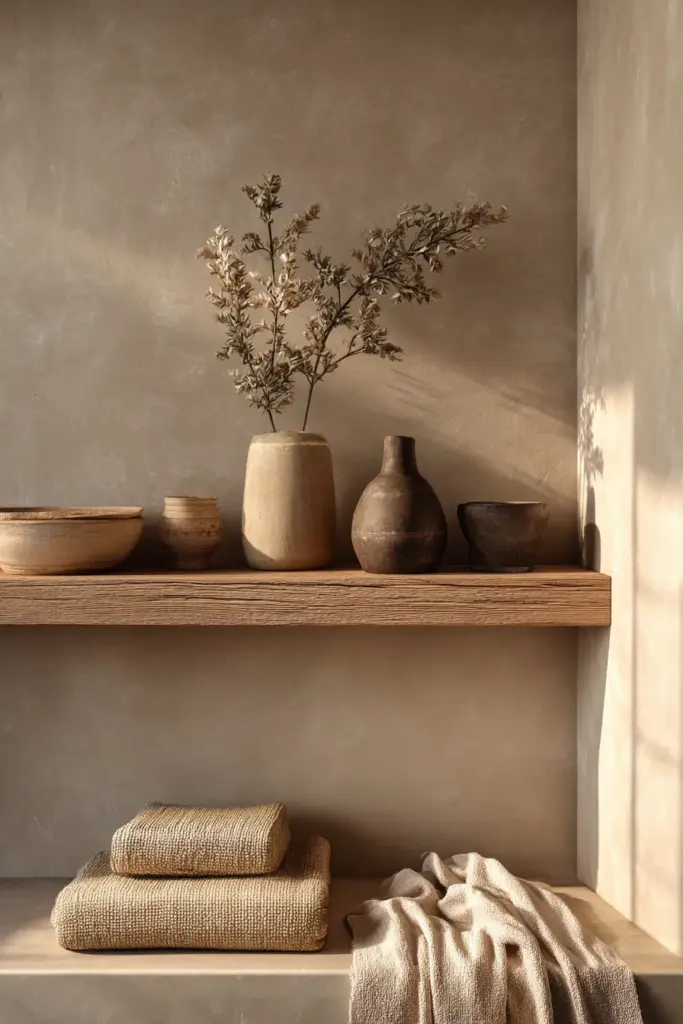
A floating shelf in a small Japandi living room should hold no more than three to five objects per shelf: a small ceramic vase, a single book stacked flat, a tiny plant, a smooth stone. Resist the urge to fill. The negative space around objects is part of the display.
Hidden Storage Under Benches
A low wooden bench (similar to a Japanese genkan bench) placed along one wall can hold baskets underneath for throw blankets, books, or shoes — keeping the floor visually clean.
Budget & DIY Japandi: Getting the Look Without Importing It
You do not need to import Scandinavian furniture to create a small Japandi living room. Here is how to do it locally and affordably.
| Element | High-End Option | Mid-Range Option | DIY / Local Option |
|---|---|---|---|
| Sofa | Danish-style linen sofa | IKEA KIVIK or local equivalent | Reupholster existing sofa in linen fabric |
| Coffee table | Solid oak slab | Bamboo or mango wood from local workshops | Sand and oil a second-hand wooden table |
| Shelving | Custom joinery | Pre-made pine shelves | DIY reclaimed wood + pipe brackets |
| Rug | Handwoven jute import | Local bayong-weave mat | Layer two inexpensive cotton mats |
| Lighting | Artisan rattan pendant | IKEA pendant + rattan shade DIY | Rewire a vintage ceramic lamp |
| Decor | Handmade ceramics | Local pottery market finds | DIY air-dry clay bowls |
Key tip: The biggest impact comes from paint and textile choices — both inexpensive. Repaint walls in warm greige and swap pillow covers to linen. The room shifts immediately.
Visual Rhythm and Balance in a Tiny Rectangular Room
A small rectangular room can feel like a corridor if furniture is placed without intention. Here is how to create Japandi balance in tight layouts.
Repeat One Shape
Choose one geometric shape — the circle — and repeat it gently. A round coffee table, a circular mirror, a spherical pendant light, a round ceramic pot. Repetition creates visual calm without monotony.
Mirror Placement
A single large mirror (70–90 cm) placed perpendicular to the window — not directly opposite — doubles natural light without creating a harsh reflection. Frame it in natural wood or matte black. Keep it clean and undecorated.
Break Visual Weight on One Wall
If three walls are light and neutral, allow one wall to carry a subtle texture — a woven wall hanging, a single piece of natural-framed art, or a cluster of three small ceramic plates. One intentional focal wall anchors the room without cluttering it.
Plants and Decor in a Small Japandi Living Room
In Japandi, plants are not accessories. They are living materials — chosen with the same care as wood or stone.
Best plants for a small Japandi living room:
- Snake plant (Sansevieria) — architectural, low-light tolerant, air-purifying
- ZZ plant — thrives in humidity, sculptural form
- Small bonsai — the ultimate Japanese design gesture
- Pothos in a hanging ceramic pot — softens a high shelf without crowding the floor
How many is too many? In a room under 25 sqm, keep plants to three to five pieces total. One large floor plant (60–80 cm tall), one or two small tabletop plants, and one hanging or shelf plant. Any more and the room tips from serene to cluttered.
Decor rule of three: For every surface — shelf, console, side table — style it with a maximum of three objects. Vary the height: tall (vase), medium (book or tray), small (stone or ceramic). Then stop.
Before & After: From Cluttered to Japandi
Here is a realistic transformation walkthrough for a 22 sqm living room.
Before:
- Dark navy accent wall, mixed furniture styles
- Large L-shaped sofa taking up 70% of floor space
- Open shelving filled with random objects and electronics
- Overhead fluorescent light only
- Patterned rug, heavy curtains
Changes made:
- Repainted all walls in warm greige (Dulux “Wheat Field” or similar)
- Replaced L-sofa with a 190 cm linen 3-seater in oat tone
- Cleared shelves to three curated objects each
- Added pendant light (rattan globe) + one floor lamp beside sofa
- Swapped curtains for linen panels in warm ivory
- Replaced patterned rug with a jute flatweave (160×240 cm)
- Added one snake plant and a small bonsai on the TV console
After:
- Room feels 30% larger
- Natural light reaches the back wall
- Eye rests easily across the space
- Cleaning time reduced by half (fewer objects, breathable materials)
Small Japandi Living Room Checklist
Use this when planning or refreshing your space.
Color & Light
- Walls in warm neutrals: beige, greige, taupe, warm white
- Three light sources at different heights
- Window treatments that filter, not block, natural light
Furniture
- Sofa max 210 cm wide with low-profile legs
- Coffee table keeps 45–60 cm clearance from sofa
- TV console floating or max 40 cm deep
- Multi-functional storage (ottoman, console with drawers)
Materials & Texture
- Light-toned wood on at least one large piece
- Natural textiles: linen, jute, cotton, rattan
- Breathable rugs (no heavy wool in tropical settings)
Decor & Plants
- Max 3–5 objects per surface
- 3–5 plants total for rooms under 25 sqm
- One mirror, perpendicular to window
- One repeated shape (circle) for visual harmony
Space & Flow
- Minimum 60 cm walking clearance around furniture
- Negative space preserved — not every corner needs filling
- Floor kept clear of bags, cables, and clutter daily
Conclusion
A small Japandi living room is not a compromise. It is a choice — to live with intention, to surround yourself with what is beautiful and useful, and to let your home breathe.
You do not need more space. You need better space. And with warm woods, soft linens, layered light, and the quiet confidence of negative space, even the most modest room becomes somewhere you never want to leave.
Start with one change. Repaint a wall. Swap a pillow cover. Add a floor lamp. Watch the room shift. That is how Japandi begins — not all at once, but gently, like morning light finding the edges of a room.
Frequently Asked Questions
How do I make a small living room look Japandi?
Start with the walls — repaint in warm beige or greige. Replace any overly ornate or bulky furniture with low-profile pieces in light wood or linen tones. Clear surfaces down to three objects each. Add a jute rug, a floor lamp, and one plant. You do not need to redecorate everything at once — Japandi builds beautifully in stages.
What colors work best for a small Japandi living room?
Warm neutrals are your foundation: beige, taupe, greige, oat, and soft terracotta as an accent. Avoid pure white, which feels clinical, and cool grays, which fight the warmth Japandi needs. Pair your wall color with light wood tones and warm ivory textiles for a cohesive, soothing palette.
What furniture should I use in a small Japandi living room?
Choose low-profile sofas (12–18 cm leg height), compact rectangular or oval coffee tables, and floating TV consoles. Prioritize multi-functional pieces: storage ottomans, benches with baskets underneath, and modular shelving. Keep the sofa under 210 cm wide and the coffee table under 100 cm long for rooms in the 20–30 sqm range.
How do I add storage in a small Japandi living room without cluttering it?
The Japandi rule is: hide what is functional, display what is beautiful. Use TV consoles with drawers, storage ottomans, and floating shelves with curated objects only. Woven baskets underneath benches and inside open consoles store items attractively. Avoid freestanding bookshelves more than 80 cm tall in rooms under 25 sqm — they visually shrink the space.
Can I do Japandi in a studio apartment or open-plan living room?
Absolutely. Use furniture placement and a large area rug to define the living zone within an open plan. A low open shelf (max 80 cm tall) can visually separate the living zone from a dining or sleeping area without closing off the space. Choose a cohesive color palette across all zones so the eye reads the whole space as one calm, unified room.
How do I keep a small Japandi living room from feeling too dark?
Layer your lighting: ambient pendant light, a floor lamp beside the sofa, and a small table lamp on the console. Place a large mirror perpendicular to your main window to double natural light. Use linen or sheer window panels in warm ivory — never block all natural light with heavy curtains. Light-toned wood and warm white walls also reflect light far better than dark or cool-toned finishes.