
Table of Contents
You’ve probably noticed it in a room where the light falls soft and golden, where linen and wood and living things coexist without noise or clutter. That’s the quiet Japandi design reaches for. And it turns out, the plants you choose aren’t just beautiful — they’re doing something extraordinary for the sound of your home.
This is the gentle art of Japandi plant acoustics: pairing the philosophy of wabi-sabi and hygge with the science of acoustic foliage to create interiors that look serene and actually feel that way. In a world full of traffic, city hum, and digital noise — especially for those of us in dense urban spaces like Metro Manila — this matters more than ever.
Lean in. We’re going to show you exactly how greenery becomes your quietest, most beautiful tool.
What Is Japandi Design — And Why Does Sound Matter?
Japandi is the marriage of Japanese minimalism and Scandinavian warmth. It favors natural textures, muted tones, handcrafted objects, and a deliberate absence of excess. Every element earns its place.
But design is never just visual. A space sounds like something too — echoes bounce off hard floors, traffic seeps through walls, voices carry in open-plan rooms. Sound is as much a part of atmosphere as light or scent.
Acoustic comfort — the feeling that a room is hushed, balanced, and serene — is foundational to the Japandi ethos. Soft furnishings, raw wood panels, woven textiles: all absorb sound. And your plants? They do it too, in ways that are both measurable and quietly remarkable.
The Science Behind Sound-Absorbing Plants
How Leaves, Stems, and Soil Catch Sound
Sound travels as vibration. When those vibrations hit a hard surface, they bounce back — creating echo, reverb, and that slightly harsh quality you feel in bare rooms.
Plants interrupt this cycle beautifully. Their leaves scatter and absorb sound waves, their stems vibrate softly at certain frequencies, and their soil acts as a low-frequency dampening layer. The result is a measurable reduction in reverberation.
Studies show that ferns, in particular, absorb up to 98% of sound at mid-to-high frequencies — roughly the range of human speech and urban noise. Broad-leafed plants like fiddle-leaf figs and bamboo palms are especially effective at scattering high-frequency reflections.
Frequency Data: What Plants Actually Absorb
Not all plants perform equally across the sound spectrum. Here’s a quick reference for Japandi-appropriate choices:
| Plant | Leaf Type | Best Frequency Range | Acoustic Strength |
|---|---|---|---|
| Boston Fern | Feathery, dense | Mid-high (1k–4kHz) | Very High (up to 98%) |
| Fiddle-Leaf Fig | Broad, waxy | High frequencies | High |
| Bamboo Palm | Feathery fronds | Mid-high | High |
| ZZ Plant | Waxy, stiff | Low-mid (100–315 Hz: ~0.59 absorption) | Moderate |
| Peace Lily | Broad, soft | Mid frequencies | Moderate–High |
| Cast Iron Plant | Dense, upright | Low-mid | Moderate |
| Snake Plant | Tall, structured | Mid frequencies | Moderate |
Grouping five or more ferns in a corner can reduce echo by 5–10 dB — a meaningful, perceptible drop, especially in a hard-floored apartment. That’s not a minor effect. That’s the difference between a room that rings and one that breathes.
The Best Plants for Japandi Acoustics
Ferns: The Quiet Champions
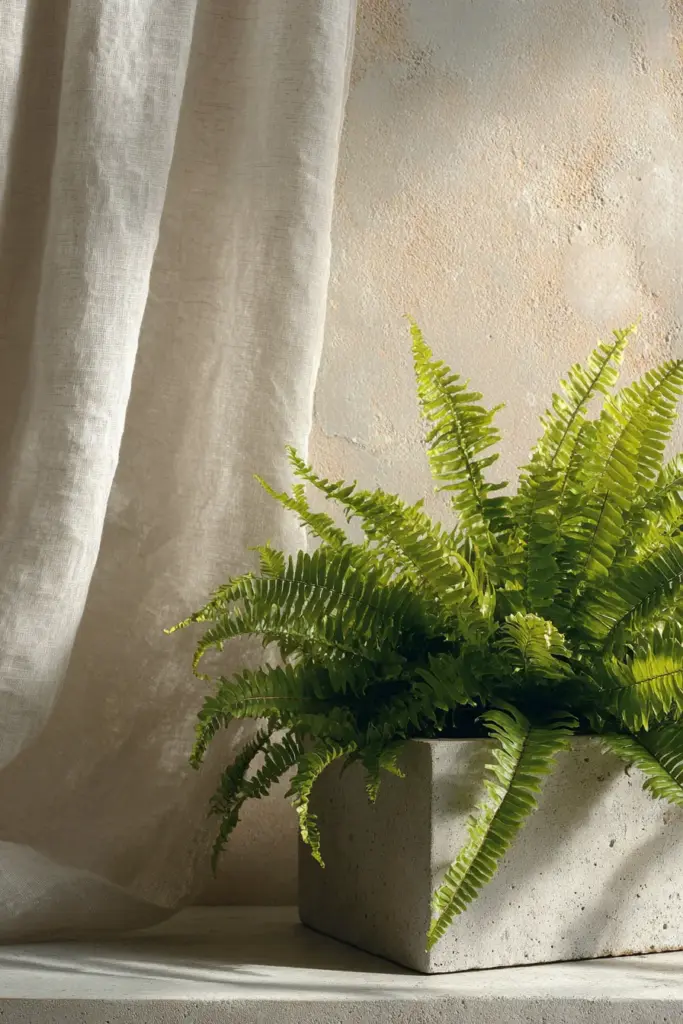
No plant works harder acoustically than a fern. The Boston fern’s dense, arching fronds scatter sound at multiple angles, making it extraordinary for mid-to-high frequency absorption.
In a Japandi space, cluster three to five ferns in a shallow concrete or matte ceramic trough near a window. Their soft, feathery texture softens not just sound but light — casting dappled shadows that feel like movement. Pair them with a linen curtain behind them for layered dampening.
Design note: Ferns thrive in indirect light and high humidity — ideal for bathrooms or kitchens where hard surfaces create the most reverberation.
Fiddle-Leaf Fig: Statement Piece, Acoustic Anchor
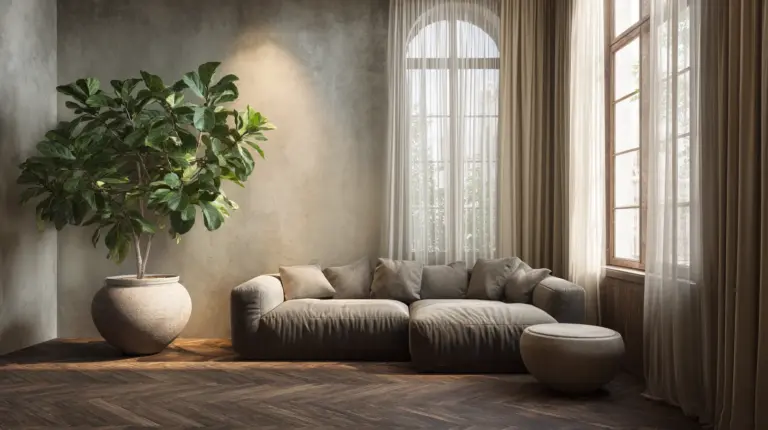
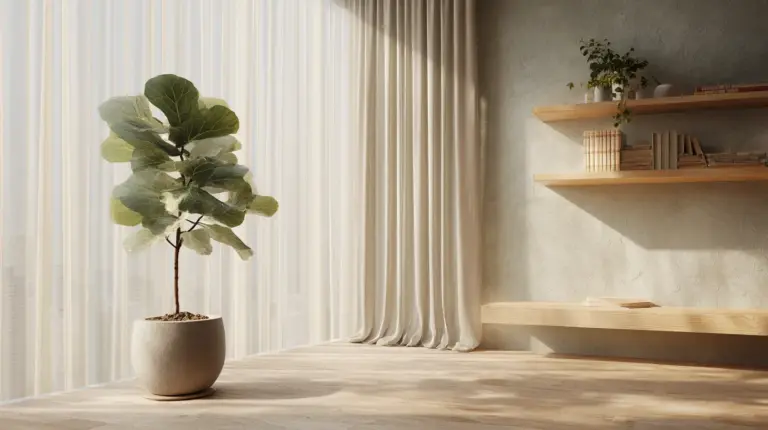
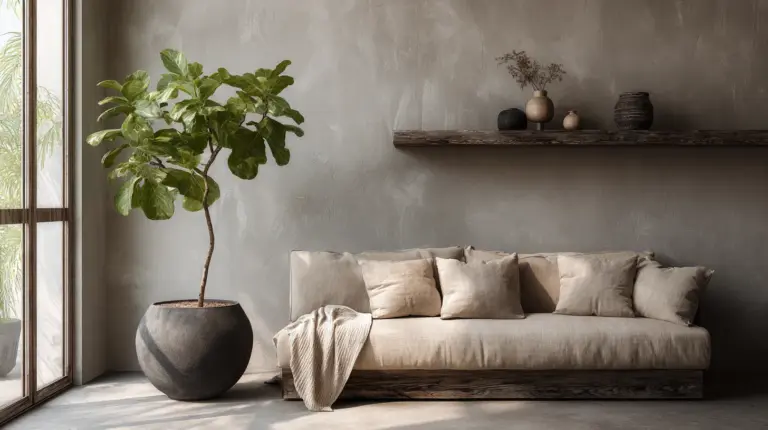
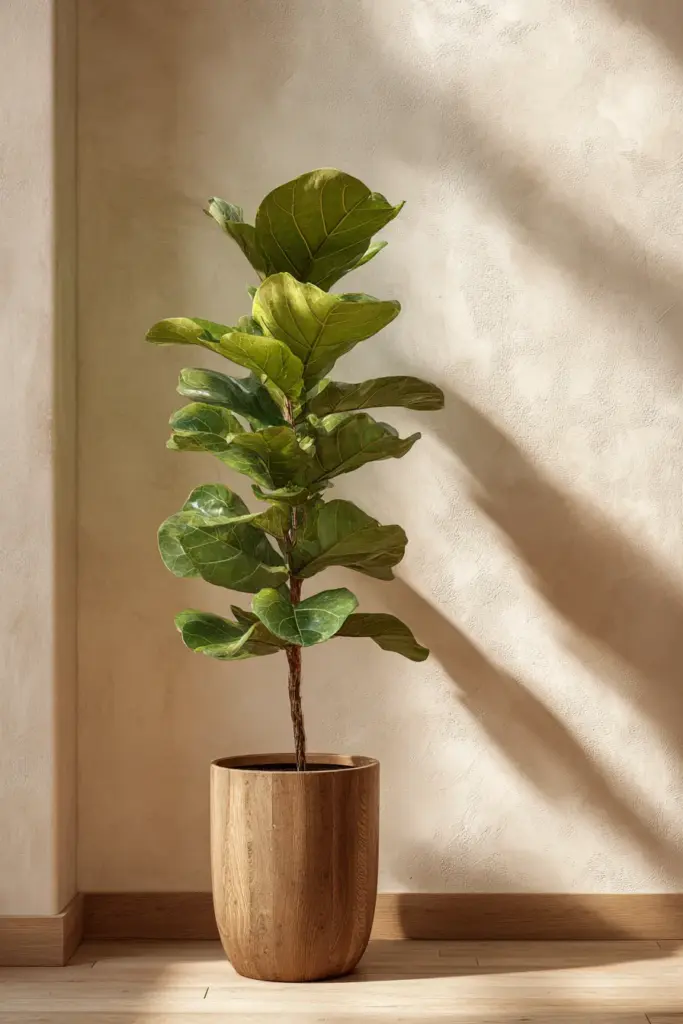
The fiddle-leaf fig (Ficus lyrata) is already a Japandi icon for its sculptural silhouette and bold leaf shape. Those broad, glossy leaves are also excellent high-frequency absorbers.
Place a mature fiddle-leaf fig in a slim oak or walnut pot in your living room corner — ideally near a concrete wall or tiled floor where sound bounces hardest. It becomes both focal point and functional acoustic buffer. This is Japandi design at its most satisfying: beauty that earns every inch of space.
Bamboo Palm: Warmth, Movement, and Sound
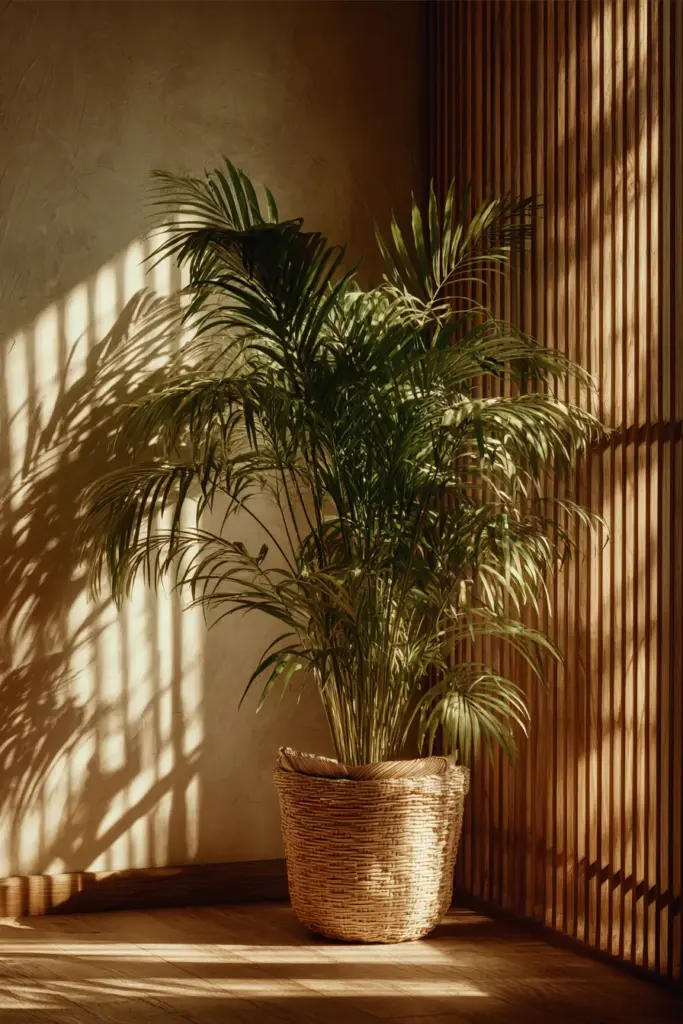
The bamboo palm brings something ferns and fiddle-leaf figs don’t — movement. Its feathery fronds sway slightly even in still air, scattering sound dynamically.
It grows lushly and clusters naturally, making it ideal for creating a living corner near a media wall or large window. Set it in a rattan or woven grass planter to reinforce Japandi’s natural material language. Against a wood-slat screen, a bamboo palm creates an acoustic wall that also looks curated and calm.
ZZ Plant: The Low-Light Acoustic Workhorse
The ZZ plant (Zamioculcas zamiifolia) is practically indestructible — and in dark Japandi corners where other plants would struggle, it quietly performs.
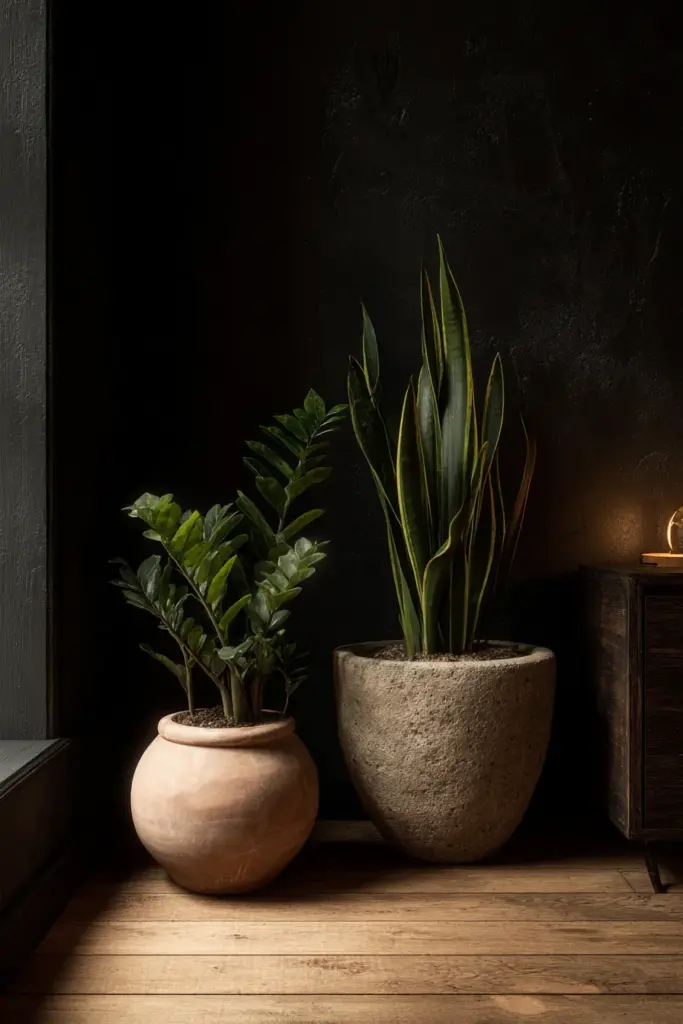
Its waxy, structured leaves absorb low-to-mid frequencies, making it particularly good at softening the low rumble of traffic or HVAC hum that plagues urban apartments. Place it beside a side table in a matte black or warm terracotta pot. It requires almost no maintenance and rewards you with structural beauty year-round.
Snake Plant: Upright Elegance, Steady Quiet
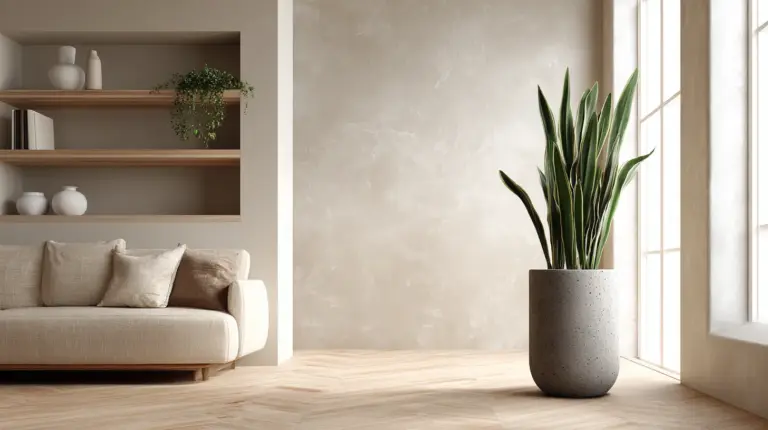
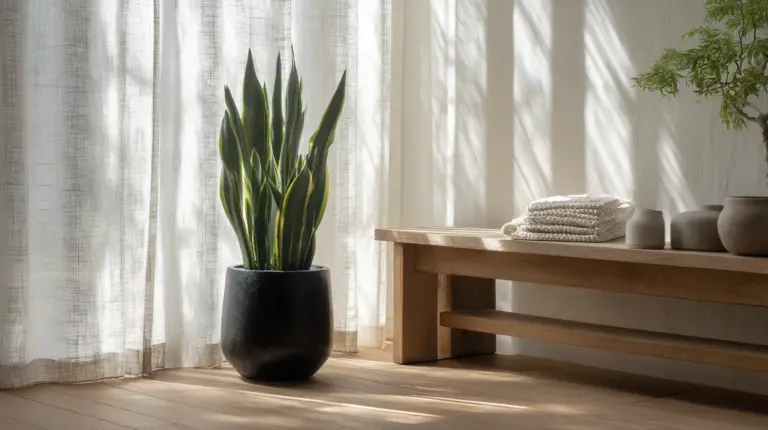
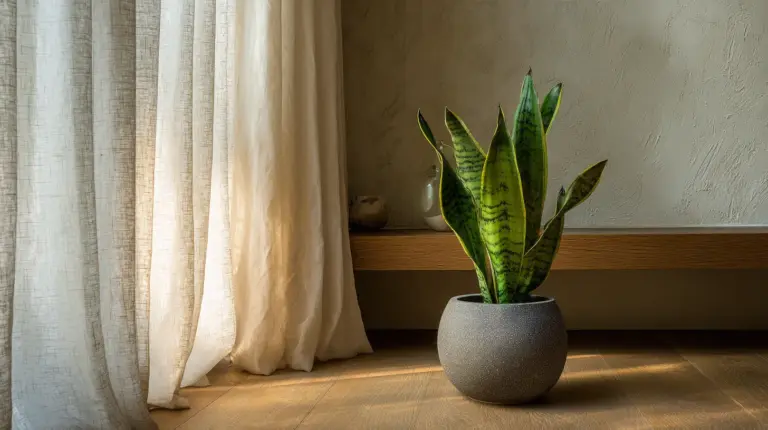
The snake plant (Sansevieria) offers vertical lines that feel deliberate and architectural — perfectly Japandi. Its stiff, upright leaves absorb mid-range frequencies and work especially well in narrow hallways or beside doorways where sound travels most.
Pair it with a flat-sided stone or raw concrete planter. A grouping of three, varied in height, creates a moment of quiet drama that also softens the acoustics of transitional spaces.
Peace Lily: Softness in Every Form
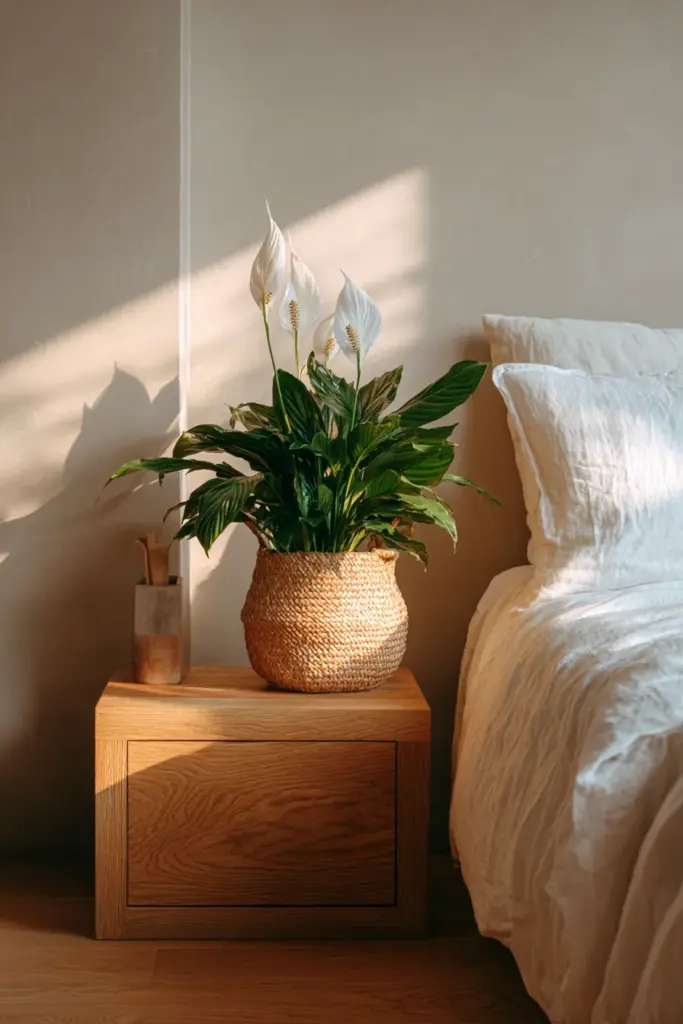
The peace lily is softer in silhouette than most acoustic performers — drooping leaves, gentle blooms, an almost tender presence. It absorbs mid-range frequencies well and thrives in low light.
In a Japandi bedroom or meditation corner, it’s unmatched. Place it on a low wooden platform beside a woven basket. The humidity it releases also gently moistens the air, which subtly enhances sound absorption across all frequencies. Humid air carries sound differently — and more softly.
Cast Iron Plant: Dim Corners, Quiet Rooms
The cast iron plant (Aspidistra elatior) is built for the corners other plants won’t touch. It thrives in deep shade and dry conditions, making it ideal for Japandi interiors where direct light is precious and deliberately controlled.
Its dense, broad leaves absorb low-mid frequencies — useful in rooms where bass frequencies (from music, traffic, footsteps on upper floors) are the primary issue. It asks almost nothing of you. In return, it softens your room quietly and completely.
Styling Japandi Plant Acoustics: Room by Room
Living Room: The Layered Green Wall
The living room is usually where urban noise is most intrusive and reverb is most noticeable. Hard floors, plaster walls, glass windows — sound has nowhere to go.
Create a living acoustic corner using this layering approach:
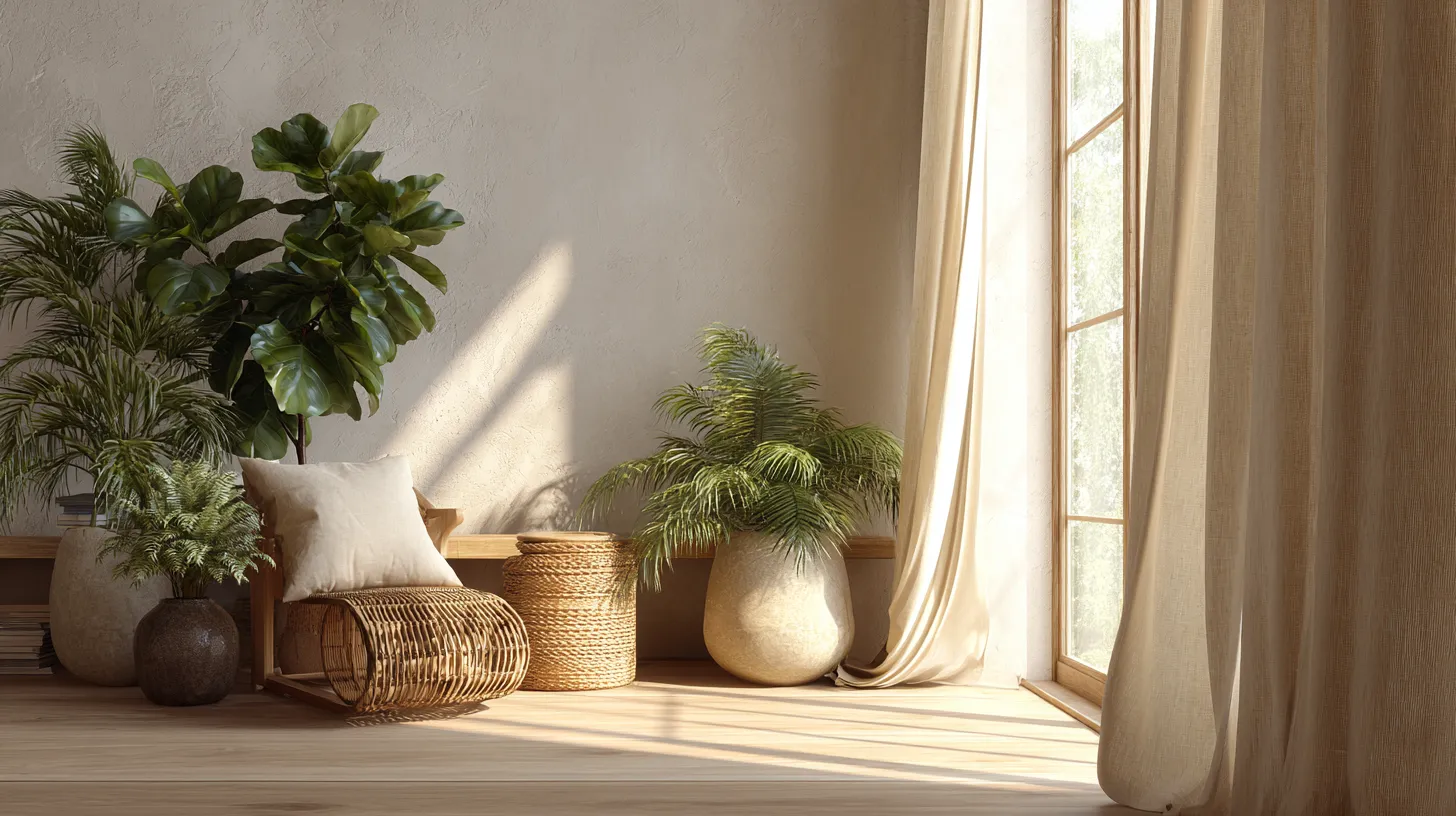
- A bamboo palm or fiddle-leaf fig as the tall anchor (back layer)
- Three ferns in graduating heights (mid layer)
- A snake plant or ZZ plant at the floor (front layer)
- A felt or wool panel behind the plants, mounted directly on the wall
This combination works because each layer scatters sound at different heights and frequencies. The felt panel behind the plants amplifies their effect significantly. Choose neutral tones — warm oat, soft grey, undyed wool — to keep the palette Japandi-pure.
Bedroom: Softness Before Sleep
Bedrooms benefit most from mid-to-high frequency dampening — the range of conversation, late-night traffic, and ambient building noise.
A peace lily on a low oak nightstand, combined with a snake plant in the corner and a trailing pothos along a shelf, creates a sound environment that feels genuinely softer. Use matte glazed ceramic pots in warm whites or dusty greens. Layer with a thick linen duvet and a wool rug to complete the acoustic softening.
Home Office: Focus Without Harshness
Hard surfaces in home offices — desks, screens, shelving — create a sharp acoustic environment that subtly increases cognitive load.
Flank your workspace with two boston ferns in identical woven planters. Add a ZZ plant beside your monitor for low-frequency balance. If your office has exposed concrete or tile, a jute or sisal rug beneath your desk will collaborate with your plants beautifully.
Small Apartment, Big Impact: The Urban Noise Challenge
For those of us in Quezon City and Metro Manila’s denser neighborhoods, urban noise is constant and layered — traffic, neighbors, construction. Small apartments make this harder because there are fewer surfaces to absorb sound.
A tested configuration for a small space:
- 5 ferns clustered in a single corner = approximately 7 dB reduction in echo
- ZZ plant near the window = low-frequency street noise buffer
- Peace lily near the bed = mid-frequency softening
- Felt panel + succulents on one wall = DIY acoustic panel with Japandi character
This isn’t a dramatic renovation. It’s a collection of considered, beautiful choices that collectively reshape how your home sounds.
Containers and Materials Matter Too
The pot you choose is acoustic — and aesthetic — infrastructure.
Rattan and woven grass planters are porous and slightly flexible, adding to sound diffusion at the surface level. Matte ceramic and stone pots add mass without being reflective. Terracotta is slightly absorbent and pairs beautifully with warm Japandi palettes.
Avoid glossy glazed ceramics and hard plastic — both are acoustically reflective and work against the softness you’re building.
Soil matters too: dense, moist soil absorbs more low-frequency sound than dry, compact soil. Water your acoustic plants consistently, and consider adding a layer of moss or fine gravel on top — both add surface texture that diffuses sound at close range.
Checklist: Your Japandi Plant Acoustics Essentials
- Choose broad-leafed or feathery plants — fiddle-leaf figs, ferns, bamboo palms for best absorption
- Cluster, don’t scatter — 5 ferns together absorb exponentially more than 5 ferns spread across a room
- Layer by height — tall anchor, mid-layer shrub, low ground plant creates multi-frequency coverage
- Add a felt or wool backing panel behind a plant cluster to amplify effect
- Use matte, porous containers — rattan, raw ceramic, terracotta over glossy or plastic
- Place plants near hard surfaces — walls, glass doors, tiled floors are where sound bounces most
- Keep soil consistently moist — hydrated plants and soil perform better acoustically
- Layer with soft textiles — rugs, linen curtains, and wool throws collaborate with your plants
- Don’t forget low-light corners — ZZ plant and cast iron plant work acoustically where others won’t
- Start with one living corner — even a single cluster of 3–5 plants creates a perceptible difference
Conclusion
The home you’re creating is trying to tell you something.
It wants to be quiet in the right way — not empty, but full of the kind of stillness that restores. Japandi design has always understood that beauty and function are the same thing, when you pay close enough attention.
Your plants are not decoration. They are collaborators — softening light, cleaning air, and now, turning down the volume on the world outside. A fiddle-leaf fig in the corner of your living room, a cluster of ferns near the window, a peace lily beside where you sleep: each one is an investment in the quality of your silence.
At ERYLIN, we believe your home should feel as good as it looks. Sometimes, that begins with a leaf.
Frequently Asked Questions
Do ZZ plants reduce echo in Japandi homes?
Yes, though moderately. ZZ plants absorb low-to-mid frequencies (around 100–315 Hz) at a coefficient of approximately 0.59 — making them particularly effective against traffic hum and low ambient noise. They perform best when grouped and placed near reflective surfaces like glass windows or tiled walls. Their low-maintenance nature makes them ideal for dim Japandi corners where other acoustic plants wouldn’t survive.
Which plants are best for Japandi interiors with noise issues?
For maximum acoustic impact in a Japandi-styled home, prioritize: Boston ferns (up to 98% mid-to-high frequency absorption), fiddle-leaf figs (high-frequency scattering), bamboo palms (broad mid-high coverage), and peace lilies (mid-range softening with added humidity). Cluster them for best results — five or more ferns in a single corner can reduce reverberation by 5–10 dB.
Do plants actually help with soundproofing in small apartments?
Plants don’t soundproof — they dampen reverberation and reduce echo within a room. For small apartments dealing with urban noise, this is still deeply meaningful. A well-composed plant cluster near a hard wall can make a room feel noticeably quieter and more settled. Pair with soft textiles (wool rugs, linen curtains) and a felt backing panel to significantly amplify the effect.
How do I style acoustic plants in a Japandi aesthetic without it looking cluttered?
Use the layering principle: one tall anchor plant, one mid-height cluster, and one low ground-level plant, all in a single corner. Choose pots in a tonal palette — warm clay, oat white, soft slate — rather than mismatched colors. Stick to three to five plant varieties maximum per room. Less is always more in Japandi design; even your acoustic wall should feel intentional and edited.
What containers should I use for acoustic plants in a Japandi home?
Choose rattan, woven grass, raw terracotta, matte ceramic, or stone planters. These materials are slightly porous or textured, contributing to sound diffusion rather than reflection. Avoid high-gloss ceramic or plastic. For an elevated look, consider placing pots on a low slatted wood platform — it lifts the arrangement visually while keeping the palette grounded in natural materials.