
Table of Contents
There’s a particular kind of calm that settles into a room when everything has a home. Not the sterile, lifeless quiet of an empty space — but the deep, easy exhale of a room that holds exactly what it needs and nothing more. That is the soul of Japandi design, and it begins with how you store.
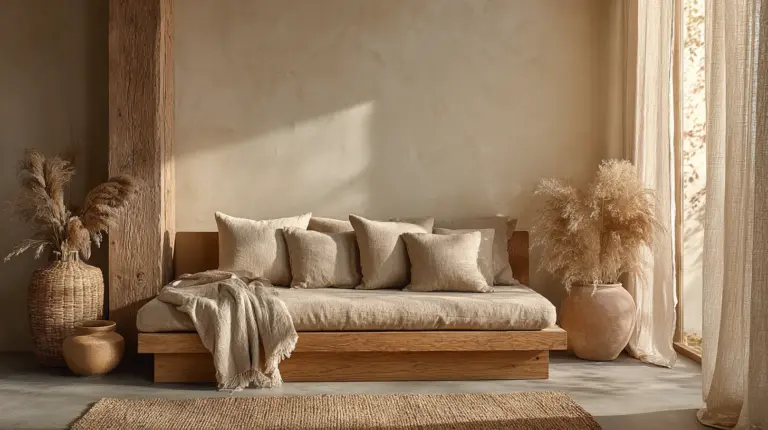
Japandi living room storage solutions are not just about tidying up. They’re about choosing pieces that breathe with you — low credenzas in pale oak, lidded baskets woven from rattan, floating shelves that let the wall rest. The philosophy borrows from Japanese wabi-sabi (beauty in imperfection) and Scandinavian hygge (warmth in simplicity), and together they create something quietly radical: a living room that feels both curated and lived-in.
If you’ve been staring at your sala and wondering how to make it feel more intentional — less “tambayan overflow” and more grounded sanctuary — you’re in the right place. ERYLIN is here to walk you through it, zone by zone, material by material, with practical advice for real homes and real lives.
Whether you’re working with a compact apartment in the city or a medium-sized family living room, these Japandi living room storage ideas will help you build a space that holds your everyday life beautifully.
Why Storage is the Heart of a Japandi Living Room
Most people think Japandi is about what you remove. In reality, it’s about what you replace — trading visual noise for thoughtful systems that honor your things.
In a Japandi room, storage is never an afterthought. It is designed into the architecture of the space: a low cabinet that doubles as a media console, a bench by the entry that tucks away bags and shoes, a cluster of identical baskets that corrals everything from power banks to extra pillows.
The result is a room that looks intentional because it is intentional. Every storage decision was made with both function and feeling in mind.
Mapping Your Living Room Into Storage Zones
Before choosing any furniture, walk through your living room and identify your three natural zones. This zone-based thinking is the fastest way to create a coherent Japandi storage flow in even the smallest apartment.
Zone 1: The TV Wall — Your Anchor
The wall where your television lives is the most visually dominant surface in your sala. It deserves your most intentional storage design.
The Low Credenza: Your Foundation Piece
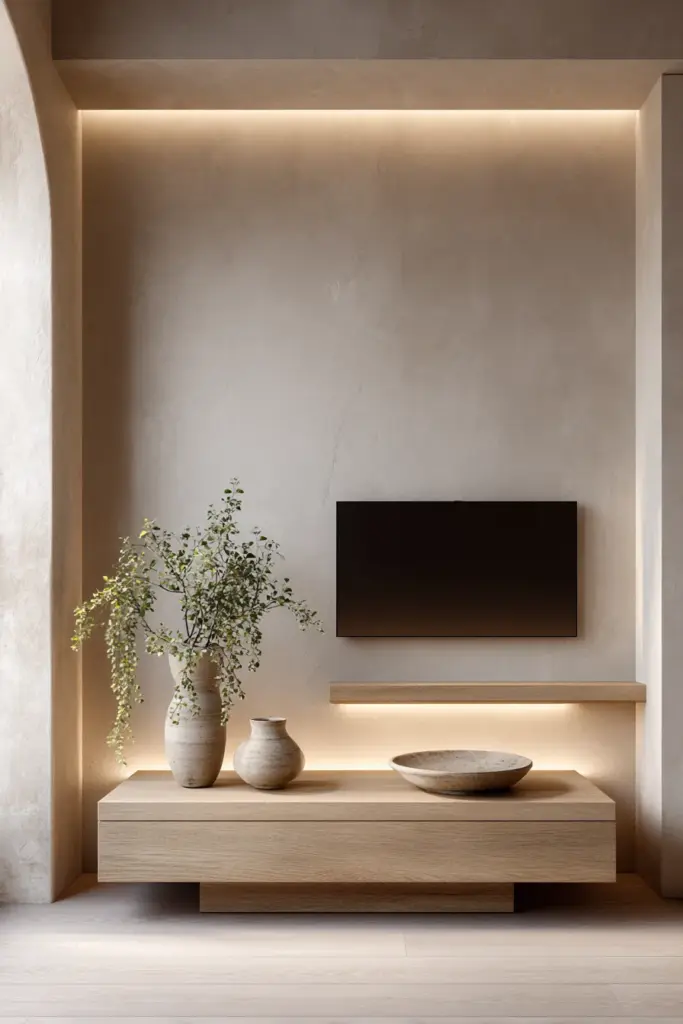
A low, flat credenza in light oak or walnut sets the Japandi tone immediately. It should sit roughly 40–50 cm off the floor — low enough to feel grounded, with enough clearance beneath for a calm negative space or a small planter.
Inside the credenza, store your routers, extension cords, gaming controllers, and remotes. Choose a unit with ventilation slots or drill small holes at the back to manage cables cleanly and keep electronics from overheating. This is your “invisible tech” zone — everything functional, nothing visible.
Vertical Shelving: Lift the Eye
Flank your credenza with two narrow vertical shelves — no deeper than 25–30 cm. Use the shelves to display a small rotation of objects: a ceramic bowl, a trailing pothos, two or three books turned spine-inward for a softer look.
Recommended dimensions for an 8-foot-wide TV wall:
- Credenza: 120–150 cm wide × 45 cm deep × 50 cm tall
- Side shelves: 25 cm wide × 25 cm deep × 150–180 cm tall
LED Strip Lighting: Mood and Function
Tuck warm LED strips (2700K–3000K) along the back edge of your shelves or under the credenza’s lip. This color temperature mimics candlelight and gives your storage wall that golden, calm glow that defines the Japandi aesthetic after sundown.
Zone 2: The Sofa Wall — Softness and Reach
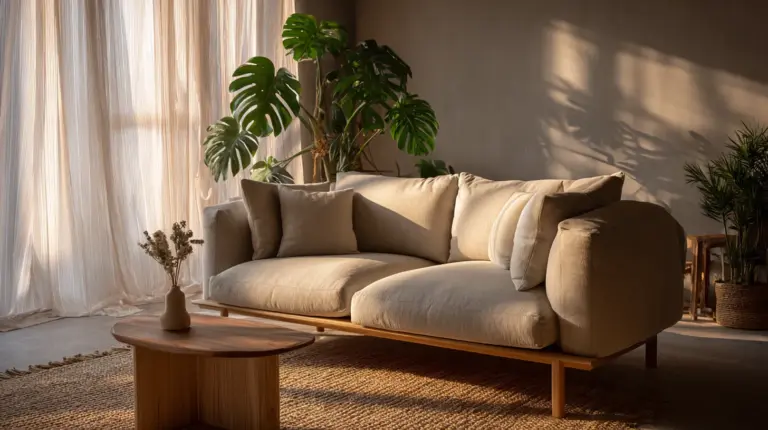
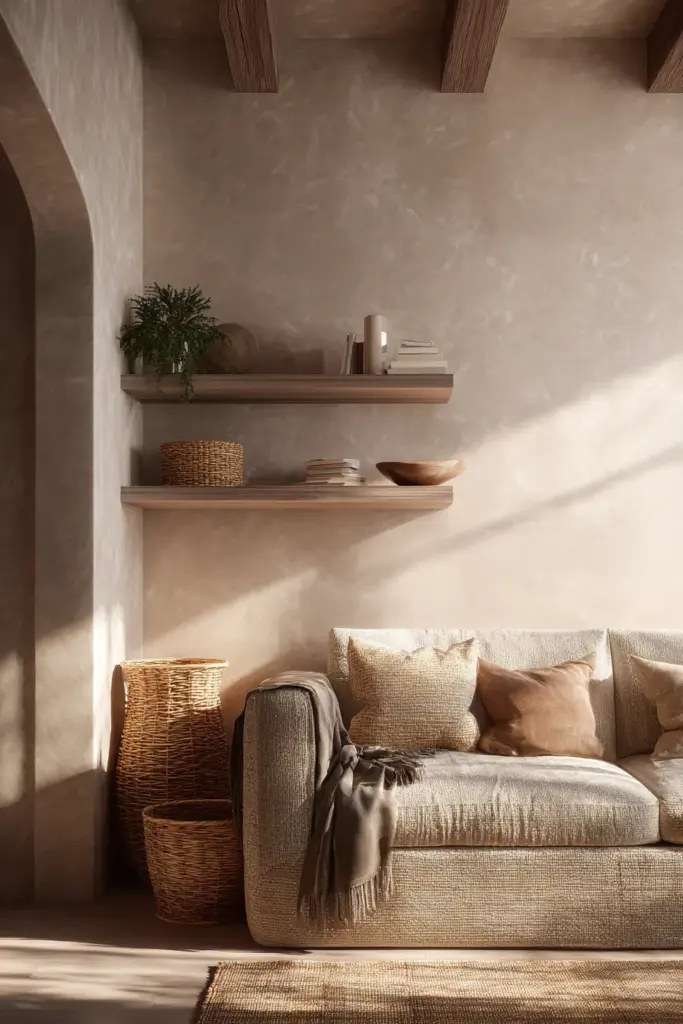
The wall behind or beside your sofa is your everyday-access zone. This is where you store what you actually reach for: blankets, magazines, remote controls, snacks, and the things that quietly accumulate on every Filipino family’s coffee table.
Wall-Mounted Slim Shelves
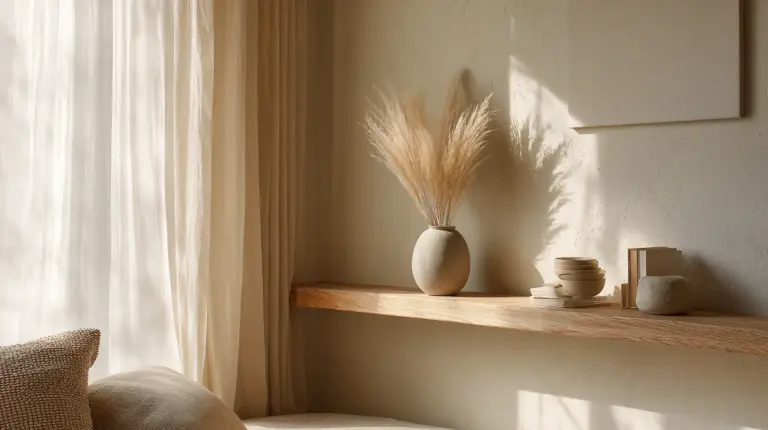
Install two or three slim floating shelves at staggered heights above the sofa or along an adjacent wall. Keep them airy — no more than 20 cm deep. Style them with a mix of functional and beautiful: a lidded box for remotes, a small plant, a scented candle in a matte ceramic vessel.
Natural Baskets: The Japandi Workhorse
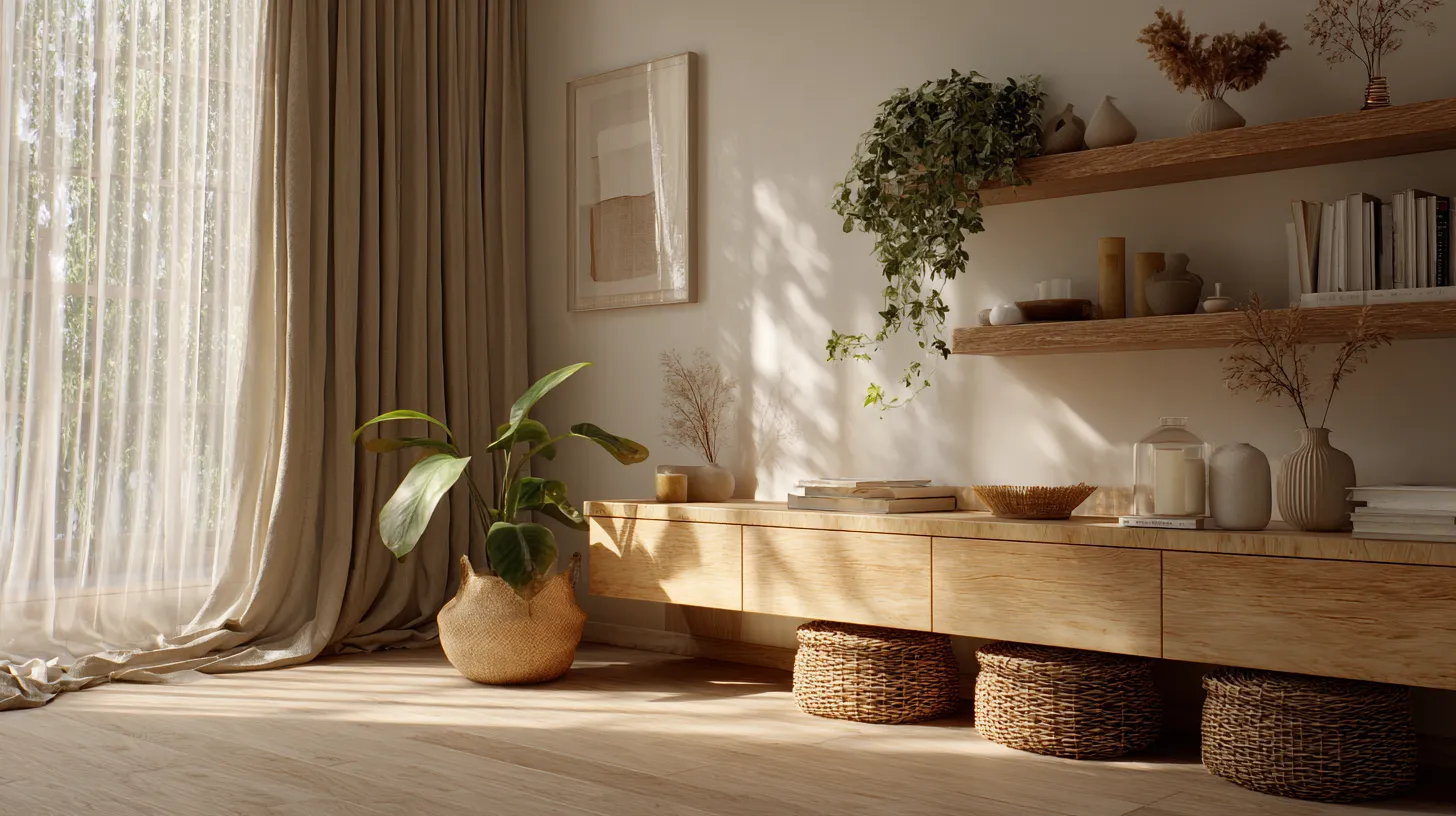
Nothing does more for a Japandi living room than a well-placed basket. Rattan, seagrass, and woven abaca baskets are ideal for the Philippine climate — they breathe, they’re naturally beautiful, and they hide everything from charging cables to kids’ toys without looking cluttered.
Use same-sized baskets in matching tones for a label-free, cohesive look. Stack two vertically beside the sofa for blankets and throws. Tuck one under the coffee table for reading material or the TV remote.
The Coffee Table as Storage
Choose a coffee table with a lower shelf or internal compartment. A solid wood table with a rattan-weave shelf beneath gives you visible, intentional storage — magazines, a small tray, a candle — while keeping the surface clear for tea, snacks, or a single statement object.
Zone 3: The Corner and Entry-Adjacent Wall — Hidden Everyday Life
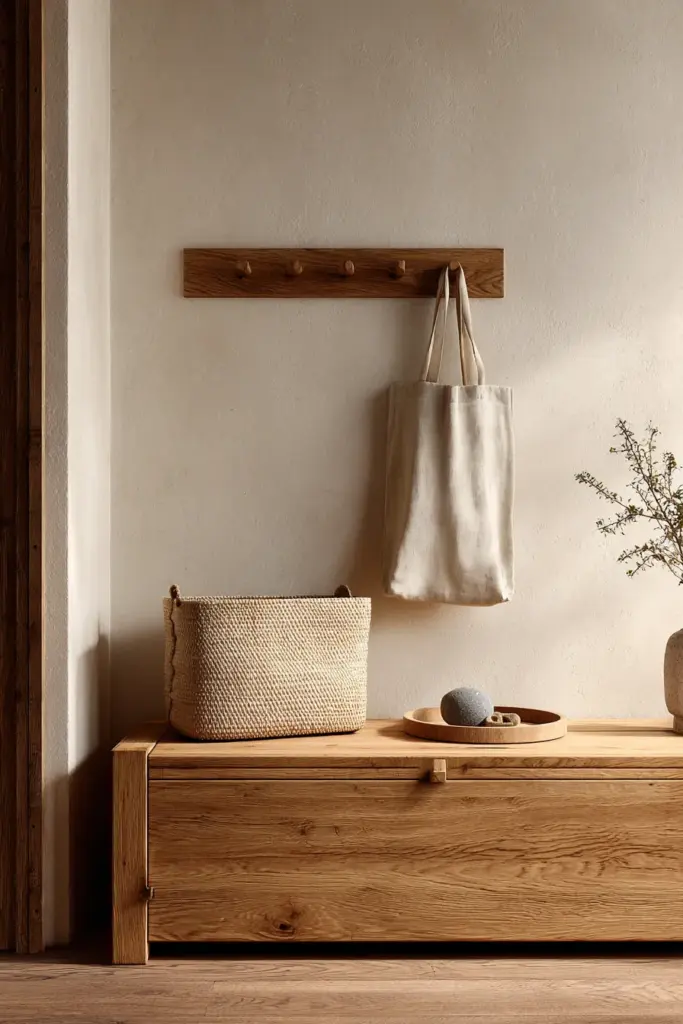
This is the zone that most Japandi guides forget — the catch-all corner where bags land, shoes pile up, and the reality of daily life accumulates. In a Japandi room, this zone is handled with a storage bench and peg rail.
The Storage Bench
A low bench in natural wood with a hinged seat or under-seat drawer is one of the most practical investments you can make for a small living room. Store school bags, fans, extra slippers, and rainy-season umbrellas inside. On top, keep a single woven tray for keys and small items.
For families: Place the bench at around 40 cm height so children can reach the top, and store their things — small toys, books, water bottles — inside at easy-access height.
Peg Rail: Simple, Beautiful, Functional
Mount a slim wooden peg rail at about 150–160 cm height along the corner wall. Hang reusable bags, light jackets, and small pouches. It looks intentional, it is accessible, and it keeps the floor completely clear.
Choosing the Right Materials for Japandi Storage
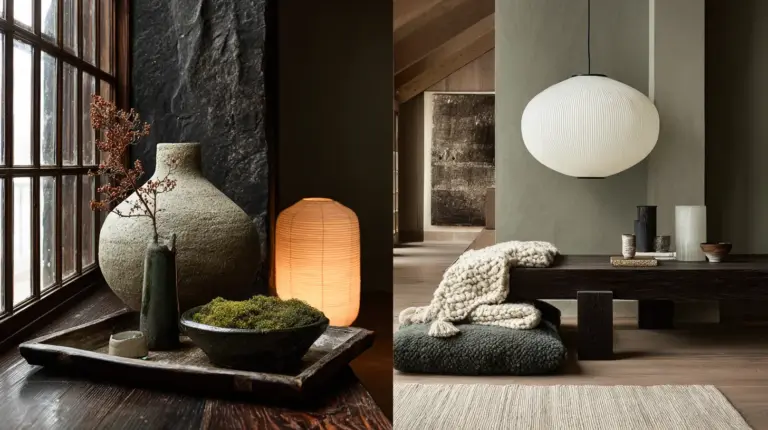
The materials you choose do as much emotional work as the forms they take. Japandi storage lives in a palette of natural, tactile, calm.
| Material | Best Used For | Feel It Creates |
|---|---|---|
| Light oak | Credenzas, shelving frames | Airy, Scandinavian warmth |
| Walnut | Accent furniture, trays | Rich, Japanese depth |
| Rattan / seagrass | Baskets, inserts, shelf accents | Organic, breathable, tropical-Japandi |
| Bamboo | Lightweight shelves, trays | Clean, minimal, sustainable |
| Linen / cotton fabric | Basket liners, drawer covers | Soft, textural, quiet |
| Matte ceramic | Lidded containers, small vessels | Grounded, artisanal |
Avoid high-gloss finishes, chrome hardware, and plastic containers in open storage areas — they break the sensory calm immediately.
Biophilic Storage: Plants and Hidden Drawers Together
Most interiors treat plants and storage as separate categories. In a truly Japandi room, they speak to each other.
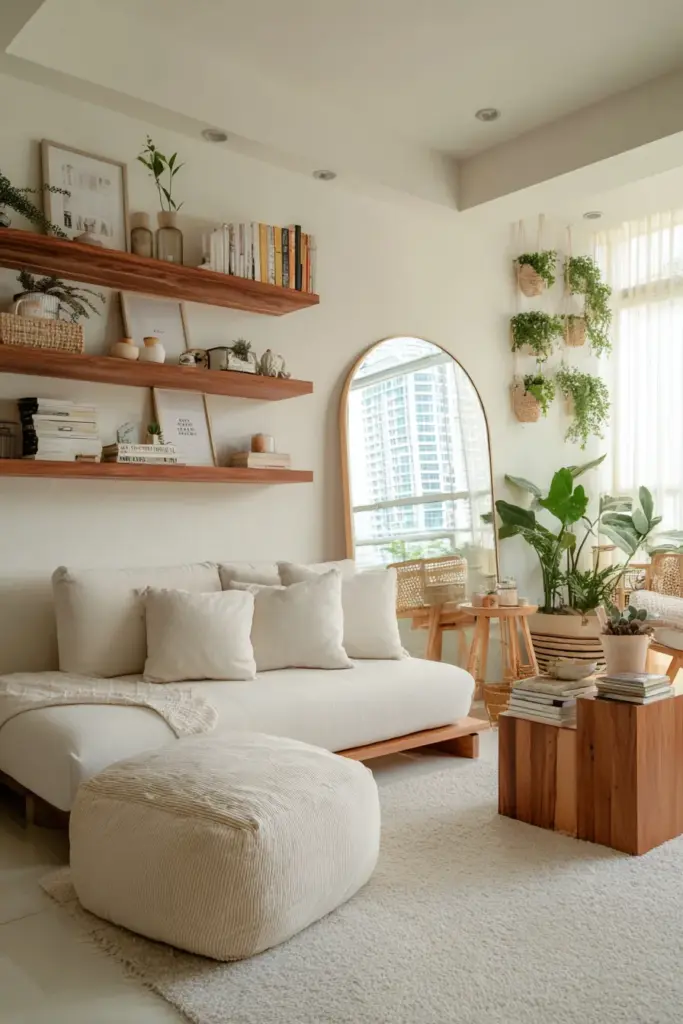
Consider a low Japandi-style planter with a hidden drawer beneath — perfect for storing a power bank, a small notebook, or a deck of cards. Or mount a wall-hanging planter system just above a slim floating shelf, so the trailing leaves soften the visual weight of the stored objects below.
In humid climates like Manila’s, vertical planters are especially effective — they use wall space rather than floor space, and the natural moisture from plants keeps the air feeling fresh and alive. Pair a vertical planter arrangement with a wall-mounted narrow shelf directly below it for a cohesive biophilic storage moment.
Hiding Tech in a Japandi Living Room
Routers, power strips, tablets, kids’ tablets, portable speakers, and charging hubs are the quiet enemies of every beautiful living room. In a Japandi home, they simply disappear.
The key is dedicated tech storage built into your credenza or a slim side cabinet:
- Route all cords through a single cable tray mounted inside the cabinet
- Use a ventilated cabinet door to allow airflow while hiding equipment
- Store devices in a single fabric-lined drawer so they charge out of sight
For families managing multiple devices, a slim charging station drawer — lined in natural linen, fitted with a multi-port USB hub — keeps everything organized without creating visual clutter on surfaces.
Japandi Storage on a Budget: Spend, Save, and Splurge
You don’t need to replace everything at once. Japandi is built gradually, with intention.
| Priority | Where to Spend | Why |
|---|---|---|
| Splurge | Built-in low credenza for the TV wall | It anchors the whole room and lasts decades |
| Spend | Quality rattan baskets in matching sets | They’re visible daily and do heavy lifting |
| Save | DIY floating shelves (wood + wall brackets) | Painted in white or warm beige, they look elevated |
| Save | Repurposed wooden crates as shelf clusters | Sand, stain light, and line with fabric baskets |
| Save | Retrofit old “kabinet” with sliding doors | Replace old hardware, add light wood stain, use neutral fabric baskets inside |
The best DIY hack for Philippine homes: Old wooden display cabinets (the kind you’ll find in every province or ukay-ukay furniture shop) can be transformed into Japandi-style storage with a light sand, a coat of natural wood stain, and new matte black or brass hardware. Add a sheer linen curtain instead of glass doors for a soft, curated look at almost no cost.
Keeping It Japandi Long-Term: The 10-Minute Reset
The most beautiful storage system falls apart without a rhythm to maintain it. Japandi is not a one-time event — it’s a daily practice.
The 10-minute nightly reset:
- Return everything to its designated basket or shelf
- Clear all surfaces down to the “base layer” (one tray, one plant, one object)
- Fold blankets and return them to their basket
- Tuck devices into their charging spots
- Wipe down the coffee table surface
Seasonal rotation: Keep a single labeled box in a storage room or cabinet for seasonal items — Christmas decor, extra blankets for cold months, rainy-season essentials. Rotate them in and out on a schedule so they never accumulate in your living room storage.
Label-free organization: Use same-sized baskets throughout, and vary only by placement — lower baskets for daily use, upper shelves for rarely-touched items. This creates visual order without the clinical feel of labeled bins.
Japandi Storage Accessibility Guide
Think of your storage in three vertical layers, each serving a different member of your household.
- 0–30 cm (floor level): Kids’ reach — small toy baskets, kids’ books, low drawers
- 30–120 cm (daily use zone): The most-used items — remote controls, chargers, snacks, blankets
- 120–180 cm (occasional access): Seasonal items, extra linens, rarely-used objects
- Above 180 cm: Display only — ceramics, art objects, plants that can fend for themselves
This hierarchy keeps your home accessible for everyone while maintaining the serene, uncluttered look Japandi is known for.
Your Japandi Storage Checklist
- Choose 1–2 storage zones and fully address each before moving to the next
- Select 1 multi-functional furniture piece (storage bench, coffee table with shelf, ottoman with lid)
- Add 1 vertical storage element (floating shelves, tall slim cabinet, peg rail)
- Invest in 1 matching set of natural baskets (rattan, seagrass, or abaca)
- Hide all tech and cables inside ventilated closed storage
- Incorporate 1 biophilic element near storage (trailing plant above shelf, planter with drawer)
- Choose warm LED lighting (2700K–3000K) for shelf and credenza illumination
- Establish a daily 10-minute reset routine to maintain the look
Closing: The Room That Breathes
Imagine walking into your living room at the end of the day. The television is off. The surfaces are clear. A rattan basket sits beside the sofa, holding tomorrow’s warmth — a folded blanket, a book you haven’t finished. The shelf glows softly under a warm strip of light, and a small ceramic pot holds a single stem of something green and alive.
This is what Japandi living room storage solutions actually create. Not just a tidy room, but a feeling — of ease, of presence, of a home that holds your life gently.
At ERYLIN, we believe your home should feel like a place you return to, not escape from. Start with one zone. Choose one beautiful basket. Let the rest follow slowly, with intention.
Your calm is closer than you think.
Frequently Asked Questions
How can I add storage to a small Japandi living room?
Focus on vertical storage — slim floating shelves, tall narrow cabinets, and peg rails use wall space without consuming your floor area. A storage bench near the entry and a coffee table with a lower shelf also add significant hidden capacity. Work in zones: address the TV wall first, then the sofa wall, then the corners.
What are the best materials for Japandi living room storage?
Light oak, walnut, bamboo, rattan, seagrass, and natural linen are the core Japandi storage materials. They’re warm, tactile, and visually calm. Avoid high-gloss finishes or plastic containers in open storage — they break the sensory cohesion of a Japandi room.
How do I keep a Japandi living room clutter-free long-term?
Build a 10-minute nightly reset into your routine — return items to their baskets, clear surfaces to their base layer, and fold textiles back into storage. Use same-sized baskets without labels for a cohesive, calm visual system. Rotate seasonal items into a single storage box kept out of sight.
Can Japandi storage work in a family or kid-friendly living room?
Absolutely. Use the vertical accessibility hierarchy: keep kids’ items in low baskets and drawers (0–30 cm), daily-use items at arm height (30–120 cm), and display objects up high. Rattan baskets with lids are ideal for concealing toys without disrupting the room’s aesthetic.
How do I style Japandi open shelves without them looking messy?
Edit ruthlessly — each shelf should hold no more than three or four objects. Mix heights: a tall ceramic, a low plant, a horizontal book. Turn books spine-inward for a softer, more cohesive look. Leave deliberate negative space on each shelf; the empty space is part of the design.